Māui Pulls Up the World
Mythic time · pan-Polynesian oral tradition, recorded from the 1820s onward · The open Pacific — the deep water beyond the reef, the ocean floor below all imagining
Contents
The youngest brother hides in the canoe they don't want him on, baits his grandmother's jawbone hook with his own blood, and drags a living island screaming out of the deep — then watches his jealous brothers hack it apart before the prayers can be said.
- When
- Mythic time · pan-Polynesian oral tradition, recorded from the 1820s onward
- Where
- The open Pacific — the deep water beyond the reef, the ocean floor below all imagining
Māui is the youngest, and he is the one they did not invite.
His mother Taranga bore him too soon — a premature child, wrapped in her topknot and cast into the sea before he drew breath. The sea-spirits found him. They wrapped him in kelp and raised him in the tides, and when he finally walked back into his mother’s house and named his four brothers in order — Māui-taha, Māui-roto, Māui-pae, Māui-whakatau — none of them recognized him. They have resented him ever since for knowing their names before they knew his face.
He is not the tallest or the strongest. He is the one who survives. He is the one who pays attention while the others sleep.
So when his brothers haul the canoe to the beach before dawn and lash down their fishing lines and their carefully wrapped bait, Māui does not argue. He waits until they turn their backs, and he climbs under the floor-mats and lies still.
By the time they have paddled past the reef and past the blue shallows and into the dark deep where the water turns the colour of honed obsidian, Māui is still.
His brothers fish. They haul up snapper and kahawai and grouper — good fish, real fish, fish that lie on the planks and stop moving. They bait and drop and pull, and the canoe settles lower, heavy with the catch. They are satisfied in the way men are satisfied when they have taken exactly what they planned to take and no more.
Then Māui comes out from under the mats.
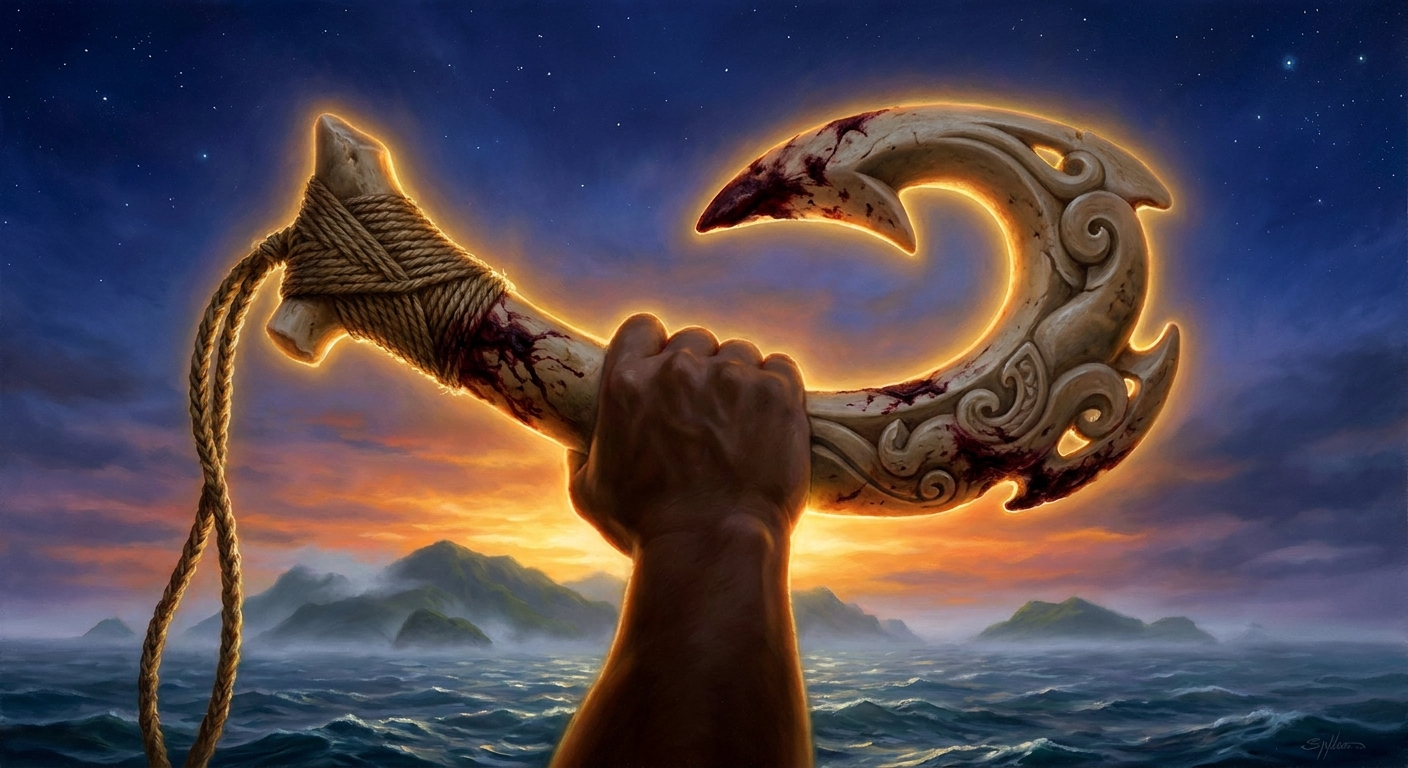
His brothers look at each other. They look at him. You have no bait, says the eldest, and there is a particular pleasure in saying it, the pleasure of a fact that cannot be argued with. Māui reaches into his satchel and takes out the hook — the one he carved from the jawbone his grandmother Murirangawhenua gave him from her own skull when she lay dying — and he punches himself in the nose.
The blood runs down.
He smears it across the carved bone, across his grandmother’s teeth still set in the jaw, and lowers the hook over the side. His brothers watch it go. It passes the depth where their lines reached. It passes the depth where the bottom should be. It keeps going — down through cold water, through water so cold and dark and pressurized that no creature from the surface has ever been there — and then it catches.
Māui feels it catch the way you feel a door swing open in a house where all the doors were locked.
He braces his foot against the gunwale. He wraps the line around his wrists, his forearms, his shoulders. The canoe tilts. The water on one side rises; the water on the other drops away into a slant that shouldn’t be possible on open ocean, and his brothers grab the rails screaming. Cut it! Cut the line! Something’s taking us under! The canoe tilts further. The horizon lurches. Māui pulls harder.
The thing that comes up is not a fish.
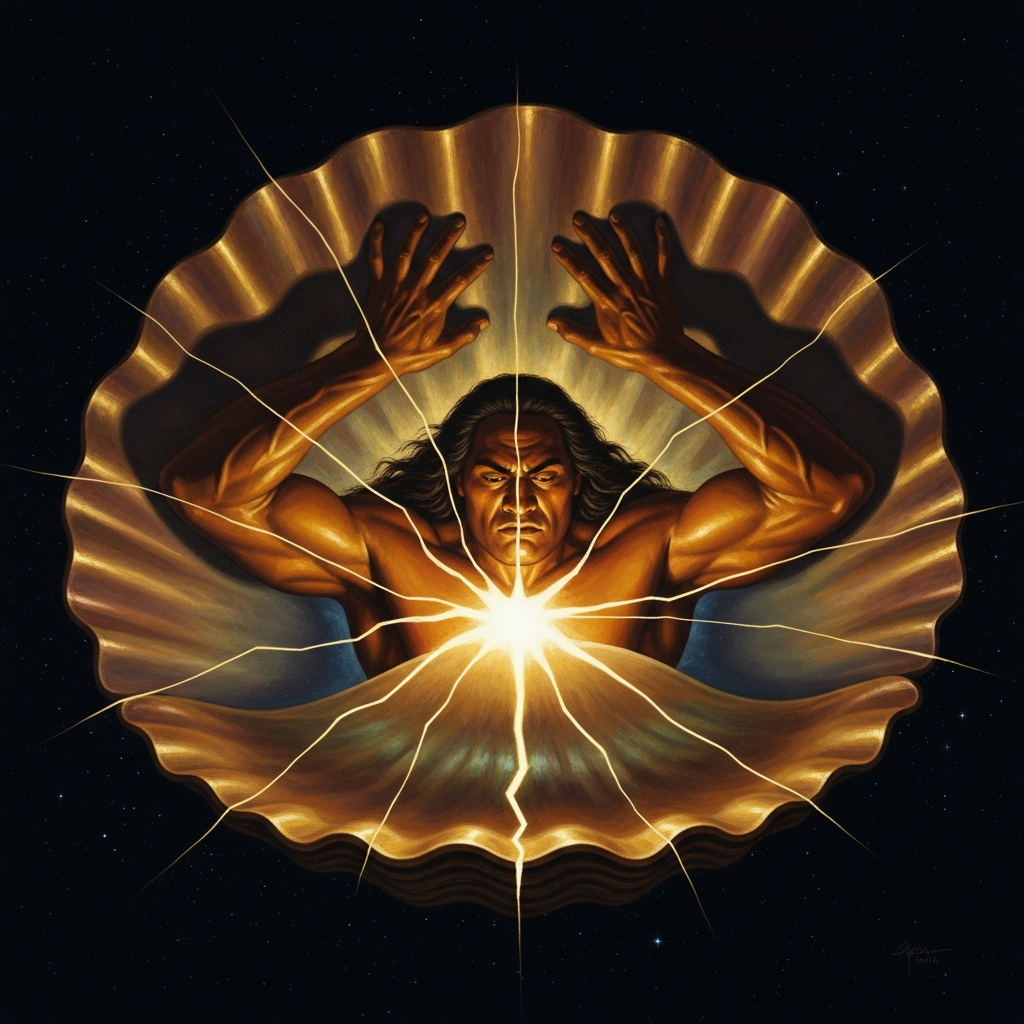
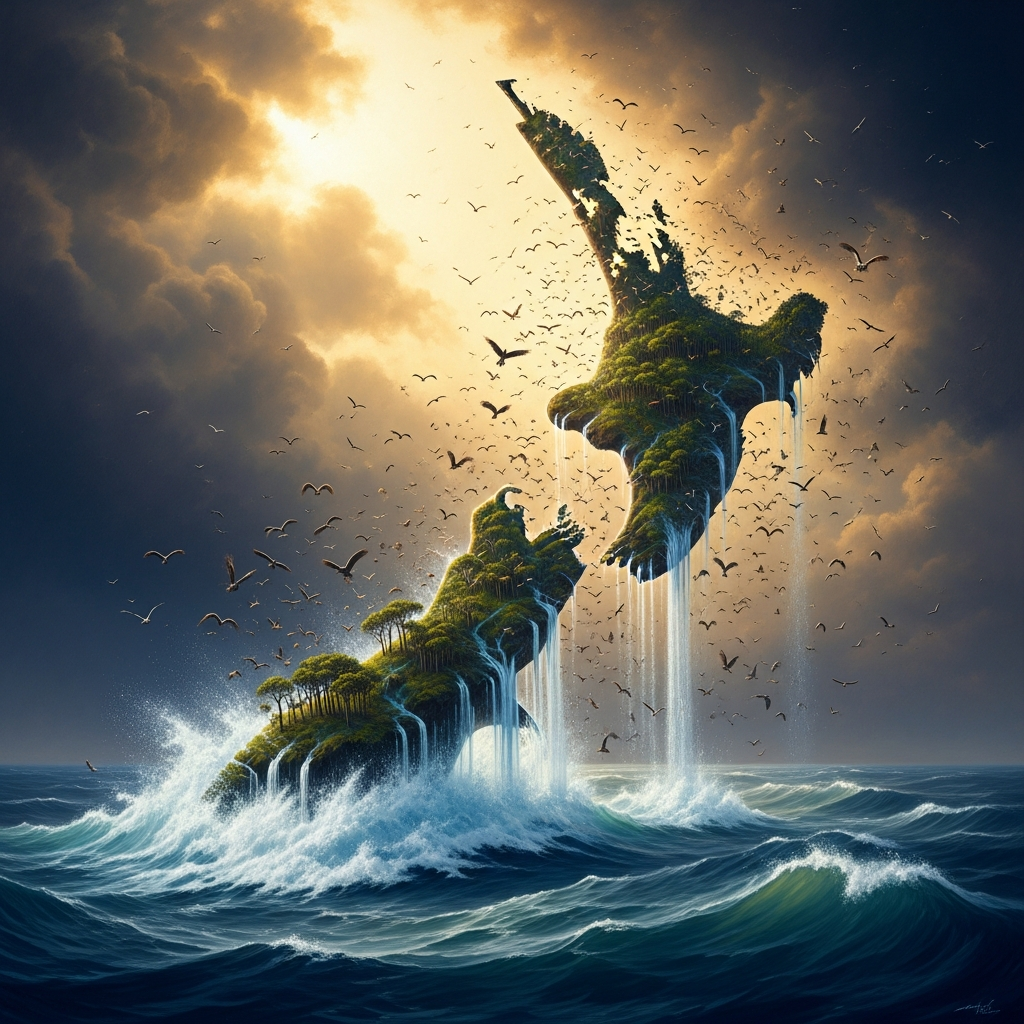
It comes up spine first — a great ridge breaking the surface like the back of a buried animal rolling over in its sleep. Then slopes, then valleys already cut, then the pale flash of a river pouring off rock that has never seen sky. Birds explode out of forest that did not know it was submerged. The trees are already grown. The ferns are ancient. The canoe sits on the ocean on one side and on a shoreline on the other, and the shoreline is still rising, still attached to the hook, and the island is alive the way a just-landed fish is alive — thrashing, not dead, the whole landscape shuddering.
This is Te Ika-a-Māui — the fish of Māui. The North Island of Aotearoa. The South Island is his canoe, beached behind him. Stewart Island is the anchor-stone.
In the Hawaiian telling it is the eight islands, one after another. In the Tongan telling it is Tongatapu. In the Tahitian telling it is Tahiti. Every island in the Pacific is the same fish, told from its own shore, in its own language.
Māui climbs onto its back.
He turns to his brothers. Do not touch it. Do not cut it. The fish is living — it must be dedicated, it must be given proper rites, the prayers must be said before you take anything from it. He is going to find a tohunga, a priest, someone who knows the words that turn a catch into a gift and a gift into land. He walks inland, over ground that is still deciding what shape to hold, and his brothers watch him go.
The brothers wait.
They watch him disappear over the first ridge. Then they look at the fish spread out beneath the canoe — all this new land, all these valleys and slopes and river-mouths, just sitting there, and no one saying who owns what piece — and they take out their knives.
The fish screams, the way the earth screams, which is with movement rather than sound.
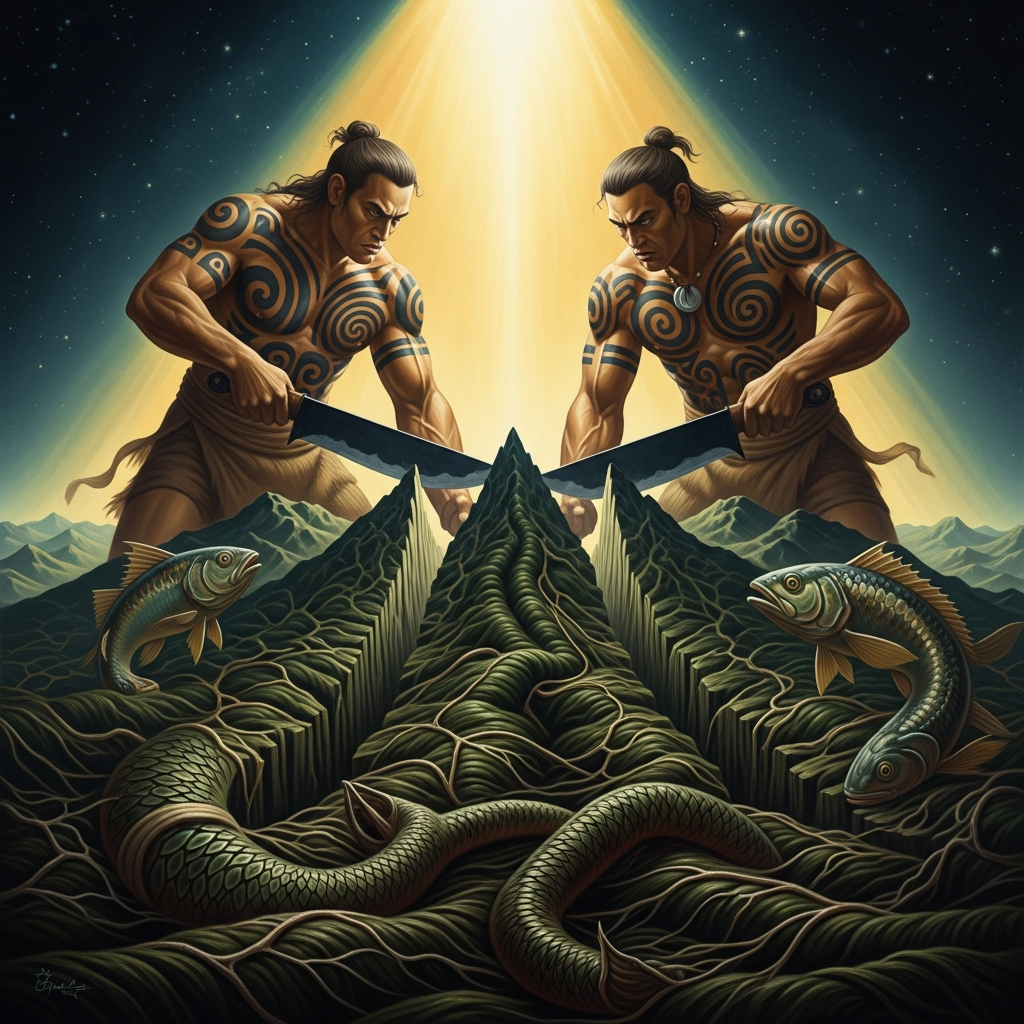
Where the first blade goes in, the ground heaves upward into a ridge. Where the second blade carves, a valley splits open and deepens faster than it should. The brothers are not trying to hurt it; they are simply hungry, and greedy, and the land is there and Māui is not, and the rites feel abstract beside the weight of a knife in hand. They cut and cut and the island writhes under every stroke and sets into the shape the blade left — a hill here, a fault-cliff there, a harbor torn open at the coast where a brother grabbed a piece and pulled.
Māui comes back to find the land already scarred.
He says nothing. There is nothing to say. The rites he intended have been made impossible. The fish has already heard the knives instead of the prayers. The hills of the North Island, the rugged coastline, the broken ridge-country of the interior — this is what jealousy does when it is given a sharp edge and no supervision.
The world is what it is because his brothers could not wait.
The Māui cycle spans more ocean than any other mythology on earth. The same demigod — same name, same jawbone hook, same brothers, same trick — appears in Hawaii, in Aotearoa, in the Marquesas, in Tonga, in Mangareva, across a stretch of the Pacific three times the width of the Atlantic. The variations are instructive: in some tellings the brothers cut the fish out of hunger; in some, out of jealousy; in a Māori account transcribed by Te Rangikāheke in the 1840s, they cut it specifically because Māui told them not to. The brothers are the same everywhere. What changes is the excuse.
The geologists who study the North Island’s terrain note that it was shaped by millions of years of volcanic uplift, tectonic compression, and river erosion. The Māori who told this story were watching the same landscape. They concluded that the correct explanation for broken terrain is interrupted ceremony — that the hills are what you get when someone takes before the blessing is given.
They were not wrong about the shape of things.
Scenes
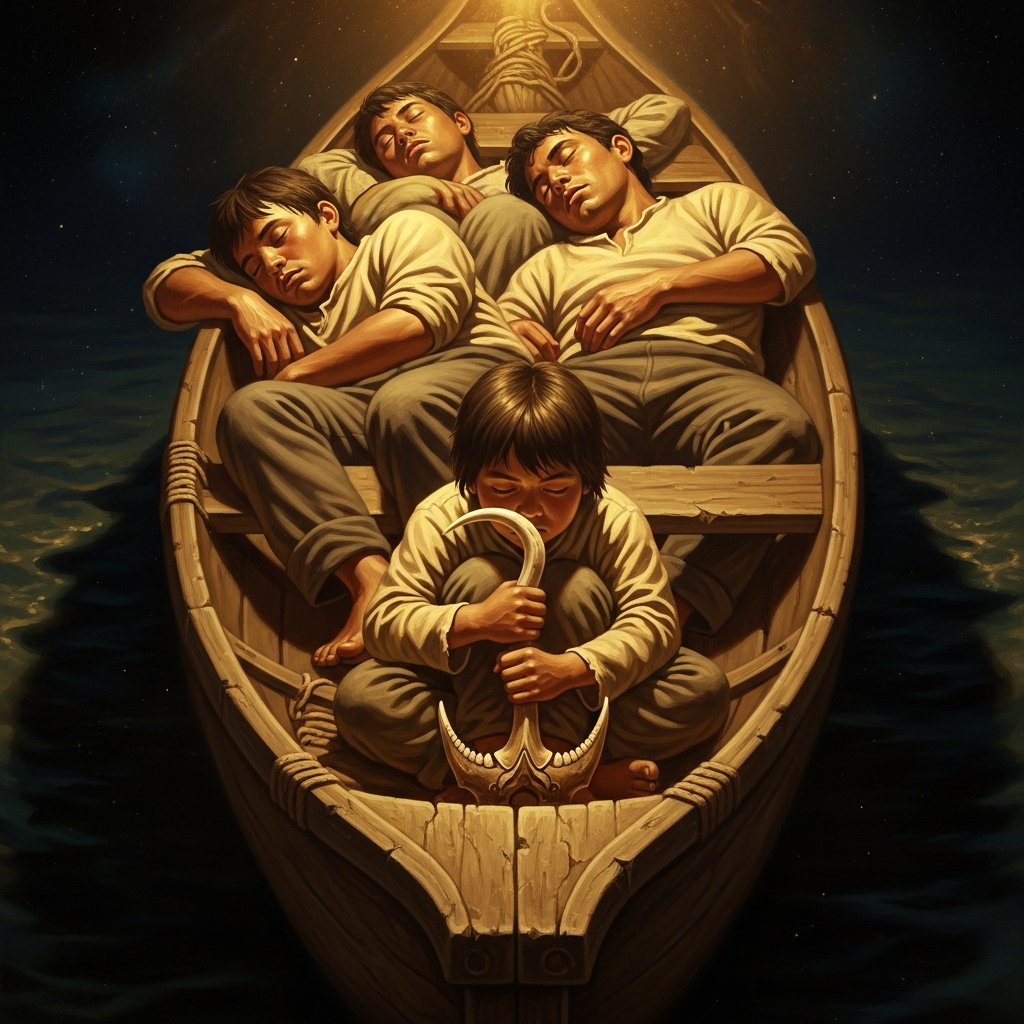
The brothers asleep in the canoe, unaware of the youngest coiled under the floor-mats, the jawbone hook warm in his fist
Generating art… Te Ika-a-Māui breaking the surface — spine first, rivers already running down its back, birds erupting from forest that did not know it was underwater
 Generating art…
 The brothers' knives cutting the still-living land before the prayers are said — each blow a valley, each gouge a ridge, the fish writhing into the hills of Aotearoa
 Generating art…
 Echoes Across Traditions
Entities
- Māui-tikitiki-a-Taranga
- Māui's brothers
- Murirangawhenua
- Manaiakalani
- Tangaroa

Sources
- George Grey, *Polynesian Mythology* (1855) — Māori variants, including the brothers hacking the fish
- Te Rangikāheke (mid-19th c. Māori manuscripts transcribed for Grey)
- Martha Beckwith, *Hawaiian Mythology* (1940), ch. 23
- Edward Tregear, *The Maori-Polynesian Comparative Dictionary* (1891)
- Patrick V. Kirch, *On the Road of the Winds* (2017) — archaeological and linguistic context