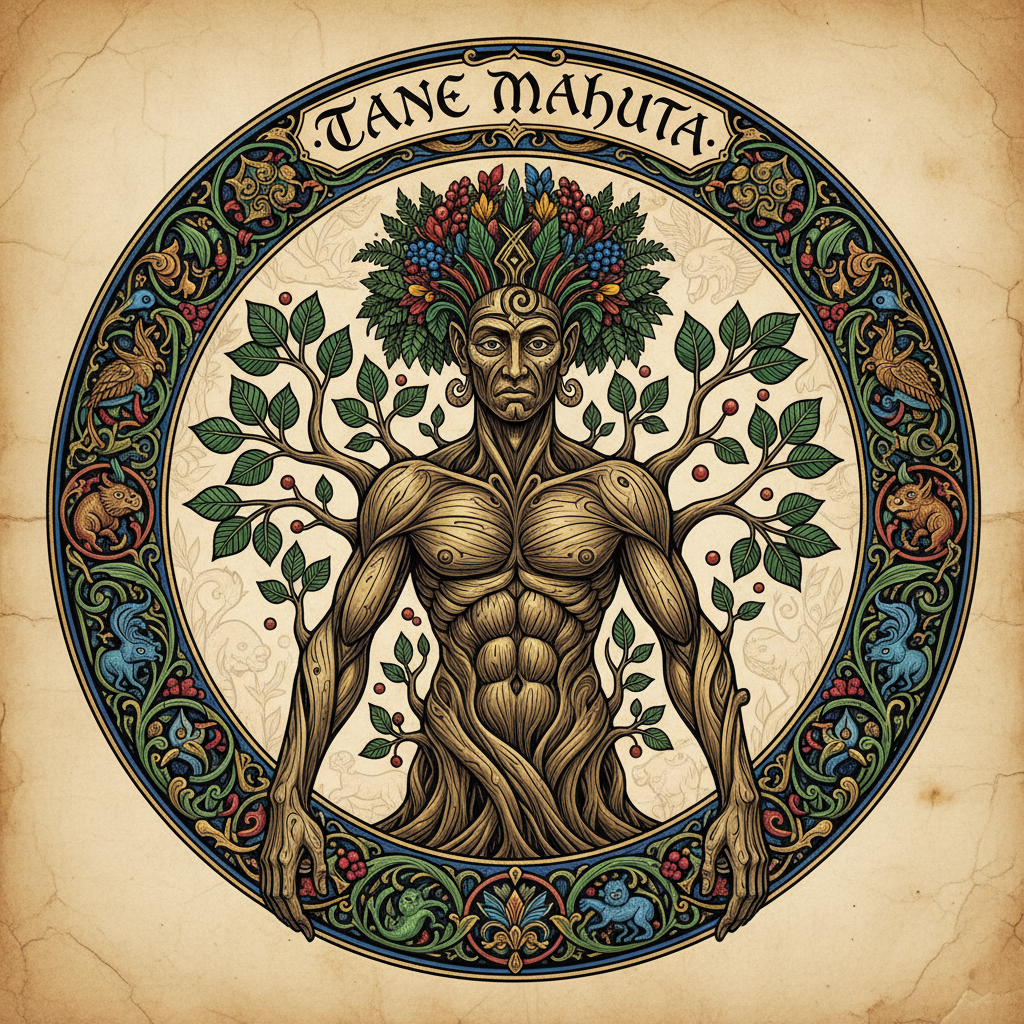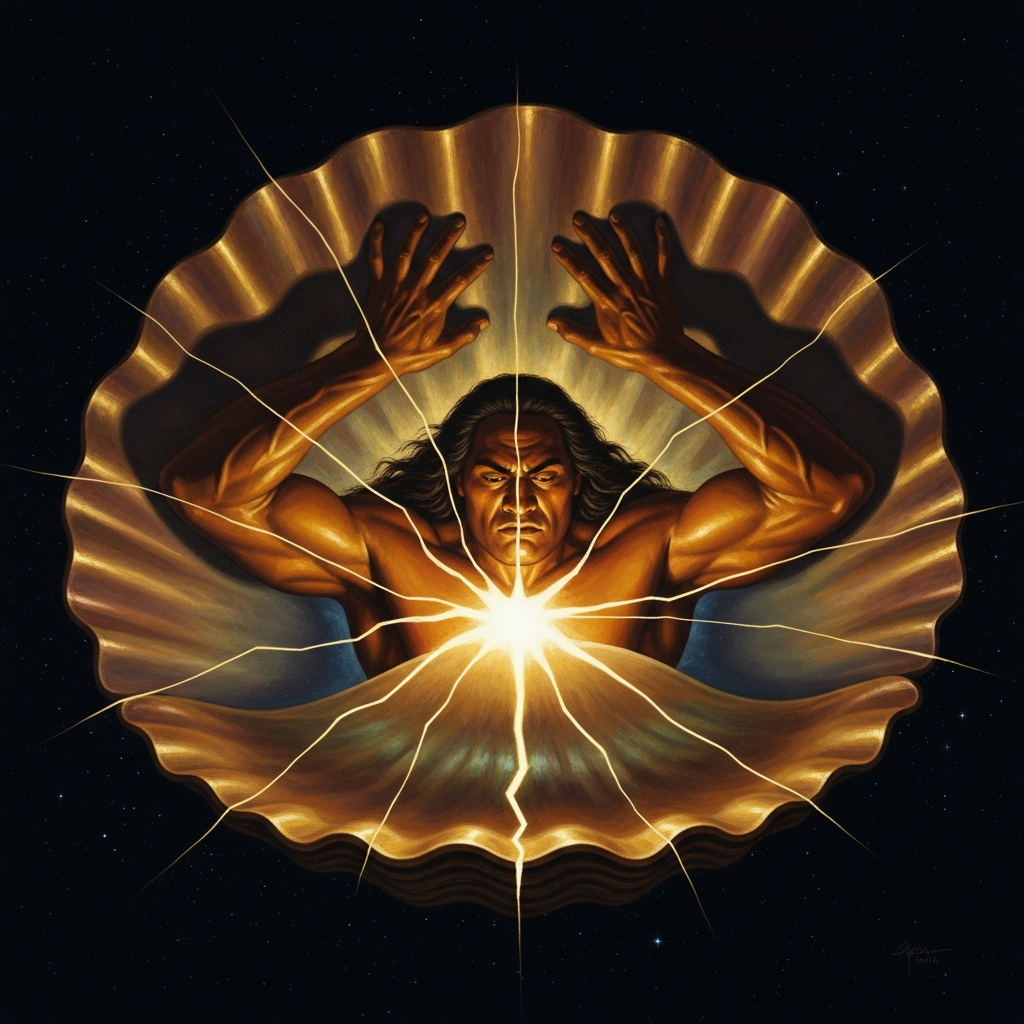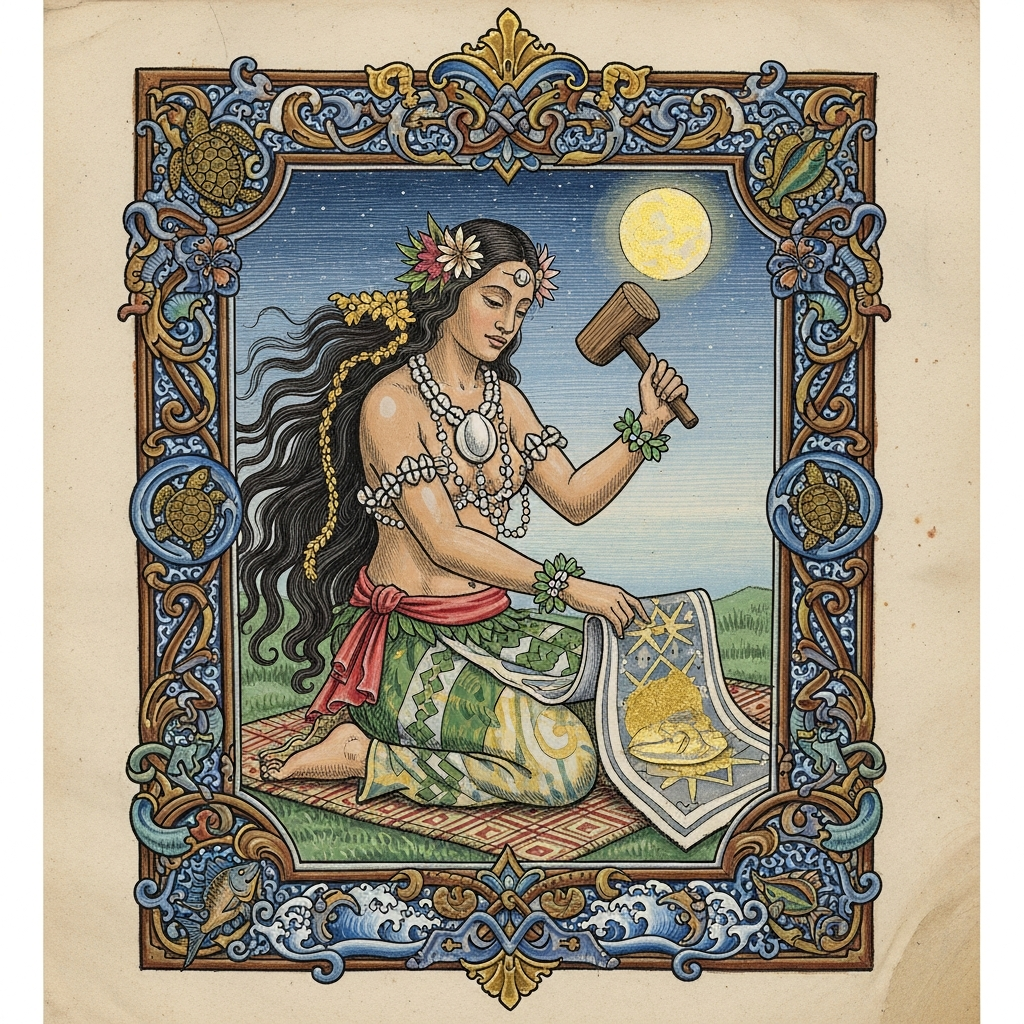
Māui Fishes Up the Islands
Mythic time · told across Polynesia from ~1000 BCE; recorded by European observers ~1820–1900 · The deep Pacific — between Hawaiʻi, Aotearoa, Tonga, and the empty horizon between
Contents
The trickster demigod baits a hook with his own blood, sinks it past the floor of the Pacific, and pulls — and the islands come up screaming, dragged into the sun against their will.
- When
- Mythic time · told across Polynesia from ~1000 BCE; recorded by European observers ~1820–1900
- Where
- The deep Pacific — between Hawaiʻi, Aotearoa, Tonga, and the empty horizon between
Māui is the youngest, and Māui is the one they did not want.
He was born premature, wrapped in his mother Taranga’s hair-knot, and thrown into the sea — a miscarriage given to the tide. The ocean-spirits raised him. He came back to his mother’s house years later, walked in during a meal, and named all four of his brothers in order before any of them recognized him. They have not stopped resenting him since.
He goes everywhere they don’t want him. He hides in their canoe when they go fishing. He cuts down the sun with a noose of his sister’s hair to slow it across the sky. He steals fire from Mahuika in her cave of flame, burning his own hands to bring it back. He is a demigod — half mortal, half the sky-people — and the half that is mortal is the half that cannot stop showing off.
His mother’s mother was Murirangawhenua. She lay dying. She gave him her jawbone.
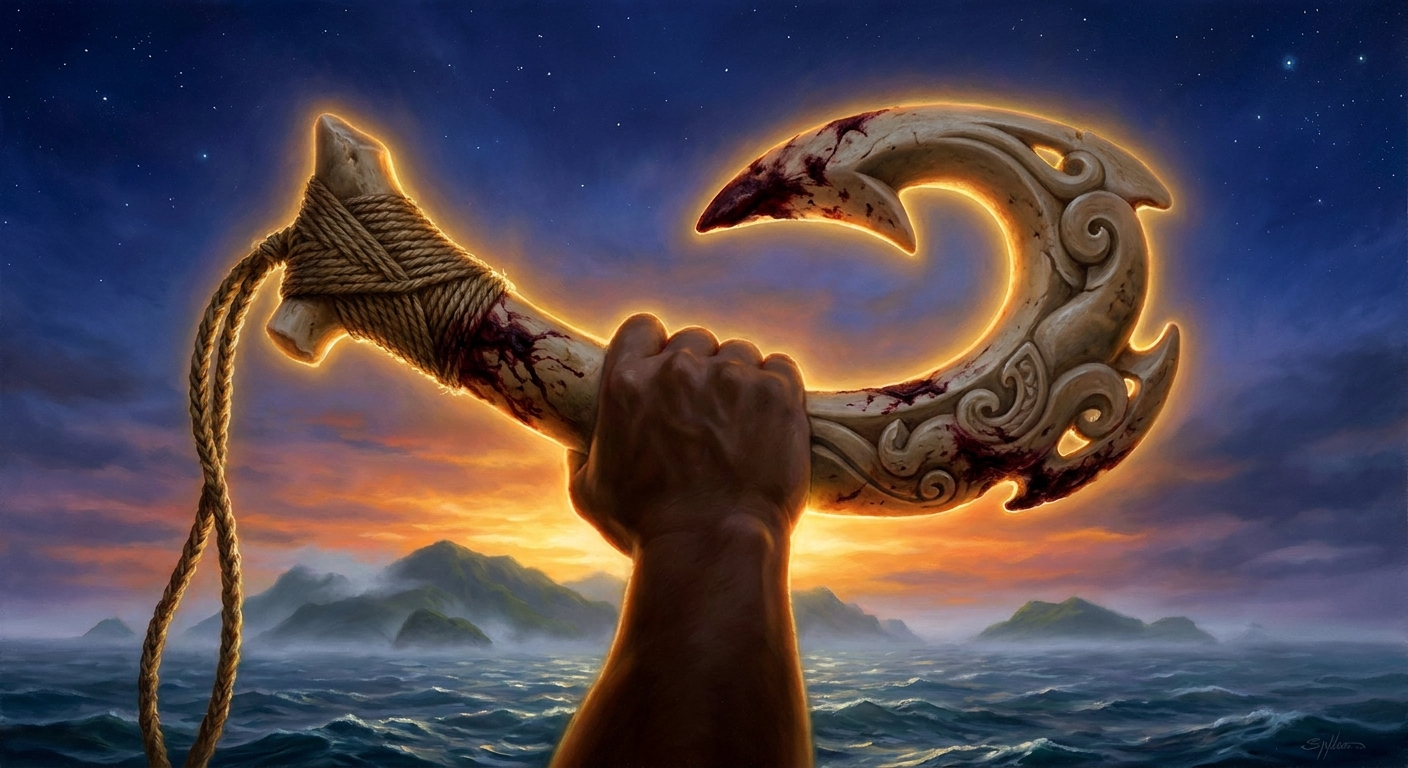
Out of the jawbone he carved a fish-hook.
He shaped it slowly, in private, the way men shape things they intend to use only once. He bound it with hair from his own head. He whispered into it the names of his ancestors. He called it Manaiakalani — the chief’s line, the cord that will not break.
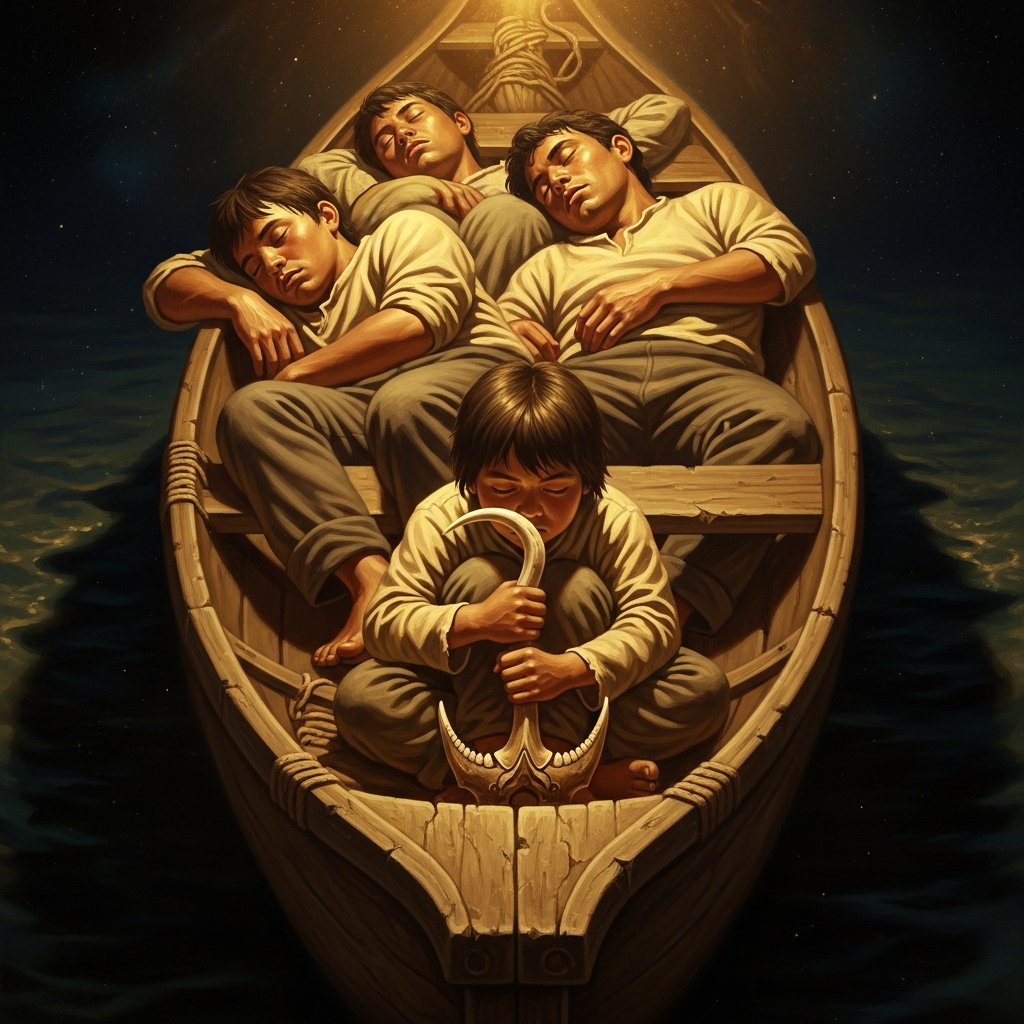
When he tried to come fishing with his brothers, they laughed him off the canoe. No bait for you, little one. We won’t waste it. So he hid under the floor-mats. They paddled out past the reef, past the swell, into the open Pacific where the water turns the colour of obsidian. They cast their lines and hauled in fish. They did not see him.
When they were tired, when the day was old and the canoe was full and they were ready to turn back, he came out from under the mats.
He had no bait.
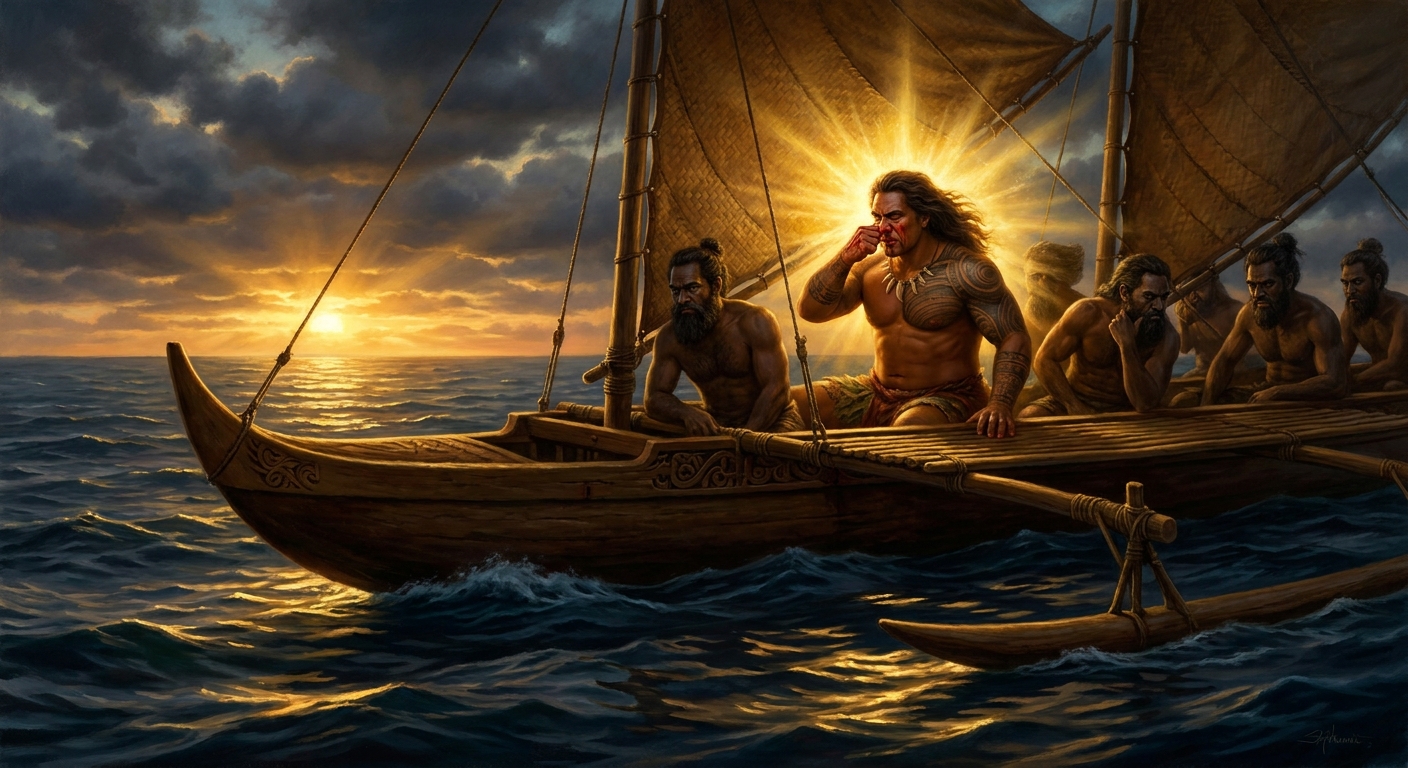
He punched himself in the nose.
The blood came down his face onto the hook.
His brothers stared. He smeared it across the bone — his grandmother’s bone, his grandfather’s blood, his own face — and dropped the line over the side. It went down. It went past the bottom that the brothers’ lines had reached. It went past the bottom they could imagine. It went down to the floor of the world, where Tangaroa keeps the things that have not been brought up yet, and it caught.
Māui felt it catch.
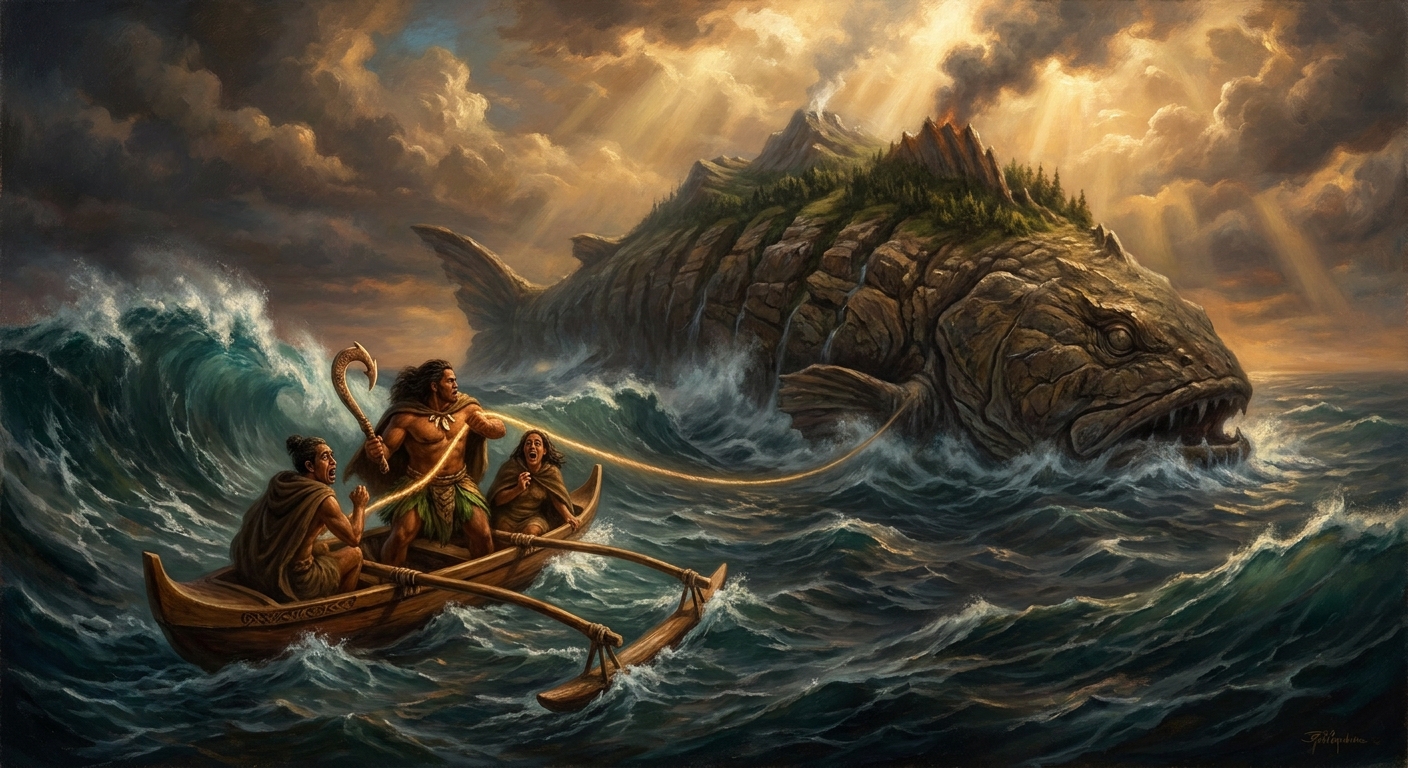
He braced his foot against the gunwale and pulled. The canoe tilted. The water on one side rose; the water on the other dropped away. His brothers grabbed the sides screaming. Cut it! Cut the line! It’s going to take us under!
He did not cut it.
He pulled harder.
The thing that came up was not a fish.
It came up whole — a back, a spine, a ridge of land breaking the surface like the rib of an immense buried animal. Trees on it. Rivers already cutting it. Birds startled into the air from a place they had been living in beneath the sea without ever knowing they were beneath anything. The brothers fell silent. The canoe rocked on top of an island that had not existed when they cast off.
This is Te Ika-a-Māui in the southern telling — the fish of Māui, the North Island of Aotearoa. The South Island is the canoe itself, beached in the catching. Stewart Island is the anchor.
In the Hawaiian telling, this is how the eight islands rose, one by one, from the same hook on the same line, the brothers paddling slowly across the deep while their younger brother dragged the ocean floor up behind the canoe. In the Tongan telling, it is Tongatapu. In the Tahitian, it is Tahiti.
Every Polynesian island is the same fish, told from its own beach.
But the fish is alive.
Māui forbids his brothers to touch it. Do not cut it. Do not eat from it. Wait for me to make peace with it — to recite the prayers, to dedicate it properly, to give the catch back its dignity. He climbs onto its back to seek a priest who can perform the rite.
The brothers do not wait.
They take their knives out. They start cutting pieces — for hunger, for greed, for proof that they were there too. The fish writhes. Where they cut, the land twists. Mountains heave up. Valleys are gouged. Cliffs break off into the sea. The reason Aotearoa’s North Island has its rugged shape, the Māori said, is that Māui’s brothers could not leave the fish alone long enough for it to be blessed.
So the islands of Polynesia are wounded at the moment of their creation. The volcanoes still smoke. The fault-lines still slip. The fish is still, in some long Pacific way, being cut.
Māui keeps trying.
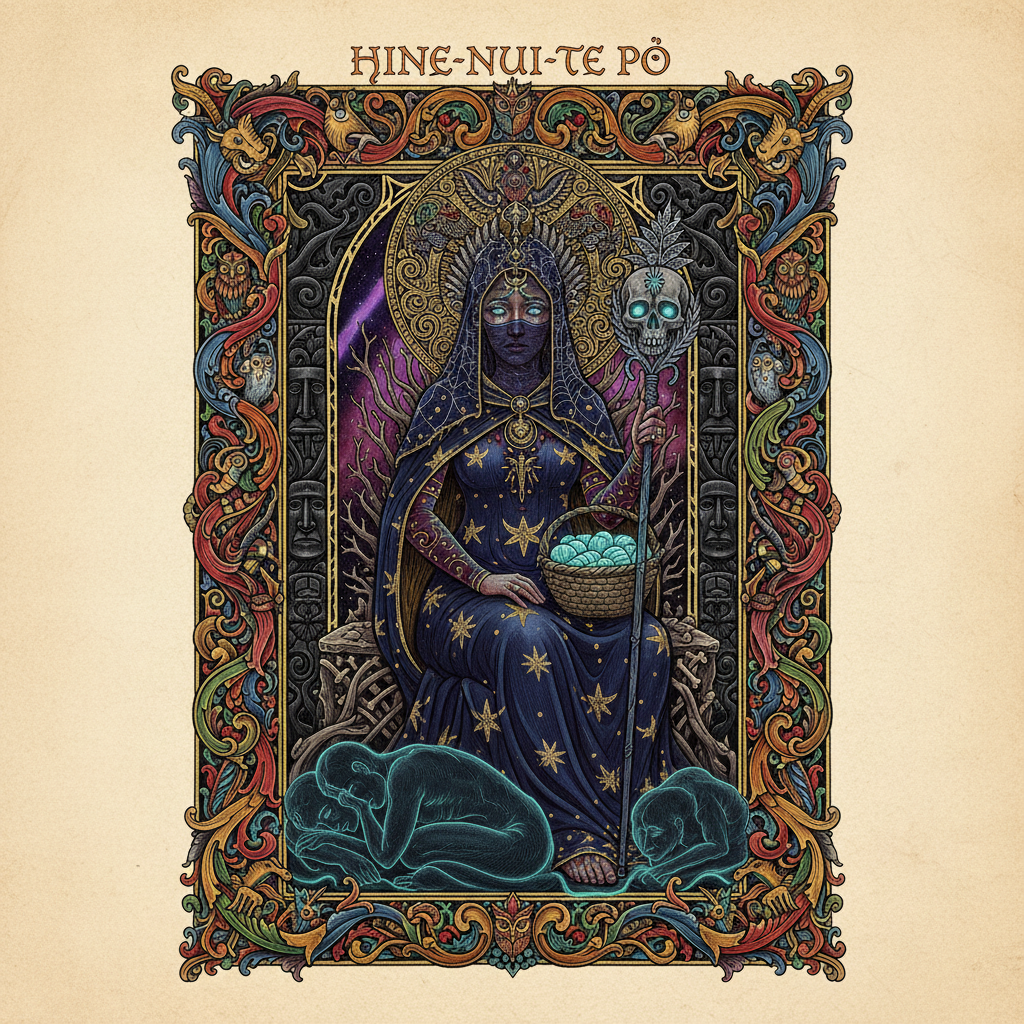
He will go on to slow the sun. He will steal fire and give it to humans. He will, eventually, attempt the trick that breaks him — crawling into the sleeping body of Hine-nui-te-pō, the goddess of death, intending to pass through her and out her mouth and so reverse mortality for all his descendants. A fantail bird laughs at the sight of him half-inside her. She wakes. She closes on him.
That is how death entered the world: a trickster’s last trick, foiled by a small bird that could not keep quiet.
But the islands stay up.
The canoes that came after him — the great voyaging canoes that carried Polynesians across the largest empty space in human history, from Samoa to Hawaiʻi to Rapa Nui to Aotearoa, by stars and swells and the flight of frigate-birds — those canoes were navigating, the navigators said, to land Māui had already pulled up. The first man to set foot on each island was not its discoverer. He was its visitor. The fish was already there.
The Māui cycle is the most widely shared mythology in the Pacific. The same demigod, with versions of the same name, appears from Hawaiʻi to New Zealand to the Marquesas to Mangareva — a span of ocean wider than the Atlantic. He fishes up land in all of them. He slows the sun in most. He steals fire in nearly all. He dies trying to defeat death in several.
Patrick Kirch and other archaeologists have shown that the Polynesian voyaging culture that carried this myth east and south is itself one of humanity’s great achievements — a navigational tradition that put humans on every habitable island in the Pacific by 1300 CE, two centuries before Columbus crossed a much smaller ocean.
They sailed by stars. They sailed by the colour of the underside of clouds, which reflects the colour of land below the horizon. They sailed by the patterns of swells refracted around islands they could not yet see.
And when they reached a new shore, they said: Māui got here first. He pulled it up.
Scenes
Manaiakalani — the fish-hook carved from his grandmother's jawbone, baited with the blood of his own nose
Generating art… The canoe in deep water
 Generating art…
 The island breaking the surface
 Generating art…
 Echoes Across Traditions
Entities
- Māui-tikitiki-a-Taranga
- Māui's brothers
- Murirangawhenua
- Manaiakalani (the fish-hook)
- Hina

Sources
- George Grey, *Polynesian Mythology* (1855) — Māori versions
- Martha Beckwith, *Hawaiian Mythology* (1940)
- Edward Tregear, *The Maori-Polynesian Comparative Dictionary* (1891)
- Te Rangikāheke (mid-19th c. Māori manuscripts, basis for Grey)
- Patrick V. Kirch, *On the Road of the Winds* (2017) — archaeological context