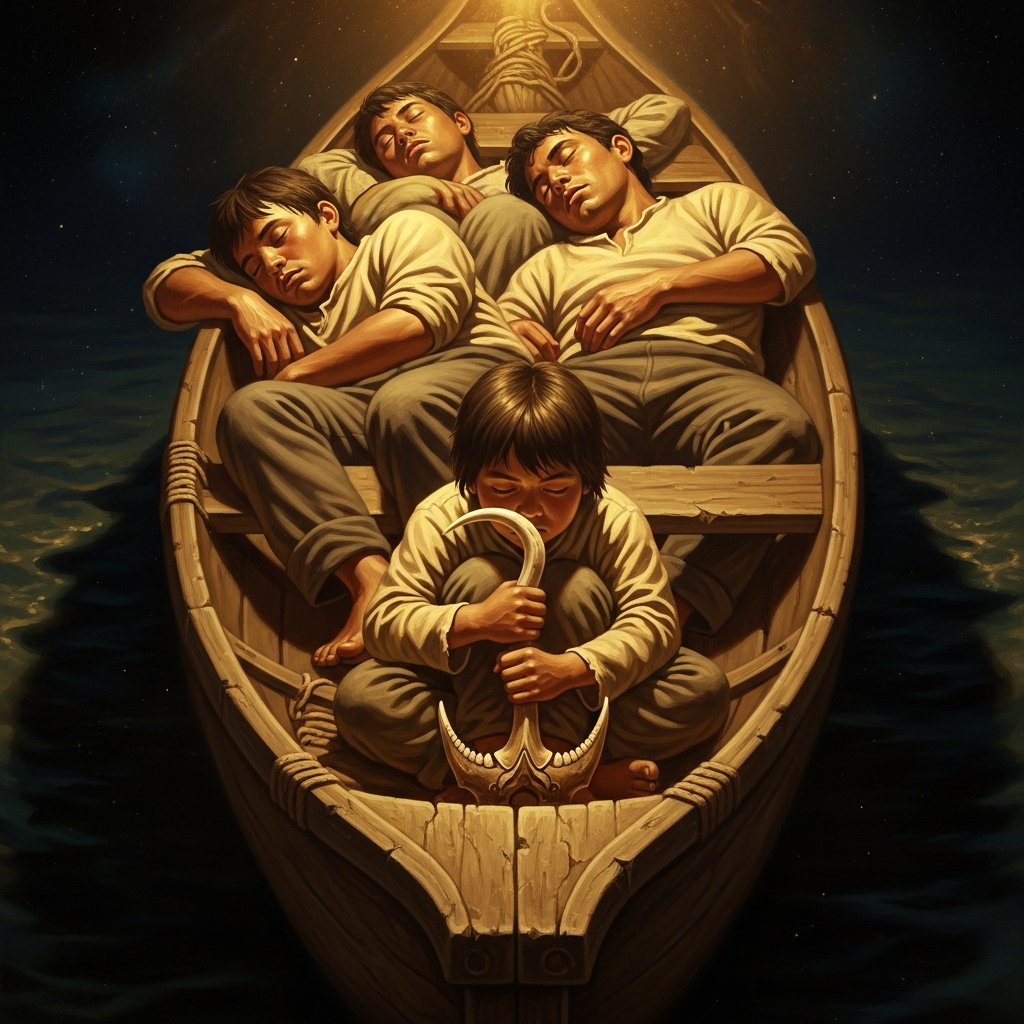
Māui Lassoes the Sun
Mythic time · pan-Polynesian oral tradition · Te Whitinga o te Rā — the place where the sun climbs from his pit at the eastern edge of the world
Contents
The days are too short. Food goes uncooked, cloth unwashed, work unfinished. Māui weaves a rope from his sister's hair, walks to the edge of the world, and beats the sun into a slower agreement.
- When
- Mythic time · pan-Polynesian oral tradition
- Where
- Te Whitinga o te Rā — the place where the sun climbs from his pit at the eastern edge of the world
The problem is not that the sun is hostile.
The problem is that the sun is fast. Tama-nui-te-rā — the great sun, the chief of the sky — climbs from his pit in the east at the first light, runs across the sky at the pace of a man in a hurry, drops into the west, and is gone before the day has properly started. The fires are lit, the ovens dug, the food set to cook — and the sun is already halfway down its arc before the steam rises. Cloth laid on the bushes to dry is still damp when dusk comes. A man sets out to walk to his neighbor’s valley and reaches it in shadow. The crops go to seed waiting for sunlight that moves too fast to ripen them.
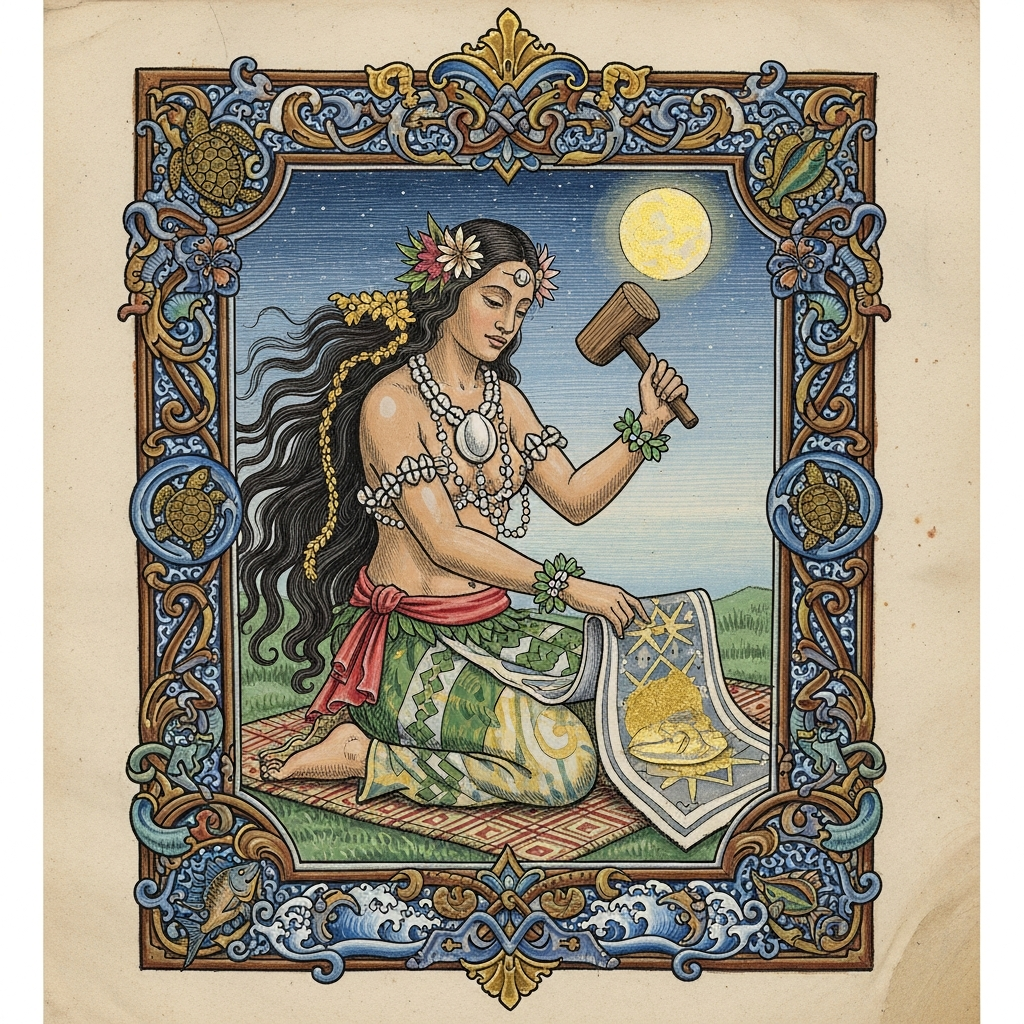
Māui’s sister Hina is the one who complains first. She pounds bark-cloth — kapa in the Hawaiian telling, tapa in others — and the sun is always going down before she finishes. Her hands hurt. Her cloth is still wet. She has been complaining about this forever.
Māui listens to her in the way Māui listens — not like a man who is being polite, but like a man taking notes.
He goes to Hina and asks for her hair.
She gives it to him without asking why, because she has learned that asking why with Māui produces answers that are more alarming than not knowing. He takes the hair and braids it — long, patient braiding, the same way men braid rope from flax or coconut-fibre, but hair is stronger and more specific. He braids in spells as he works, the names of his ancestors, the words that bind one thing to another. The rope grows long. It grows longer than it should from the hair she gave him. He coils it over his shoulder.
He goes to his brothers. Come with me, he says. Bring your clubs. They have learned not to ask why either.
They walk east. They walk past the last fishing village. They walk past the last garden. They walk through the place where the ground is black and cracked and warm underfoot, where the birds do not go, where the air smells of something older than smoke.
They reach the pit.
The pit is where the sun sleeps.
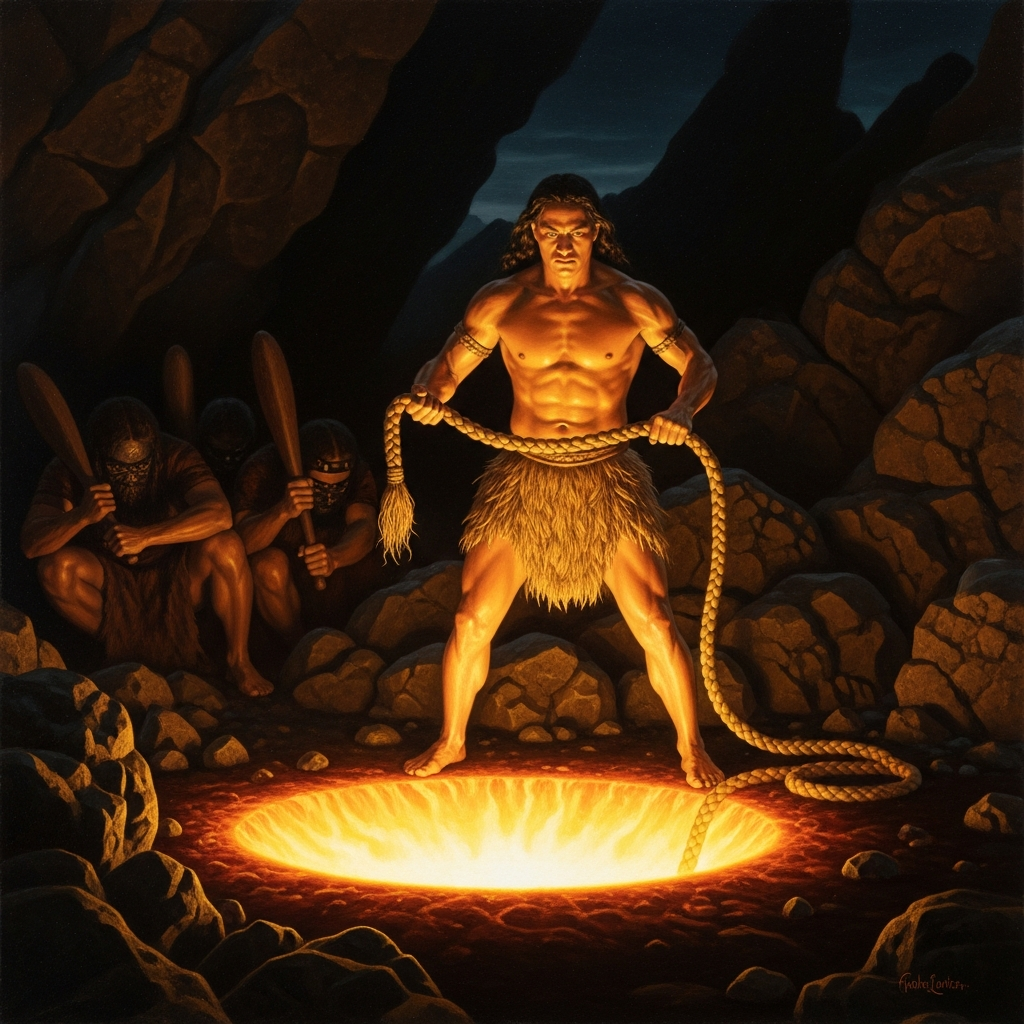
It is a hollow at the edge of the world, exactly the size a sun would be, and the walls are glazed with centuries of heat. The brothers crouch behind rocks at the rim, clubs ready, not breathing. The eastern sky is beginning to pale. The first suggestion of Tama-nui-te-rā’s approach comes as warmth — not warmth on the skin but warmth in the stone underfoot, as if the rock is waking up.
Māui crouches at the rim with the rope coiled in his hands and waits.
He is not afraid of the sun. This is either courage or a failure to fully imagine what a burning god can do to a man who has looped his sister’s hair around its legs. Māui has always been the kind of hero who does not spend much time imagining consequences. His grandmother’s jawbone is in his other hand — the carved hook-bone she gave him when she was dying, the bone that pulled up the islands. Today it is a weapon.
The sun comes up.
The sun’s legs appear first — in the Māori telling, Tama-nui-te-rā is a being with legs that he uses to climb the sky, and it is the legs that Māui is waiting for.
Māui throws the rope.
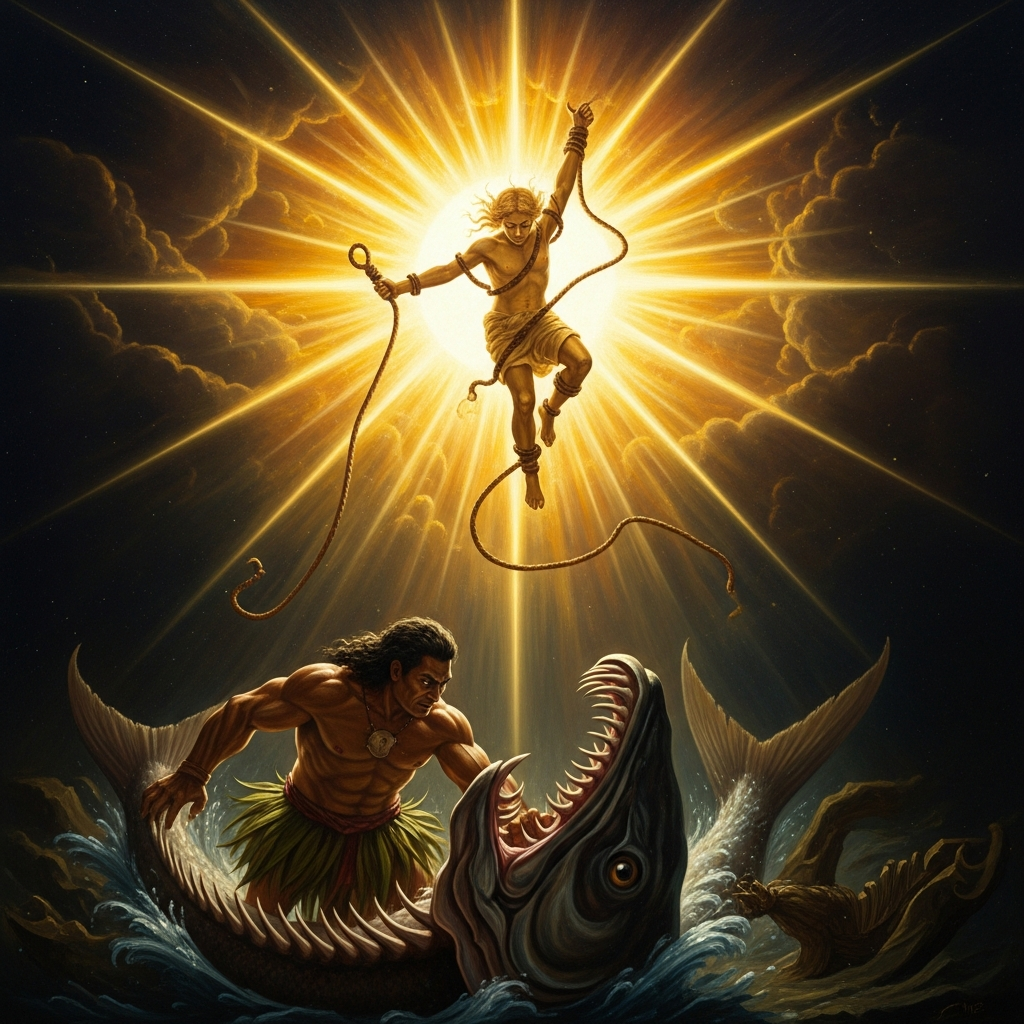
The noose drops over the sun’s first leg and Māui yanks it tight, and then it is nothing like anything that has ever happened at the edge of the world before. The sun is not used to resistance. It has been moving at this speed for so long that it has forgotten that speed is a choice. It lunges forward and the rope goes taut and Māui is dragged off his feet and has to dig both heels into the rock at the rim of the pit and pull back with everything he has. The brothers rush out from behind their rocks, swinging their clubs at whatever they can reach — not very much, the sun is very large, but the point is noise and confusion and the jawbone swinging.
Māui beats the sun.
It is not a graceful fight.
The sun is enormous and Māui is a man — a demigod, yes, half sky-people, stronger than any ordinary man, but still something you could hold in one hand if you were Tama-nui-te-rā. The light is blinding in every direction. The brothers are on fire, more or less, scrambling to hit something without looking at it. The jawbone rises and falls. The rope holds — Māui braided it to hold, and his grandmother’s bone is in the braid, and his grandfather’s names, and the hair of his sister who just wants to finish her cloth before dark.
The sun begins to slow.
It is partly the rope. It is partly the blows. It is partly — Māui suspects — that no one has ever done this to the sun before, and surprise is its own kind of restraint. Tama-nui-te-rā is not injured, exactly; gods do not break the way men break. But he is listening now. He is paying attention. The trickster at his legs has his attention.
Māui stops swinging.
Agree, he says, to go slowly. The sun agrees — in the way that trapped, astonished things agree, which is completely. It will still move fast in winter, when the world needs less warmth. But in summer it will move slowly, and the food will cook, and the cloth will dry, and the people will finish their work before dark.
Tama-nui-te-rā keeps his agreement.
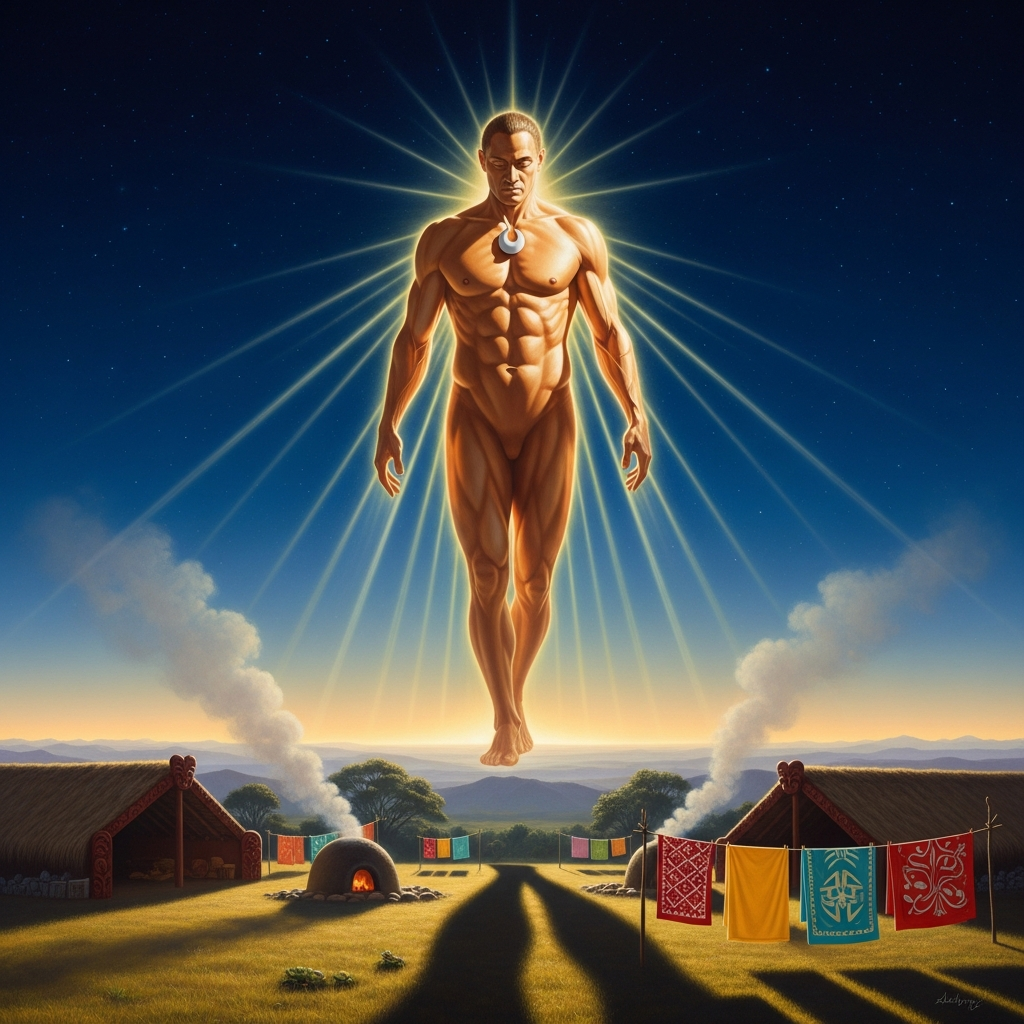
He is a god, and even a humiliated god keeps an agreement made at the edge of his own pit with a noose around his legs. Summer days are long because of this. The long afternoon light on the Pacific — the hours when the sun hangs in the northwest sky and the canoes move through gold-lit swells and the ovens breathe — that is the sun keeping its promise to a trickster with a rope made of his sister’s hair.
Māui uncoils the noose from the sun’s leg, and the sun finishes climbing the sky, and that day is the longest day that has ever been, and Hina’s cloth dries before noon.
She does not thank him, exactly. But she does finish it.
The snaring of the sun appears across virtually every Polynesian island group — Hawaii, Aotearoa, Tonga, the Marquesas, Mangareva, Tahiti. The weapon varies (a jawbone, a stone adze, a club made from his own bones in some retellings), and the rope varies (hair, flax, spider-web in one Māori variant). What does not vary is the premise: the sun was moving too fast, someone decided this was unacceptable, and the someone was Māui.
Katherine Luomala’s 1949 cross-Pacific analysis counted 158 distinct Māui-variants and found the sun-snaring episode in most of them, second in frequency only to the fish-hook story. The two stories are usually told in the same breath: first he pulled up the land, then he slowed the sky. He was building a livable world from the outside in, and the world required negotiation at every step.
His mother Taranga wove his topknot from her own hair before she threw him into the sea. The rope he used on the sun was his sister’s hair. The jawbone was his grandmother’s skull. Every tool Māui makes is made from someone he owes something to — and every victory he wins is therefore a debt paid, imperfectly, in the world he improves for them.
Scenes
Māui at the rim of the sun's pit — the rope of braided hair in both hands, waiting in the dark before dawn, his brothers crouched behind rocks with clubs
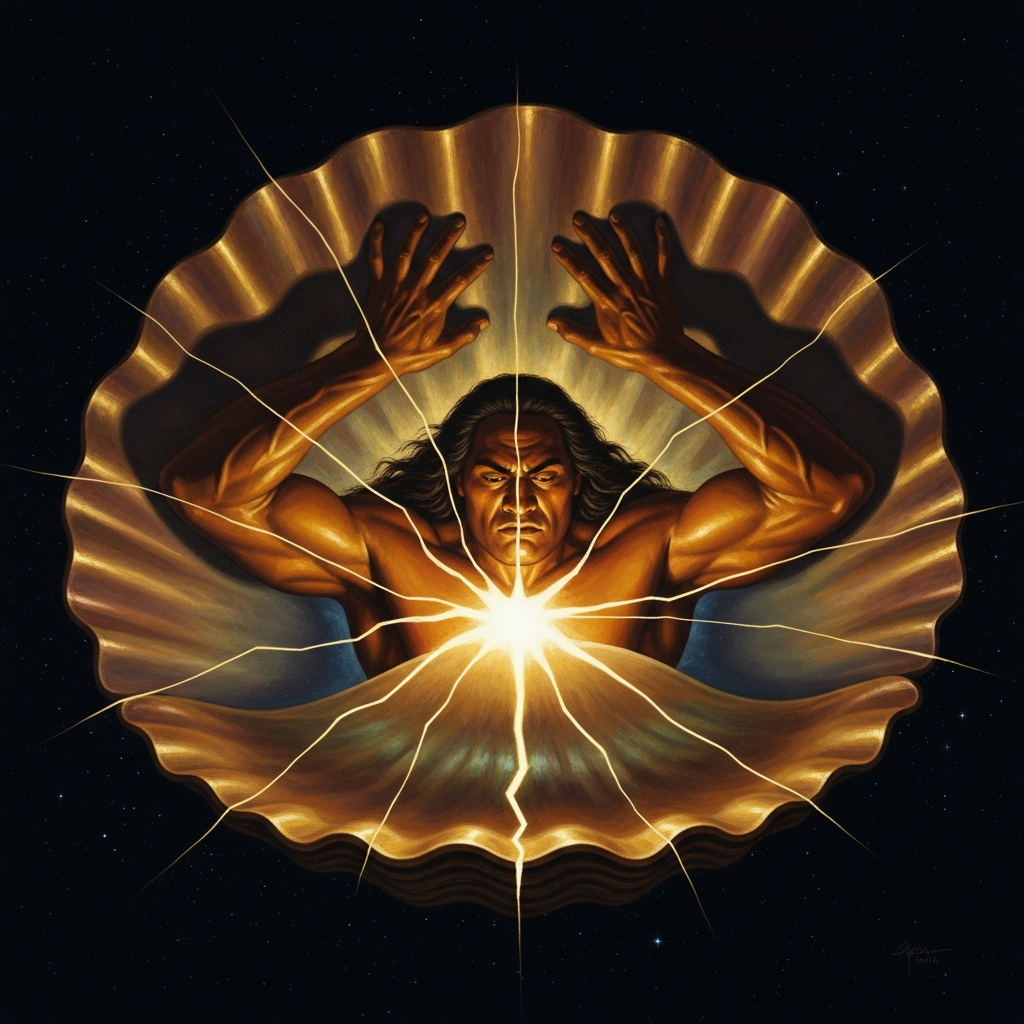
Generating art… The jawbone rising and falling — the sun's legs tangled in the noose, light exploding in every direction, Māui's arms burning with each stroke
 Generating art…
 Tama-nui-te-rā moving slowly across the sky after the agreement — the long afternoon light of summer, food cooked, cloth dry, the horizon patient
 Generating art…
 Echoes Across Traditions
Entities
- Māui-tikitiki-a-Taranga
- Tama-nui-te-rā
- Hina
- Māui's brothers

Sources
- George Grey, *Polynesian Mythology* (1855) — Māori version, with Hina's hair
- Martha Beckwith, *Hawaiian Mythology* (1940), ch. 23 — Hawaiian variants
- Antony Alpers, *Maori Myths and Tribal Legends* (1964)
- Te Rangikāheke (mid-19th c. Māori manuscripts)
- Katherine Luomala, *Maui-of-a-Thousand-Tricks* (1949) — comprehensive cross-Pacific analysis