Nergal's Second Descent
Amarna version c. 1350 BCE; Standard Babylonian version c. 700 BCE · The Great Below — the underworld throne room, and the divine court of heaven above it
Contents
The god Nergal is sent to the underworld to apologize for a protocol violation, sleeps with the queen of the dead for six days, and flees back to heaven. Ereshkigal sends an ultimatum: return him or the dead will outnumber the living. He is dragged back down, seizes her by the hair, and is offered the throne and her body. He accepts both. This is how the god of plague and war came to rule the dead.
- When
- Amarna version c. 1350 BCE; Standard Babylonian version c. 700 BCE
- Where
- The Great Below — the underworld throne room, and the divine court of heaven above it
The gods are holding a feast to which Ereshkigal cannot come.
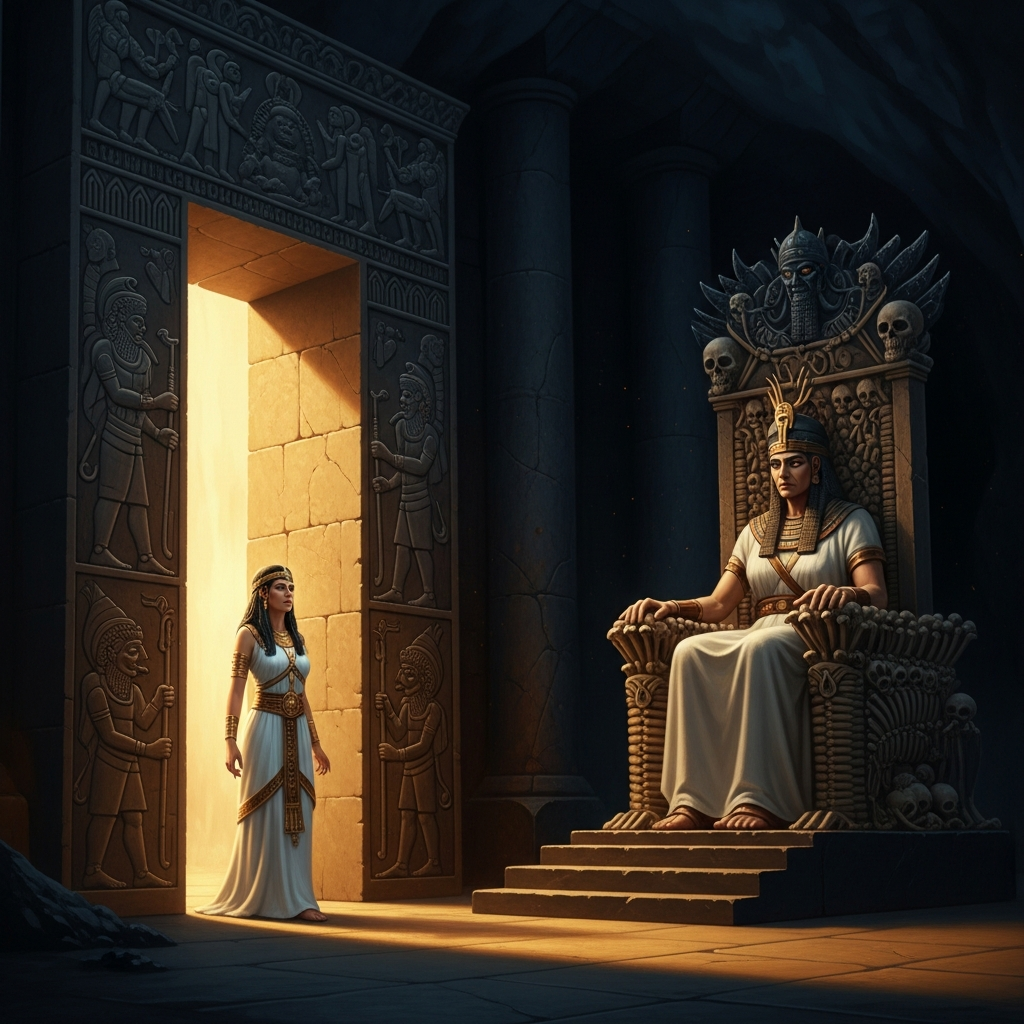
She is queen of the underworld, the Great Below, the land of no return, and her kingdom operates on the rule that defines it: what enters does not leave. This applies to gods as much as to humans. She cannot ascend to the feast of the upper gods any more than the dead can walk back out of her gates. Anu, the sky-father, sends his message down through Namtar, her minister, her son by Enlil who carries the decrees of fate: send your envoy up and we will give him your portion.
Namtar ascends through the seven gates to the divine banquet hall. When death’s minister enters a room, gods stand. This is the courtesy: you rise for the representative of what you cannot escape. Every god in the hall rises. One god does not.
Nergal keeps eating.
Namtar carries the insult back to the Great Below and reports it to his queen. Ereshkigal is not surprised that one of the upper gods has failed at courtesy. She is surprised at the specificity of it, the choice to remain seated while every other divine being in the hall stands. She sends Namtar back up with a demand: give me the god who would not rise.
Ea hears the demand and summons Nergal. He gives him fourteen demons as escort — one for each gate on the descent, to hold the doors — and a list of instructions. Do not sit down in the underworld. Do not eat the food. Do not drink the water or the beer. Do not wash your feet in their basins. Do not accept the garment they will offer you. Above all, do not lie with the woman.
Nergal descends through seven gates, posting a demon at each to hold it open. He arrives in the throne room and makes his apology correctly. Ereshkigal receives it correctly. She goes to bathe, which is the protocol, and comes back to the meeting clean from the water. Her attendant brings a basin for Nergal’s feet. Nergal looks at Ereshkigal still damp from her bath.
He ignores every instruction Ea gave him.
He lies with Ereshkigal for six days and seven nights.
On the seventh day, he leaves.
He takes his fourteen demons back through the seven gates. The gates close behind him as he ascends, and he arrives in the upper world and takes his seat in the divine assembly as though the week in the underworld has left no residue. Anu looks at him with the expression a king uses when he is deciding whether to speak. Ea says nothing.
Below the seven gates, Ereshkigal sits on the throne that she has sat on since the beginning, because she is the queen of the first place, the original one, the rule itself. She has been queen of the dead since before anyone was dead to rule. No one has ever descended to her realm and returned. That is the definition of her realm. And Nergal has descended, and lain with her for seven nights, and left, and taken something she did not know she possessed until it was removed.
She calls Namtar. Her face as she speaks is the face of someone who has been shown a world that was then taken away. She says: Go to Anu and Ea and tell them this. Since I was young I have not known the play of maidens. I have not known the joy of children. The god who lay with me — give him to me for a husband. Otherwise I will raise the dead until they outnumber the living. I will open every gate of the underworld and send the dead up through them. The dead will eat the living until the living are fewer than the dead.
This is not a bluff. She is reporting a capability.
The dead in her keeping outnumber the living by every count that has ever been taken. Every king and soldier and child and scribe who has ever walked down through her seven gates is still there, held in the underworld by the simple fact that she exists and commands it. She has been holding the barrier since the beginning because the barrier is the law and she is the law. If she opens it, there is no force in heaven that can close it.
Anu receives the message. Ea receives the message. They call Nergal. They say: go back.
Nergal descends again through the seven gates. This time he does not carry fourteen demons to hold the doors open for a gentle exit. This time Ereshkigal hears his approach from below, and the text says her face becomes as radiant as the day — which is a remarkable thing for the queen of eternal darkness to become. She sends Namtar to open the gates. She waits.
Nergal comes through the throne room door.
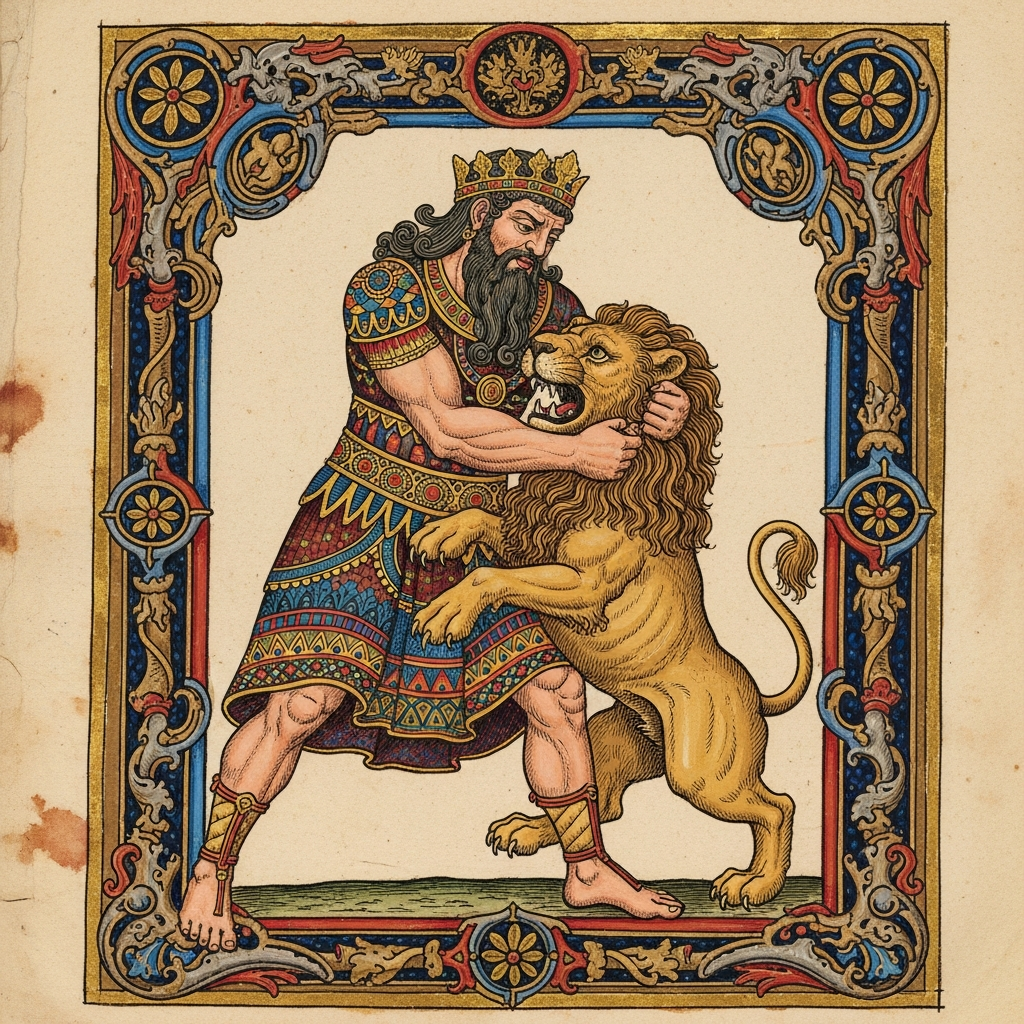
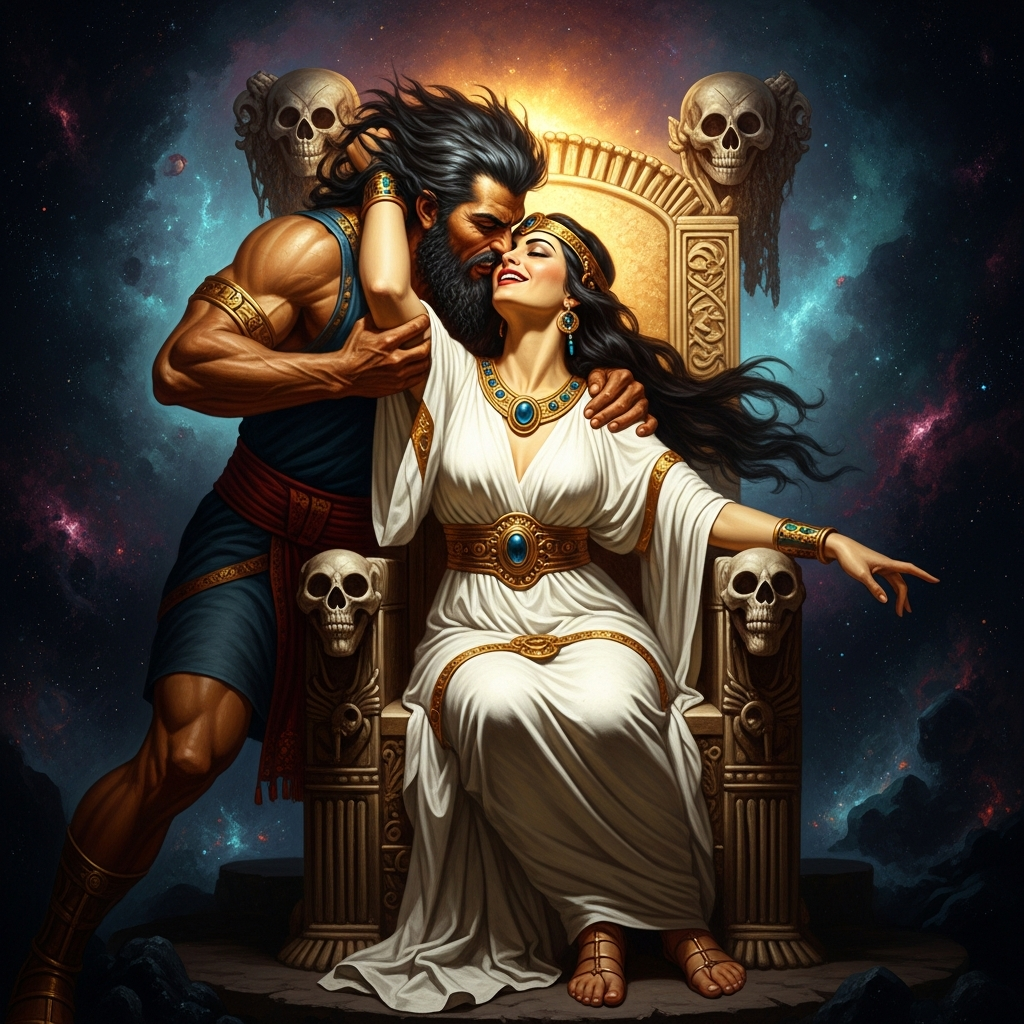
He does not stop in the doorway. He does not bow. He crosses the floor at speed and takes Ereshkigal by her hair — the text is specific about this: he takes her by her hair from the throne itself, pulling her down from the seat of absolute power to the floor of her own throne room — and he holds her there, and he kisses her.
He is still pulling her hair. She is still half-off the throne. This is how it is written.
Ereshkigal weeps. Then she laughs. She says: Be my husband. I will be your wife. I will let you hold dominion over all the broad underworld. I will place the tablet of wisdom in your hand. You will be master. I will be mistress.
Nergal releases her hair. He helps her back onto the throne. They sit together — the god of plague and war beside the queen of the land of no return — and behind them the seven gates of the underworld close, and the dead remain below, and the barrier holds.
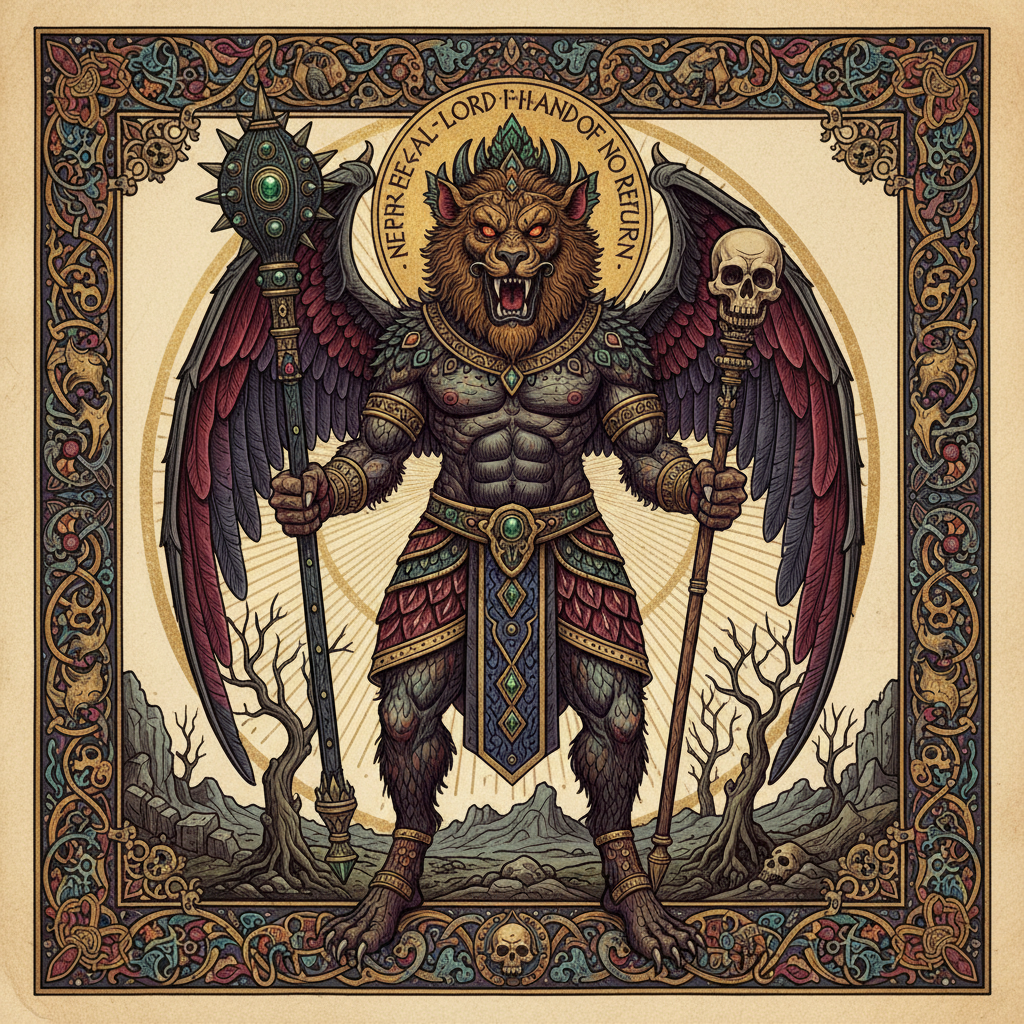
The city of Cutha in Babylonia is Nergal’s city. His temple there, the Emeslam, was understood by its priests to sit directly above the gate to the underworld. The priests of Cutha knew the story: that their god did not inherit his domain by divine appointment or cosmic precedence but by a sequence of failures that accumulated into permanence. He failed to stand. He failed to follow instructions. He ran. He was dragged back. He grabbed the queen by the hair.
None of this makes him a lesser god. In the Babylonian theology of the divine assembly, gods acquire their offices through crises as often as through orderly succession. What matters is that they hold the office, not how they came to hold it. Nergal holds the gate of the underworld because Ereshkigal offered it to him on the floor of her throne room and he accepted, and the older gods ratified the arrangement because it kept the dead below ground where they belonged.
The Amarna version of the myth was found in the Egyptian diplomatic archive at Tell el-Amarna, among the tablets of Akhenaten’s foreign correspondence. Someone in Babylon sent a copy of this story to the court of the sun-king as part of the ordinary exchange of texts between courts. It traveled from Mesopotamia to Egypt in the pouch of a courier carrying letters between kings, survived the end of the Amarna period and the erasure of Akhenaten’s name, survived the fall of Egypt and the fall of Babylon, survived the sand of seventeen centuries, and came up in 1887 in the hands of a woman digging for fertilizer who found a tablet and did not know what she had found.
The Standard Babylonian version sits in Ashurbanipal’s library at Nineveh, catalogued with the rest of the divine world, filed next to Gilgamesh and the Flood and the Descent of Ishtar. Ashurbanipal sent his scribes through the conquered cities of the ancient world to copy every text they found, understanding that the stories of the gods were the architecture of the order he governed, and that if the stories were lost the order would eventually follow.
Nineveh fell in 612 BCE. The library fell with it and was buried for twenty-five centuries. George Smith of the British Museum opened the tablets in 1872 and found among them the Flood story, then the rest of Gilgamesh, then the rest of the Mesopotamian divine world. The love story of Nergal and Ereshkigal — the most violent proposal in ancient literature — emerged from the same burning that buried it.
Ereshkigal does not become less herself because she desires something. She becomes more herself. The queen who threatens to raise the dead if the upper gods fail her is the same queen who accepts a husband who drags her from her throne. The absolute rule of the underworld is not softened by what she wants; it is complicated by it. She weeps and laughs within the same breath, on the floor of her own throne room, and both responses are the response of the goddess who rules the land of no return — because the land of no return just had someone return from it, and she wants him back, and she gets him.
Echoes Across Traditions
Entities
- Nergal
- Ereshkigal
- Namtar
- Ea
- Anu


Sources
- Stephanie Dalley (trans.), *Myths from Mesopotamia* (Oxford University Press, 1989)
- Benjamin R. Foster (trans.), *Before the Muses: An Anthology of Akkadian Literature* (CDL Press, 2005)
- Thorkild Jacobsen, *The Treasures of Darkness: A History of Mesopotamian Religion* (Yale University Press, 1976)
- Dina Katz, *The Image of the Netherworld in the Sumerian Sources* (CDL Press, 2003)
- Andrew George, *The Epic of Gilgamesh* (Penguin Classics, 2003)