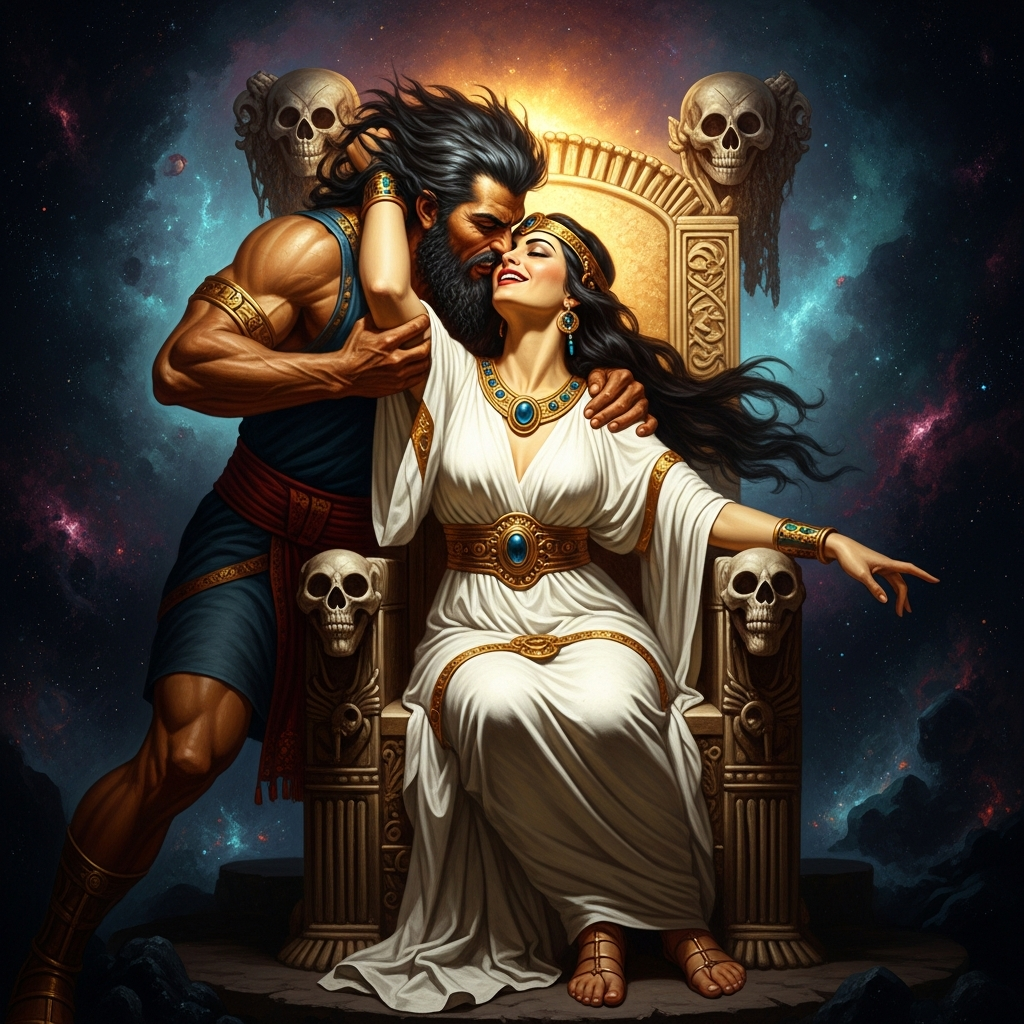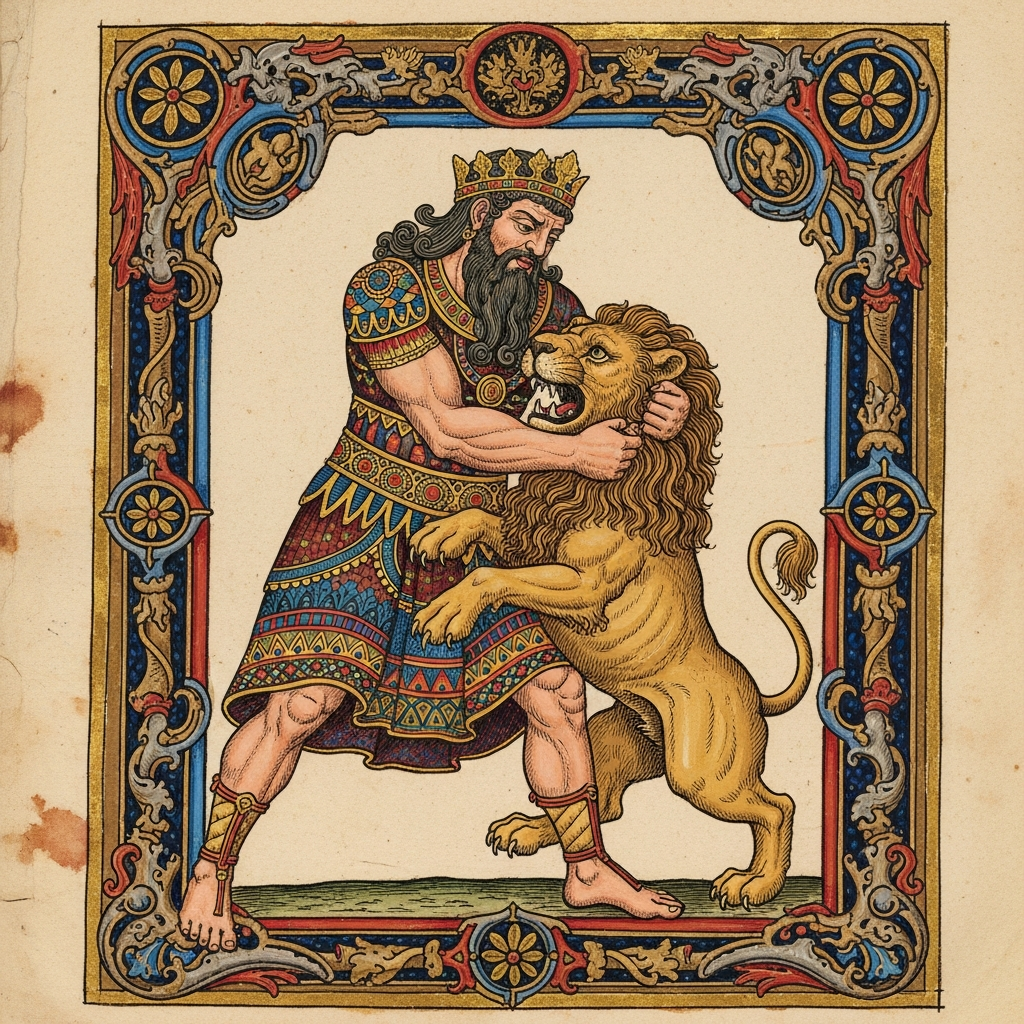
Gilgamesh at the End of the World
~2100 BCE Sumerian original; Standard Babylonian version c. 1300 BCE; Tablet IX · The mountain of Mashu — the edge of the known world, where the sun enters the earth each night
Contents
After Enkidu's death, Gilgamesh travels to the edge of the world to find Utnapishtim and ask him the secret of eternal life. At the mountain of Mashu, the Scorpion-people guard the tunnel through which the sun travels. No living human has passed this way. Gilgamesh presents his credentials: grief. The gate opens. He walks twelve double-hours through absolute darkness.
- When
- ~2100 BCE Sumerian original; Standard Babylonian version c. 1300 BCE; Tablet IX
- Where
- The mountain of Mashu — the edge of the known world, where the sun enters the earth each night
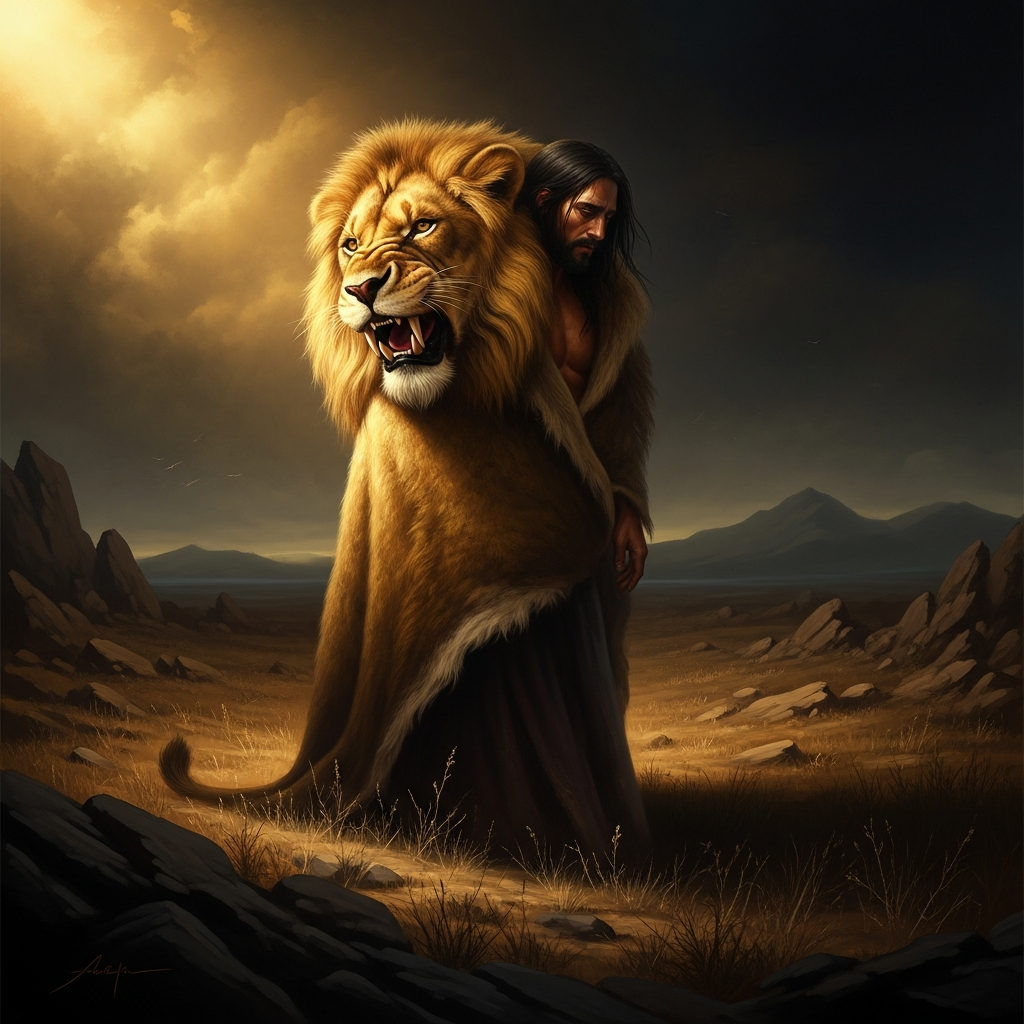
He wanders in lion-skins, weeping.
This is the king of Uruk. The man who built the walls — burnt brick and kiln-fired tile, nine miles of wall, the great rampart that the epic’s opening tablet holds up as his proof of greatness. He killed Humbaba in the Cedar Forest. He killed the Bull of Heaven. He refused Ishtar’s proposal with an inventory of her previous lovers’ fates, and when she wept in rage he threw the bull’s leg at her face. He was afraid of nothing. He wanders now in lion-skins in the steppe beyond the Euphrates, and his face has changed. The citizens of Uruk would not know him.
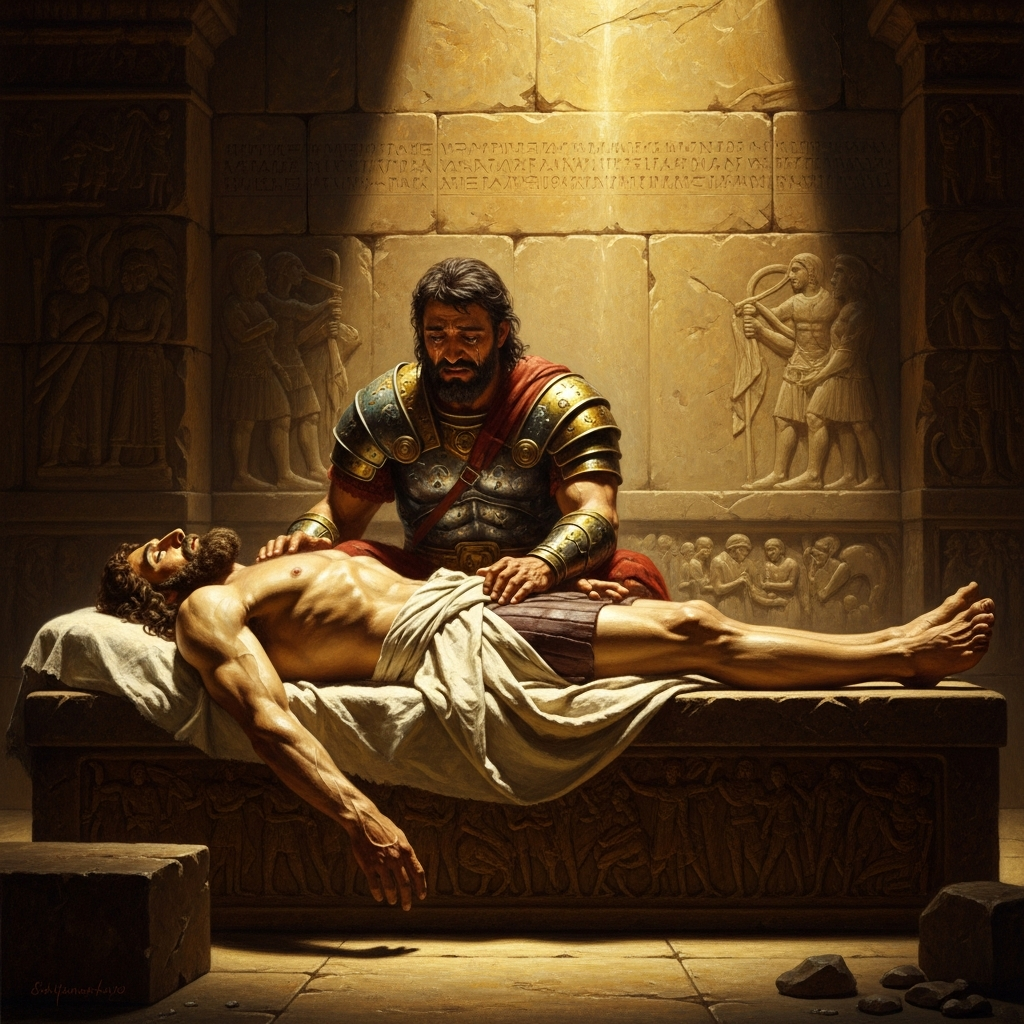
Enkidu is dead. Not killed in battle, not destroyed by an enemy Gilgamesh could have fought. The gods killed him for the Bull of Heaven — sentenced him in a divine tribunal Gilgamesh was not permitted to attend. Enkidu lay in the bed for twelve days, first his legs, then his chest, and he said: Gilgamesh, you were the ax at my side, the dagger at my belt, the shield before me. Then he stopped speaking. Then he stopped breathing. Then, on the seventh day of silence, a worm fell from his nostril.
Gilgamesh could not look away from the worm.
He looked at it and understood for the first time what was also waiting for him, what the walls of Uruk cannot stop, what no amount of heroic résumé can address. He covered Enkidu’s face with a veil like a bride’s. He roared like a lion. He tore his hair and threw off his magnificent clothes and put on the skins of the animals he kills to survive, and he walked out of Uruk and kept walking east toward the rising sun because there was only one place he could be trying to go.
He is going to find Utnapishtim the Faraway.
Utnapishtim is the one human being the gods have granted immortality, the survivor of the great flood, the man who was translated from mortal to eternal at the far end of the world and placed at the mouth of the rivers. If anyone knows the secret of deathlessness, it is the one person who was given it without asking. Gilgamesh has no plan beyond this logic. He walks. He kills lions at night and eats them and wears their skins and keeps walking.
The god Shamash watches him traveling and says, gently, from the position of a god who knows how this ends: Gilgamesh, where are you wandering? The life that you seek you will never find. Shamash is the sun. He knows the road Gilgamesh is on because the road leads to the mountain his own body enters each night.
Gilgamesh does not answer. He keeps walking.
He reaches the mountain of Mashu.
Mashu is the twin-peaked mountain at the edge of the world, the place where the sky rests on the mountains and the mountains rest on the underworld. Its peaks hold up the vault of heaven. Its roots go down to the Great Below. Between the peaks is the gate of the sun’s passage — the opening through which Shamash’s body enters the mountain each evening to travel through absolute darkness and emerge at the eastern gate each morning. This tunnel is the mechanism by which there is a tomorrow. This mountain is the edge of the known world.
Standing at the gate are the Scorpion-people.
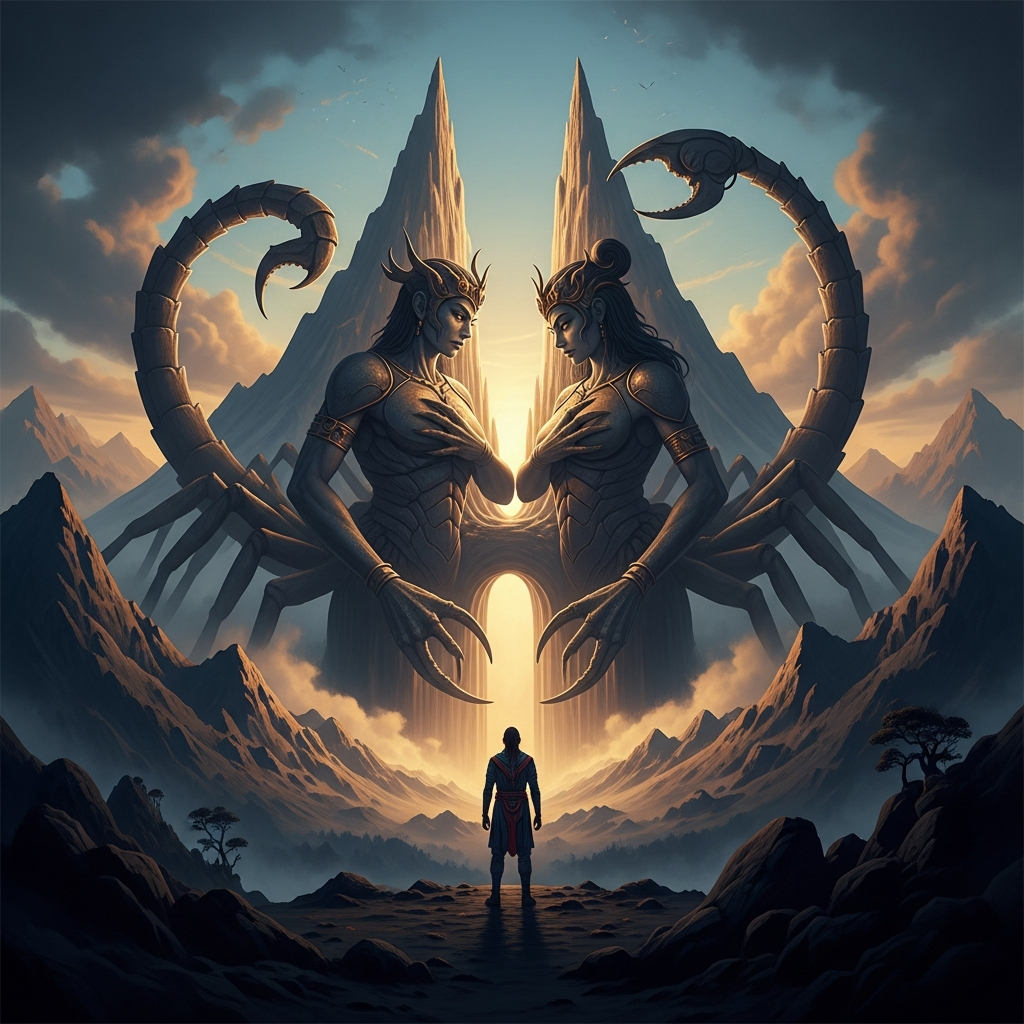
The text describes them: their terror is awesome, the sight of them is death. Their shimmering radiance overwhelms the mountains. Their backs brush the sky. Their lower halves reach into the underworld below. They are the threshold. They are the gate made flesh. No human being has ever stood here, because no human being has had a reason to come to the place where the known world ends, because the known world ending has always been sufficient reason to stop.
Gilgamesh keeps walking toward them.
The Scorpion-man sees him coming at a distance and speaks to the Scorpion-woman: He who comes to us — his body is the flesh of the gods. She says: Two-thirds of him is god. One-third is human. They watch him approach. He is shaking. He is continuing to walk toward them while he shakes, which is a thing the gods do not do and a thing that no human before him has done here either, which means what they are watching is something genuinely new.
The Scorpion-man calls out when Gilgamesh is close enough to hear.
Why have you come this long road to me? Why have you come before me? Why have you crossed the seas whose crossing is difficult? Tell me the reason for your coming.
Gilgamesh answers without pausing to arrange his answer. He speaks the way grief makes people speak, with the directness that has nothing left to protect: I come because of Enkidu my companion. He was the ax at my side, the dagger at my belt, the shield before me, my festival robe, my most magnificent sash. Fate has taken him. I weep for him day and night. I do not want to die as Enkidu died. Grief and fear have entered my body. I am afraid of death and I am wandering the steppe. I want to go to Utnapishtim, my ancestor, who entered the assembly of the gods and found life. I want to ask him about death and life.
The Scorpion-man is quiet.
He says: No mortal man has gone into the mountain, Gilgamesh. The innards of the mountain are twelve double-hours of darkness. Dense is the darkness, there is no light. At the rising of the sun, Shamash comes forth. At the setting of the sun, Shamash enters. The darkness is complete and there is no direction inside it. I do not know what you will find. It is not possible that you should make this passage.
Gilgamesh says: Although it be in sorrow, in pain, in cold and heat — in sighing and weeping — I will go. Open the gate of the mountain.
The gate opens.
He enters the tunnel through which the sun travels each night. At the first double-hour, the darkness is absolute. He cannot see his hands. He cannot see the ground under his feet. He is navigating by the resistance of stone through his sandals and the sound of his own movement in the silence. At the second double-hour, the darkness is still total. At the third, the fourth, the fifth — each station the same report: dense is the darkness, there is no light, it is not possible to see in either direction. He is in the body of the mountain that holds the sky and roots into the underworld, moving through it, which is a thing no living body has done.
At the sixth double-hour he is halfway through. The darkness is dense. He keeps walking.
At the seventh, the eighth, the ninth — he keeps walking. He walks because Enkidu is dead and there is no other road left. He walks because two-thirds of him is god and that fraction does not know how to stop, and one-third of him is human and afraid of the dark and afraid of death and afraid that Utnapishtim will not have an answer when he finds him, and that fraction keeps walking too.
At the eleventh double-hour, something changes in the air ahead. Not light. The intimation of where light will come from. A graying, a direction.
At the twelfth double-hour, full light breaks.
He emerges from the eastern gate of Mashu into the garden of the gods.
The trees bear jewels instead of fruit. Carnelian hangs from the branches. Lapis lazuli grows on the vines. The light that falls through the foliage is the first light of a day that no human has watched begin from this side of the mountain. He is in the garden where the sun rises, past the edge of the world, alive.
He has not found Utnapishtim yet. He has not found immortality. He will find a tavern keeper named Siduri who will tell him to eat and drink and look at his child’s hand in his, because she knows the answer even if she cannot give it. He will find a boatman named Urshanabi. He will cross the waters of death. He will find Utnapishtim at the mouth of the rivers and ask the question directly, and Utnapishtim will tell him to find the plant of rejuvenation at the bottom of the sea, and he will find it, and a serpent will steal it from him while he sleeps, and he will go home.
He will go home to Uruk with nothing but the city he built, the walls of baked brick and kiln-fired tile, the great rampart that the opening tablet holds up as his proof. Two-thirds god, one-third human, and the human third is the part that grieves and the part that walks through darkness and the part that eventually comes back and sits in the city and writes it all down.
The Scorpion-people let Gilgamesh pass not because he is two-thirds divine. The gods who visited them before — Shamash himself, entering the tunnel each night — did not need their permission. What Gilgamesh presents at the gate that no one has presented before is not divinity but grief combined with the refusal to stop walking. The gate opens for the first time in the history of the world for a mortal who is afraid, and shaking, and walking anyway.
This is what the epic proposes, and what no later tradition quite says as clearly: that the credential that opens the gate at the end of the world is not strength or divine lineage or correct ritual performance. It is the specific stubbornness of a human being who loved someone and will not stop moving.
Scenes
Gilgamesh wanders the steppe in lion-skins after Enkidu's death, his face changed by grief into something the citizens of Uruk would not recognize
 Generating art…
 The twin-peaked mountain of Mashu at the edge of the world: the Scorpion-man and Scorpion-woman at the gate, their magnitude filling the mountain, their backs touching the sky, their chests in the underworld
 Generating art…
 The interior of the sun's tunnel at the fourth double-hour: total darkness in every direction, no up or down, no sign of either gate
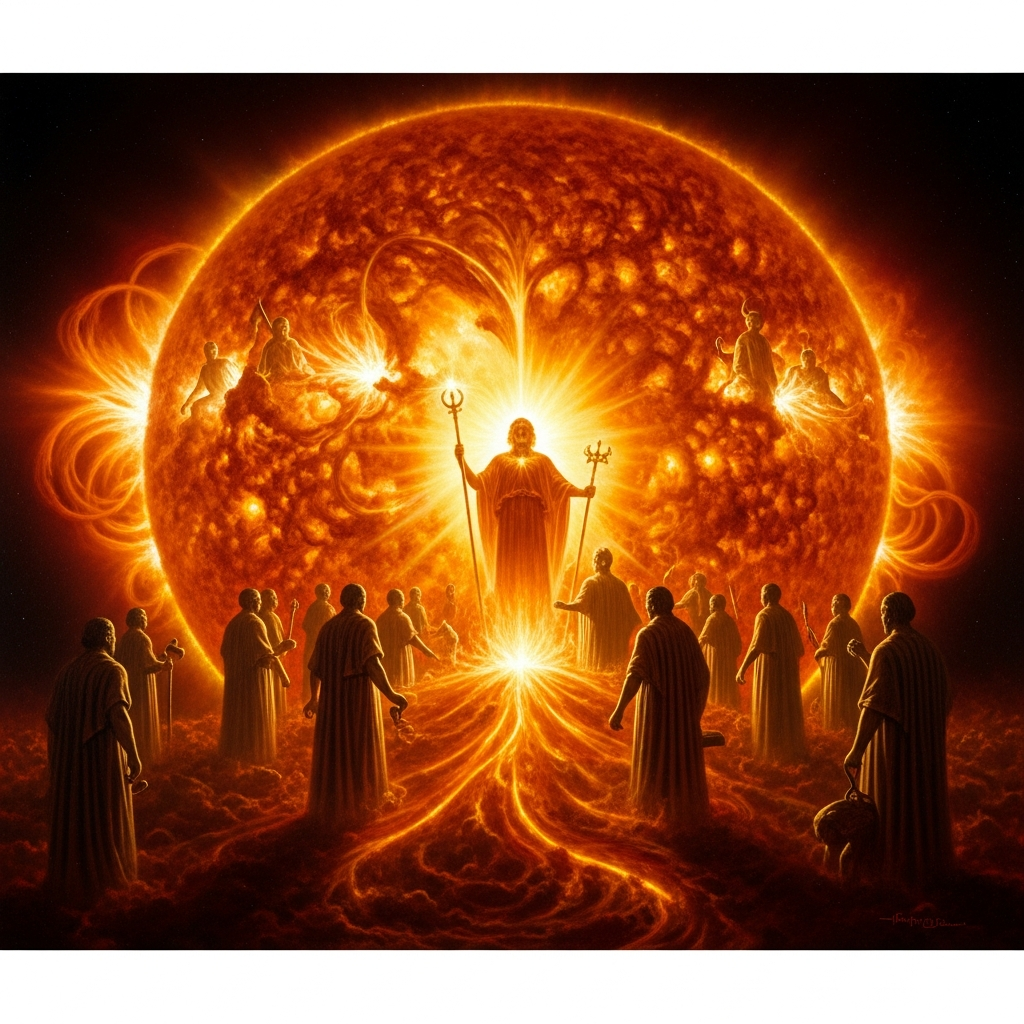 Generating art…
 Echoes Across Traditions
Entities
- Gilgamesh
- Enkidu
- Utnapishtim
- Scorpion-man
- Scorpion-woman
- Shamash


Sources
- Andrew George (trans.), *The Epic of Gilgamesh* (Penguin Classics, 2003)
- Stephanie Dalley (trans.), *Myths from Mesopotamia* (Oxford University Press, 1989)
- Jeffrey H. Tigay, *The Evolution of the Gilgamesh Epic* (University of Pennsylvania Press, 1982)
- Martin West, *The East Face of Helicon: West Asiatic Elements in Greek Poetry and Myth* (Oxford University Press, 1997)