White Buffalo Calf Woman and the Sacred Pipe
Mythic time — before the current age of the Lakota people, placed in oral tradition as foundational · The great plains of the Lakota homeland, now the northern Great Plains of North America
Contents
A beautiful woman walks out of the prairie mist toward two Lakota scouts. One looks at her with desire and is struck to bones by lightning. She tells the other: I bring a gift to your people. She teaches the seven sacred rites and gives the Lakota the *chanunpa wakan* — the sacred pipe. When she walks away, she becomes a white buffalo calf.
- When
- Mythic time — before the current age of the Lakota people, placed in oral tradition as foundational
- Where
- The great plains of the Lakota homeland, now the northern Great Plains of North America
Two scouts are hunting on the plain when they see her.
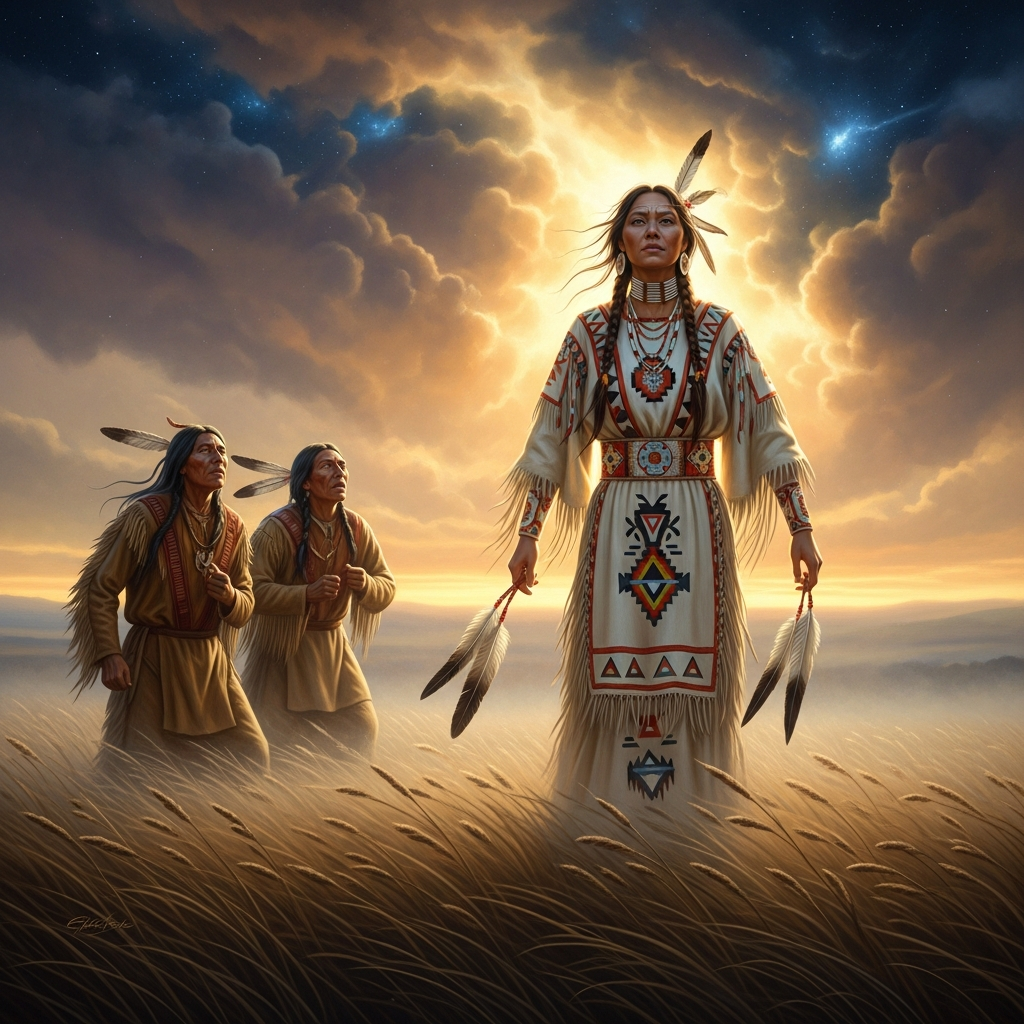
She appears out of the morning mist on a hill to the east — a woman, walking alone, dressed all in white buckskin so finely made it catches the light. She carries a bundle on her back. She walks toward them without hurry, and the prairie grass bends around her in a way that has nothing to do with the wind, and the two men feel the back of their necks go cold.
One scout looks at her and thinks what a man without discipline thinks when he sees a beautiful woman alone on a plain.
The other looks at her and understands, in the wordless way that understanding arrives in sacred moments, that she is not ordinary.
“Do not,” the second scout says.
The first scout does not listen. He steps forward with desire in his eyes, and she looks at him — she looks at him exactly, she sees exactly what is in him — and the world acts on what she sees.
A cloud comes from nowhere. Lightning without thunder. Where the first scout stood there are bones. The bones are clean and white as winter, already old-looking, already sinking into the grass.
She looks at the second scout. Her face holds no judgment, only clarity.
“Go to your people,” she says. “Tell them what you have seen. Tell them to prepare a great lodge in the center of the camp. I am coming. I bring something for them.”
The camp of the Lakota makes ready.
The crier rides through every tipi ring with the news. The people clean the lodge. Standing Hollow Horn, the chief, orders the sacred place prepared — the altar of earth, the buffalo skull facing east, the rack for the pipe. The people do not know what is coming. They know that something is. The children fall quiet. The horses stand still at their pickets. Even the dogs stop their quarreling.
She arrives at midday.
She walks into the center of the camp without stopping and the people open before her, and she stops in front of Standing Hollow Horn and faces him, and in her hands she is holding a bundle wrapped in sage.
She unwraps it slowly.
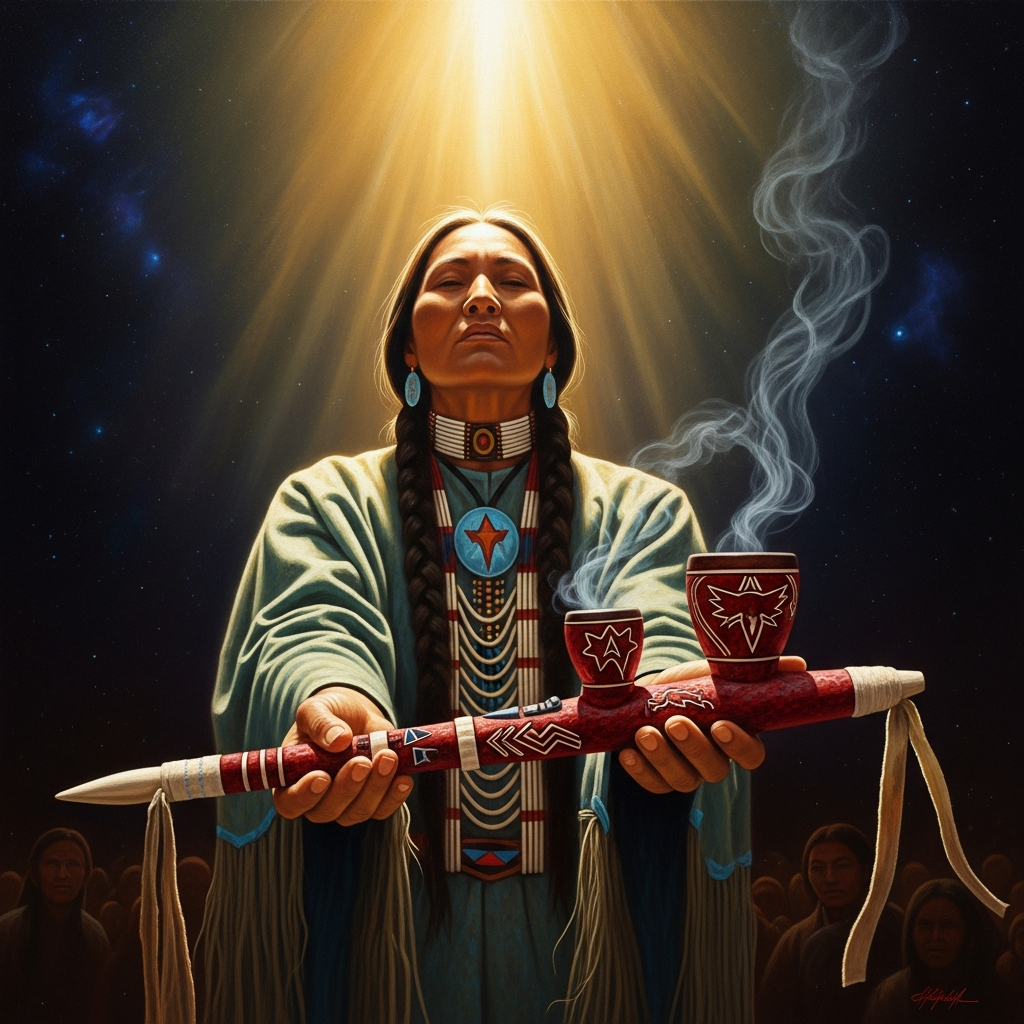
Inside is a pipe. The bowl is red — red pipestone, chanupa, carved from the earth’s own flesh. The stem is wood, the length of a man’s arm, wrapped with sweet grass and eagle feathers. She holds it with the stem toward the east.
“Behold,” she says. “With this sacred pipe you will walk upon the Earth, for the Earth is your grandmother and mother and is sacred. Every step taken upon her should be as a prayer.”
She stays with the Lakota.
She stays four days — in some tellings, longer — and in that time she teaches them everything. Not as a teacher who speaks and leaves, but as one who shows, who demonstrates, who holds the people’s hands and walks them through it until the knowledge is in their bodies.
She teaches the first rite: inipi, the purification lodge. Steam from heated stones carries the prayers upward. The body is made clean. The spirit is made ready.
She teaches hanblecheyapi, the vision quest — alone in the wilderness, without food or water, crying for a vision, crying for Wakan Tanka to notice the smallness of a human being and take pity.
She teaches the Sun Dance — wiwanyag wachipi, the dance looking at the sun — the great ceremony of sacrifice and thanksgiving, the people’s annual offering of their own suffering as prayer.
She teaches the girl’s coming-of-age ceremony, the throwing of the ball, the keeping of the soul, the making of relatives. She teaches them that every relationship is sacred — to the four-legged ones, the winged ones, the plants, the stones, the water — that mitakuye oyasin, we are all related, is not poetry but fact, the fundamental structure of the world.
With each teaching she fills the pipe again, and the smoke carries the prayers up.
“Treat this pipe as holy,” she tells them. “It is alive. It is a relative. When you hold it, you hold all of creation in your hands.”
On the last day, she prepares to leave.
She walks to the edge of the camp and stops and turns back once to look at the people gathered in silence behind her.
“Remember me,” she says. “And I will always remember you.”
She walks out onto the plain.
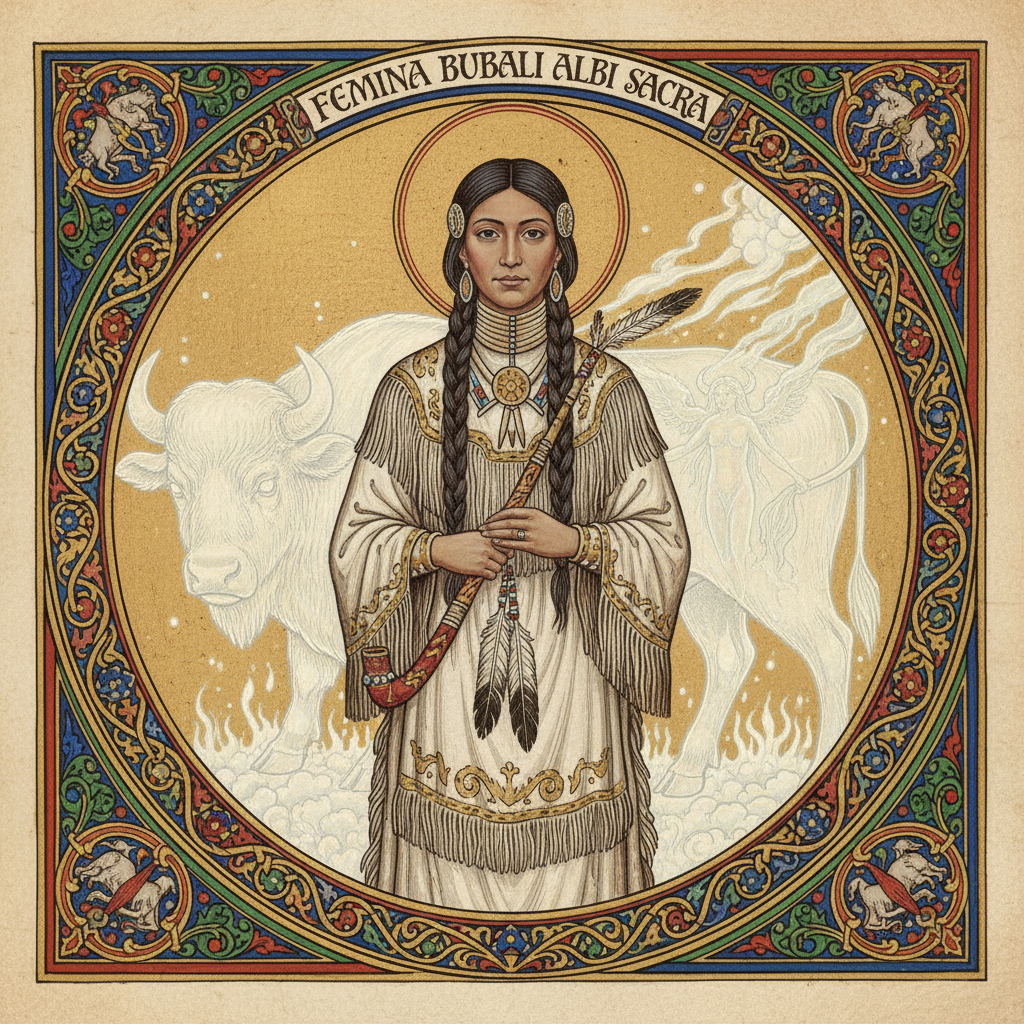
A hundred paces out, she stops and rolls on the earth. She rises as a black buffalo. The people watch, not breathing.
She rolls again. She rises brown.
She rolls again. She rises red.
She rolls a fourth time. She rises white — a white buffalo calf, the color of new snow, the color of the north, the color that means the sacred. She stands in the morning light and looks back at the people, and in her eyes they see something that does not have a word in any language for it — the look of one who loves completely and also must go.
Then she walks over the hill and is gone.
The Lakota have kept the sacred pipe since that morning. The original pipe — or a lineal descendant of it — has been kept by the Elk Head family and then by the Looking Horse family, each keeper receiving it as a sacred responsibility that structures their entire life. Arvol Looking Horse, the nineteenth-generation keeper, has carried it into the twenty-first century.
The white buffalo is still born, rarely, across the plains. When one is born, the Lakota — and people from many other nations — come to pray. The birth of a white buffalo calf is understood as a sign: she has not forgotten. She is still in the world, still watching, still walking just beyond the hill’s edge, waiting for the people to remember what she taught them.
The pipe is still lit. The smoke still rises.
Scenes
She walks out of the prairie mist, dressed in white buckskin worked with sacred designs
Generating art… She holds the *chanunpa wakan* out with both hands, stem toward the people
 Generating art…
 She walks away across the plain and four times she rolls on the ground
 Generating art…
 Echoes Across Traditions
Entities
- White Buffalo Calf Woman (Ptesan-Wi)
- Wakan Tanka
- the Two Scouts
- Standing Hollow Horn

Sources
- Joseph Epes Brown, *The Sacred Pipe: Black Elk's Account of the Seven Rites of the Oglala Sioux* (1953)
- James R. Walker, *Lakota Belief and Ritual*, ed. Raymond J. DeMallie and Elaine Jahner (1980)
- Ella Deloria, *Waterlily* (1988) and unpublished ethnographic notes, American Philosophical Society
- Raymond J. DeMallie, ed., *Handbook of North American Indians, Vol. 13: Plains* (2001)
- Vine Deloria Jr. and Clifford Lytle, *The Nations Within* (1984)