The Vision of Crazy Horse
The vision: approximately 1854–1857, when he was a young man. Little Bighorn: June 25–26, 1876. · The Black Hills and Powder River country of the northern Great Plains; Little Bighorn River, Montana Territory
Contents
In his youth, Tȟašúŋke Witko goes alone into the wilderness and sees a rider who cannot be touched by bullets, who has a small stone behind his ear and lightning on his cheek. He is given instructions: never wear a war bonnet, never take anything for himself after battle, always wash in running water. He becomes the vision. At Little Bighorn in 1876, bullets pass through him.
- When
- The vision: approximately 1854–1857, when he was a young man. Little Bighorn: June 25–26, 1876.
- Where
- The Black Hills and Powder River country of the northern Great Plains; Little Bighorn River, Montana Territory
He goes alone into the wilderness when he is still young — perhaps fourteen, perhaps younger; the exact year is uncertain, which is appropriate, because this kind of event does not belong to the calendar.
His name at this point is not yet Crazy Horse. He has not yet earned that name. He is still Curly, a quiet boy with unusually light curly hair and eyes that rest on things longer than most people’s eyes do, as if he is waiting for objects to confess their true nature. His father is a medicine man. His father has seen the kind of restlessness that has come over his son and he knows, as a medicine man knows, that this restlessness is not something to be managed. It is a hunger for what only the wilderness can give.
Curly goes out alone. He does not eat. He lies down beside a lake with small stones pressing into his back and he looks at the sky and the sky looks back.
He waits.
On the second day or the third day — he is not certain, time having become strange — the vision comes.
A rider.
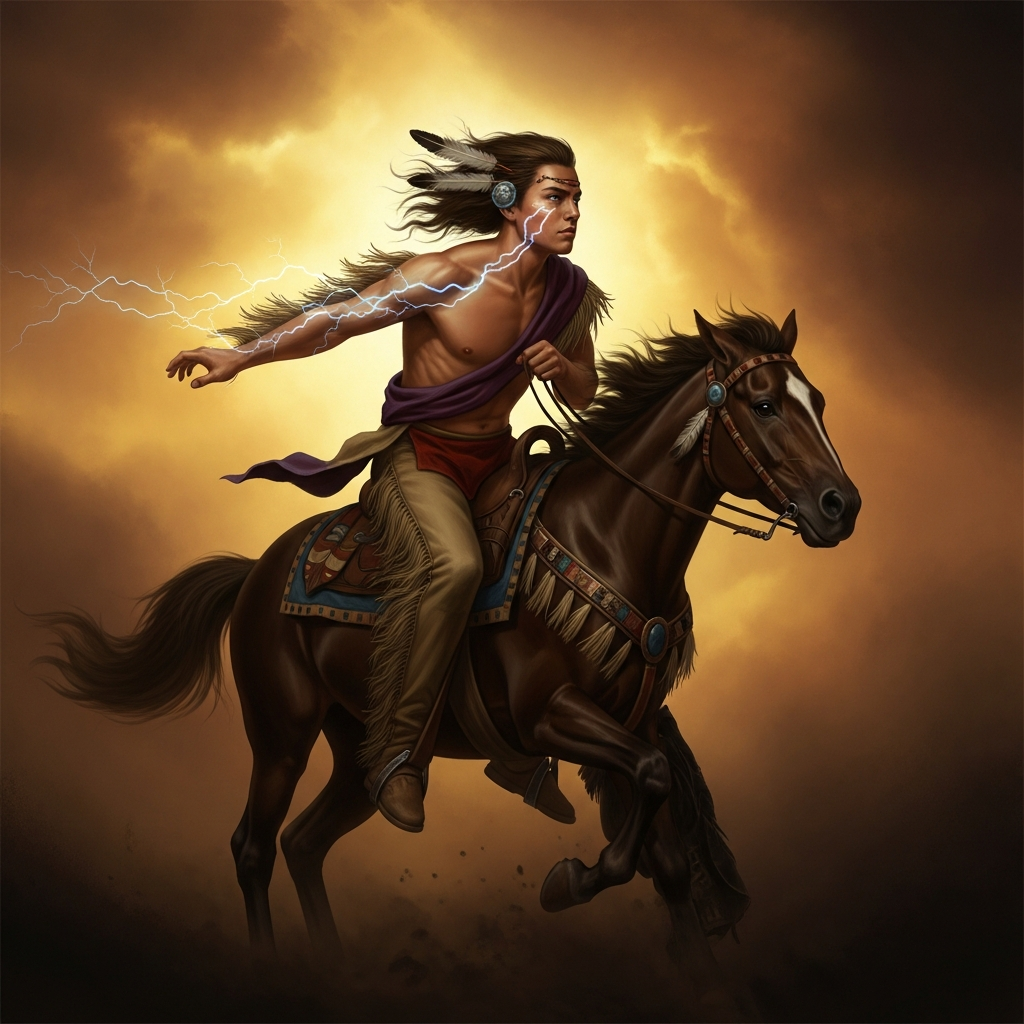
The rider comes from a great distance, galloping, and the first unusual thing is that his horse’s hooves do not touch the ground. The horse and rider float, not suspended the way a thing hangs when it is stopped, but floating forward, the motion of galloping without the contact, as if the usual laws between body and earth have been suspended specifically for this figure.
The rider’s hair is loose and long. He wears nothing on his head — no feathers, no bonnet. His face is streaked with zigzag lightning on one cheek. Small hailstone dots below the lightning. Around him, like a disturbance in the air, small stones of all colors circle, orbiting him.
Behind his ear, attached there by a cord or by nothing, a single small stone.
The rider gallops toward Curly and past him and away, and Curly watches from his position on the ground, and the rider’s face as he passes is Curly’s own face, older, with the lightning already on it, with the certainty already in it.
Voices speak.
They speak the instructions the way instructions are given in visions: not as commands from outside but as recognitions from inside, truths the receiver already knew but had not yet been given the words for.
Never wear a war bonnet. Not because it is not beautiful, but because it will make you a chief rather than a warrior, and a chief holds power over people, and power over people is not the work.
Tie a small stone behind your ear when you go into battle. Not as charm or luck but as reminder: this is who you are. You have seen yourself.
Never take anything for yourself after battle. No scalps, no horses claimed beyond what is needed, nothing accumulated. The warrior who takes from the dead for personal glory is trading his power for decoration.
Always wash in running water, not standing water. Running water is alive. The living thing cleanses; the still thing accumulates what it has held.
Do not be touched by water when it is raining on the earth. Let the rain do its work on the earth without using the warrior’s body as an instrument. This one he does not fully understand yet. He will.
The rider circles back. He is not threatening — he is showing. He rides through a hail of arrows, which pass through him. Through a barrage of bullets, which pass through him. Not because he is a ghost but because he is right — because he is in the exact alignment between his commission and his actions, and in that alignment there is no gap for a bullet to find.
The rider fades.
Curly lies still for a long time with his face turned toward the sky.
He comes back into the camp changed.
This is the word the people use, in retrospect: changed. He was already quiet; now the quiet is structured. He was already attentive; now the attention has a direction. He does not speak much about the vision. The vision is not for speaking; it is for becoming.
His father sees the change immediately and calls him to him and does not ask what happened but sits with him in silence in the way that the Lakota use silence — as the appropriate container for things that do not fit in words. After a long time, Curly tells him the shape of it. Not the whole vision; visions are not owned and they are not shared except in the parts the person is directed to share.
His father listens.
“You have been shown who you are,” his father says.
“I have been shown who I must become.”
“In you, they are the same thing.”
He becomes the vision slowly, over years.
His name becomes Crazy Horse — his father’s name, given to him in the way that the Lakota transfer power through naming. He fights in the hundred small engagements that are the daily texture of the plains wars: the soldiers pushing west, the treaties signed and broken in the same season, the reservations shrinking. He takes nothing for himself after battle. He does not wear a war bonnet. He ties the small stone behind his ear.
The men who ride with him notice that he is different in the field — not reckless, but fearless in a specific way that is different from the fearlessness of men who have decided they do not care about dying. He cares about dying. He simply does not expect it, not yet, not before his work is finished. The vision has given him a kind of appointment with his own life, and the appointment has not been fulfilled yet.
The Custer who rides into the Little Bighorn valley on June 25, 1876, with seven hundred cavalrymen, is riding into the largest gathering of Lakota and Cheyenne in recorded history — ten thousand people camped along the river. He does not know this. He has divided his command and he has outrun his supply lines and he is riding fast in the way of a man who trusts his luck more than his intelligence.
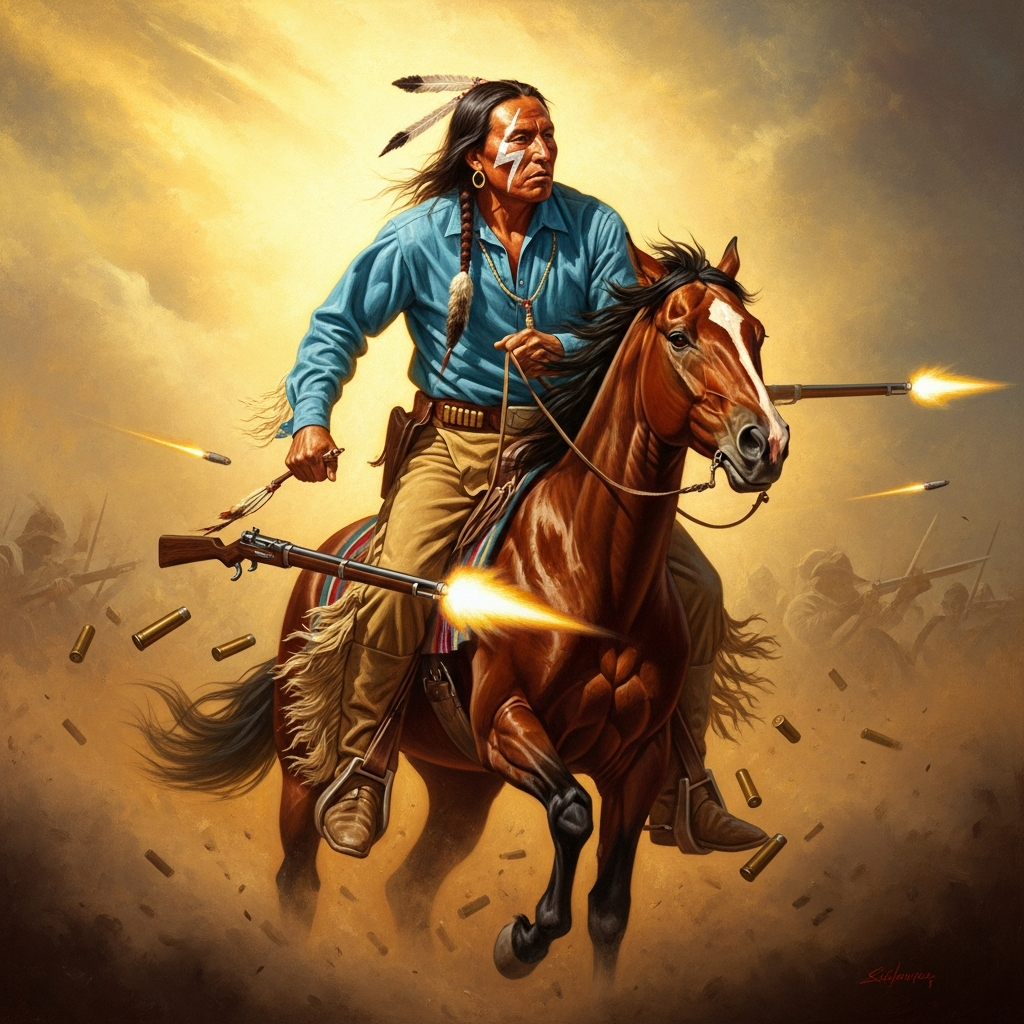
Crazy Horse paints his face. Zigzag lightning on the left cheek. Hailstone dots. The small stone behind the ear.
He crosses the river.
What happens in the next two hours on the bluffs above the Little Bighorn is recorded differently by every person who survived it — and no one who rode with Custer survived it — so the record belongs to the Lakota and Cheyenne witnesses. What they say is consistent: Crazy Horse was everywhere at once. He was never where the bullets were when they were fired. He rode through the dust and the smoke at angles that should not have protected him and were protecting him, and men fell around him and he did not fall.
Custer never photographs Crazy Horse. Never, in the years before the battle, during the many parleyes and councils and military expeditions through Lakota territory. There are photographs of Sitting Bull, of Red Cloud, of Spotted Tail — but Crazy Horse refuses, every time, and the refusal is not defiance or modesty. It is the vision’s instruction, understood now: do not be possessed. Do not let the image of yourself be taken from you and held by someone else. The self is not a possession to be traded.
Custer dies on the hill the Lakota call Last Stand Hill and the soldiers call Custer Hill. Crazy Horse is alive in the valley below.
He goes to care for the wounded. He takes nothing.
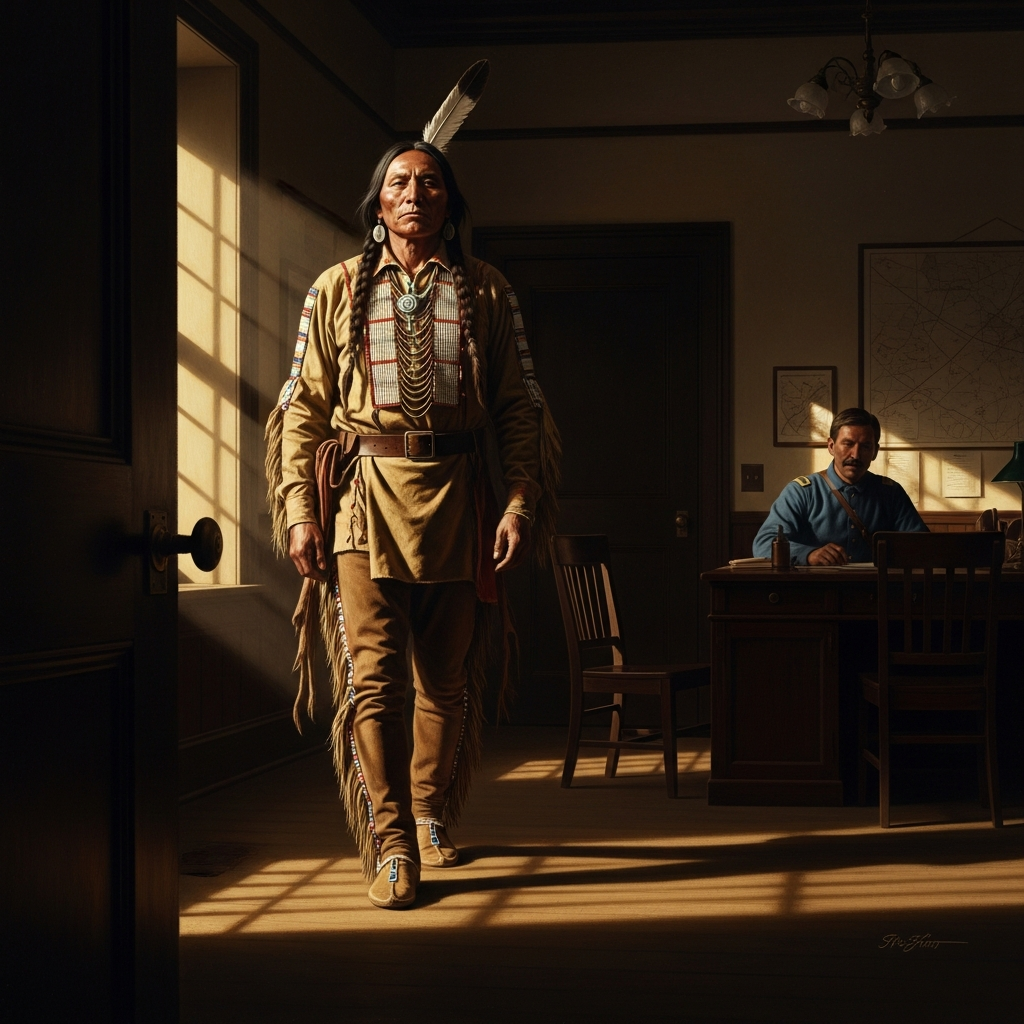
He surrenders at Fort Robinson in May 1877, not because he is defeated but because his people are hungry and the buffalo are gone and the children are cold, and no vision holds against the hunger of children.
On September 5, 1877, he is bayoneted by a soldier at Fort Robinson. He is thirty-five years old, approximately. He is buried in a place his family keeps secret.
There are no authenticated photographs of his face. This is the most complete victory of the vision over the world’s appetite for possession. His face belongs to the people who loved him and to the tradition that made him and to no one else. You cannot buy it. You cannot display it. You cannot conquer what you cannot picture.
The stone in the vision is still behind his ear, wherever he is. The lightning is still on his cheek.
The rider does not touch the ground.
Scenes
The vision rider gallops forward without touching the ground
Generating art… At Little Bighorn, Crazy Horse rides through the dust and smoke with his face painted — the zigzag lightning on one cheek, the hailstone dots
 Generating art…
 Fort Robinson, September 5, 1877
 Generating art…
 Echoes Across Traditions
Entities
- Crazy Horse (Tȟašúŋke Witko)
- Worm (his father, a medicine man)
- the Vision Rider
- Wakan Tanka
- George Armstrong Custer

Sources
- Mari Sandoz, *Crazy Horse: The Strange Man of the Oglalas* (1942)
- Larry McMurtry, *Crazy Horse* (1999)
- Joseph Marshall III, *The Journey of Crazy Horse: A Lakota History* (2004)
- Stephen E. Ambrose, *Crazy Horse and Custer* (1975)
- Kingsley M. Bray, *Crazy Horse: A Lakota Life* (2006)