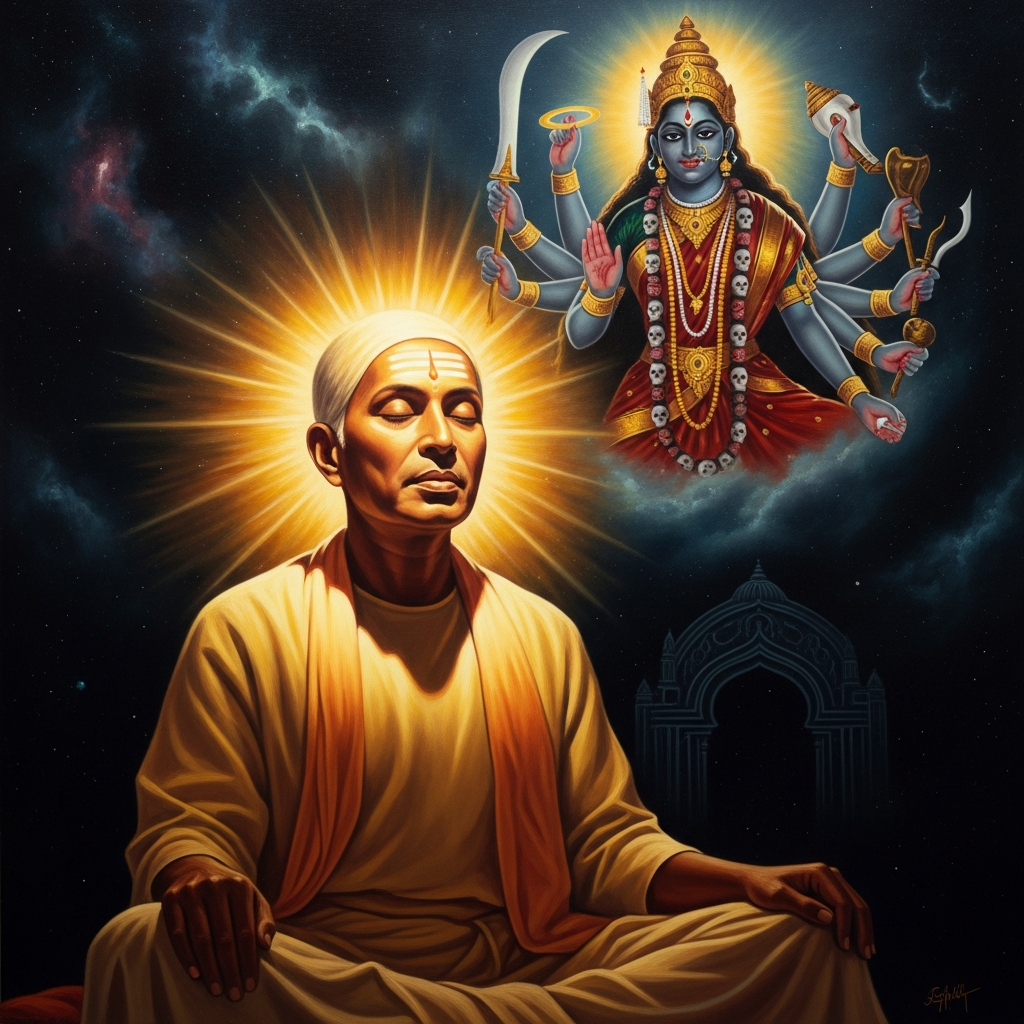
Ramakrishna Sees the Mother of the Universe
c. 1856 (the first vision); 1836-1886 (his life) · The Dakshineswar Kali Temple, on the bank of the Hooghly River north of Calcutta
Contents
He has been the priest at the Dakshineswar Kali temple for weeks and the goddess has not come. The image is stone. The flowers are flowers. The food is food. He cannot bear it. One evening, standing before the image at the close of the worship, he picks up the sword used for animal sacrifice and raises it to his own throat. He has decided. In the moment before he would have struck, the temple fills with light. The image becomes a living presence. He falls unconscious. He will have the same vision for the rest of his life — for hours at a time, for days at a time, until his body becomes a public laboratory of mystical experience and his words become one of the most widely read spiritual texts of the twentieth century.
- When
- c. 1856 (the first vision); 1836-1886 (his life)
- Where
- The Dakshineswar Kali Temple, on the bank of the Hooghly River north of Calcutta
His name at birth is Gadadhar Chattopadhyaya.
He is born in 1836 in a village called Kamarpukur in West Bengal — a village so small that the railway will not reach it for another century, a Brahmin household so poor that the family owns no land but is fed by the rituals the father performs for the local landlords. The family is orthodox. The father has had visions before Gadadhar’s birth. The boy is treated from infancy as someone marked.
He fails at every conventional task.
He cannot learn arithmetic. The teacher hits him with a stick and he laughs. He cannot learn Sanskrit grammar. He memorizes the poetry but the rules slide off him. By the time he is sixteen and his elder brother has moved to Calcutta to set up a Sanskrit school, the family has decided that Gadadhar will not be a scholar. They send him to Calcutta to assist the brother in performing pujas for wealthy patrons — the practical use of Brahmin training, the only thing he might be good for.
He resists this also. Brother, he says, I do not want to learn the kind of thing that earns money. I want to learn the kind of thing that makes one understand God.
The brother has no answer for this.
In 1855, Rani Rashmoni — a wealthy widow of low caste who has fought the Calcutta Brahmin establishment for the right to build a temple complex on the Hooghly River — opens her temple at Dakshineswar. The complex includes shrines to Vishnu and Shiva, but the central temple is to Kali, the black goddess of time and death. Rashmoni cannot find a Brahmin priest willing to serve in a temple built by a low-caste woman. She finds Gadadhar’s elder brother, who agrees, who soon dies, who passes the position to Gadadhar at the age of twenty.
The young priest takes up his duties. He performs the arati — the lamp ceremony — at dawn and dusk. He places food before the image. He recites the mantras. He waits.
Nothing happens.
He cannot bear it.
The image at Dakshineswar is a black stone Kali in the Bengal style — four-armed, garlanded with skulls, tongue extended, foot on Shiva’s chest. The other priests perform their rituals professionally. They do their hours and go home. Gadadhar, twenty years old, cannot accept the professional relation. He asks the image questions and the image does not answer. He cooks the food and serves it as he was instructed and watches the food remain food. The flowers remain flowers. The stone remains stone.
He stops sleeping.
He spends the nights in the small grove of trees behind the temple — the panchavati, five sacred trees, where he has built himself a meditation seat. The temple staff hears him weeping in the grove. He calls out: Mother, where are you? Why do you not come?
His mental state begins to alarm Rashmoni’s nephew Mathur, who manages the temple. They talk about replacing him. He looks unwell. He has stopped eating. His eyes are red.
The night of the vision is unrecorded in date. Saradananda’s biography places it sometime in 1856. Ramakrishna told the story to his disciples decades later and the version that survives is theirs.
He has finished the evening arati. The temple is empty. The lamps are still burning. The image of Kali looks at him and does not see him. He looks at it and does not see it. He has been doing this for almost a year.
The sword used for animal sacrifice — the khadga, hanging on the temple wall — catches his eye. The sword is sharp. The sword has been used to behead goats. The sword would work on a man’s throat as well as on a goat’s.
He takes it down.
He turns the blade toward himself.
He has decided. He will not continue as a priest who has not seen the goddess he serves. The choice is between the vision and the sword and the goddess can decide which it will be.
The temple fills with light.
He describes it later, many times, with slight variations.
A sea of consciousness, infinite and shining. Wave after wave breaking over me. The stone — the stone of the image — became transparent. I saw the Mother. She was not separate from me. The walls of the temple were also Her. The lamps were Her. The blood on the sacrificial floor was Her. I saw nothing else.
He drops the sword. He falls to the floor. He loses consciousness.
The temple servants find him in the morning. He is unable to speak. He is smiling. The vision has not finished — it continues for what the texts describe as days, and over the following weeks it returns whenever he closes his eyes, whenever he turns to the image, whenever he sits in the panchavati grove.
Mathur, who had been considering replacing him, watches him for a week and changes his mind. The young priest is in a state Mathur has heard about but never witnessed — bhava, the divine mood, the condition the great Vaishnava saint Chaitanya had been in three centuries earlier on the same Bengal soil. Mathur places extra resources at his disposal. Whatever the priest needs, he will have. The priest needs almost nothing. He needs a small room. He needs occasional food when the disciples remind him to eat. He needs to be left alone in the panchavati grove for whole nights and not disturbed.
The vision returns whenever he asks for it. The vision returns whenever he does not ask for it. The vision is the new condition of his life.
He decides, after some years of this, that he must verify it.
The decision is the most extraordinary feature of the Ramakrishna biography. He is a Bengal Brahmin priest in a Kali temple, having ecstatic visions of the goddess that have made him locally famous and that have begun to draw visitors from Calcutta. He could spend the rest of his life in this single mode and be entirely sufficient as a saint.
He does not.
He decides instead to test whether the experience is specific to Kali — specific to Shaktism, specific to his particular tradition — or whether it is something more general. The test will involve practicing every other major spiritual path he can find, in sequence, and observing whether the same vision arrives.
A wandering renunciant called Tota Puri arrives at Dakshineswar. Tota Puri is an Advaita Vedantin — the philosophical school of Shankara, attribute-less monism, the negation of all images including the image of Kali. He offers to initiate Ramakrishna into the nirvikalpa samadhi — the formless absorption that is the goal of Advaita.
Ramakrishna accepts. He attempts the practice. The image of Kali appears in his consciousness and he cannot dispel it. Tota Puri picks up a piece of glass and presses it between Ramakrishna’s eyes. Now, Tota Puri says, cut her with the sword of discrimination and pass through. Ramakrishna closes his eyes. He raises an internal sword. He cuts through the image of Kali — cuts the form he has been worshipping — and passes into the formless. He stays there for three days. The body would have died if the disciples had not forced food into the mouth.
He emerges and continues. The next year a Sufi master, Govinda Roy, teaches him dhikr — the Sufi practice of repeating the name of Allah. Ramakrishna takes off the sacred thread of his Brahmin caste, eats food cooked by Muslims, performs namaz five times a day. After a few days he has a vision of a radiant figure with a white beard who passes into him — Allah, by his identification, indistinguishable in mode from the Mother. He returns to Hindu practice convinced that the path was equivalent.
He does the same with Christianity. He has a portrait of the Madonna placed in the room. He meditates on Jesus for three days. A figure walks toward him out of the painting and embraces him and disappears into him. He recognizes Jesus afterward as another form of the same.
The disciples watching this have no theological precedent for it. Most religious figures are inside one tradition. Ramakrishna is performing a controlled experiment across traditions and reporting that the result is constant.
His conclusion, repeated in dozens of forms across the recorded conversations: jata mat tata path — as many faiths, so many paths. They lead to the same place. The form differs. The destination is one.
He marries.
The marriage is technically arranged when he is twenty-three and the girl, Sarada, is five — the standard practice of Bengal in the period. They do not live together until she is eighteen. When she comes to Dakshineswar, Ramakrishna performs a ritual on her: he installs her on the throne of the goddess and worships her formally as Kali. He never consummates the marriage. He treats Sarada for the rest of his life as the living embodiment of the Mother — the same vision he had at the temple, now sitting in his room, pouring his tea, mending his clothes.
Sarada Devi will outlive him by thirty years. She will become the Holy Mother of the Ramakrishna Order. The other disciples consult her after his death. She will quietly run a global movement from her village house, never raising her voice, never claiming authority she does not have, ratifying or vetoing institutional decisions with a sentence.
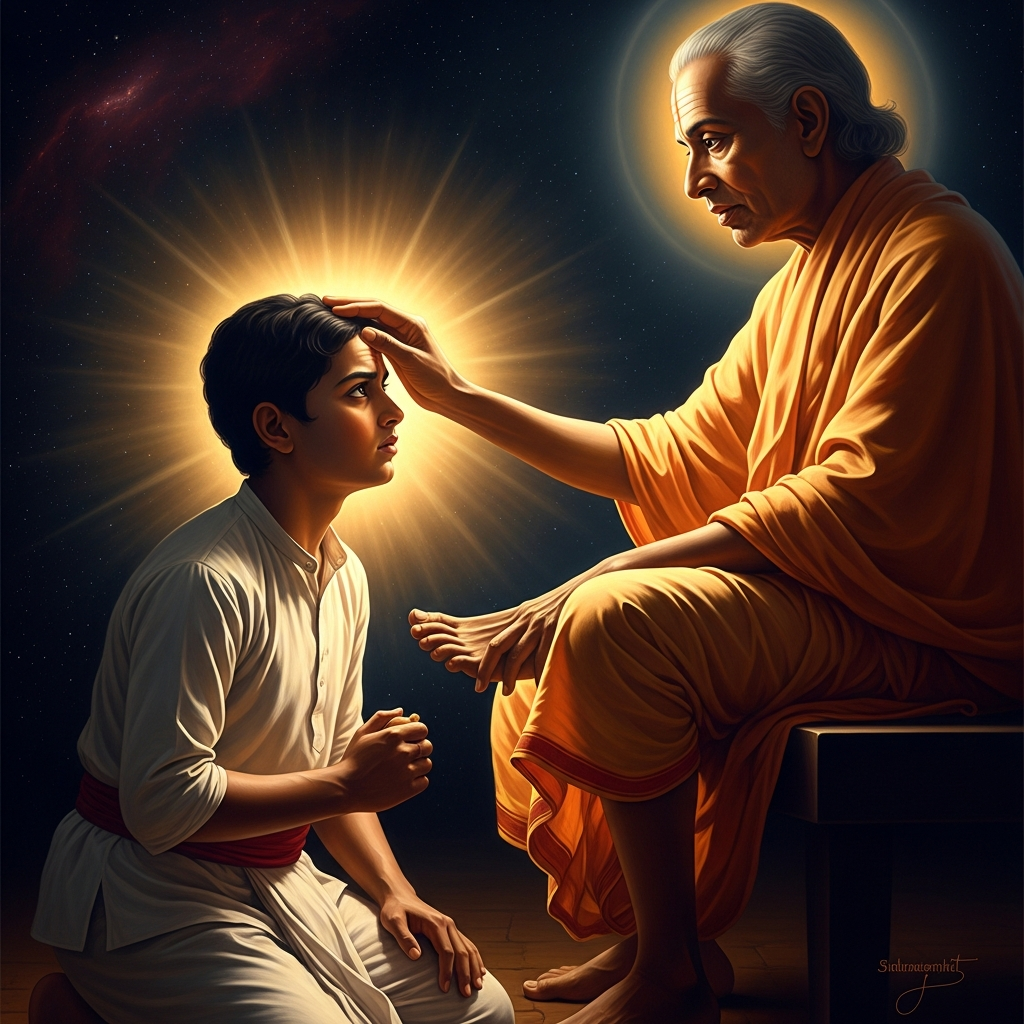
The young men begin to gather around Ramakrishna in the 1870s and 1880s. They include the future Vivekananda, who arrives skeptical — a Brahmo Samaj rationalist, a college student, a singer with a beautiful voice — and who Ramakrishna identifies on first sight as the disciple who will carry the message west. Mahendranath Gupta, a schoolteacher in Calcutta, begins coming to the temple in the early 1880s and begins keeping a notebook of every conversation. The notebook will become The Gospel of Sri Ramakrishna — the most detailed transcript of any Indian saint’s daily speech that survives.
Ramakrishna develops throat cancer in 1885. The disciples nurse him through the final year. He dies in August 1886 at a rented house in Cossipore, surrounded by the young men who will become the Ramakrishna Mission.
Vivekananda goes to America in 1893.
At the Parliament of the World’s Religions in Chicago, he stands and addresses the audience as sisters and brothers of America and the audience applauds for two minutes before he can begin the lecture. The lecture is the systematic presentation of what Ramakrishna had embodied in private practice — that the religions of the world are not competitors, that mystical experience is the common substrate, that the goddess at Dakshineswar and the Christ on the cross and the Allah of the Sufis are the same vision in different inflections.
The argument enters the modern world from there.
The image of Kali at Dakshineswar is still there. The temple receives several million visitors a year. The room where Ramakrishna lived is preserved. The panchavati grove where he sat the nights of the vision is preserved.
The sword has been preserved.
It hangs on the wall where it always hung. It has not been used to behead anything in a long time. The animal sacrifices at Dakshineswar continue but the temple has assigned other implements for the purpose, leaving the sword alone, as a relic of the moment when a young priest who could not bear the silence of the goddess decided to force the issue and the goddess answered before the blade made contact.
The texts insist on the order: he raised the sword, and then the light came. The decision preceded the vision. The Mother does not come to those who are merely waiting. She comes to those who have decided that the wait is over.
That is the sentence Ramakrishna repeated, in many variants, for the next thirty years to anyone who came to ask him how to find God.
Cry for Her, he said. Cry for Her the way a child cries for its mother. The Mother is not stone. The Mother will come. But you must want Her enough to stop pretending the wait is bearable.
The young men nodded. Some of them understood. One of them — a college student named Narendra — understood enough to carry the teaching to Chicago and from there into the bloodstream of every Western city’s spiritual subculture for the next century.
The vision is still arriving. The form differs. The work is the same.
Scenes
He has been the priest for weeks
 Generating art…
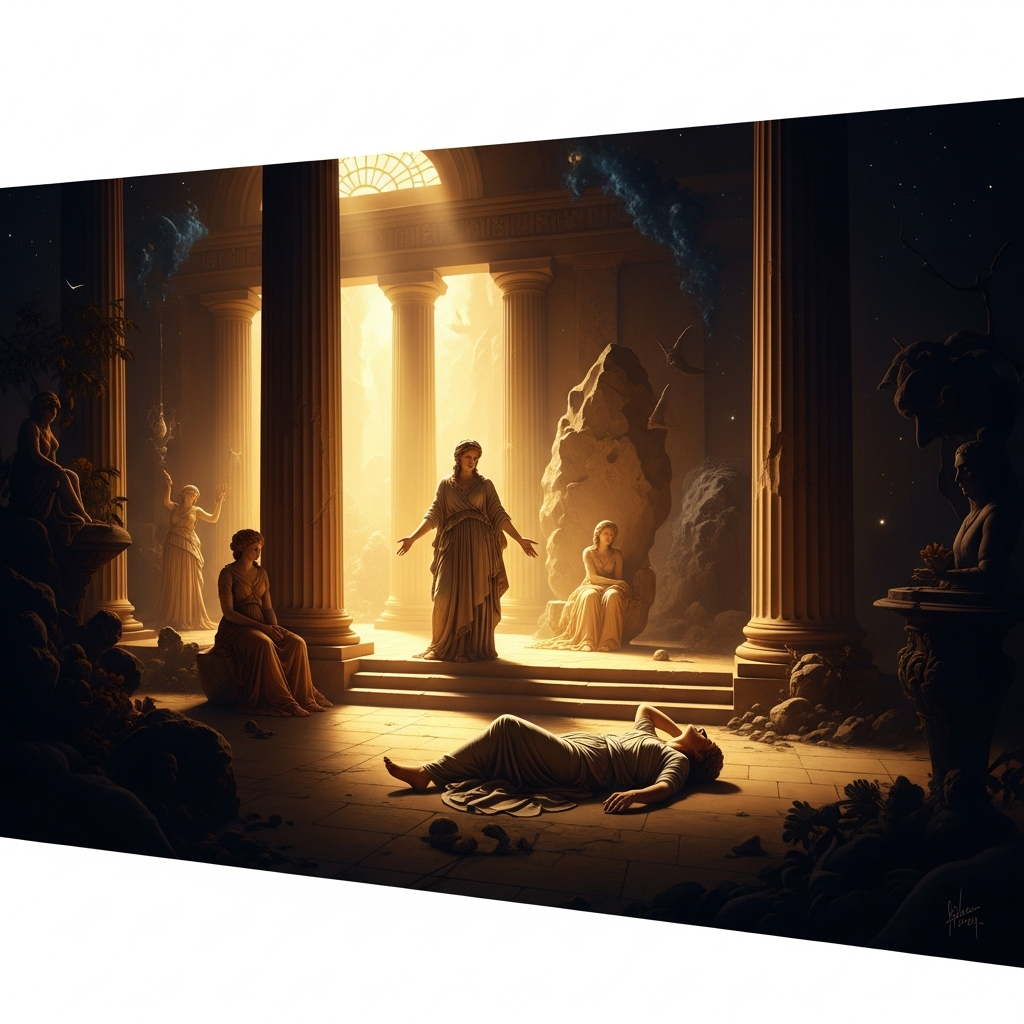
 The temple fills with a light he later describes as *a sea of consciousness, shining and roaring*
 Generating art…
 Decades later
 Generating art…
 Echoes Across Traditions
Entities
- Ramakrishna Paramahamsa
- Sarada Devi
- Swami Vivekananda
- Mahendranath Gupta
- The Kali Image at Dakshineswar
- Rani Rashmoni
Sources
- Mahendranath Gupta, *The Gospel of Sri Ramakrishna* (trans. Swami Nikhilananda, 1942)
- Swami Saradananda, *Sri Ramakrishna the Great Master* (trans. Swami Jagadananda, 1952)
- Jeffrey Kripal, *Kali's Child: The Mystical and the Erotic in the Life and Teachings of Ramakrishna* (1995)
- Narasingha Sil, *Ramakrishna Paramahansa: A Psychological Profile* (1991)
- Romain Rolland, *The Life of Ramakrishna* (1929; English trans. 1930)
- Amiya P. Sen, *Hindu Revivalism in Bengal 1872-1905* (1993)