The Sun Dance: What It Costs to Ask
c. 1862 · The Great Plains, Lakota territory
Contents
In 1862, a young Lakota man named Two Strikes watches his son die of fever in three days. In his grief, he makes a vow: if the people survive the winter, he will offer himself at the next Sun Dance. What follows is not torture but fulfillment — the body made into the bridge between the human and the sacred, the vow completed in the only coin that means anything.
- When
- c. 1862
- Where
- The Great Plains, Lakota territory
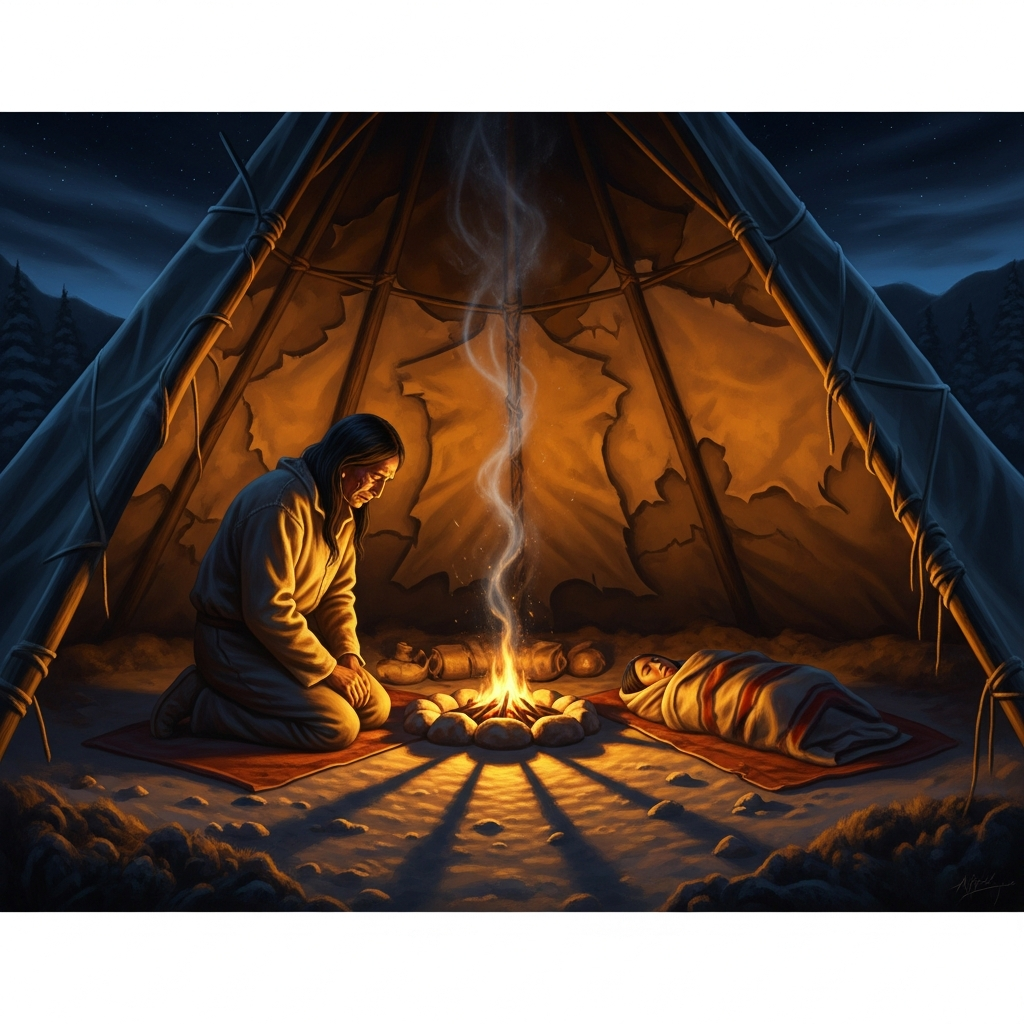
The boy is sick for three days, and then he is gone.
His name is not remembered in this account. He was four years old and he had a fever and his father did everything the medicine man said to do, and on the morning of the third day the tipi was quiet in a way that had nothing to do with sound.
His father is a man in his late twenties named Two Strikes, or something that translates as Two Strikes, and he kneels in the tipi beside his son’s still body and he understands the following thing: there is no amount of medicine, no amount of cleverness, no amount of ordinary human effort that would have changed this. The fever came from a world that does not respond to cleverness. The world that governs fevers and winters and the survival of children is not the world he can manage by ordinary means.
He lifts his face in the cold tipi, in the dark, and he makes a vow.
He says: if the people survive this winter — the fever going around the camp has already taken three others — he will offer himself at the Sun Dance. He says this aloud, to the dark, to the cottonwood poles of the tipi, to whatever in the universe is capable of holding a promise.
He does not know whether anyone hears.
The winter does not take the people.
Three more die of the fever — two elders, one infant — and then the cold deepens enough to stop the fever’s spread, and when spring comes the band has survived, diminished but intact. Two Strikes does not pretend not to remember his vow. Some vows are made in the extremity of grief and forgotten when the extremity passes; this is understood and there is no great shame in it. But he does not forget.
He goes to the holy man and tells him what he promised. The holy man listens without comment. Then he explains what will be required.
The Sun Dance is held in midsummer, when the chokecherries are ripe, when the sun is at its highest and hottest. The ceremony takes days of preparation: the choosing and cutting of a cottonwood for the center pole, the construction of the circular arbor of brush and posts, the preparation of the dancers through fasting and sweat lodge ceremonies. Those who have made vows to pierce are prepared separately, counseled on what they are undertaking and why, given time to consider whether they are certain.
Two Strikes is certain. He has been certain since the February night in the tipi. The months of waiting have not diminished the certainty; they have clarified it.
There is a misunderstanding about the piercing that matters to address before describing it.
The misunderstanding is that the Sun Dance is a test of endurance — that the point is to see how much a person can bear, or to demonstrate courage through the bearing of pain, or that it is in some way an ordeal designed to produce an altered state through physical extremity.
The point is the vow.
The vow was made to the sacred world in a moment of extremity: I will give you this if you give the people that. The sacred world gave the people that. The Sun Dance is the payment. It is not a transaction of the ordinary kind — the suffering is not currency in the sense that more suffering produces more result — but the body is the offering, and the only way to offer the body fully is to offer it in a form that costs something.
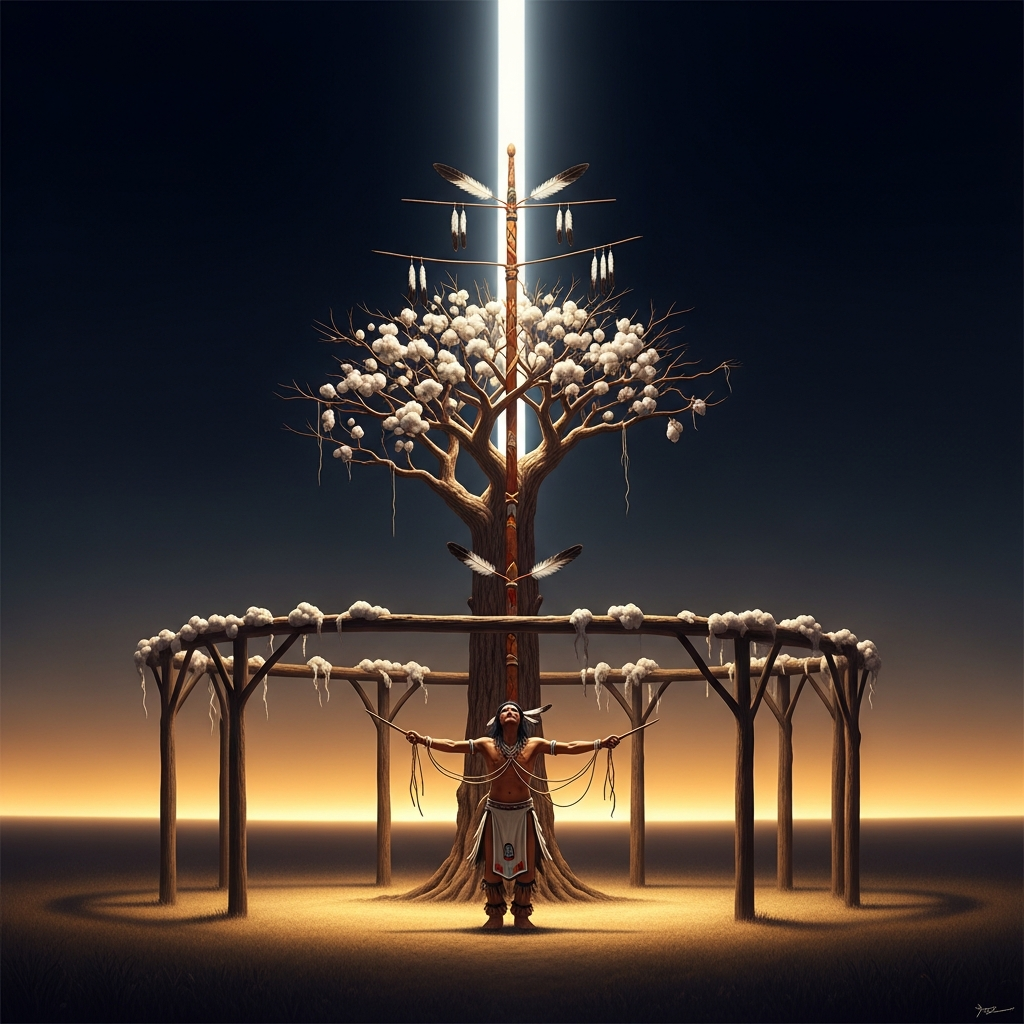
The rawhide skewers go through the skin of the chest, one on each side. The skewers are connected by rawhide tethers to the center pole, high up where the eagle feathers are tied. The dancer faces the pole and dances backward and the tethers go taut and this is the point of completion: the body connected to the sacred center, the vow held in the tension of the rope and the skin, the dancer pulling against the pull, the skin stretching toward the moment when it tears free.
The tearing free is the fulfillment of the vow. It is not the conclusion of suffering but the conclusion of the promise. After it, the dancer is released — not just from the pole but from the obligation he has carried since the night of his son’s death. The vow is complete. The debt is paid. The dancers who have been through it describe not the pain but the quality of the moment afterward: clean, empty, free in the specific way that only the honoring of a serious promise can produce.
The ceremony itself is something else entirely from any description of it.
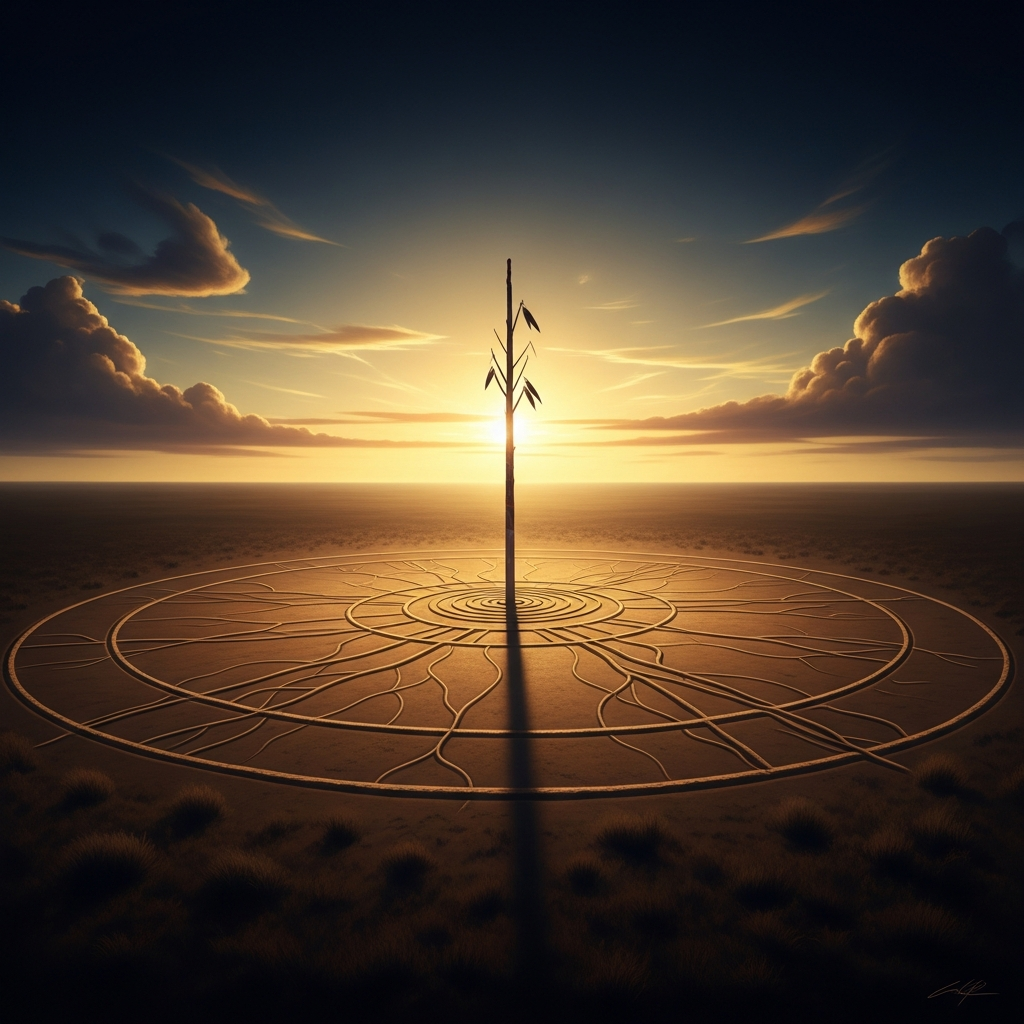
The drumming begins before the sun comes up and it does not stop. The singers’ voices layer over the drum. The arbor fills with people who have come to witness, to participate by witnessing, to add their presence to the collective weight of the moment. The center pole stands at the arbor’s heart, cottonwood chosen because it is the tree that the wind moves constantly, whose leaves sound like water, whose inner bark shows a five-pointed star in cross-section that the Lakota connect to the morning star.
Two Strikes dances toward the pole and away from it, toward it and away, the tethers going taut and slack with each backward step. He is looking at the eagle feathers tied above him, at the place where the tethers meet the wood, at the sun, which he is not supposed to look at directly but which fills everything with light regardless. He does not think of his son. He does not think of the fever or the February tipi or anything that happened before this moment. The drumming is so encompassing that there is nothing outside of it.
At some point — the exact moment is impossible to anticipate and impossible to mistake — the skin tears. Two Strikes goes backward and stumbles and the holy men are there to receive him and he is laid gently on the earth while the blood is seen to.
He is weeping. This is not unusual. Many dancers weep at the moment of release, and the weeping is not pain.
He carries the scars for the rest of his life.
This is considered neither shameful nor remarkable. The scars are evidence of completion, the marks of a promise that was made and kept. When Two Strikes is an old man, the scars are still there — two parallel marks on his chest, slightly puckered, not large — and his grandchildren ask about them and he explains what they are.
He does not describe the ceremony in detail. Some things about the Sun Dance are not transmitted by description but only by direct experience, by sitting in the arbor and watching and being part of the collective body of witnesses. He tells them what the vow was. He tells them what the winter took and what it spared. He tells them that the pipe and the Sun Dance and the sacred ceremonies in general exist to give people a way to interact with the world that governs fevers and winters and the survival of children — the world that does not respond to cleverness.
He tells them that the body is the only thing that is fully yours, which makes it the only thing you can fully give.
His grandchildren listen. Some of them will make vows of their own. Some of those vows will bring them to the center pole on a summer morning, looking at eagle feathers against a white sky, the drumming so complete that nothing else exists.
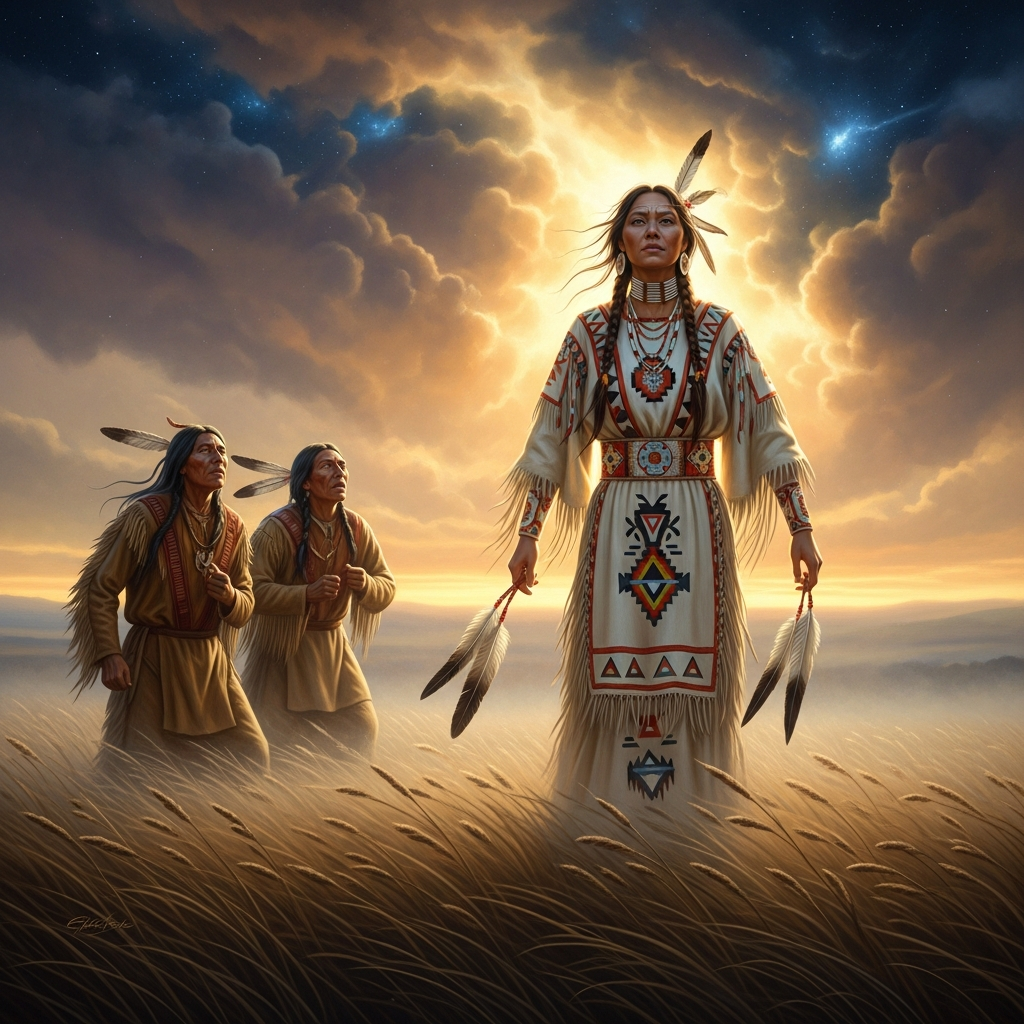
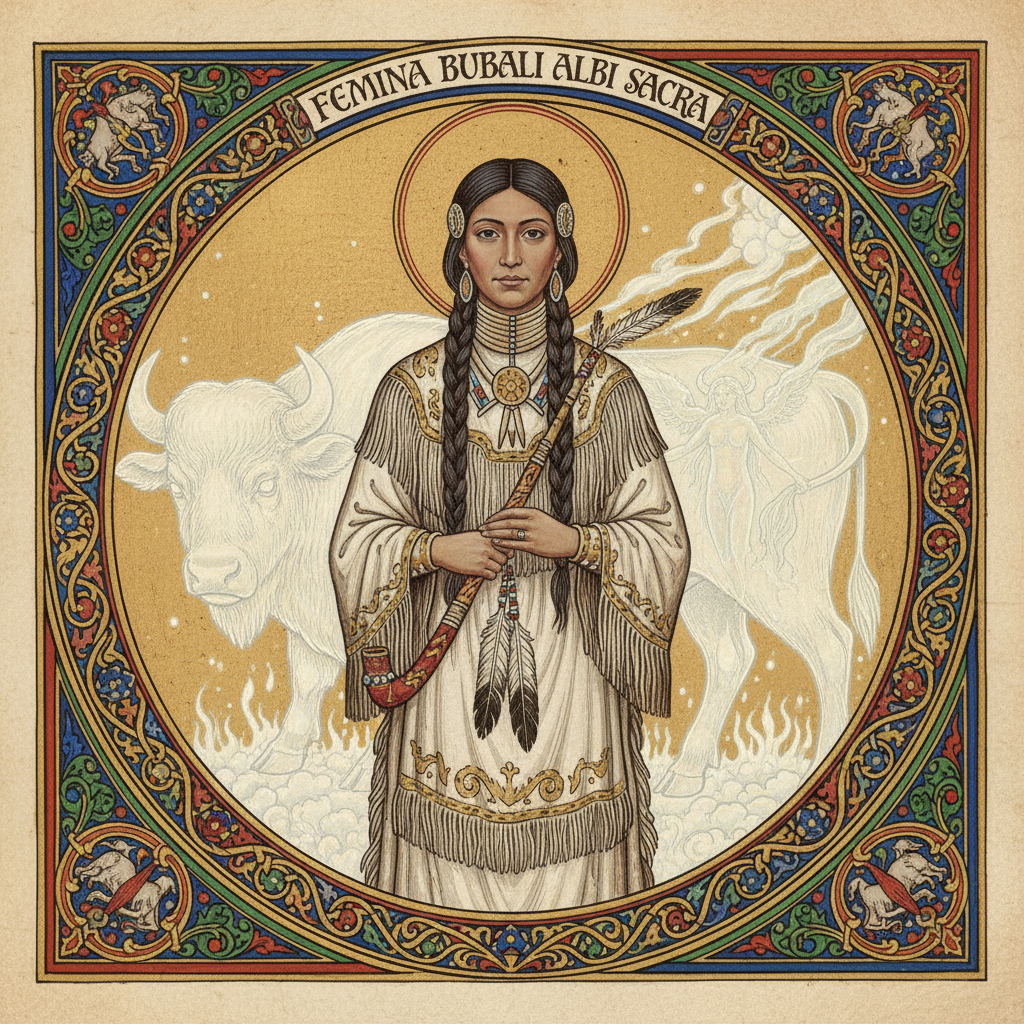
This is the structure White Buffalo Calf Woman taught: the ceremony that makes the body into a bridge.
The U.S. government banned the Sun Dance in 1883. The stated reason was that it was cruel and barbaric. The actual reason was that it assembled the people in their hundreds, renewed communal bonds, and enacted a set of relationships between the Lakota and their world that did not require anything the United States government could offer or withhold.
The ceremony continued anyway, quietly, in modified forms. When the American Indian Religious Freedom Act passed in 1978, the Sun Dance was already intact, carried in the memory and practice of those who had kept it through ninety-five years of prohibition.
You cannot ban a vow. A vow exists in the moment it is spoken, held by the one who spoke it, witnessed by whatever in the universe is capable of witnessing. The government can ban the ceremony of its completion. It cannot reach back and unmake the words spoken in a dark tipi in February over the body of a child.
Two Strikes made his vow in the dark and kept it in the light. That is all that was required.
Scenes
A tall cottonwood stands at the center of a circular arbor on the summer plains
 Generating art…
 A man kneeling in a tipi beside a small still form wrapped in blankets
 Generating art…
 The Sun Dance circle at dawn, after the ceremony
 Generating art…
 Echoes Across Traditions
Entities
- Wiwanyag Wacipi
- the Center Pole
- the Thunderbeings
- White Buffalo Calf Woman

Sources
- Vine Deloria Jr., *God Is Red: A Native View of Religion* (Fulcrum Publishing, 1973; 3rd ed. 2003)
- Raymond J. DeMallie (ed.), *The Sixth Grandfather: Black Elk's Teachings Given to John G. Neihardt* (University of Nebraska Press, 1984)
- Joseph Epes Brown, *The Sacred Pipe: Black Elk's Account of the Seven Rites of the Oglala Sioux* (University of Oklahoma Press, 1953)
- Clyde Holler, *Black Elk's Religion: The Sun Dance and Lakota Catholicism* (Syracuse University Press, 1995)
- William K. Powers, *Oglala Religion* (University of Nebraska Press, 1977)