Twelve Days in the Garden of Ridván
April 21 – May 3, 1863 · the twelve days of Ridván · the Najibiyyih Garden (renamed *Ridván*, *Paradise*) on the east bank of the Tigris, outside Baghdad
Contents
Camped in a rose garden outside Baghdad on the eve of his exile to Constantinople, a Persian nobleman tells his closest followers that he is the one the Báb foretold — He Whom God Shall Make Manifest.
- When
- April 21 – May 3, 1863 · the twelve days of Ridván
- Where
- the Najibiyyih Garden (renamed *Ridván*, *Paradise*) on the east bank of the Tigris, outside Baghdad
The order from the Sublime Porte arrives in Baghdad in the spring.
Mírzá Husayn-ʻAlí Núrí — Persian nobleman, exiled Babi leader, age forty-five, ten years in Baghdad and increasingly the sun the entire surviving Babi community orbits — is to be moved. The Ottoman authorities, at the Persian shah’s insistence, want him farther from the Iranian border. He is summoned to Constantinople. The exile is forced; the household is to be packed; thirty-one days have been allotted for departure.
He chooses to spend the last twelve of them in a garden across the river.
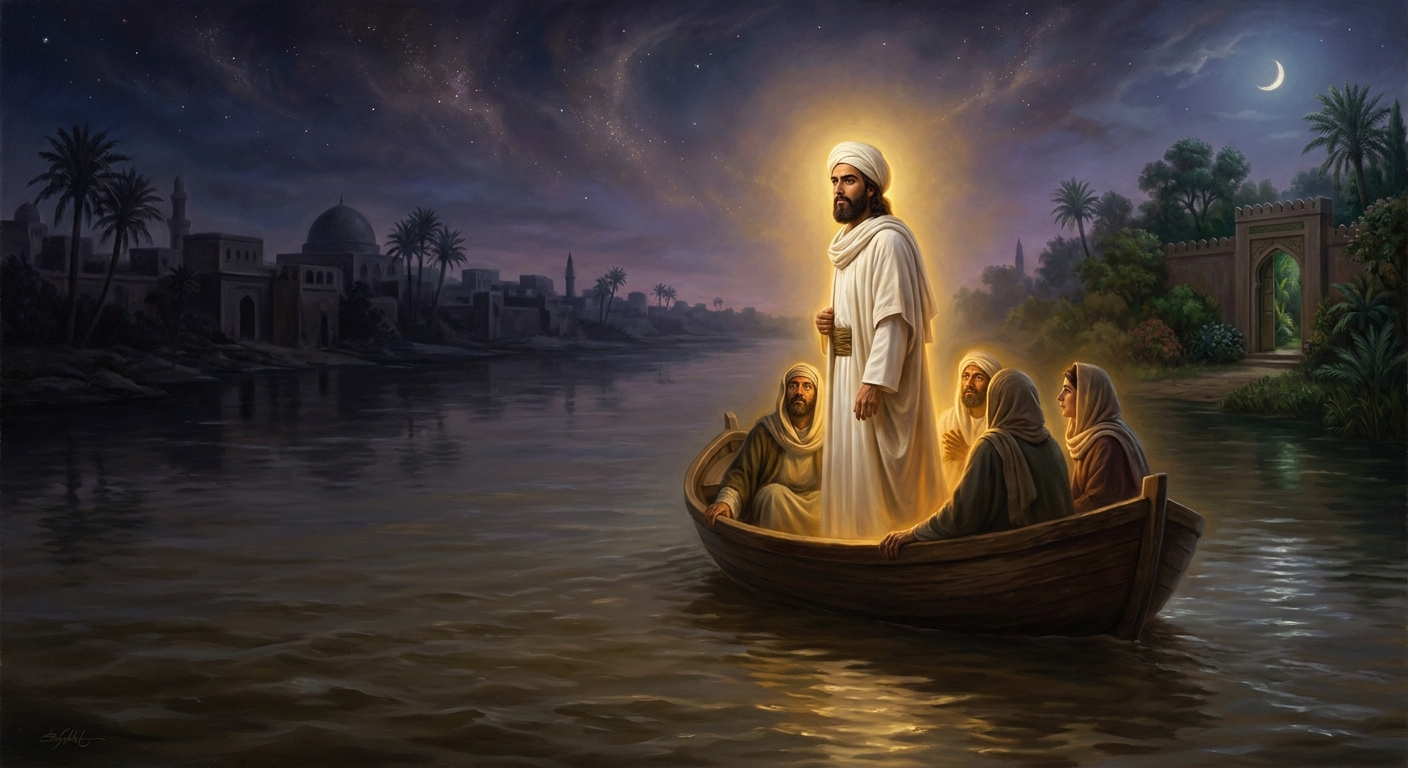
The Najibiyyih Garden belongs to a friendly notable. Roses grow there in a profusion the Tigris valley does not otherwise allow. He has his tent pitched in the center, by a marble fountain. His family will follow nine days later. For now, only his sons and his closest companions cross the river with him.
It is the afternoon of April 21, 1863. He steps onto the garden’s bank.
He says, almost in passing, what no one but the Báb has previously been allowed to suspect.
The Báb — Siyyid ʻAlí-Muhammad of Shiraz, executed by firing squad in Tabriz on July 9, 1850 — had told his followers for six years that he was a forerunner. Not the messiah; the gate. Man yuẓhiruhu’lláh, he called the one to come — He Whom God Shall Make Manifest. The Báb’s last writings are full of him: a figure already alive, already among the believers, who would declare himself when the time was ripe and complete the work. Six thousand Babis had been killed in Persian persecutions waiting for him. Bahá’u’lláh’s own younger half-brother Mírzá Yahyá, nominally the head of the community, had spent the Baghdad decade hiding indoors and waiting too.
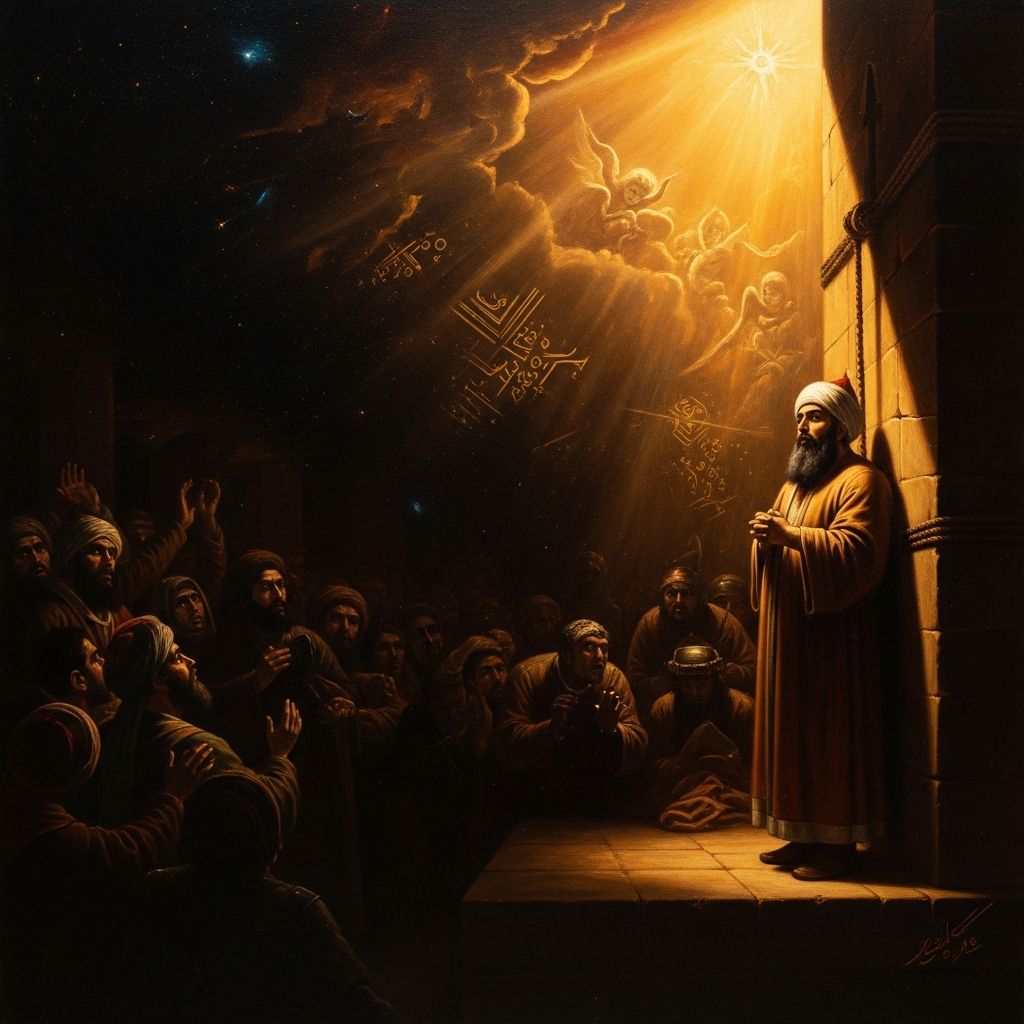
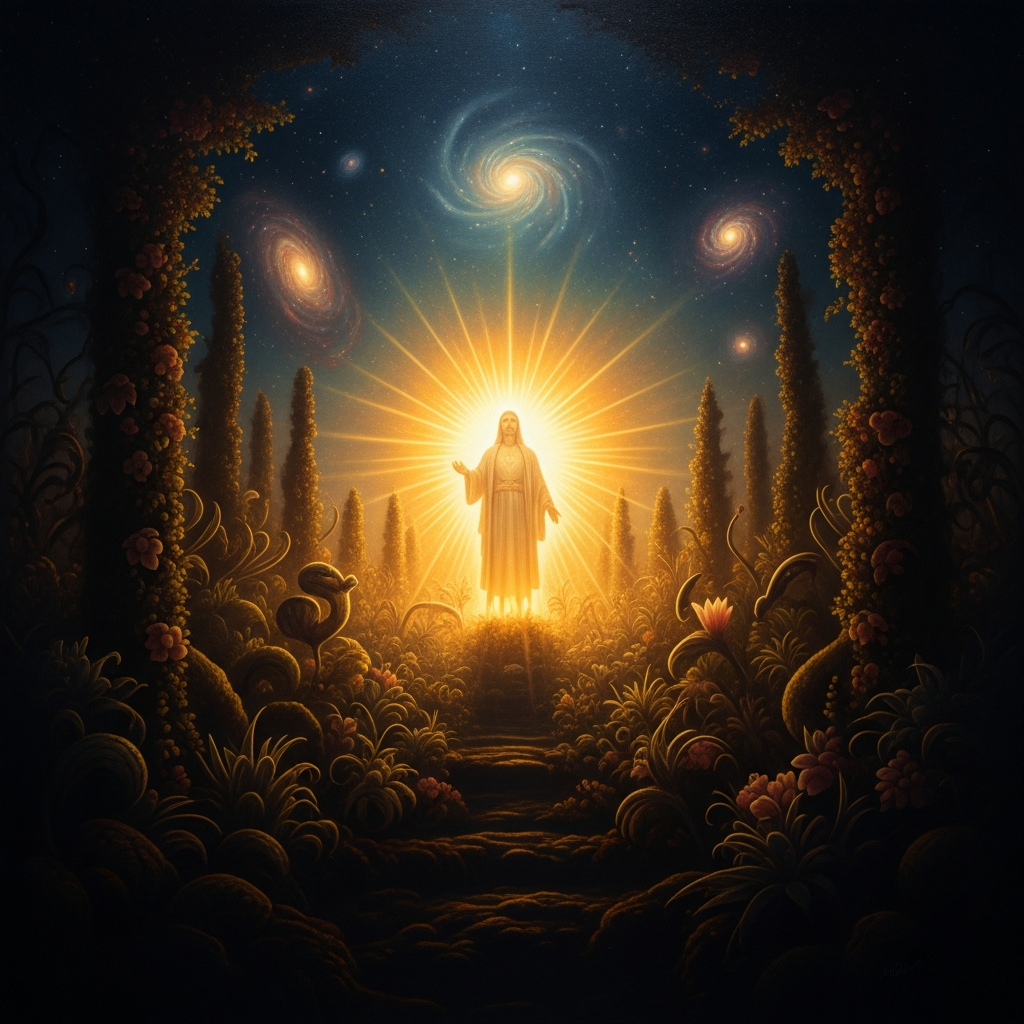
Now, in the garden, Bahá’u’lláh tells the small circle around him: I am he.
He says it without ceremony. The texts that record the moment — Nabíl, who had it from those present — note that one of the companions wept aloud and another could not stand. The rest sat in silence so complete that the only sound was the fountain.
The first of the twelve days is later called the Most Great Festival.
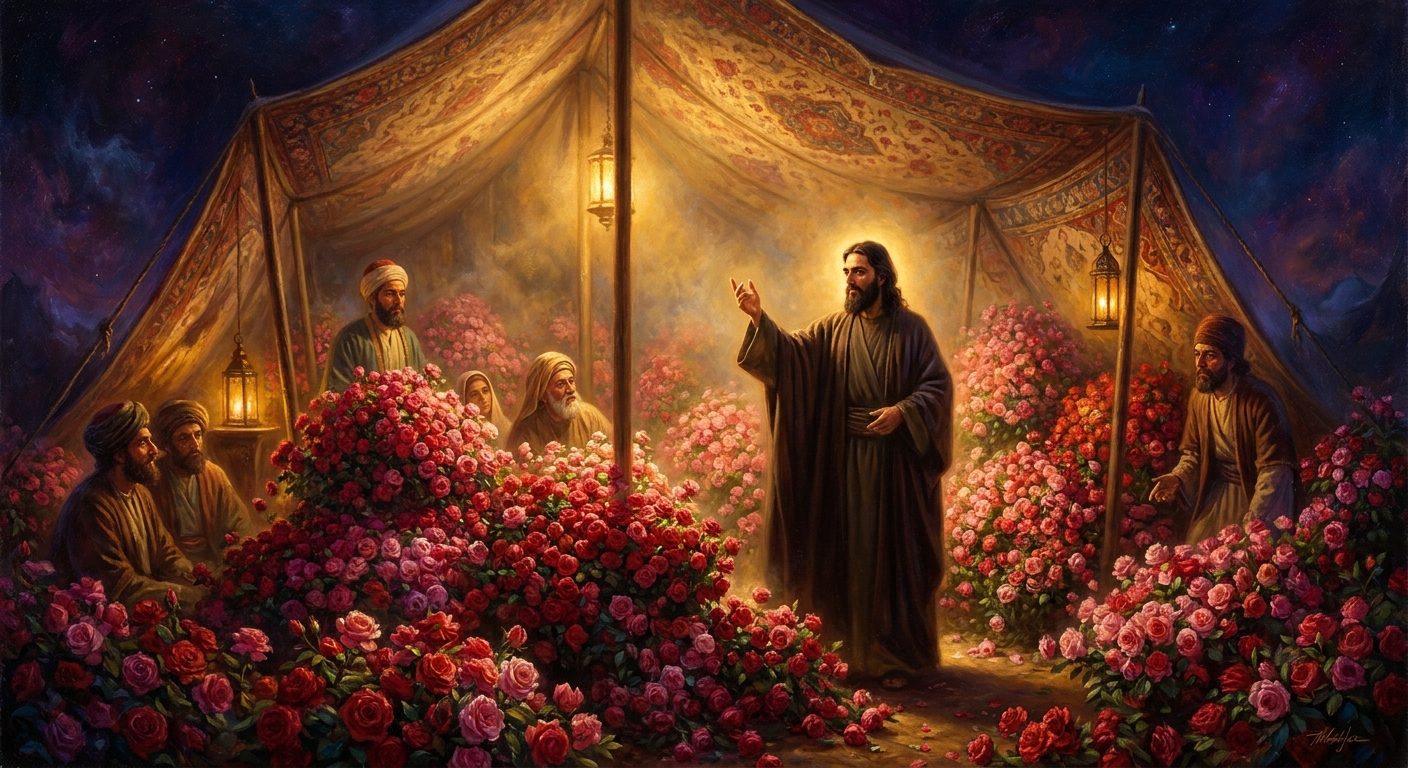
He receives visitors all day. Roses are cut from the garden and piled inside his tent in heaps so high that, by evening, pilgrims sitting against opposite walls cannot see each other across the bloom. The companions take turns carrying armfuls of cut roses out of the tent to friends not yet arrived; the gardeners cannot keep up. The Tigris reflects the lamps. Nightingales — the gardeners had not heard so many in years — sing without stopping.
He speaks little. When he speaks, he speaks of unity.
Not the Babi unity that had been a matter of secret signs and passwords through a decade of persecution. A larger unity. All the prophets are one, he says, in language that will harden, ten years later in the Kitáb-i-Aqdas, into doctrine: every age has its Manifestation, every Manifestation says what the age can hear, and the religion of God is one religion, progressively revealed. Abraham, Krishna, Moses, Zoroaster, Buddha, Christ, Muhammad, the Báb, and now him: links in a chain, not rivals on a field.
The men in the tent are mostly Persian Shi’ites raised on the absolute supremacy of Muhammad. He is asking them to enlarge.
The garden becomes a small utopia for twelve days.
Word spreads through Baghdad — the Persian community, the Sunni officials, the Christian merchants, the European consuls. They come to look. He receives them all. The shah’s own representative, sent to make sure the exile is proceeding, comes and ends up sitting on a carpet drinking tea. The governor of Baghdad sends gifts. The local Sufis, who had argued with him for years over wine and verse, come to say goodbye and leave with copies of his poetry. He gives away nearly everything he owns. By the ninth day his family has crossed the river to join him; his eldest son, ʻAbbás Effendi — later ʻAbdu’l-Bahá, the Most Great Branch — is nineteen, and watches his father move through the visitors like a man already in the next world.
Mírzá Yahyá does not come.
The half-brother who had been the nominal leader stays in Baghdad and pretends not to understand what is happening. Within five years he will lead an open schism, accuse Bahá’u’lláh of usurpation, and try (the Bahá’í accounts say) to poison him. The breach will harden into the Bahá’í/Azali split that survives, in tiny fragments, today. But not in the garden. In the garden, for twelve days, the schism has not yet begun. The roses are still being carried in.
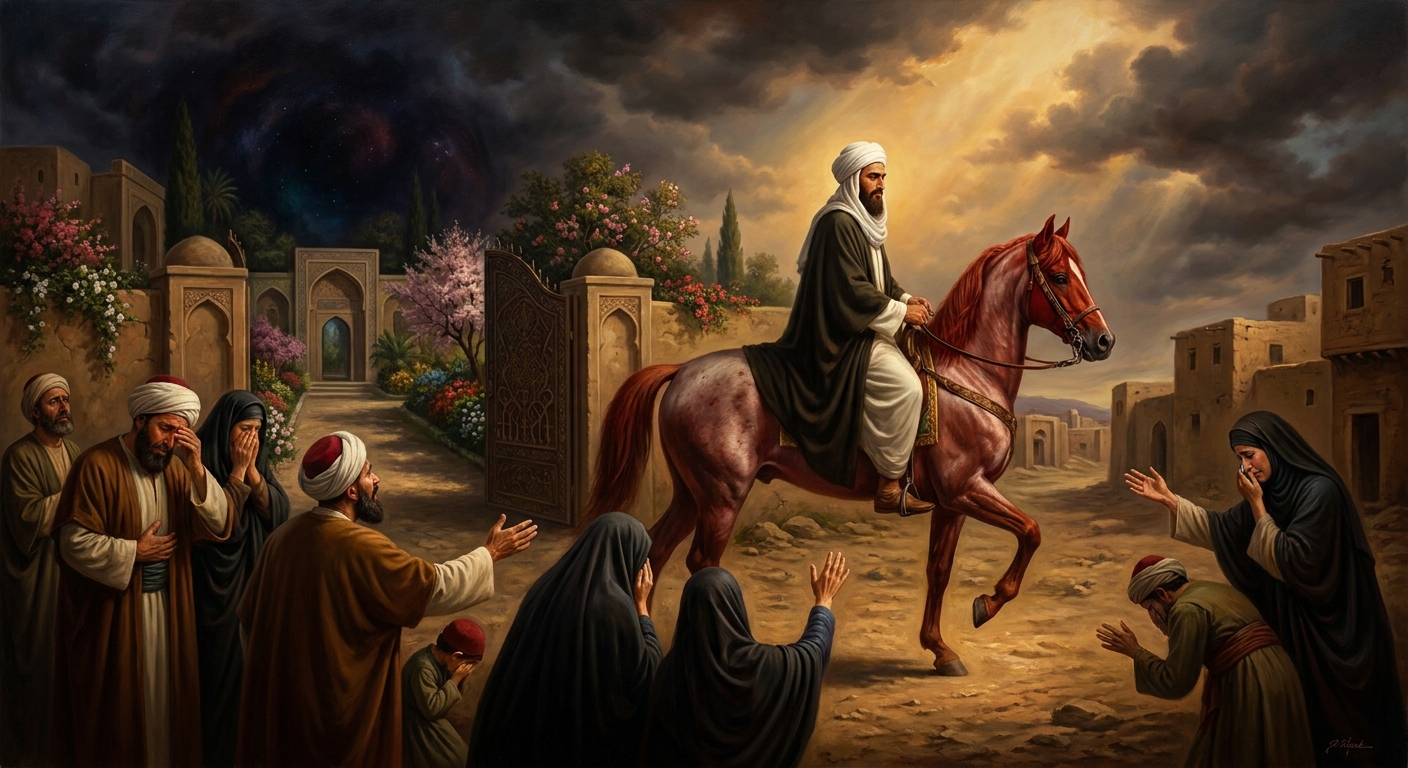
On the morning of May 3 he rides out.
A red roan stallion has been provided. He mounts in the garden gate; the companions weep openly; women of the household watch from a distance. The exile to Constantinople will be 110 days of overland travel, much of it in winter conditions before they have even reached Mosul. After Constantinople will come Adrianople — four years there. After Adrianople, Acre — twenty-four years in the worst Ottoman penal colony in the Levant. He will write the Kitáb-i-Aqdas, the Most Holy Book, inside its walls. He will die there, at age seventy-four, in 1892, having never returned to Persia.
But on May 3, 1863, he is still in the gate of the Najibiyyih garden, on the red horse, with the rose-petals scattered on the path, and the Tigris glittering behind him, and the twelve days closing like a book that will be reopened, every spring, by every Bahá’í community on earth, for as long as the religion lasts.
He rides north.
The Bahá’í Faith claims somewhere between five and eight million adherents today, in more than 200 countries — the second most geographically widespread religion in the world after Christianity. Every April 21, work stops in Bahá’í households on six continents. Roses are cut. The story of the garden is read aloud.
The progressive-revelation claim Bahá’u’lláh first made in those twelve days is, in 2026, the most ambitious unifying claim in any living religion. It says, structurally, that Hindus and Christians and Muslims and Jews and Buddhists and Zoroastrians have not been worshipping different gods; they have been hearing the same voice in the language they were prepared to hear. It says the prophets are colleagues, not rivals. It says the disagreements are translation problems.
Whether the claim is true is, of course, the question of every religion.
The garden, in any case, is still there. The Najibiyyih site, in modern Baghdad, has been built over and rebuilt many times; the original tent and fountain are gone. But the name has migrated. Every Bahá’í House of Worship from Wilmette, Illinois to Sydney, Australia keeps the word: Ridván. Paradise. The garden where the man on the red horse said, twelve days running, what no one had been ready, until then, to hear.
Scenes
April 21, 1863
 Generating art…
 Inside the tent: roses heaped so high that pilgrims passing them across the floor cannot see the man on the other side
 Generating art…
 May 3, the twelfth day
 Generating art…
 Echoes Across Traditions
Entities
- Bahá'u'lláh
- the Báb
- Mírzá Yahyá
- the Most Great Branch (ʻAbdu'l-Bahá)
- the Babis


Sources
- Shoghi Effendi, *God Passes By* (Bahá'í Publishing Trust, 1944), ch. 8
- Nabíl-i-Aʻẓam, *The Dawn-Breakers* (trans. Shoghi Effendi, 1932)
- H. M. Balyuzi, *Bahá'u'lláh: The King of Glory* (George Ronald, 1980)
- Bahá'u'lláh, *Kitáb-i-Aqdas* (1873; authorized English trans. 1992)
- Moojan Momen, *The Bahá'í Faith: A Beginner's Guide* (Oneworld, 2007)