Combat Profile
Divine Utterance
Bahá'u'lláh's words restructure reality itself, establishing new spiritual laws that transform consciousness and unite disparate peoples through revealed truth.
Manifestation of God
Bahá'u'lláh embodies perfect divine knowledge and mercy; all who encounter his teachings experience an inexorable pull toward unity, justice, and spiritual enlightenment that cannot be overcome by conventional resistance.
Mortal; suffered imprisonment, exile, and isolation for 40 years
“It is not for him to pride himself who loveth his own country, but rather for him who loveth the whole world. The earth is but one country, and mankind its citizens.” — Bahá’u’lláh
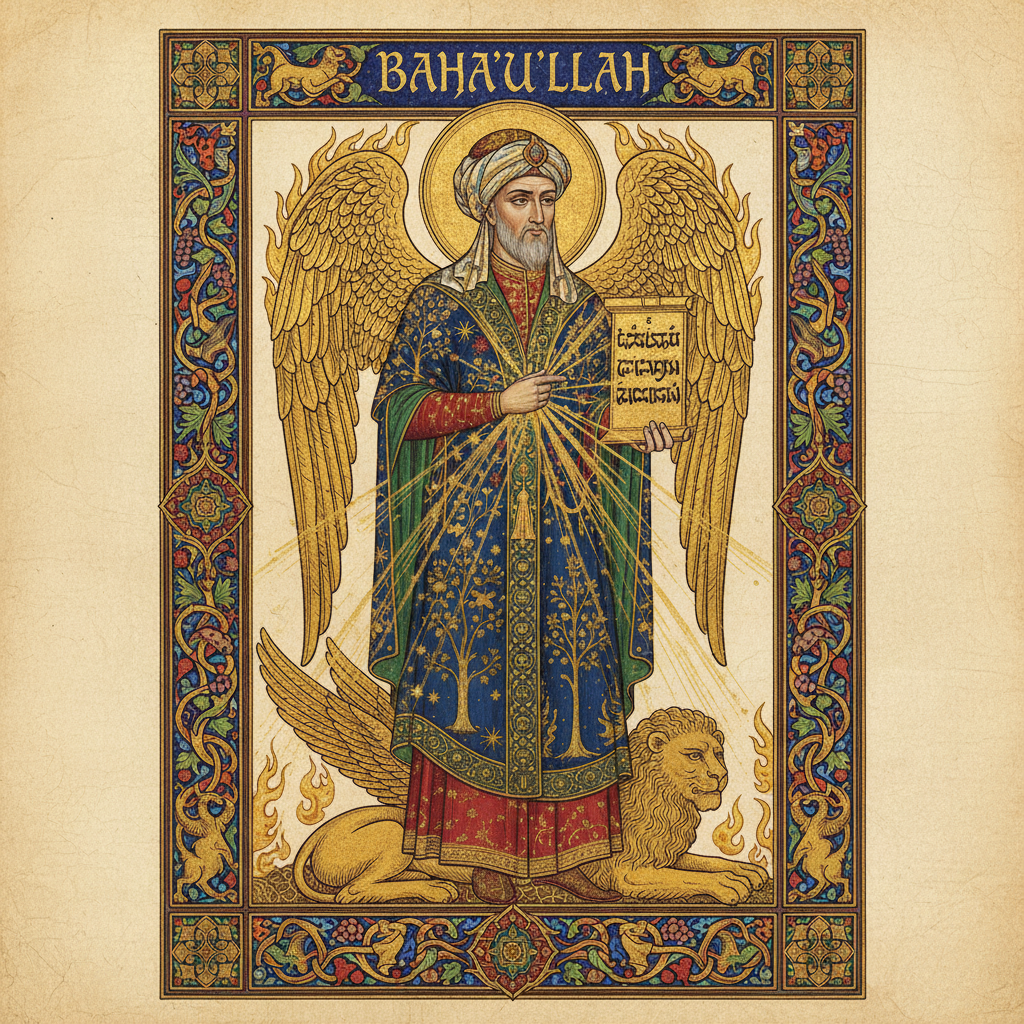
Lore: Mírzá Ḥusayn-ʻAlí Núrí — Bahá’u’lláh, “the Glory of God” — was born in 1817 to a wealthy Persian nobleman’s family. He could have lived a comfortable life. He chose revelation instead. When the Báb’s movement began (1844), Bahá’u’lláh became one of its most prominent advocates, despite having never met the Báb personally. He was imprisoned in the notorious Síyáh-Chál dungeon in Tehran — an underground pit, former water reservoir, home to no light and all manner of prisoners — where, he declared, the revelation first came to him. He heard a Maiden, the embodiment of God’s spirit, announce: He is the One the world has been waiting for.
From that moment, Bahá’u’lláh never lived free again. Banished from Persia to Baghdad, then Istanbul, then Adrianople, then the prison-city of ‘Akká in Ottoman Palestine — each exile designed to further isolate him from his growing community of followers. The Ottoman authorities intended ‘Akká to be his tomb. He was confined there for decades, first within the prison walls, then within the city itself. He died in 1892 in a mansion near the prison, technically still a prisoner, having spent 40 years under confinement.
He spent those 40 years writing. Tablets addressed to the kings and rulers of the world — to Queen Victoria, Napoleon III, the Shah of Persia, the Pope, the Tsar of Russia — calling them to justice, warning them of coming catastrophe. The Kitáb-i-Aqdas, the Bahá’í holy law. The Kitáb-i-Íqán, the theology of progressive revelation. Thousands of letters, prayers, meditations, and decrees that his followers transcribed and circulated at mortal risk. He wrote in Arabic and Persian, often in a style so elevated that scholars regard it as among the finest prose ever produced in either language.
Parallel: Every prophet in every tradition was persecuted. Moses died without entering the Promised Land. Jesus was crucified at 33. Muhammad fled Mecca. The Buddha was occasionally poisoned. But Bahá’u’lláh suffered longer than almost any other founder in religious history — 40 years of continuous imprisonment and exile, from age 35 until his death at 74. He was never free after his declaration. The closest parallel in terms of duration of suffering is Paul (who spent years imprisoned) or the Báb (who was executed before he could be exiled further). But neither matches the sheer sustained endurance: four decades, multiple prisons, multiple continents, writing the holy law of a new world religion from inside a cell.
2 min read
The Shah of Persia, the Ottoman Sultan, the clergy of both Islam and Christianity -- every temporal and religious authority of his age conspired against him
*Kitáb-i-Aqdas*; *Kitáb-i-Íqán*; *The Hidden Words*; *Gleanings from the Writings of Bahá'u'lláh*; Shoghi Effendi, *God Passes By*