Combat Profile
Divine Consultation
renders infallible guidance on matters of faith and community through collective deliberation, establishing laws that harmonize spiritual and social progress
Covenant Guardian
maintains unbroken connection to Bahá'u'lláh's teachings, ensuring all institutional decisions align with divine principles and universal justice
Women cannot serve on it -- a limitation explicitly acknowledged as unexplained in the texts, to be understood in the future
“The men of God’s House of Justice have been charged with the affairs of the people. They, in truth, are the Trustees of God among His servants and the daysprings of authority in His countries.” — Bahá’u’lláh
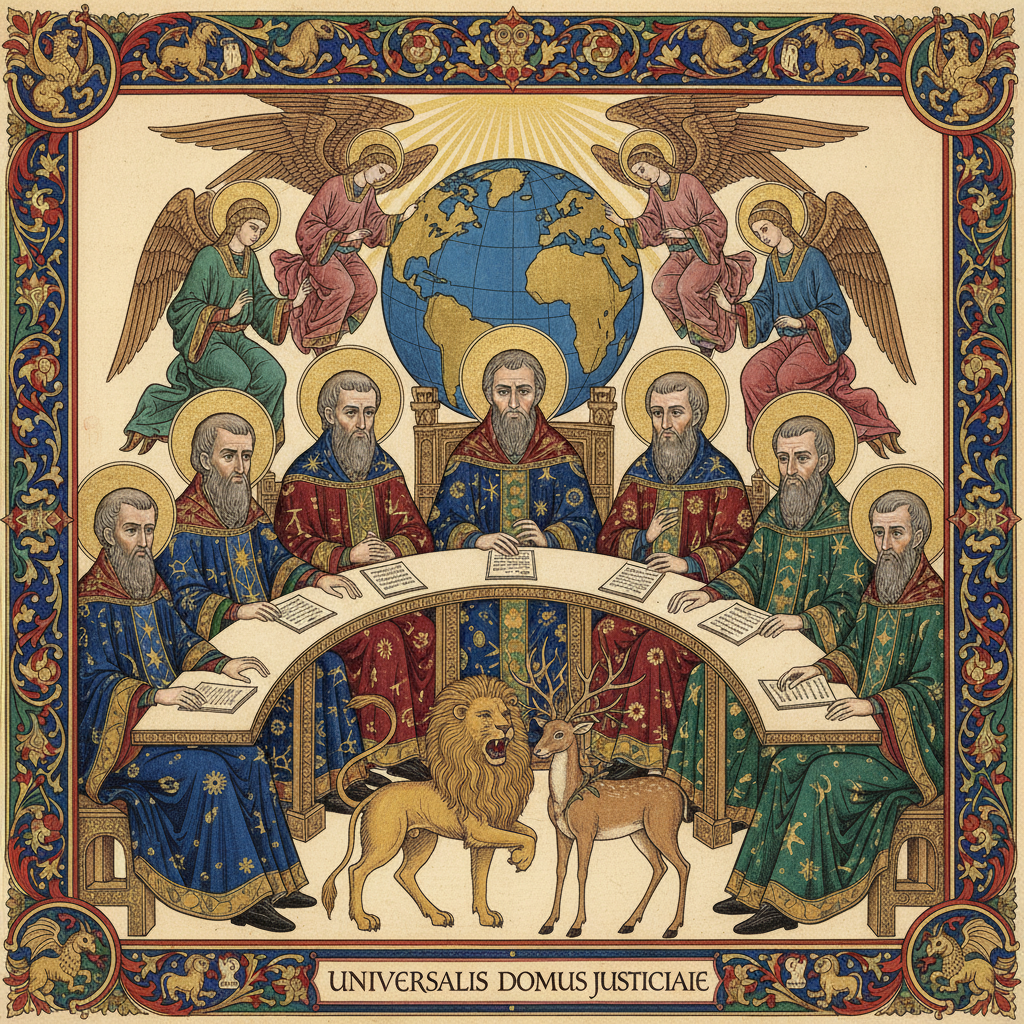
Lore: The Universal House of Justice is the institution that Bahá’u’lláh promised in the Kitáb-i-Aqdas and that ‘Abdu’l-Bahá elaborated in his Will and Testament: a supreme elected body that would guide the Bahá’í community in all matters not already addressed in the sacred texts. It was first elected in 1963, six years after Shoghi Effendi’s death, by members of National Spiritual Assemblies around the world. It sits on the slopes of Mount Carmel in Haifa — on land that Bahá’u’lláh himself identified as the permanent center of the Faith during his exile to ‘Akká.
Nine members. Five-year terms. No individual authority — all decisions made collectively, often by consultation rather than simple majority. No clergy. No ordained religious hierarchy anywhere in the Bahá’í administrative system. The Local and National Spiritual Assemblies that elect delegates to the Universal House of Justice are themselves elected by all adult members of their communities. The entire structure is bottom-up democratic at every level, with elected bodies rather than appointed priests at every tier.
The Universal House of Justice has authority to legislate on matters the texts do not address — and as the world changes, it does. It has addressed questions from gender equality to environmental responsibility to the use of technology. Its letters to the Bahá’í world — and occasionally to the world at large — constitute a body of contemporary guidance. What it cannot do: it cannot change the content of the sacred texts or contradict ‘Abdu’l-Bahá’s interpretations. The Guardian’s role was to interpret; the House of Justice’s role is to legislate. The division of powers was built into the design.
Parallel: The Sanhedrin (Jewish — the council of 70 elders that governed religious law; the Universal House of Justice likewise governs Bahá’í law). The College of Cardinals (Catholic — the body that elects the Pope and advises him; but the Universal House of Justice is elected by the broader community rather than being self-perpetuating). The General Conference of the United Methodist Church (a democratic governing body of a global religious community — structurally the closest parallel). The difference from all of these: no priests, no ordination, no hereditary religious authority anywhere in the system. Elected. Rotated. Accountable.
2 min read
No earthly counter exists within the Bahá'í system; its decisions are binding on all Bahá'ís worldwide
Bahá'u'lláh, *Kitáb-i-Aqdas*; 'Abdu'l-Bahá, *Will and Testament*; Smith, *A Concise Encyclopedia of the Bahá'í Faith*