Combat Profile
Covenant Interpreter
reveals divine will through authoritative guidance, unifying disparate believers under singular truth
Beacon of Service
radiates transformative spiritual influence that elevates consciousness and inspires radical acts of compassion toward all humanity
Mortal; imprisoned from age 9 until age 64; deeply grieved by division within the community
“I want you to be happy… to laugh, smile and rejoice in order that others may be made happy by you.”
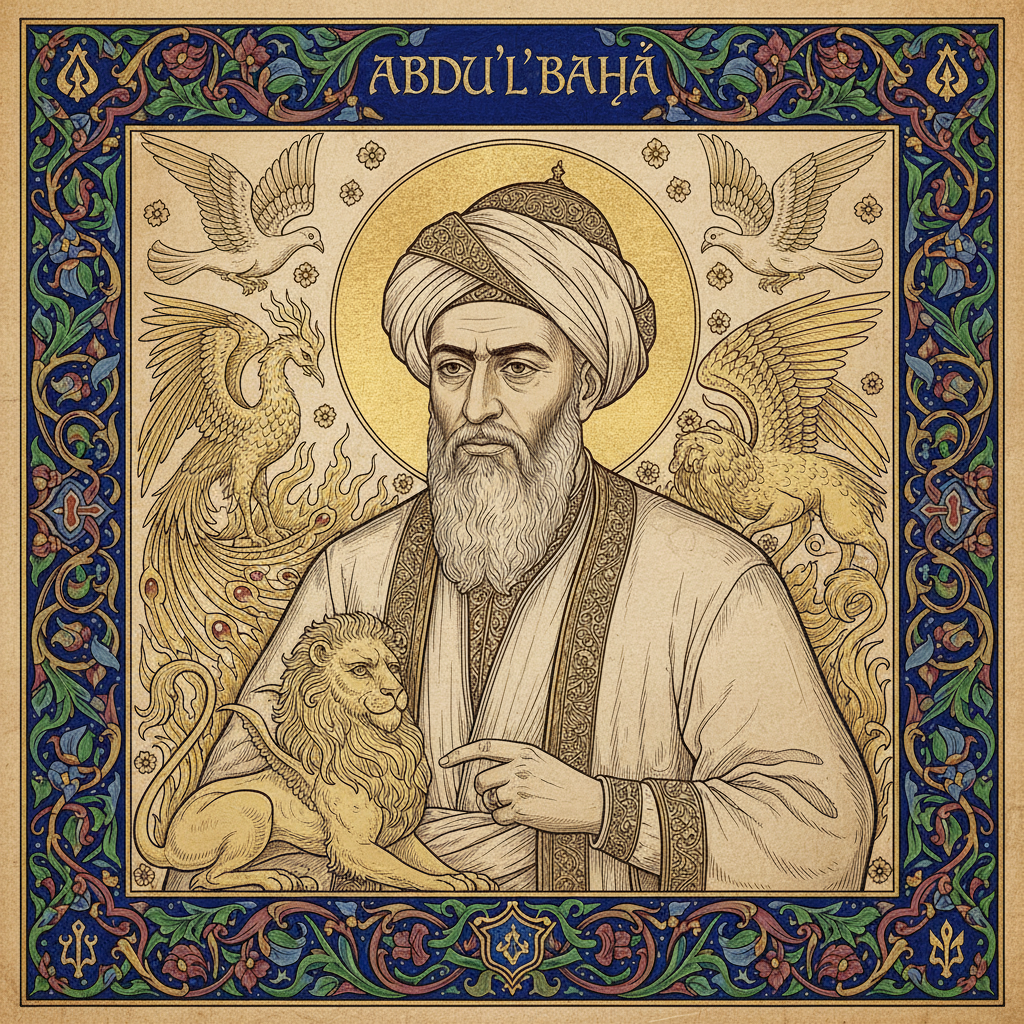
Lore: ʻAbbás Effendi — ‘Abdu’l-Bahá, “the Servant of Bahá” — was born on May 23, 1844, the same night the Báb made his declaration. Whether coincidence or providence, the symmetry became a symbol. He was Bahá’u’lláh’s eldest son and, in his father’s explicit written testament, the sole authorized interpreter of the Bahá’í writings and the Center of the Covenant. He spent the first 55 years of his life as a prisoner — traveling with his father through exile to prison-city after prison-city, imprisoned in ‘Akká from boyhood.
He was released in 1908 when the Young Turk revolution overthrew the Ottoman government that had held him. He was 64 years old. He had been imprisoned since age 9. He was frail. He was exhausted. He immediately embarked on an international journey to Europe and North America.
In London, Paris, New York, Boston, Chicago, and dozens of smaller cities, the elderly Persian prisoner spoke to packed audiences: about the unity of religions, the equality of women and men, the abolition of racial prejudice, the need for economic justice. This was 1911-1913. He was saying, in public, in America, that racial segregation was a sin. In Washington D.C., he refused to speak at a reception unless the Black Bahá’ís were seated with the white Bahá’ís. They were. In every city he visited, he gave away everything he had — clothing, money, sometimes his shoes. He arrived back in Palestine with almost nothing.
He died in 1921 in Haifa, surrounded by followers. Thousands attended his funeral — Muslims, Christians, Jews, Druze, all weeping together. The British High Commissioner for Palestine and the Governor of Phenicia were among the mourners.
Parallel: St. Francis of Assisi (radical dispossession, radical joy, the sense that poverty is not deprivation but freedom). The Desert Fathers (who gave away everything and said “enough”). But ‘Abdu’l-Bahá differs from the ascetic tradition in one key way: he was not fleeing the world but engaging it. He didn’t retreat to a cave. He gave speeches in New York. He had dinner with suffragettes and philosophers and factory workers. He gave his shoes to a man he met on the street and walked home barefoot in the cold. He was the model Bahá’í: not the mystic in isolation but the servant in the world.
2 min read
The Ottoman government (which imprisoned him); his own half-brothers (who attempted to undermine his authority after Bahá'u'lláh's death)
'Abdu'l-Bahá, *Some Answered Questions*; *The Secret of Divine Civilization*; *Paris Talks*; *The Promulgation of Universal Peace*