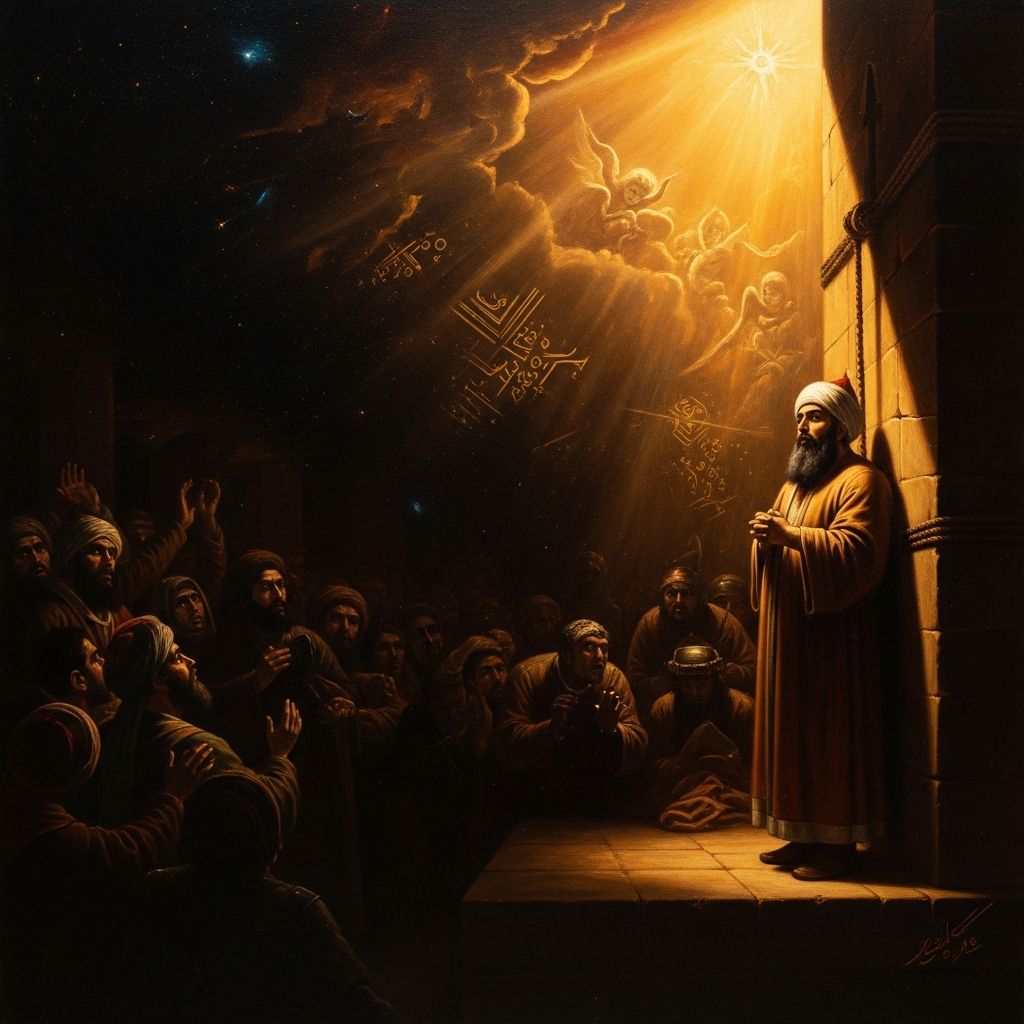
The Volley That Cut the Ropes
Noon · July 9, 1850 · Tabriz, Qajar Persia · the parade-square of the army barracks at Tabriz, in the northwestern province of Azerbaijan
Contents
A thirty-year-old merchant from Shiraz is hung by ropes against a barrack wall in Tabriz. Seven hundred and fifty rifles fire. The smoke clears. The ropes are severed. The Báb is gone. They find him back in his cell, finishing the sentence he had been dictating to his secretary an hour earlier.
- When
- Noon · July 9, 1850 · Tabriz, Qajar Persia
- Where
- the parade-square of the army barracks at Tabriz, in the northwestern province of Azerbaijan
The morning of July 9, 1850. The citadel of Tabriz.
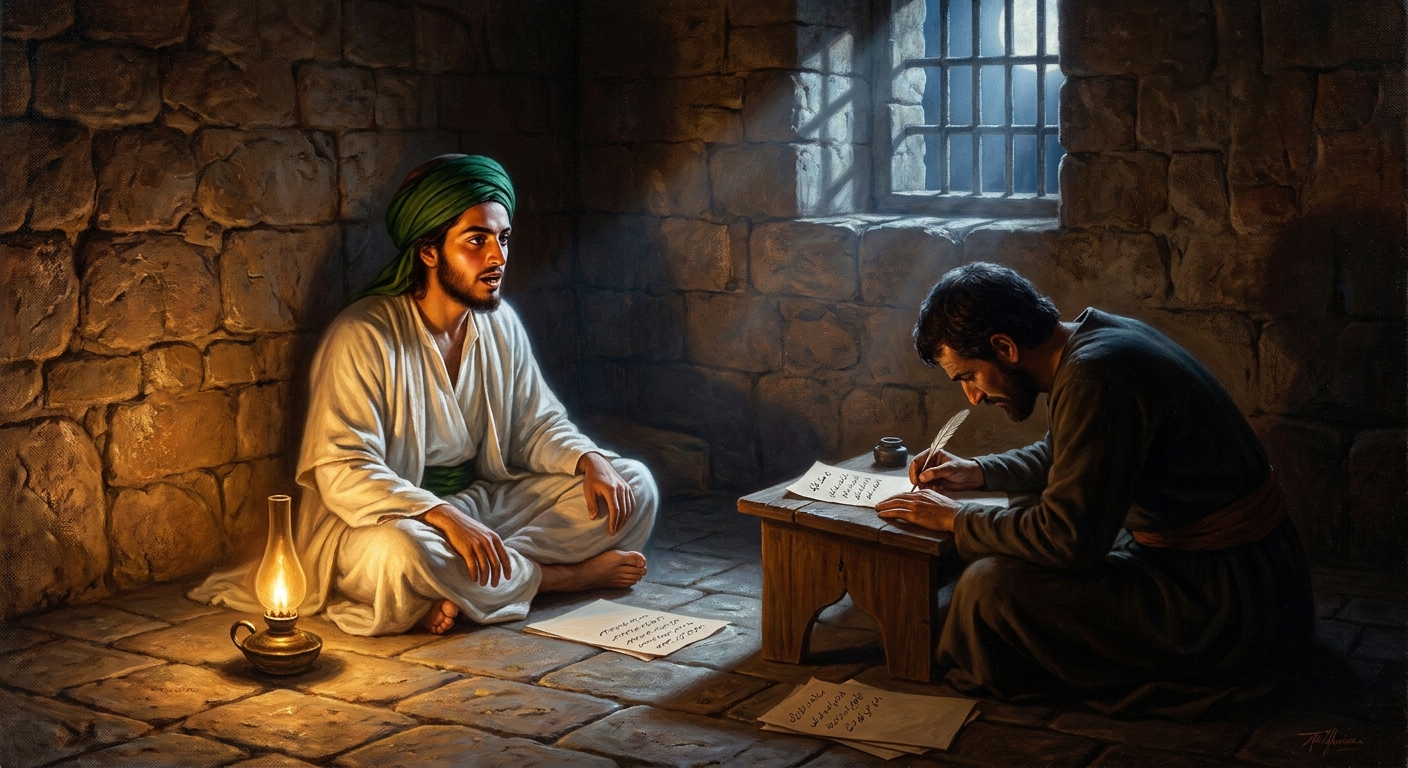
The Báb is in a stone cell. He is thirty years old. He has been a prisoner of the Qajar state for two years, moved between three fortresses on the Russian border. He is dictating final instructions to his secretary Mírzá Aḥmad. He has been writing all night. The candle has burned to a pool.
The execution warrant arrives at the door before dawn. The farrash — the prime minister’s enforcer — orders him to come immediately. The Báb does not look up. He says: Not until I have said what I have to say to my last disciple, will any earthly power be able to silence me. The dictation continues.
The farrash waits at the door. The candle gutters out. The light through the high window shifts from grey to gold. Mírzá Aḥmad’s hand cramps and is shaken loose and cramps again. The dictation does not stop until midmorning.
Then the Báb rises. He says: Now you may proceed.
They march him through Tabriz to the houses of the four leading mujtahids.
It is required, under Qajar law, that a death sentence on a Sayyid — a descendant of the Prophet Muhammad — be confirmed by the four chief jurisprudents. The Báb is a Sayyid. He is taken to each house in turn. Each cleric refuses to see him; each sends down a signed fatwa of execution by the staircase.
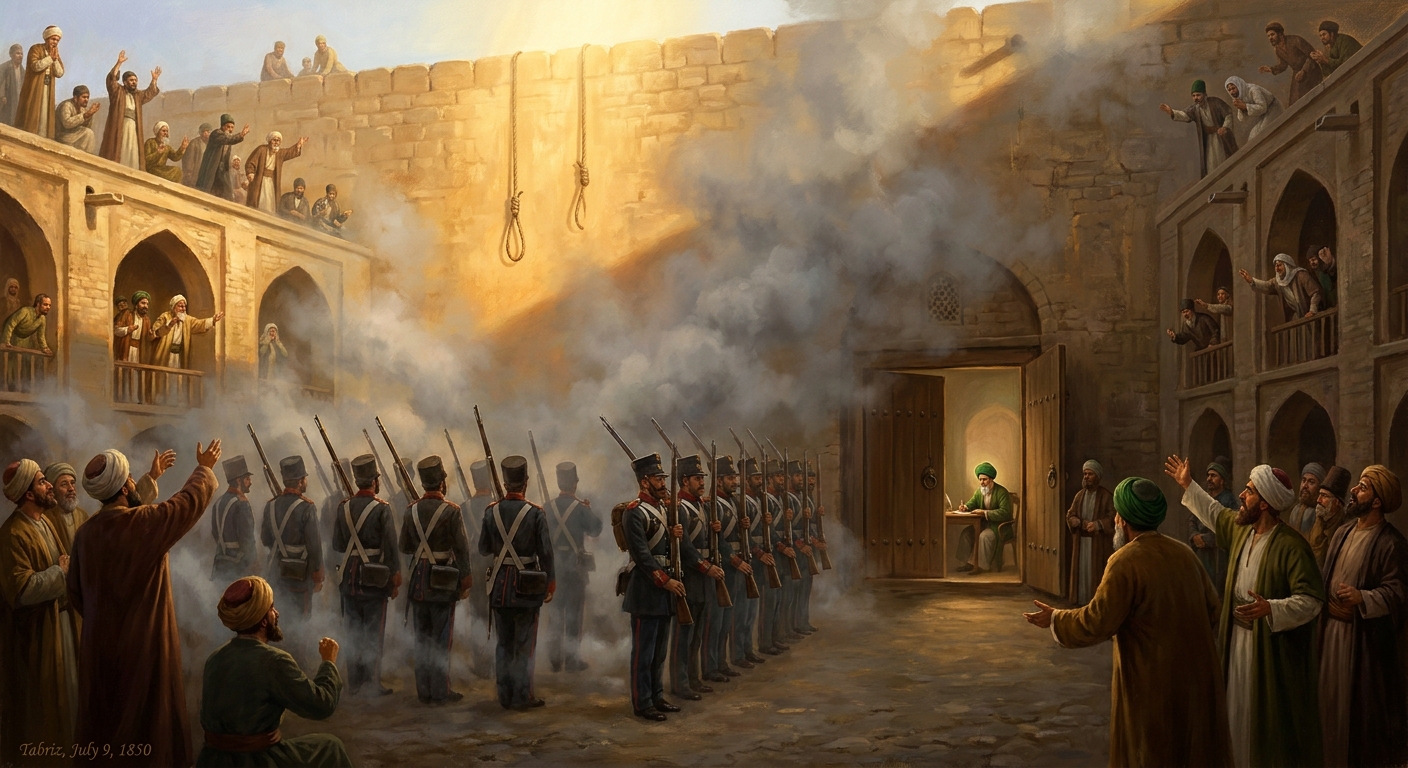
By eleven o’clock he is in the parade-square of the army barracks. A crowd of ten thousand has gathered. The flat roofs of the surrounding buildings are black with people. The British agent is in the crowd. The French consul is in the crowd. An Armenian colonel named Sám Khán commands the firing regiment — seven hundred and fifty Christian soldiers chosen, the order specifies, because Muslim troops cannot be made to shoot a Sayyid.
A young Bábí merchant named Mírzá Muḥammad-ʻAlí Zunúzí — given the title Anís, Companion — has thrown himself at the Báb’s feet through the crowd. He begs to die with his master. The order is given to bind them both to the same iron nail on the wall of the barracks, one above the other, so that Anís’s head rests against the Báb’s chest.
Sám Khán steps forward. He has been a soldier for twenty years. He has seen executions. He pauses. He approaches the wall.
He says, quietly: I am a Christian. I have nothing against you. If your cause is the cause of God, deliver me from this.
The Báb says: Follow your instructions. If your intention is sincere, the Almighty is able to relieve you.
Sám Khán returns to his line. He gives the order.
Three rows of two hundred and fifty rifles. Seven hundred and fifty rounds, fired in three coordinated volleys, the standard Qajar protocol for politically significant executions. The smoke is enormous. It rolls across the parade-square in a single white slab and hides the wall completely. The crowd cannot see for thirty seconds. The British agent, Justin Sheil’s man, will write to London that the noise was like the discharge of a cannon battery.
The smoke clears.
The crowd inhales as one.
The ropes that bound the Báb to the wall are cut, frayed at the points where they crossed the iron nail. Anís is standing on the ground, untouched, smiling. The Báb is gone.
A murmur rises through ten thousand people. The Christian soldiers of the firing regiment lower their rifles in confusion. Sám Khán walks toward the wall and stops three paces from it. He turns to his commander. He says: I am leaving. I will not fire on this man again. He marches his regiment off the field.
The Bábí cell is at the back of the barracks compound.
The farrash — the same one who came at dawn — runs. He finds the Báb sitting cross-legged on the floor of the cell. Mírzá Aḥmad is at his side. The Báb is dictating the last sentence of the document interrupted that morning. He does not look up.
The farrash stops in the doorway. He cannot speak.
The Báb finishes the sentence. He sets down the pen. He says, without rancor: I have finished my conversation with Siyyid Husayn. Now you may proceed to fulfill your intention.
The farrash refuses. He resigns his position on the spot, in front of his men, and leaves the army. A second farrash is found. A second regiment of soldiers — Muslim this time, against the original protocol, because no Christian regiment will accept the order — is mustered. The Báb and Anís are returned to the wall and tied a second time, the same iron nail, the same arrangement.
It is past noon. The crowd is quieter. The flat roofs are still full but the murmur has thickened into something that sounds, an Armenian chronicler will write, like the breath of a single very large animal.
The second volley fires.
It is, this time, sufficient.
The Báb’s body is shattered against the wall, but his face — every account agrees — is untouched. Anís is killed beside him. The smoke takes longer to clear this time, or seems to. When the soldiers finally pull the bodies down, the Báb’s last words to the assembled crowd are still hanging in the air: O wayward generation! Had you believed in Me every one of you would have followed the example of this youth, who stood in rank above most of you, and would have willingly sacrificed himself in My path. The day will come when you will have recognized Me; that day I shall have ceased to be with you.
The bodies are thrown into the moat outside the city for the dogs. Bábí merchants bribe the guards that night and recover them. They wrap the remains in white silk. They begin a transit that will last fifty-nine years, hidden in safe houses across Iran, then Iraq, then Lebanon, then Palestine. They are buried in nine different places before they reach their permanent home.
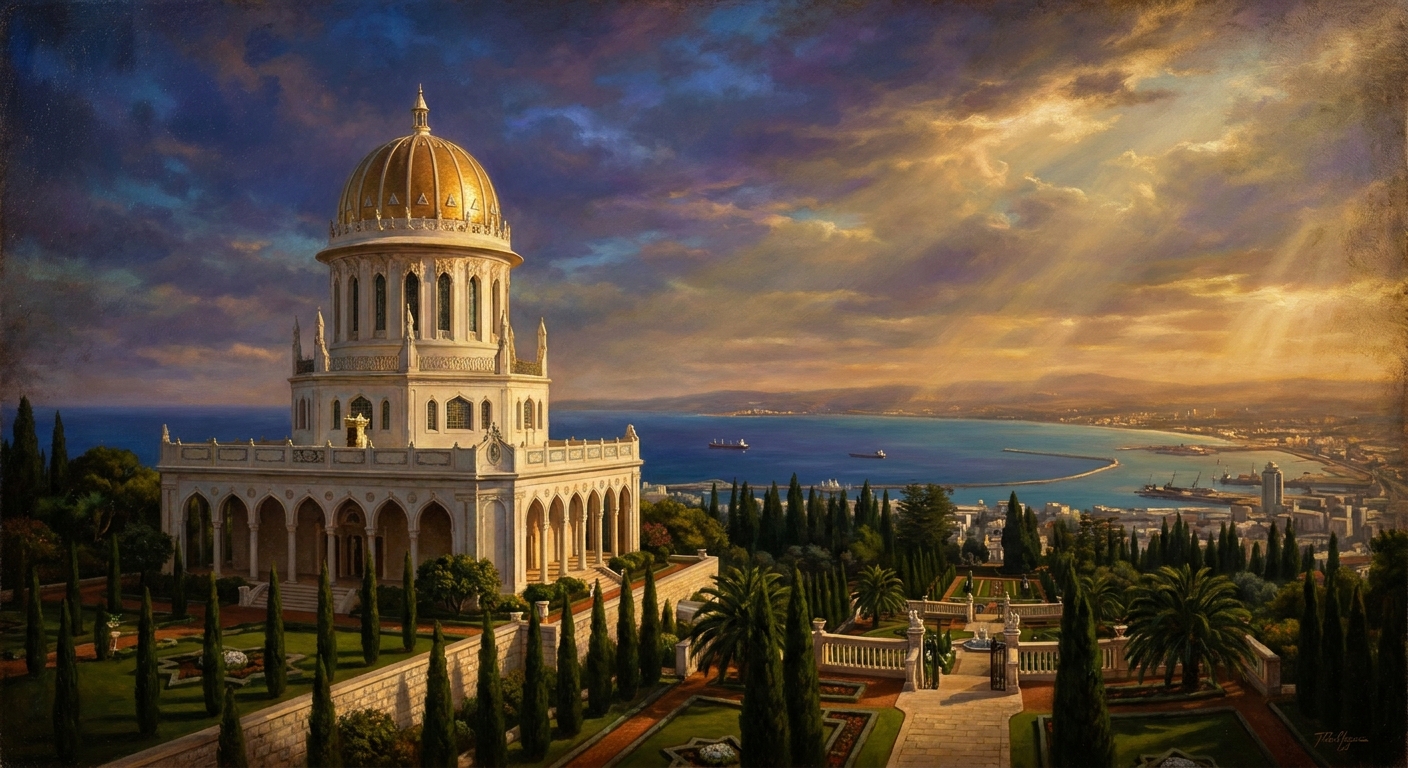
In 1909, on Mount Carmel above the bay of Haifa, ʻAbdu’l-Bahá lays the Báb’s remains in a vault he has built into the mountainside.
It is the spot Bahá’u’lláh — the prophet the Báb foretold — pointed to from his prison-house in Akká, across the bay, three decades earlier. The shrine is, at first, a simple stone room. Over the next half-century it will grow upward: a dome added in 1953 in the reign of Shoghi Effendi, gold-leafed in the Italianate style, fourteen thousand tiles imported from the Netherlands. Around the shrine the Bahá’í Terraces will descend the mountain in nineteen levels — one for each Letter of the Living, the Báb’s first eighteen disciples plus the Báb himself.
By the twenty-first century the shrine is a UNESCO World Heritage site. Pilgrims from two hundred countries arrive every year. They climb the terraces in white. At the threshold of the shrine they remove their shoes. They face the inner chamber where, beneath alabaster, the body that was twice tied to a wall in Tabriz now rests.
Sám Khán, the Christian Armenian colonel who refused the second volley, kept his word. He never returned to the Persian army. The chronicles record him alive in the Caucasus a decade later, telling the story.
The Báb’s writings — the Bayán, the Qayyúmu’l-Asmá’, the prayers — fill twenty-some volumes. The Bahá’í Faith reads them now as the herald-scripture of the dispensation Bahá’u’lláh would proclaim in the garden of Ridván in 1863, thirteen years after Tabriz. The forerunner is not the founder; he is, the tradition says, the one who clears the road.
He was thirty when he died. The volley took two attempts. The first one cut the ropes. He used the interval, witnesses agree, to finish dictating a sentence.
In the Bahá’í reading, that interval was not a miracle. It was a sentence.
Scenes
Morning of July 9, 1850
 Generating art…
 Noon, the parade-square
 Generating art…
 1909
 Generating art…
 Echoes Across Traditions
Entities
- the Báb (Siyyid `Alí Muḥammad)
- Mírzá Muḥammad-ʻAlí Zunúzí (Anís)
- Sám Khán (commander of the first regiment)
- Ḥájí Mírzá Áqásí
- Ámír Kabír
- Náṣir al-Dín Sháh
Sources
- Nabíl-i-Aʻẓam, *The Dawn-Breakers: Nabíl's Narrative of the Early Days of the Bahá'í Revelation* (trans. Shoghi Effendi, 1932), ch. 23
- Shoghi Effendi, *God Passes By* (Bahá'í Publishing Trust, 1944), ch. 4
- H. M. Balyuzi, *The Báb: The Herald of the Day of Days* (George Ronald, 1973)
- Abbas Amanat, *Resurrection and Renewal: The Making of the Bábí Movement in Iran, 1844-1850* (Cornell, 1989)
- Denis MacEoin, *The Messiah of Shiraz: Studies in Early and Middle Babism* (Brill, 2009)
- Justin Sheil (British envoy to Tehran), dispatch to Lord Palmerston, July 22, 1850 (FO 60/152)