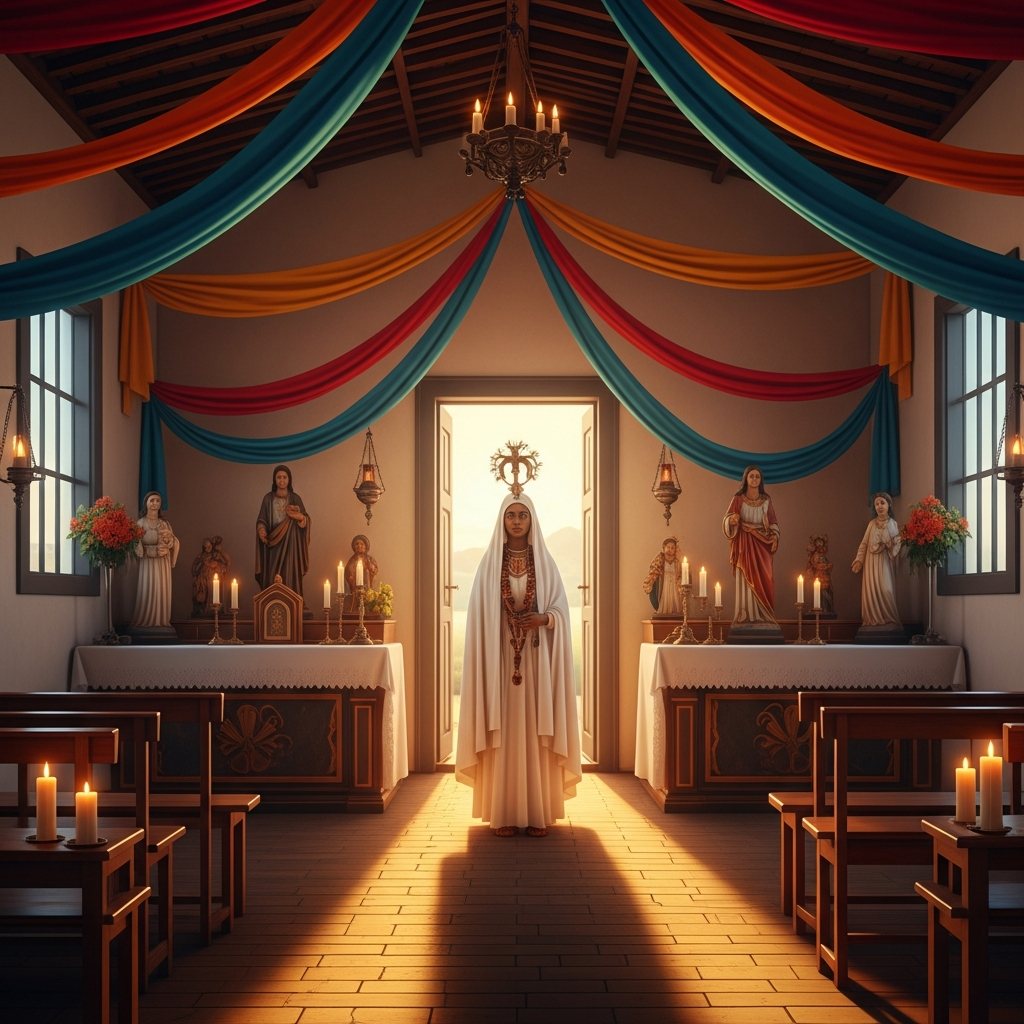
The Orishas Hidden in the Saints: Candomblé in Bahia
19th century Bahia — though Candomblé has been practiced continuously since the 16th century and persists as a living religion today · A terreiro in Salvador, Bahia — the city where 80% of the population was enslaved African in the early 19th century, the most African city in the Americas outside Africa
Contents
Salvador, Bahia, 19th century. The enslaved Yoruba people of Brazil preserve their orisha religion beneath the masks of Catholic saints — Oxum becomes the Virgin, Ogum becomes Saint George, Xango becomes Saint Jerome. In the terreiros, the mae de santo knows which orisha has chosen each initiate. When the drums begin, the orishas descend.
- When
- 19th century Bahia — though Candomblé has been practiced continuously since the 16th century and persists as a living religion today
- Where
- A terreiro in Salvador, Bahia — the city where 80% of the population was enslaved African in the early 19th century, the most African city in the Americas outside Africa
The saint on the altar is not only a saint.
The altar is in a corner of the main room of the terreiro — the sacred house, the house of the orisha — in a neighborhood of Salvador, Bahia, where the streets are cobbled and steep and the sea is visible from the high ground and the smell of the city is always partly salt. On the altar: a statue of Our Lady of the Immaculate Conception, blue and white, her hands folded, her feet on the crescent moon. Around her feet: a small brass mirror. A pot of honey. A jar of fresh water from the river at the edge of the city. Marigolds. A length of gold cloth.
These are not offerings to the Virgin. These are offerings to Oxum.
Oxum is the orisha of rivers, of sweet water, of love and beauty and gold. She is the orisha who presides over fertility and the gentler emotions, who lives in the places where the current moves slowly and the water is clear enough to see the bottom. She is vaidosa — vain, yes, but in the way that beauty is vain: she knows what she is, and she is not apologetic about it. Her color is gold. Her number is five. Her element is honey.
In Portugal, those who brought the Catholic religion to Brazil would have looked at this altar and seen Our Lady. In the terreiro, the mae de santo and her children see both: the lady and the river, the saint and the orisha, the face that was the disguise and the face that was always underneath.
The mae de santo has been reading the new initiate since the girl arrived.
The girl is seventeen. She has been coming to the terreiro for a year, brought by her aunt, who is a daughter of Iemanja, the sea orisha. But the girl’s orisha is not Iemanja. The mae de santo has watched the girl move through the preparations, has watched which colors make her restless and which calm her, has listened to what she says when she speaks without thinking, has noted — most importantly — which offerings on which altars she is drawn toward without being directed.
She is always at Oxum’s corner. She does not know why. She cannot explain it except to say that the honey and the mirror and the gold cloth feel like home in a way that nothing else in the room does.
The mae de santo has seen it dozens of times. The orisha chooses the person; the person does not choose the orisha. The theological term in the tradition is elegun — one who is mounted by the orisha — and whether you believe it as metaphysics or as psychology, the practical truth is that some people are simply more available to particular forms of divine attention than others, and the tradition’s job is to recognize and cultivate that availability.
She tells the girl: Oxum te escolheu. Oxum has chosen you.
The girl’s initiation takes seven years.
This is not unusual. The kanzo — the full initiation — is a years-long process of learning: the orisha’s specific foods and colors and rhythms and prayers, the Yoruba liturgical language that is no longer spoken in daily Brazilian life but is still used in the terreiro ceremonies, the ritual protocols for every occasion, the hierarchy of the house and its obligations to other houses. The girl becomes iawo — bride of the orisha — and is reborn into her relationship with Oxum in stages, each stage marked by ceremony.
During the years of her initiation, the police come twice.
In the nineteenth century, Candomblé is illegal. It will remain illegal in Brazil until 1976 — three centuries of prohibition enforced with varying intensity depending on the political season. The mae de santo of this terreiro has been raided three times in her life, her drums confiscated, her altars photographed as evidence, her name written in police registers under the heading curandeirismo — witchcraft. Each time, the terreiro was rebuilt. Each time, the altars came back up with the saints on them, which the police could not touch, and behind the saints, the orishas, who the police could not touch either for different reasons.
The survival strategy was not deception, exactly. It was architecture. You build the face that can be seen in front, and the truth you need to protect behind it, and you make the face genuine enough that it does not feel like a lie — because it is not a lie. The saints and the orishas share the same cosmic office. They are not enemies. They are the same work done in two languages.
The first Sunday of each month: the ceremony.
The drums are atabaque — three tall conical drums in different sizes, their heads struck with bare hands or padded sticks, their rhythms specific to each orisha and known by name to every initiate. The drummers are the alabes, and they have been trained from childhood in rhythms that the tradition carried across the Atlantic and has been preserving for three hundred years. If the drumming is wrong — if the rhythm is off, if the pattern does not match the orisha being called — the orisha will not come. The drums are not decoration. They are the address.
The ceremony begins with Exu — the Candomblé form of the Yoruba Eshu, the master of the crossroads who must be saluted first before any other orisha is called. The prayers are in Yoruba. The offerings are laid at the entrance of the terreiro. The mae de santo pours cachaça on the floor at the door.
Then the community sings. The singing is in Yoruba — cantigas, songs of praise and invocation for each orisha in their proper order — and the voices of the congregation fill the room with words most of them do not speak in any other context. The Yoruba language survived in Brazil the same way the religion survived: protected inside the ceremony, passed from mae de santo to initiate, carried in the throat.
The girl — now a woman of twenty-four, seven years into her initiation — stands in the circle of dancers.
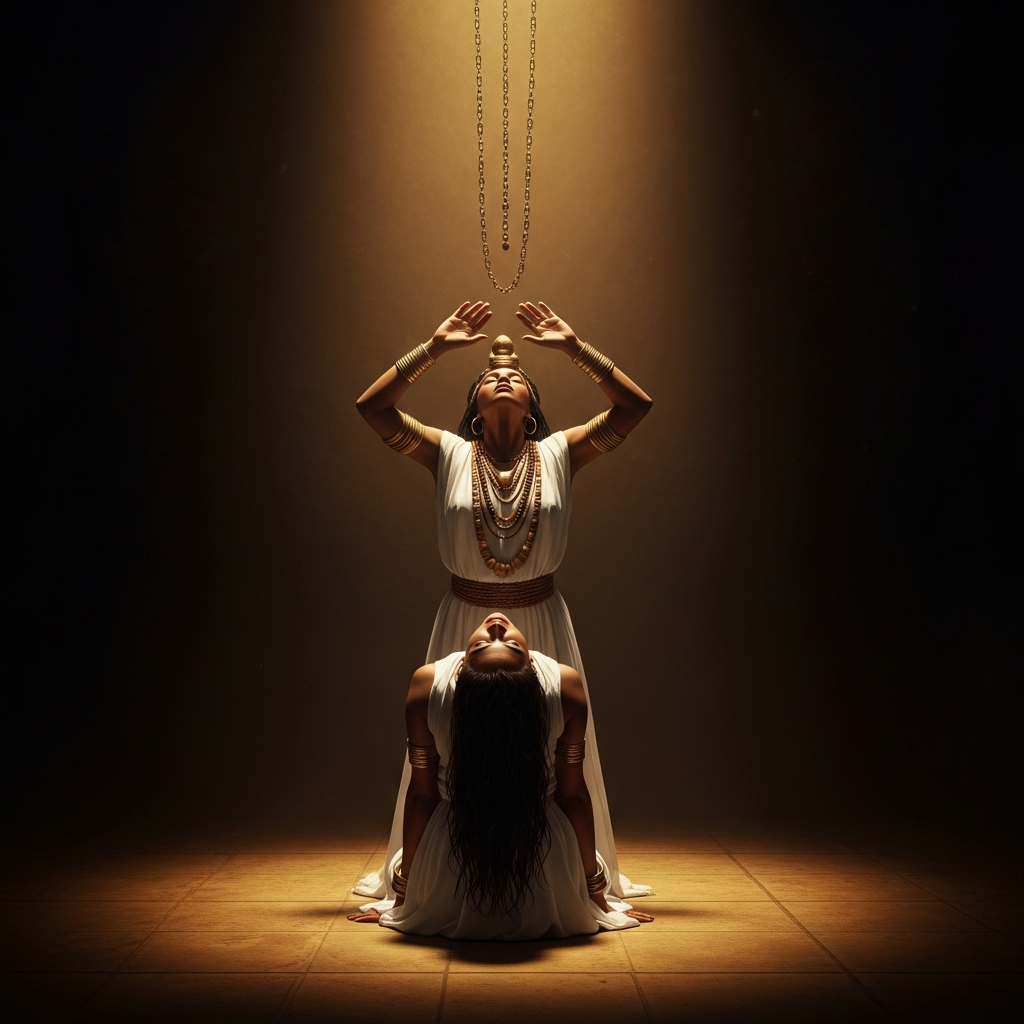
She is dressed in the colors of Oxum: gold and yellow, cloth wound and layered, brass jewelry at her wrists and throat. Her feet move in the oforibale — the posture of submission before the orisha — head slightly bowed, arms lifted. The drums are playing Oxum’s rhythm: the slow, rolling, water-like rhythm that sounds exactly like what it is named for.
The mae de santo watches from the side.
The moment comes the way it always comes: not gradually, not with warning. The woman’s shoulders drop and then lift. Her arms rise into a particular position — not a dancing position, a gesture, the gesture of a woman who is seeing something beautiful and bending to touch it. Her face changes. It does not become another face — it becomes less a face and more a surface, less a person’s expression and more a state of being, something that was always underneath the human features and has now come to the front.
Oxum has arrived.
The other dancers step back and then bow, the traditional greeting: forehead to the ground before the descended orisha. The mae de santo steps forward. She does not bow — her rank puts her in relationship with the orisha rather than submission to it — but she lowers her eyes for a moment in acknowledgment.
The orisha who is also the woman moves through the room. She stops at her altar. She touches the jar of honey and the brass mirror. She lifts the mirror and looks into it for a long time. It is not vanity. It is recognition.
The terreiro holds this across three centuries.
The enslaved Yoruba people who were brought to Brazil beginning in the sixteenth century were stripped of everything that could be taken: their names, their freedom, their families, their status. What they could not be stripped of was what was inside: the rhythms their grandmothers had sung, the names of the orishas, the knowledge of what foods and colors and waters belonged to which divine power. They carried this knowledge the way you carry something precious — not in your hands where it can be taken, but in your chest, against your ribs, where the beating keeps it warm.
They built the terreiros in the back rooms and hidden yards of Bahia. They taught each initiation to the next generation. They taught the Yoruba prayers to children whose mother tongue was Portuguese. When the police came, they put the saints in front. When the police left, they went on.
The tradition they preserved is not unchanged — three centuries in Brazil added things, absorbed things, combined with Bantu tradition from the Congo and with Indigenous elements and eventually with European spiritualism. Candomblé is not a museum. It is a living religion, which means it grows.
But at the center of every ceremony, in every terreiro in Salvador and São Paulo and Rio de Janeiro: the same drums, the same rhythms, the same Yoruba words, the same orisha descending into the same bodies. The crossing did not erase them. The centuries did not erase them. The police did not erase them.
The orishas are still coming. On any given Sunday in Salvador — in the city that was 80 percent enslaved African in the early nineteenth century, the most African city in the Americas outside Africa — in terreiros tucked into city neighborhoods and hillside communities, the atabaque drums play Oxum’s rhythm and a woman’s arms rise into that particular posture and the fresh water in the jar on the altar grows still. They were carried here in memory and they stayed. The colonial project was to erase them. What happened instead is that they found a new home and learned the local saints’ names and waited, patient as rivers, for the drums.
Scenes
The terreiro in Salvador — a whitewashed room hung with the colors of the orishas, the altar dense with Catholic statues that are also something else entirely
Generating art… The iawo — the initiated devotee — shudders and stills as the orisha descends
 Generating art…
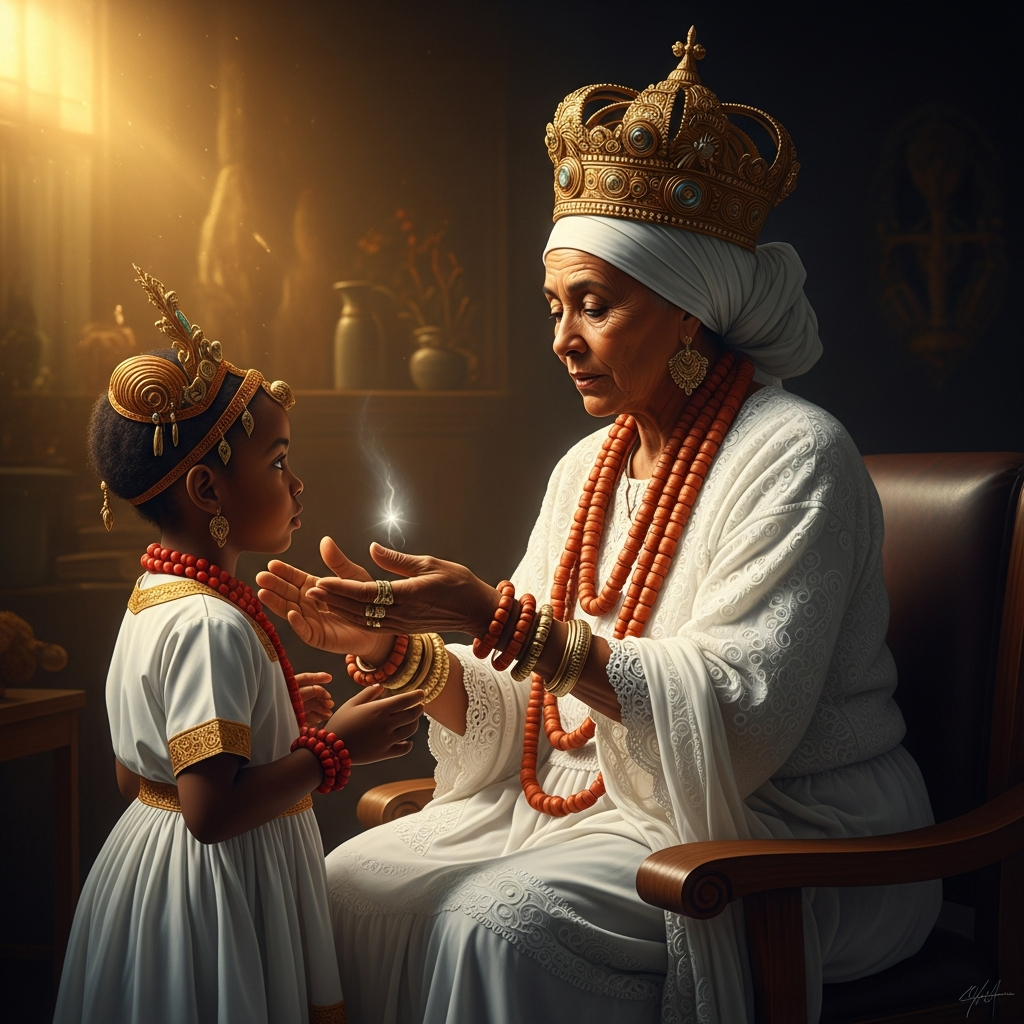
 The mae de santo, in her seventies, dressed in the full regalia of her decades of initiation — the crown, the beads, the white cloth — receives the orisha that has descended into her youngest child
 Generating art…
 Echoes Across Traditions
Entities
- Oxum (orisha of love, rivers, and gold — syncreted with Our Lady of the Immaculate Conception)
- Ogum (orisha of iron, war, and roads — syncreted with Saint George)
- Xango (orisha of thunder and justice — syncreted with Saint Jerome and Saint Barbara)
- Iemanja (orisha of the sea — syncreted with Our Lady of the Navigators)
- the mae de santo (mother of the saint, spiritual mother of the terreiro)
Sources
- Roger Bastide, *The African Religions of Brazil* (1960, English translation 1978)
- Reginaldo Prandi, *Mitologia dos Orixás* (2001)
- J. Lowell Lewis and Patrick Mendonça, eds., *Candomblé* (Oxford Research Encyclopedias, 2019)
- Rachel E. Harding, *A Refuge in Thunder: Candomblé and Alternative Spaces of Blackness* (2000)
- Jocélio Teles dos Santos, *O Dono da Terra: O Caboclo nos Candomblés da Bahia* (1995)