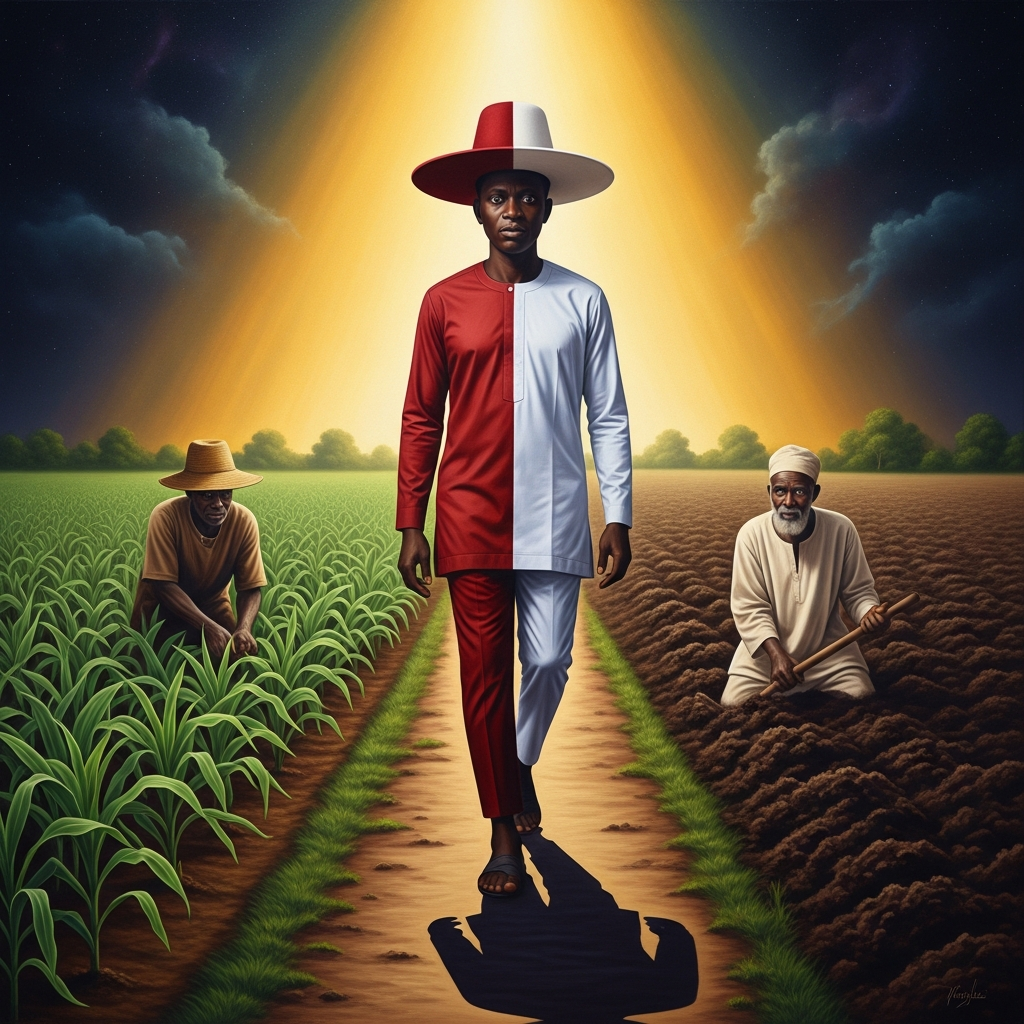
Egungun: When the Ancestors Return
~19th century CE · and every festival since the first · A Yoruba town in Oyo State, Nigeria — the sacred grove, the marketplace, the family compound
Contents
In a Yoruba town gripped by drought, a disputed throne, and a false accusation that has destroyed a family, the Egungun masquerade emerges from the sacred grove. The dead have returned. They know things the living have hidden. What the ancestor says cannot be argued with.
- When
- ~19th century CE · and every festival since the first
- Where
- A Yoruba town in Oyo State, Nigeria — the sacred grove, the marketplace, the family compound
Before the ancestor can return, the grove must be prepared.
The sacred grove stands at the town’s edge, where the cultivated fields end and the old trees begin — trees that are old enough to have been saplings when the first inhabitants of this town arrived, when the land was being organized into compounds and the gods were being settled into their domains. The grove is not a park or a forest; it is a maintained wilderness, a kept wildness, a place that belongs to the dead and is tended by the living specifically so that the dead have somewhere to be when they return. The Egungun society enters it before dawn, in the dark that is also before the community wakes.
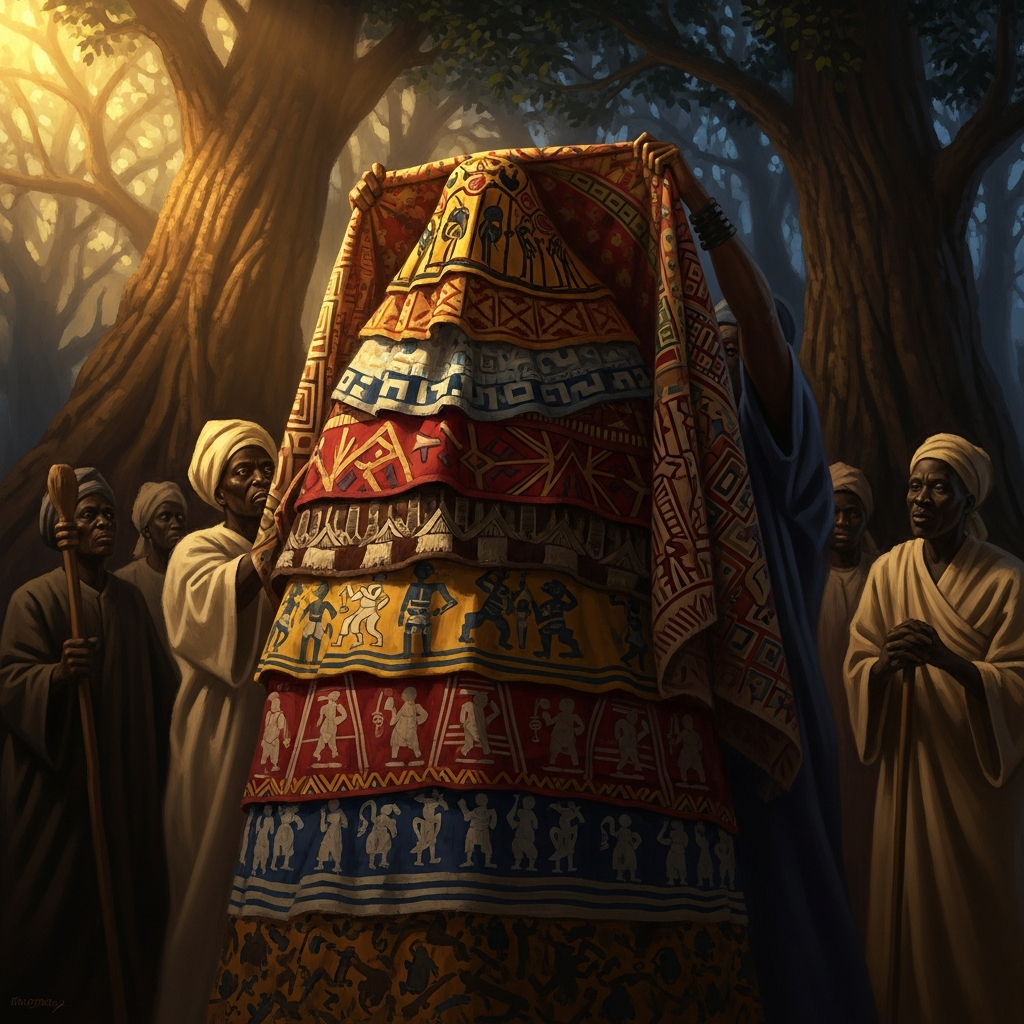
The costume is stored here.
Not hanging — not arranged like clothing waiting to be worn, which would suggest a human use, a human wearer, the ordinary relationship between a garment and the body it covers. The costume lives in the grove the way a shrine lives in a shrine room: present, presided over, requiring attention, not an object but an inhabited form. It is layered cloth — hundreds of strips and panels of fabric, some old enough to have been contributed by ancestors themselves, some recent additions from the families whose dead it carries, a textile record of the community’s history organized vertically, the oldest layers underneath and the newest on top, so that to wear it is to be covered in time.
The men of the Egungun society know what they are doing. They have known what they are doing for generations. The preparation is ritual in the precise sense: each action in a specific order, the order itself encoding meaning, the meaning accumulated over centuries of correct performance. They do not hurry. The community does not wake up yet. The birds are not even awake yet.
This year the community needs the ancestor badly.
The drought has entered its second season. The millet came up thin and yellowed. The yam harvest was less than half of what a normal year produces, and a normal year is not abundance — it is sufficiency, the precise amount that permits a community to function without anyone going hungry, and anything less than sufficiency is an emergency that unfolds slowly and is therefore more difficult to respond to than a fast emergency. The chiefs have argued about the cause and the response for months. The diviner has been consulted. The Ifa readings have produced suggestions that some families have followed and some have not, because following suggestions requires resources and the community’s resources are thin.
And then there is the matter of the Adeyemi family.
The Adeyemis have been accused. The accusation involves the drought — specifically, the claim that a practice conducted in the Adeyemi compound is responsible for drawing the rain away, that someone in that family has made an arrangement with forces hostile to the town’s prosperity in exchange for private benefit. The accuser is a man named Falola, who has reasons of his own for wanting the Adeyemi family destroyed, reasons that have nothing to do with rain: land, a marriage dispute, an old debt that was never settled to his satisfaction and that he has been carrying for a decade, growing heavier and more dangerous as it ages.
The accusation has been taken seriously because accusations made in the context of drought always are. Fear is a medium that makes things grow faster than they should. The Adeyemi family has been shunned. Their children cannot play with other children. Their patriarch is sick. Their eldest son, Taiwo, is a young man who has done nothing wrong and who has spent three months watching his family become a category error in their own community, a thing that cannot be touched without contamination.
The Egungun society sends word the day before.
Not to Falola. Not to the chiefs. To the community at large — the word goes out through the familiar channels, the announcement that the ancestor will come the following morning, that the community should gather in the marketplace at the first light. This announcement carries a particular weight, because the Egungun does not come on schedule. It comes when the community needs it. Its arrival has been interpreted as a response to the specific situation for as long as anyone can remember, which is a long time in a culture organized around memory.
Taiwo Adeyemi hears the announcement and does not know what it means for his family. He lies in the compound that night and listens to his father’s labored breathing and the sound of the town outside the wall, and he does not sleep. He is twenty-three years old and has not yet learned that not sleeping is something you learn to stop doing eventually because it does not help anything and exhaustion makes you stupid, and he needs to not be stupid right now.
He is still awake when the drum starts.
The drum is the Bata — the sacred drum, the drum that speaks in the register that the Egungun uses, that can produce sounds that are not quite language but carry more information than language, that the body processes before the mind understands. It begins before dawn, a single drum, not complex — a heartbeat rhythm, very slow, the rhythm of someone walking at a pace that is not hurrying. The rhythm moves through the town’s sleeping body. It is not meant to wake people but it wakes them, because that rhythm, in that context, does not permit sleep.
By the time the light is gray, the marketplace is full.
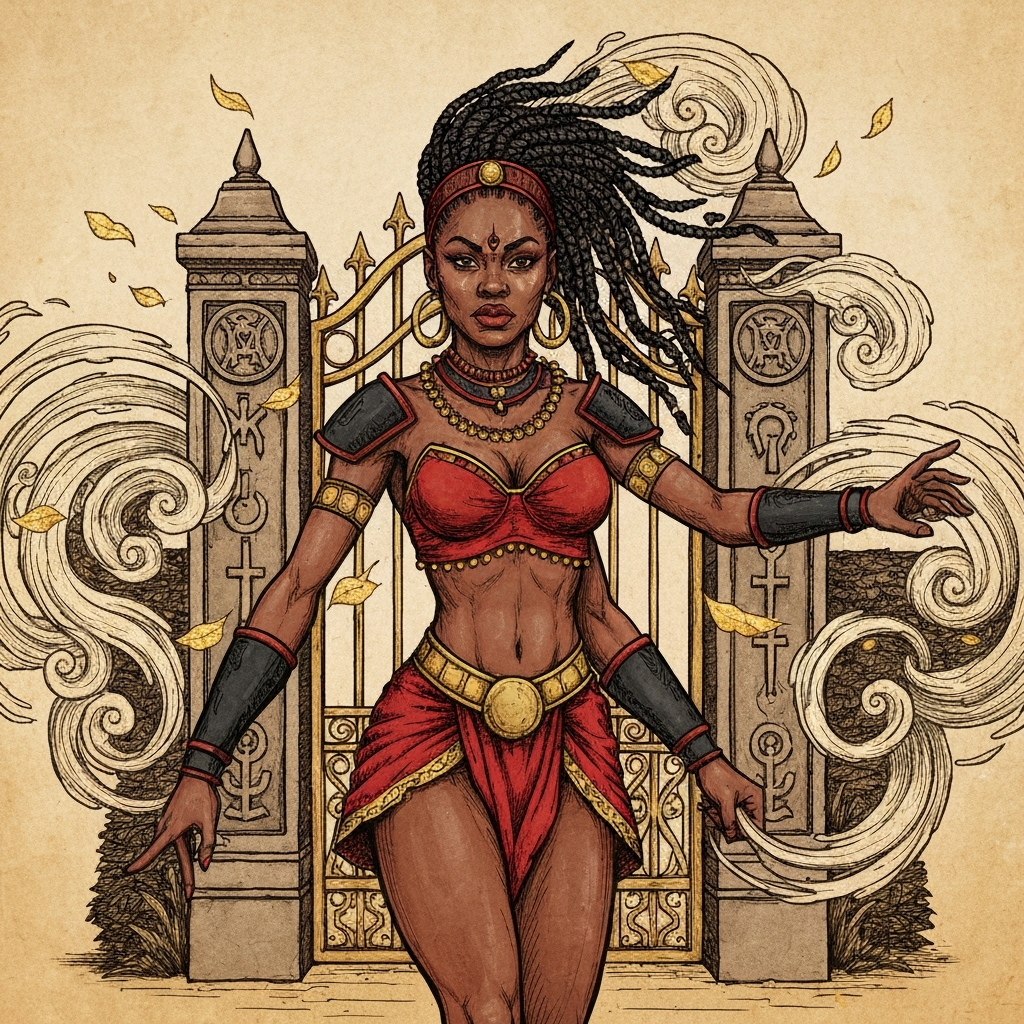
The marketplace is the right place for this. It is Oya’s space — the marketplace belongs to the orisha of storms and the boundary between the living and the dead, who presides over commerce because commerce is what the living and the dead share: the dead made the tools being sold, grew the families buying them, built the roads the buyers walked. The marketplace is the ongoing conversation between the living and what the living inherited from the dead, which means it is already a space with one foot on each side of the boundary.
The crowd is quiet in a way that crowds rarely are. There are hundreds of people and the sound they make is breathing.
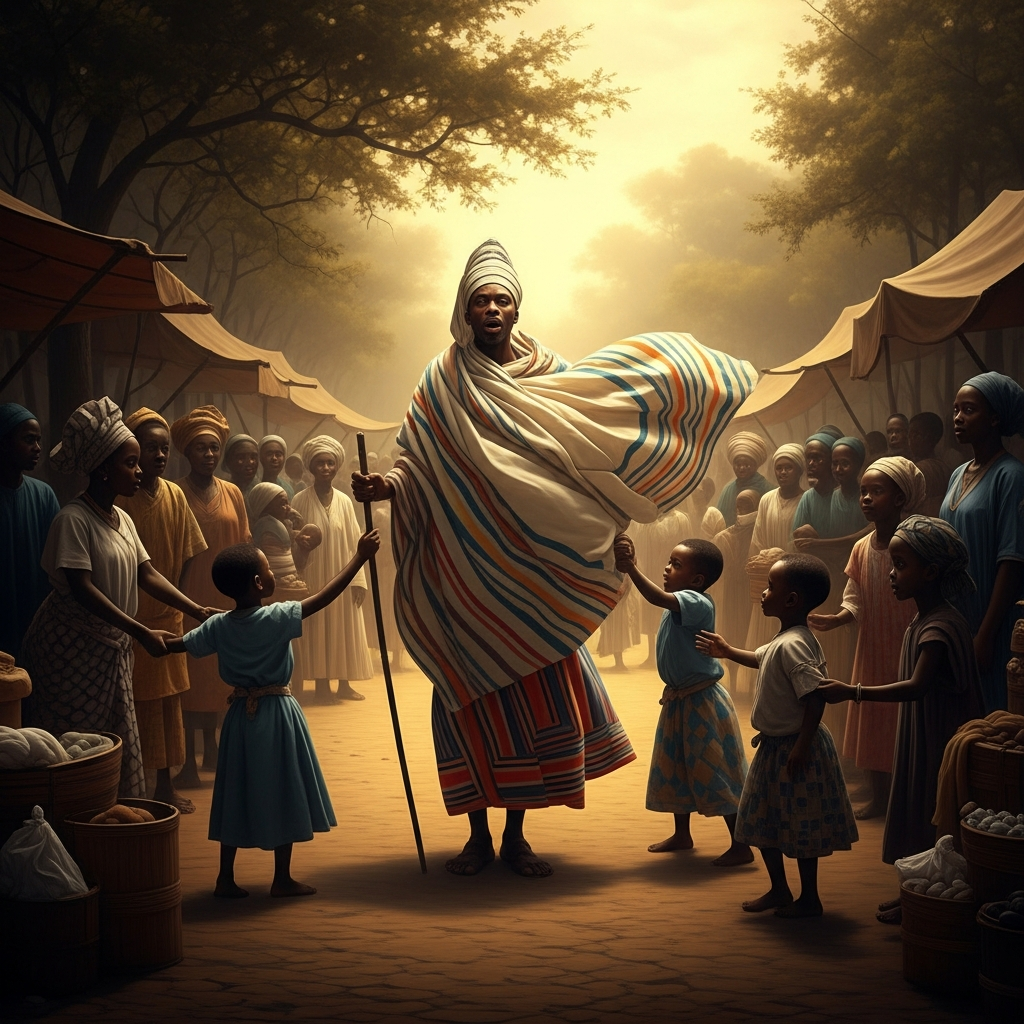
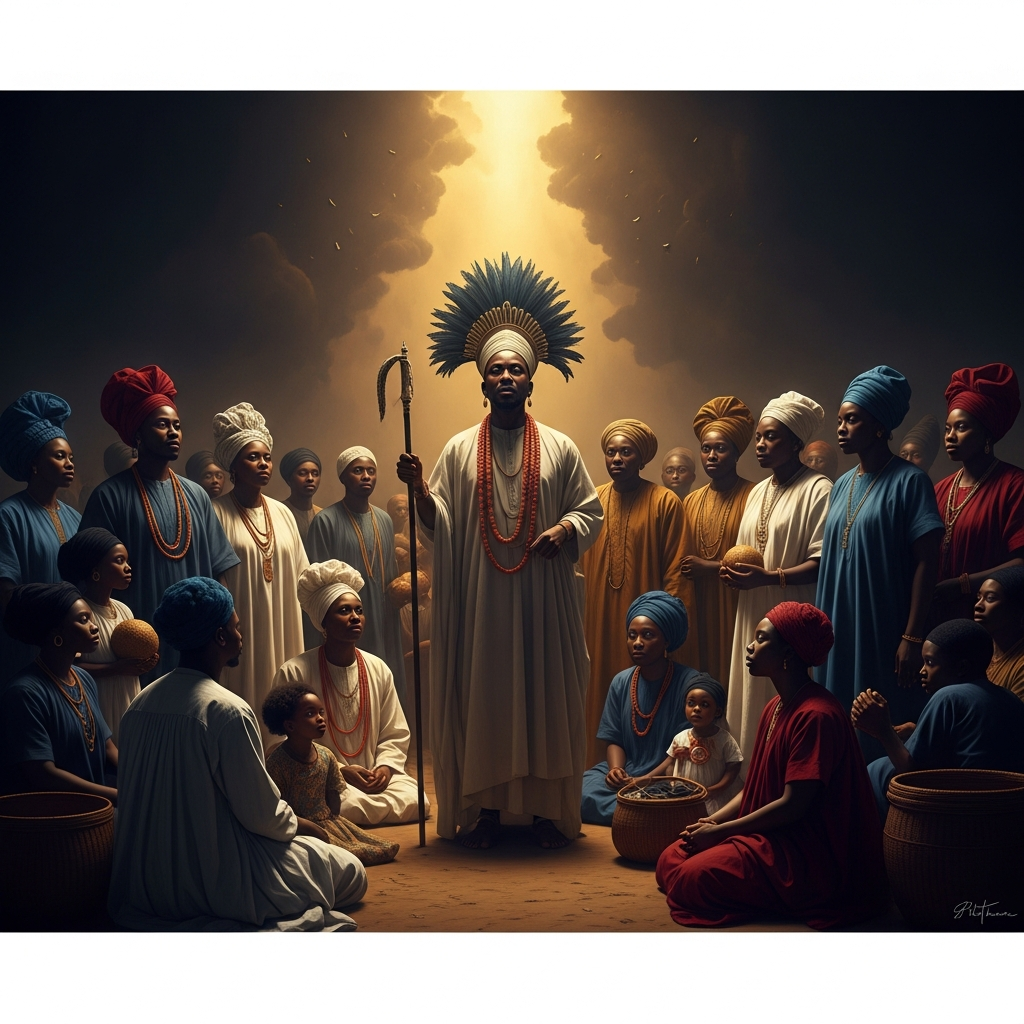
The Egungun emerges from the grove.
Later, people will disagree about exactly how it comes — some say it was already at the edge of the grove before anyone noticed, some say they saw it approach from the trees in a way that made the trees seem to lean away from it, some say it simply appeared, which is not a supernatural claim but a perceptual one, the way a thing that has been there all along suddenly becomes visible when the light changes. What everyone agrees on is the cloth.
The cloth moves.
It moves in a wind that is not blowing — or rather, in a wind that is coming from inside the costume, from whatever is inside the costume, the principle that animates it pushing against the fabric from within and making it billow and ripple in directions that do not correspond to the morning air. The costume is every color in layers — the newest cloth on the outside, bright and deliberate, and underneath it the older cloths, darker, and underneath those the cloths that are so old their color is a kind of deep brown that is also every color, the way very old wood is all the trees it has ever been. The masked face at the top is not a face but a presence, the gestalt of the layers assembled into something that looks at you without eyes and is seen.
The crowd makes way. No one is pushed. People simply find themselves to one side or the other.
The Egungun moves to the center of the marketplace. It does not move like a man moves — not because anyone can confirm what is or is not inside the cloth, but because movement inside the cloth becomes something else, something the cloth mediates and transforms the way a river mediates between the rain and the sea, what goes in one end is not what comes out the other end and the transformation is the point. It turns. The cloth flares. It turns again.
It speaks.
The voice is the voice of the dead.
This is the description that will be given afterward, by everyone who was there, with the particular confidence of people describing something they actually experienced. Not like the voice of the dead. Not similar to a transformed voice. The voice of the dead, the voice of someone who has been to the other side of the boundary that Oya walked to and not returned from, the voice of someone who has no stake in what happens next in this marketplace because they are already past the part where stakes apply.
It says the name Falola.
The crowd does not move. Falola is in the crowd, which means everyone around him now has a slight awareness of where he is, the way everyone becomes aware of a particular person when a room’s attention moves toward that person. He does not move either. He is the kind of man who has prepared himself for this by deciding in advance that he will not show fear, and his preparation is holding, but the preparation costs him something he can see going.
The voice says things it should not be able to know.
It says the name of the woman Falola wanted the Adeyemi patriarch’s land for — a woman he has not spoken of in ten years, a woman whose name has not been spoken in this community in ten years, a woman whose involvement in the original land dispute is known only to Falola and to the dead who were present when the original wrong was done. The voice speaks that name and then it speaks the year and then it speaks what happened in the year, not as accusation but as record, the neutral precision of a ledger being read aloud, the voice with no stake saying what the stake was and who held it and who made the claim and what the claim was built on.
The marketplace is completely still.
Falola does not confess. Not publicly, not in the marketplace, not in words.
But the quality of his stillness changes. Anyone watching him — and many people are — can see the change, the way you can see someone realize they have been in the wrong room for a long time. He looks at the Egungun and the Egungun looks at him from its non-face and the negotiation that happens between them in that silence is one the community understands without requiring the words to be spoken.
He withdraws the accusation the next day. He does this through the intermediaries the community provides for exactly this purpose — the process is old and well-developed, because the need for it is old. He withdraws it in terms that acknowledge its falsehood without requiring him to name the machinery behind it, which is a courtesy the community extends because the alternative is the kind of public destruction that produces only more damage and they are already in a drought.
The Adeyemi family is received back into the community with the matter-of-fact efficiency of people who are very busy and have other things to do. The patriarch’s health improves, not dramatically but perceptibly, over the following weeks. Taiwo Adeyemi spends the rest of his life with a clear understanding of what truth requires to survive in conditions where truth is dangerous — it requires a voice that cannot be threatened. It requires the dead.
The Egungun returns to the grove. The cloth is re-stored. The men of the society complete the closing rituals in the afternoon, the village returning to its ordinary state, the grove returning to its kept wildness.
But the grove is different now than it was yesterday, in the way that all places of action are different after the action — inhabited by what happened there, the air carrying a residue of the voice, the ground holding the memory of the cloth moving through it. The old trees lean in slightly. The birds that live in the sacred grove have come back and are making ordinary bird sounds, which are also not ordinary, which are also carrying information in a register that takes time to learn to read.
The drought will break. It will break in two weeks, in a rain that begins slowly and then becomes the kind of rain that makes the farmers stand in their fields and look up with their faces open.
No one attributes this to the Egungun publicly. But no one doesn’t.
The dead do not return to haunt — they return to complete. What they come back for is what the living have left unfinished, the truths they have allowed to be buried with the witnesses, the debts they have permitted to go unnamed. The cloth is not a disguise because there is no deception in it. The man inside the cloth disappears. The ancestor appears. These are not contradictions. They are the same event, described from two sides of the boundary that the cloth makes visible. In the moment the ancestor speaks, the community remembers what it is for: not only to sustain the living, but to remain in conversation with the dead who made everything the living are standing on.
Scenes
In the sacred grove before dawn, the Egungun society dresses the masquerader
 Generating art…
 The Egungun emerges from the grove's edge into the morning marketplace
 Generating art…
 Before the gathered families, the Egungun stops and turns
 Generating art…
 Echoes Across Traditions
Entities


Sources
- Robert Farris Thompson, *Flash of the Spirit* (1983)
- Margaret Thompson Drewal, *Yoruba Ritual: Performers, Play, Agency* (1992)
- John Pemberton III, *Epics, Masquerades, and Modernity: The Oyo Yoruba Arts* (2020)
- Wande Abimbola, *Ifá: An Exposition of Ifá Literary Corpus* (1976)