Combat Profile
Tempest of Souls
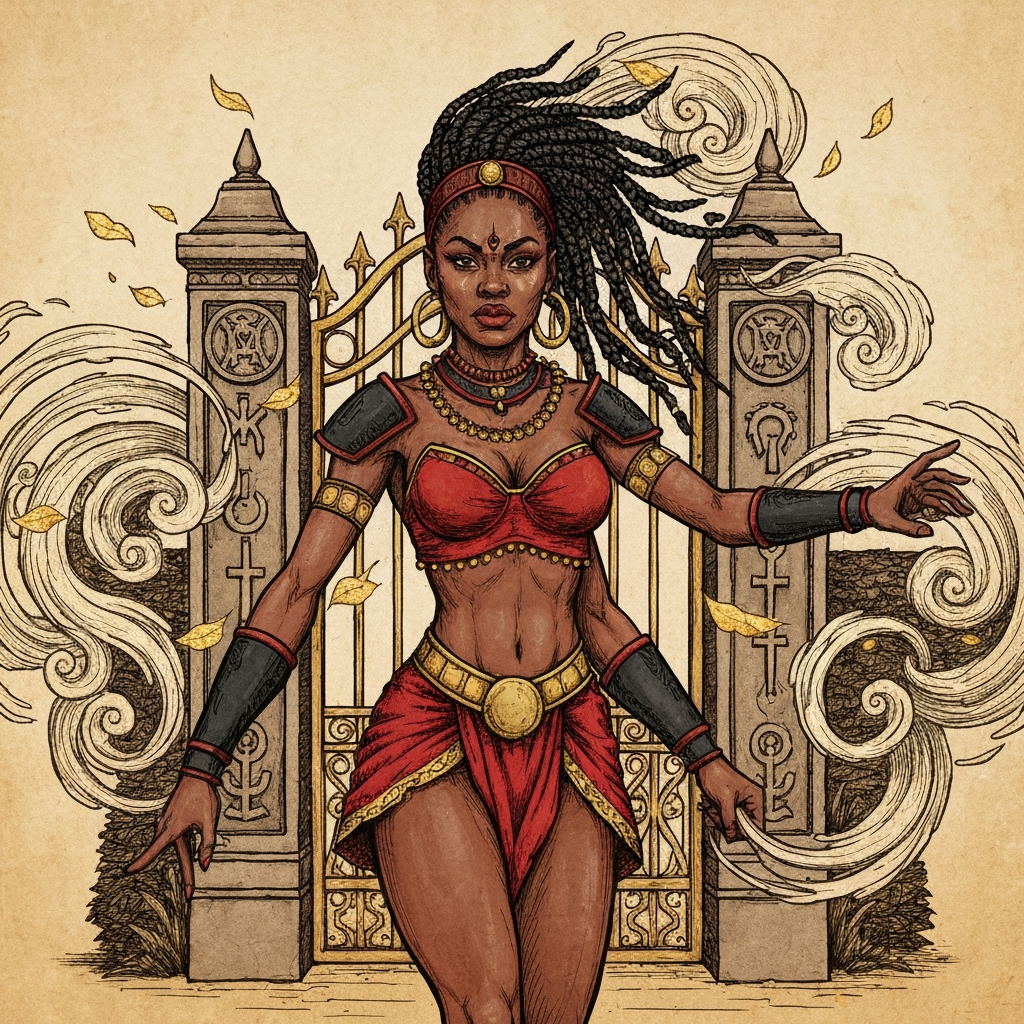
Oya summons a devastating storm that strikes all enemies while opening pathways between the living and dead, dealing massive damage and temporarily allowing spirit allies to manifest.
Liminal Guardian
Oya's presence blurs boundaries between states of being; she gains power near death thresholds and can transform damage taken into offensive momentum.
Her intensity. Oya is the hurricane, not the breeze. She destroys in order to transform, but the destruction is real. She is feared even by other Orishas. Her grief and rage are as vast as her storms
“Oya tears down the rotten tree so the new forest can grow.” — Yoruba proverb
Lore: Oya (Iansa in Brazil, Oya in Cuba) is the Orisha of storms, wind, transformation, and death — the fierce feminine principle at its most terrifying and most necessary. She is the wife of Shango (his favorite, the one who rides into battle at his side), the guardian of the cemetery gate, the force of transformation that tears down the old to make way for the new. She is not gentle. She does not negotiate. When Oya comes, things change — structures fall, relationships end, old identities die, and something new is born in the aftermath. She is associated with the tornado, the hurricane, the Niger River (whose Yoruba name, Odo Oya, is her name), and the number nine (representing her nine children or the nine tributaries of the Niger). She is one of the few Orishas who can handle the dead — most Orishas avoid corpses and cemeteries, but Oya rules this boundary. She is the last face you see before crossing over.
Parallel: Oya parallels the Morrigan (Celtic goddess of war, death, and transformation who appears as a storm crow on the battlefield), Kali (Hindu goddess of time, death, and liberation whose destruction is ultimately creative), and the Angel of Death (the biblical figure who stands at the boundary between life and death). She is also structurally parallel to Hecate (Greek goddess of crossroads, boundaries, and the liminal) and to Ereshkigal (Mesopotamian queen of the underworld). The Catholic saint she was syncretized with — Our Lady of Candelaria and sometimes St. Theresa — captures only a fraction of her ferocity.
1 min read
Only Shango can match her energy (they are married, and their relationship is the collision of thunder and wind). Obatala's cool wisdom can sometimes temper her fury. Nothing else slows her down
Odu Ifa; Judith Gleason, *Oya: In Praise of an African Goddess* (1992); Robert Farris Thompson, *Flash of the Spirit* (1983)