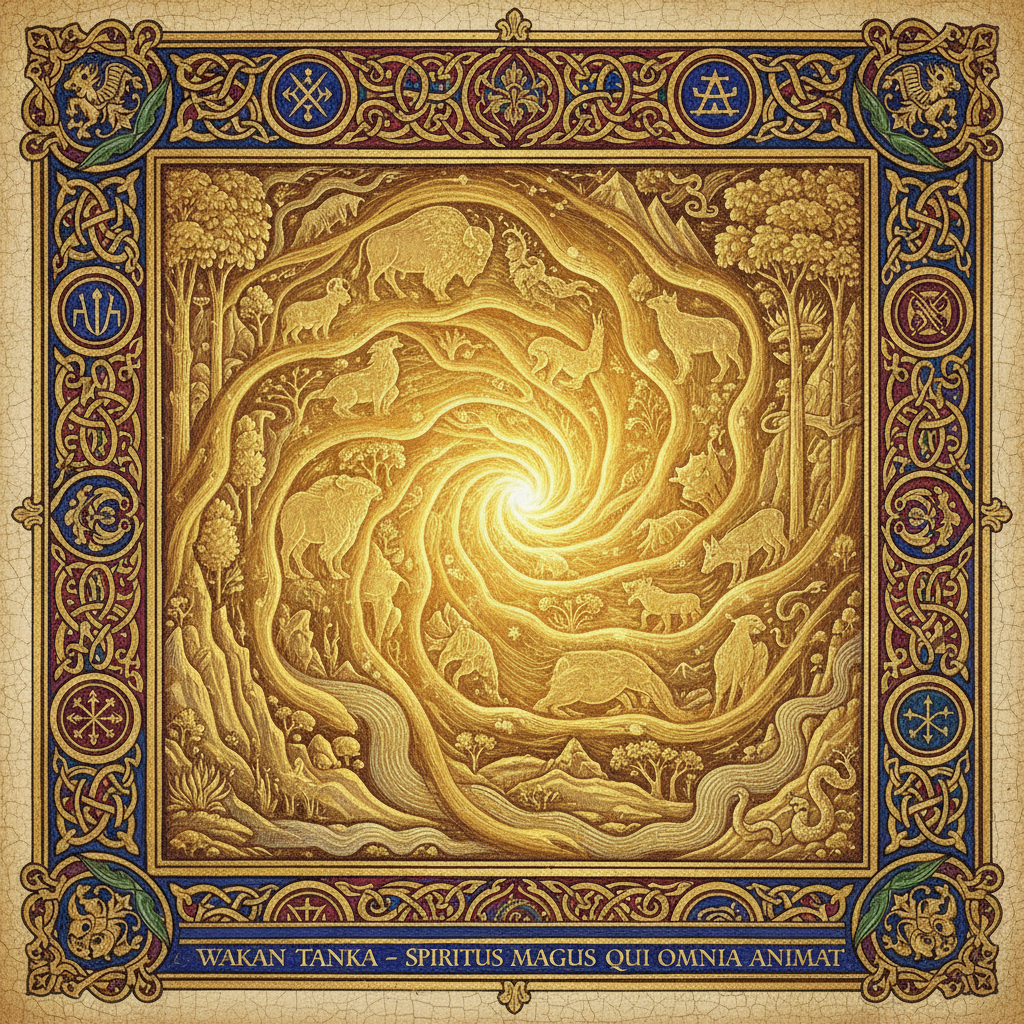
Black Elk's Great Vision
Summer 1872 (the vision); August 1930 (the telling) · The Little Powder River, Wyoming Territory; later, Harney Peak in the Black Hills
Contents
A nine-year-old Lakota boy lies dying of fever in 1872 and is carried up into the sky to meet the Six Grandfathers, who give him the sacred hoop of the nations and a flowering tree at its center — a vision he will spend seventy years believing he failed.
- When
- Summer 1872 (the vision); August 1930 (the telling)
- Where
- The Little Powder River, Wyoming Territory; later, Harney Peak in the Black Hills
The boy is nine and dying.
The fever came in the morning. By afternoon his legs will not hold him. His mother lays him on the buffalo robe at the back of the tipi and cools his face with river water, and his father — a medicine man who has seen this kind of thing — does not say what he is thinking.
Outside, the Little Powder River keeps moving. The Lakota camp keeps moving with it. There is a war coming, though the boy does not know the word yet. There is a railroad coming, though no one in the camp has seen one. There is a year called 1876 coming, four years away, and a hill called Greasy Grass, and a grandfather of his named Crazy Horse who will be there.
But for now there is only the fever and the tipi poles spinning above him.
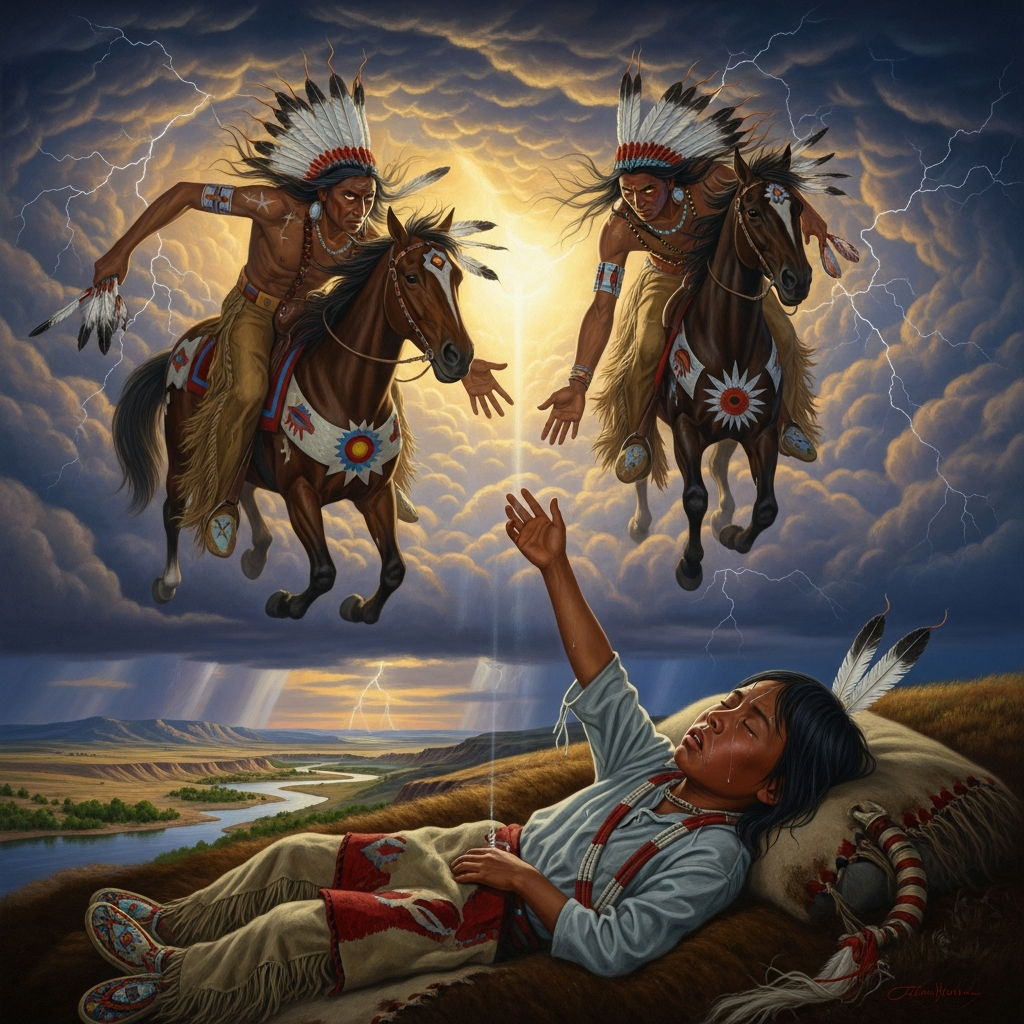
Two men step through the smoke flap. They are not from the camp.
“Your Grandfathers are calling you,” they say. “Hurry.”
They lift him. He is light suddenly, lighter than a bundle of switch grass. The tipi is gone. Beneath him, a small cloud rises and carries him up the way a leaf rises on a thermal, and when he looks down the camp is a ring of dots and the river is a thread of mercury and the world is a green plate with four directions painted on it.
Four horses come — bay horses from the east, white horses from the north, black horses from the west, sorrel horses from the south — and behind them more horses than he can count, every horse that has ever lived. They wheel around him in a great circle. They neigh in a voice that is not horses. They are calling him toward a tipi made of cloud.
He goes in.
Six old men sit inside.
They are older than the rocks and they are also young. They are the powers of the four directions, the sky above, the earth below — Wakan Tanka in six faces. They have been waiting for him.
The first Grandfather, the West, gives him a wooden cup full of water with the sky inside it, and a bow. “With this you shall make live, and with this you shall destroy.”
The second, the North, gives him an herb — a daybreak-star herb — and a white wing. “With this you shall make the people walk.”
The third, the East, gives him the sacred pipe, and on the pipe a spotted eagle. “With this you shall heal.”
The fourth, the South, gives him the bright red stick that flowers as he watches — a cottonwood stick with green leaves, then white blossoms, then birds singing in the leaves. “This is the living center of your nation.”
The fifth Grandfather, the Sky, says nothing. He becomes a spotted eagle and circles the tipi.
The sixth Grandfather is the Earth. The boy looks at him and realizes, slowly, that the sixth Grandfather is himself, grown old. He is being shown his own face at the end of the road.
He cannot speak.
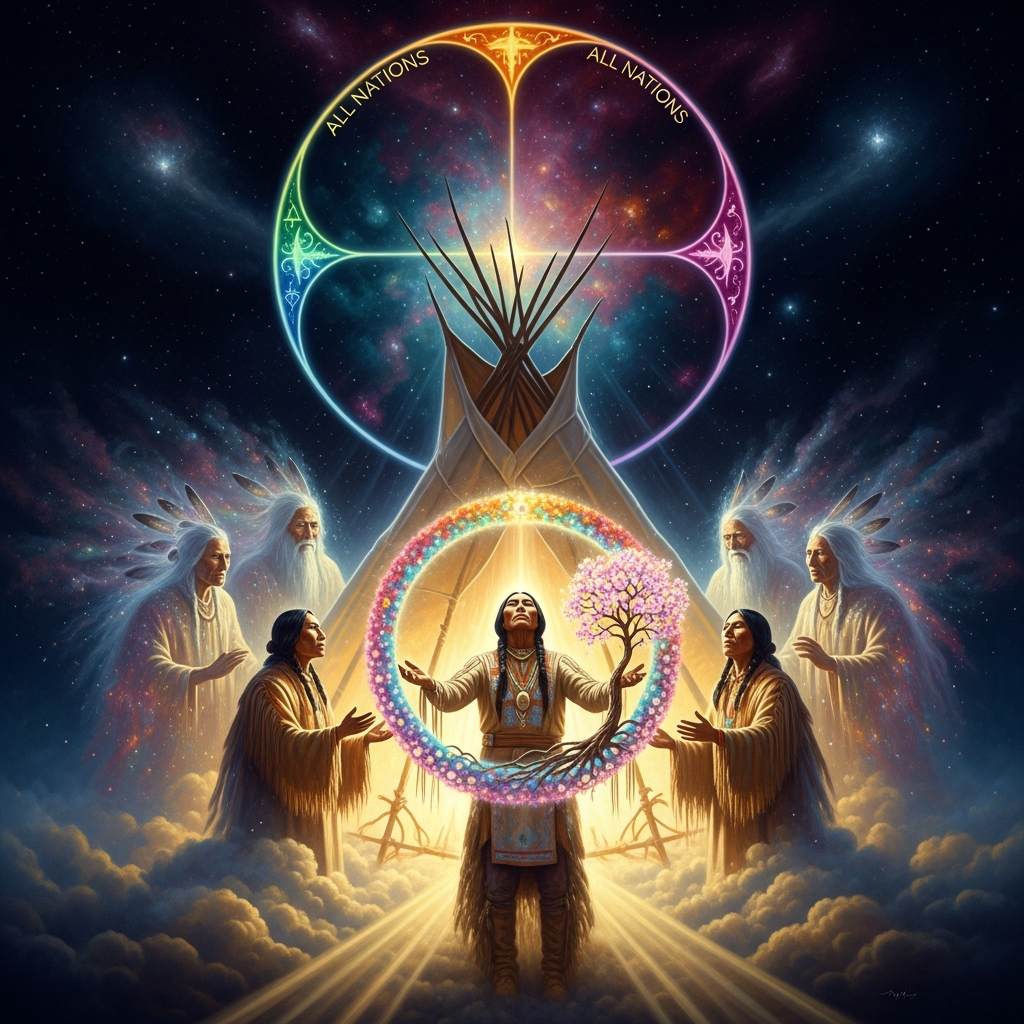
They take him out and show him the hoop of his nation.
It is a great circle drawn in light. Inside it, his people — the Lakota — stand in their tens of thousands. But the hoop he is shown is bigger. It contains other hoops: the hoop of the Cheyenne, the hoop of the Crow, the hoop of the Arapaho, the hoop of every people, all the way down to peoples whose faces he does not know — pale faces, dark faces, faces from across the salt water. All the hoops nest inside one great hoop, and at the center of the great hoop stands the flowering tree.
The Grandfathers say: “Behold the circle of the nations. In the center grows the holy tree. Make it bloom.”
He understands, with the certainty children have, that this is his work.
He understands, with the same certainty, that he will fail.
The vision does not warn him. The vision only shows him the tree blooming, the four-quarter hoop intact, every people sheltering in the shade. It does not show him 1876, or the iron horse, or the boarding schools, or the year 1890 when the snow at Wounded Knee will be the color of the tree he was supposed to make bloom.
It shows him only the gift.
He comes back into his body twelve days later.
His mother has been weeping for twelve days. His father has not eaten. The medicine men of the camp have been singing over him in shifts. When he opens his eyes, he is nine years old again, and the cup of water is gone, and the herb is gone, and the flowering stick is gone.
He says nothing.
He keeps the vision inside him for years — through the killing of his cousin Crazy Horse, through Greasy Grass, through the long retreat into Canada with Sitting Bull, through the surrender, through Pine Ridge, through the cold winter of 1890 when he rides toward Wounded Knee Creek and finds the dead lying in the snow like spilled cornmeal, the women and the babies and the old men, and the hoop of his nation broken in a way he does not know how to mend.
He thinks: the tree is dying because of me.
He becomes a Catholic. He raises children. He gets old.
In August 1930, an old white poet named John Neihardt drives a Model T onto the Pine Ridge reservation and asks to speak with him. Black Elk is sixty-seven. He has not told the vision to anyone in fifty-eight years.
He looks at Neihardt. Something in him recognizes something in the visitor. He says, in Lakota, “As I sit here, I can feel in this man beside me a strong desire to know the things of the Other World.”
He tells the vision.
It takes weeks. His son translates. Neihardt’s daughter writes it down in shorthand. The flowering tree, the four horses, the six Grandfathers, the hoop of the nations, the spotted eagle, the daybreak-star herb — all of it.
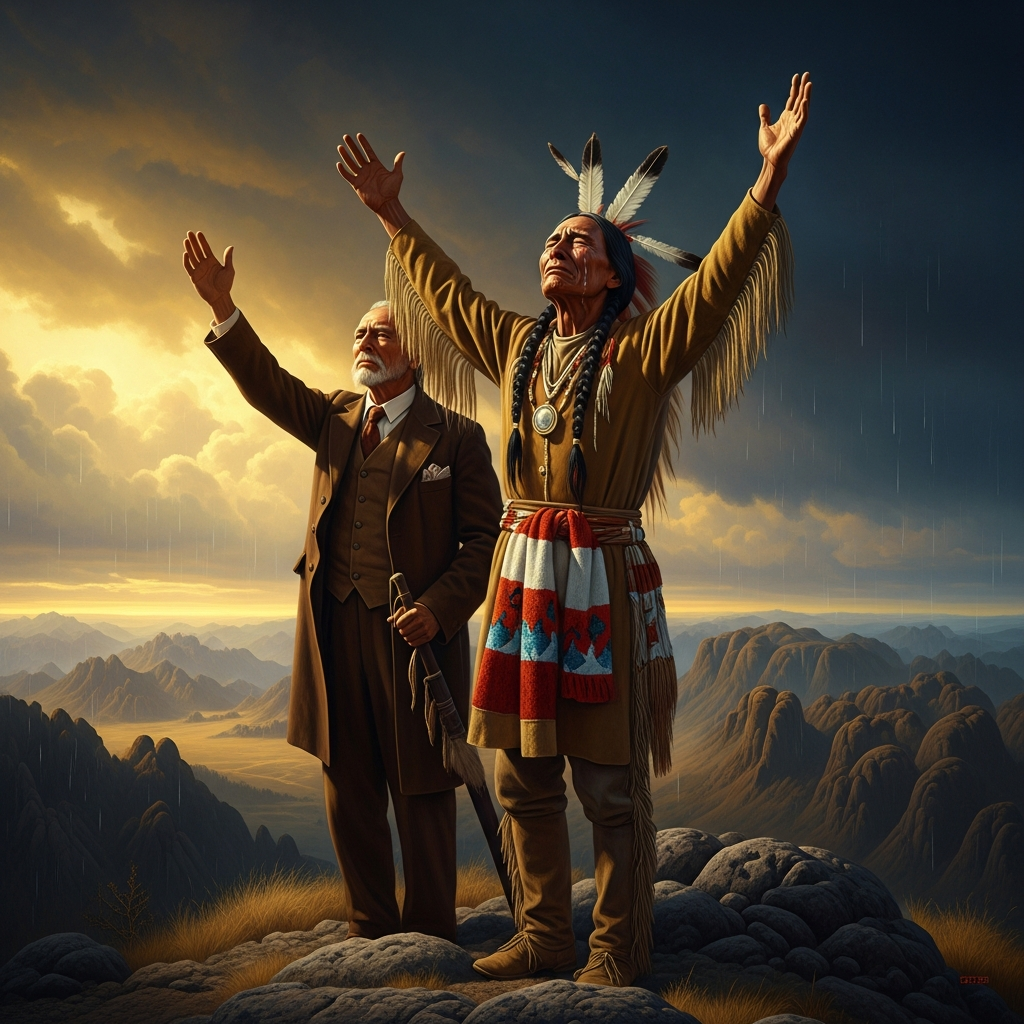
When he finishes, he asks Neihardt to take him up Harney Peak in the Black Hills, the center of the world in his vision, where as a boy in the cloud-tipi he had stood with the Grandfathers and seen the hoop whole.
It is a clear day when they arrive. Black Elk lifts his arms and prays in Lakota.
“Grandfather, Great Spirit, you have been always, and before you nothing has been. There is nothing to pray to but you. The star nations all over the universe are yours, and yours are the grasses of the earth. You are older than all need, older than all prayer. With tears running down my face I am sending a voice. Hear me, the nation’s hoop is broken and scattered. There is no center any longer, and the sacred tree is dead.”
Then, very quietly, he weeps.
The sky, which had been clear all morning, begins suddenly to thunder. Cold rain blows across the peak. Neihardt stands beside him and does not know what to say.
Black Elk died in 1950, still believing the tree had not bloomed.
He was wrong, in the way prophets are wrong: not in the vision, but in the timeline. Black Elk Speaks was published in 1932 and ignored. It was rediscovered in the 1960s by a generation looking for a sacred America that had been there all along. It is now read in fifty languages. The hoop of the nations — the picture of all peoples sheltering under one tree — has become one of the most quoted images in American religion.
The tree the Grandfathers gave him was never the Lakota nation alone. It was the picture of every nation. He spent his life thinking he had failed to make it bloom. He had spent his life telling people what it looked like.
That is how the tree blooms. Slowly. In the telling.
Scenes
The boy collapses; the thunder beings come for him on horseback above the Little Powder River
 Generating art…
 He stands before the Six Grandfathers in the cloud-tipi and receives the sacred hoop and the flowering tree
 Generating art…
 Sixty years later, at the foot of Harney Peak, Black Elk speaks the vision aloud and grieves what he could not save
 Generating art…
 Echoes Across Traditions
Entities
- Black Elk
- the Six Grandfathers
- Wakan Tanka
- the Thunder Beings
- John Neihardt

Sources
- Black Elk and John G. Neihardt, *Black Elk Speaks* (1932)
- Joseph Epes Brown, *The Sacred Pipe* (1953)
- Raymond J. DeMallie, *The Sixth Grandfather: Black Elk's Teachings Given to John G. Neihardt* (1984)
- Clyde Holler, *Black Elk's Religion* (1995)