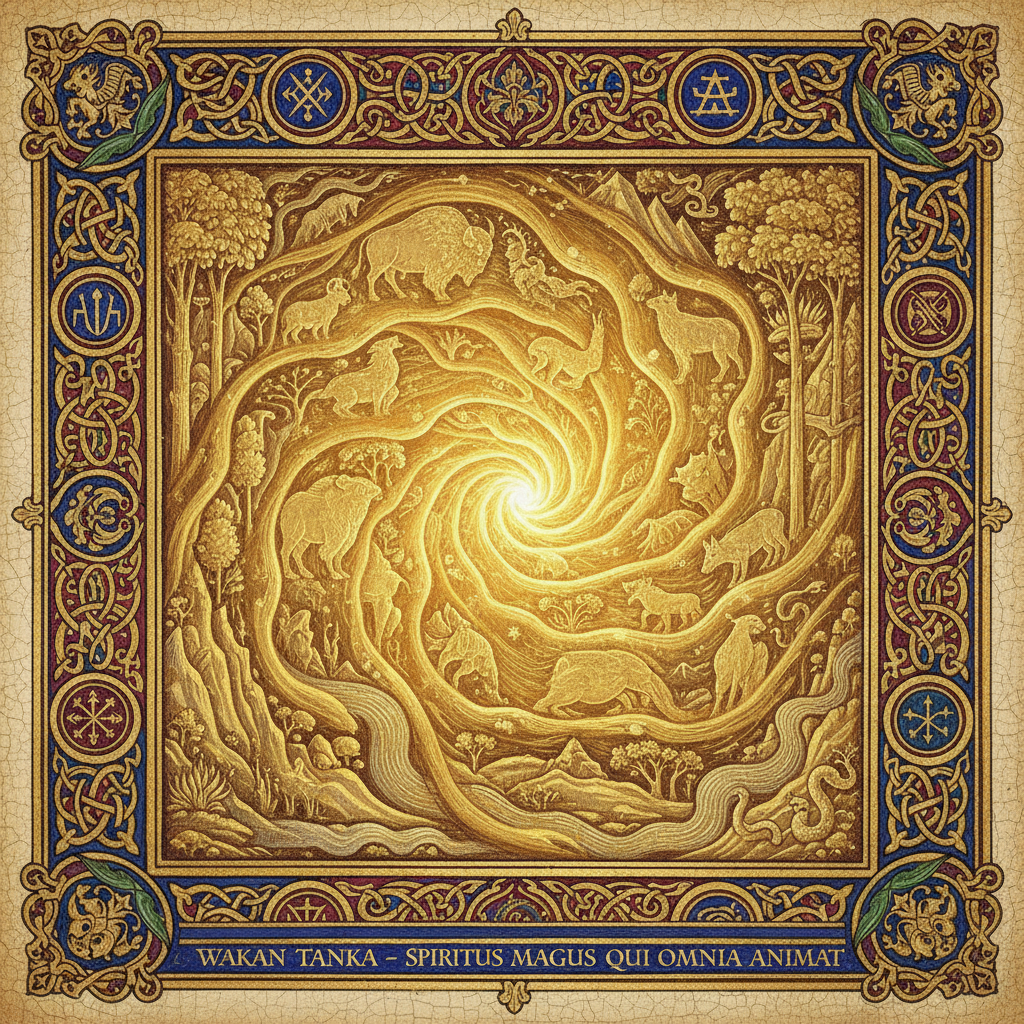
Combat Profile
Mitákuye Oyásʼin
All connections are instantly revealed and harmonized; the wielder perceives the sacred interdependence binding all existence and can realign fundamental relationships.
Wakan
The entity exists simultaneously in all places and forms; every stone, wind, and creature is an expression of their omnipresent consciousness, making them impossible to oppose directly.
None -- Wakan Tanka is not a being that can be opposed
“The Great Spirit is not like a human being. The Great Spirit is a power. That power could be in a cup of coffee. The Great Spirit is not a ‘he’ or a ‘she.’ The Great Spirit is ‘it.’” — Lakota elder, recorded in oral tradition
Lore: Wakan Tanka is not a god. This cannot be stated firmly enough. Western missionaries and anthropologists, encountering Lakota spirituality, reached for the nearest European concept — “the Great Spirit” — and in doing so committed a fundamental mistranslation that persists to this day. Wakan Tanka does not sit on a throne. Wakan Tanka does not issue commandments. Wakan Tanka does not judge the dead. Wakan Tanka is the totality of the sacred — the sum of all spiritual power, present in every rock, every animal, every gust of wind, every human breath. The word wakan means “sacred” or “holy” or “mysterious” — it indicates something set apart, something charged with spiritual power. Tanka means “great” or “large.” Together: the Great Sacred. The Great Mystery. The everything.
In Lakota theology, Wakan Tanka manifests through sixteen aspects — including Wi (the Sun), Skan (the Sky), Maka (the Earth), and Inyan (the Rock) — but these are not separate gods. They are faces of the same mystery, aspects of the same power, the way sunlight can be broken into colors through a prism but remains one light. The distinction between monotheism and polytheism, which obsesses Western theologians, simply does not apply here. The categories are wrong.
Parallel: The closest parallels in this compendium are not personal gods but impersonal ultimates: Brahman in Hindu philosophy (the ultimate reality behind all gods and all things), Ein Sof in Kabbalah (the infinite, unknowable aspect of God before any emanation), and the Tao in Taoism (“the Tao that can be spoken is not the eternal Tao”). Each of these traditions arrived, independently, at the insight that the deepest level of spiritual reality is beyond personhood, beyond narrative, beyond naming. That four utterly unrelated traditions — Lakota, Hindu, Jewish mystical, and Chinese — converge on this point is one of the most profound facts in comparative theology.
2 min read
None -- you do not counter the totality of reality
Walker, *Lakota Belief and Ritual*; Brown, *The Sacred Pipe: Black Elk's Account of the Seven Rites of the Oglala Sioux*; Erdoes & Ortiz, *American Indian Myths and Legends*