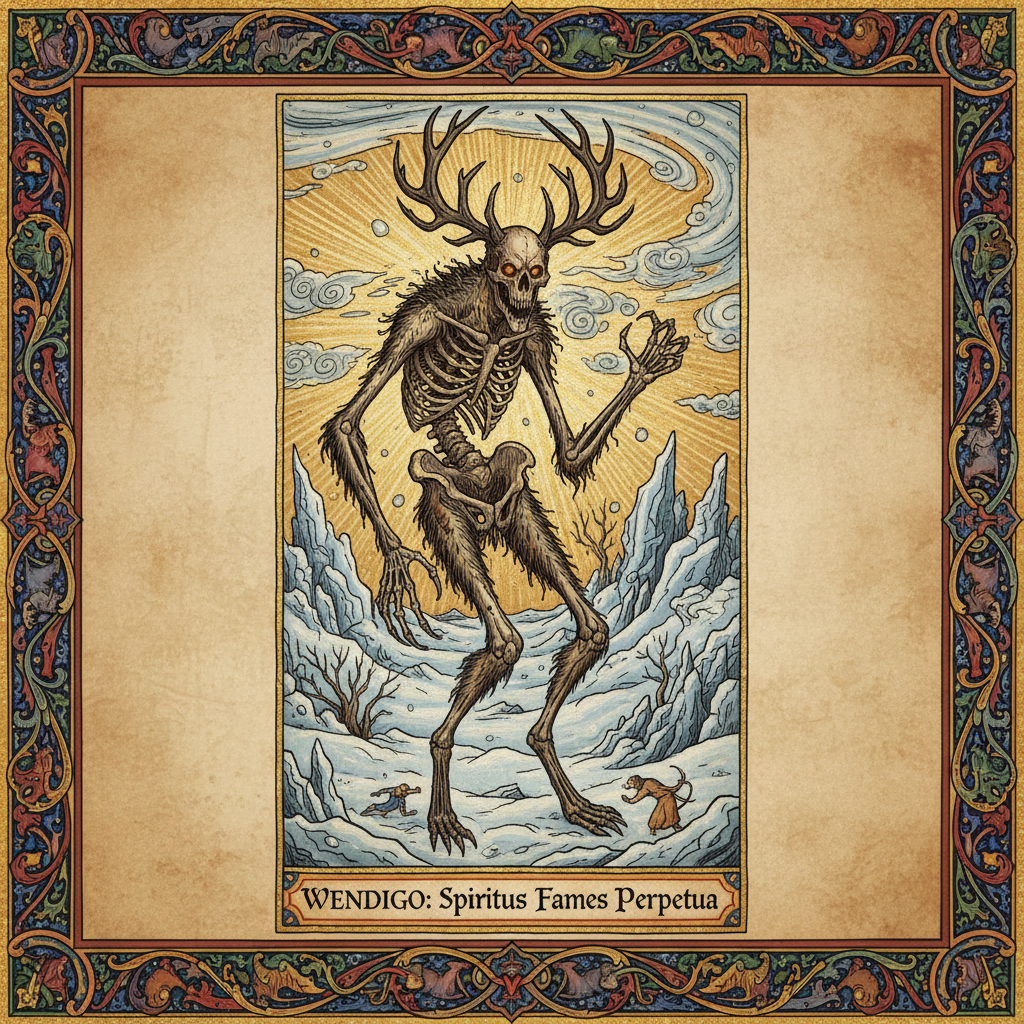
Combat Profile
Insatiable Hunger
Wendigo's attacks grow progressively stronger with each consecutive hit, reflecting its endless appetite and inability to be satisfied.
Cannibalistic Corruption
Wendigo permanently radiates an aura of desperation and greed that weakens nearby entities' resolve and self-control.
Fire; in some traditions, Wendigo has a heart of ice that must be melted. Also: community, generosity, and sharing -- the social virtues that are the Wendigo's opposite
“It was once a man. It is not a man anymore.”
Lore: The Wendigo (also Windigo, Witiko) is a figure from Algonquian-speaking traditions — Ojibwe, Cree, Innu, Naskapi — and it is perhaps the most psychologically sophisticated monster in any world mythology. It is not a demon in the Judeo-Christian sense. It is a transformation. A human being, faced with the ultimate extremity of winter starvation, crosses the taboo boundary of cannibalism. In doing so, they do not simply commit a crime — they become something else. They become Wendigo: an enormous, emaciated, skeletal figure with an insatiable hunger that grows with every meal. The more it eats, the larger it becomes, and the larger it becomes, the hungrier it is. The Wendigo can never be full. It has chosen consumption over community, and consumption consumes it.
The Wendigo is a moral teaching encoded as horror. In the harsh winters of the subarctic, where Algonquian peoples lived, starvation was a real and recurring danger. The Wendigo narrative served as a warning: no matter how desperate things become, you do not eat your own people. You share what you have. You die together before you consume each other. The Wendigo is the embodiment of radical selfishness in a culture that required radical generosity to survive.
“Wendigo psychosis” was documented by early ethnographers as a culture-bound syndrome — individuals who believed they were transforming into Wendigos, experiencing an overwhelming desire for human flesh. Whether this was a genuine psychological phenomenon or an artifact of colonial observation is debated, but its existence points to the power of the Wendigo concept: it was not merely a story but a lived dread.
Parallel: The Wendigo’s closest parallel is the Hungry Ghost (Preta) in Buddhist cosmology — beings trapped in a realm of insatiable craving, with enormous stomachs and tiny mouths, who can never consume enough to be satisfied. Both traditions arrived at the same insight: that unchecked desire is its own hell. In the Christian framework, the Wendigo maps to the demon of Gluttony among the seven deadly sins, but it is far more nuanced — it is not merely about eating too much, but about what you become when you consume others. The vampire tradition in European folklore carries echoes of the Wendigo (the undead who consume the living, who were once human), but the Wendigo is more terrifying because its transformation is understood as a real psychological possibility, not a supernatural curse.
2 min read
The values of communal living. Wendigo is what happens when you choose yourself over your people
Erdoes & Ortiz, *American Indian Myths and Legends*; Colombo, *Windigo: An Anthology of Fact and Fantastic Fiction*; Thompson, *Tales of the North American Indians*