Contents
In 1872, a young Lakota man climbs alone to a hill in the Black Hills, lies down within a circle of sacred flags, and cries for a vision for four days and four nights without food or water. What arrives is not what he expected. Black Elk's account from Black Elk Speaks illuminates what the hanbleceya demands and what it gives back.
- When
- c. 1872
- Where
- The Black Hills, Lakota territory
The hill is bare and high and the wind is continuous.
He has been brought here by the holy man, who helped him purify himself in the sweat lodge before ascending, who has marked the circle in which he will lie — four small prayer flags, one at each direction, the flags cut from cloth given to the ceremony — who has prayed over him and then gone back down the hill and left him alone.
He is perhaps nineteen years old. He has made the decision to cry for a vision — hanbleceya, which means crying for a dream, though the translation loses the specific quality of the crying, which is not weeping from grief but the sustained, directed appeal of a person who is asking for something with his entire being. The word means both crying and praying, which in the Lakota understanding are not different things when done with sufficient seriousness.
He has no food and no water. He will have none for four days and four nights, which is the standard period, though some seek shorter visions and some — the most desperate or the most dedicated — stay longer. The four days are not arbitrary. They correspond to the four directions, the four stages of life, the four ages of the world. Everything in Lakota ceremonial life is structured around the four, which is not the same as the arbitrary decision to use a certain number, but the recognition that four is the shape the world actually takes when it is seen clearly.
The first night, nothing happens.
He lies within his circle, or sits within it, or kneels — the body finds different positions through a night without sleep. The stars move overhead in their ordinary arcs. The wind comes from the west, from the direction of the Thunderbeings, and it is cold enough in the Black Hills at night even in summer to make the cold itself feel intentional, as if the darkness is testing whether he will get up and go back down the hill.
He does not go back down the hill.
This is the first thing the hanbleceya asks: that you stay. This sounds trivial. It is not trivial. The body has very good reasons to leave the hill — it is cold, it is hungry, it is thirsty, it is alone in the dark in an exposed place where the wind has been blowing for what feels like the entire existence of the world. The body makes its case continuously, and the case is persuasive. The person who stays is the person who has decided that what might come is more important than the body’s very reasonable arguments.
On the second night, he begins to understand how much the ordinary life is structured around distraction.
When there is nothing to do except be present in this place and ask, the quality of asking changes. The asking that happens in the first hours is the asking of a person who still has energy and expectation — the petition addressed to the sacred, articulate and organized. The asking that happens on the second night is something different: it is the asking of a person who is running out of words and finding that the asking continues anyway, past the words, in a register that is not speech.
Black Elk’s vision, which came to him when he was nine years old in a different context — during an illness, not a formal hanbleceya — and which he later confirmed and deepened through the formal vision quest, is one of the most complete recorded visions in the literature of North American spirituality.
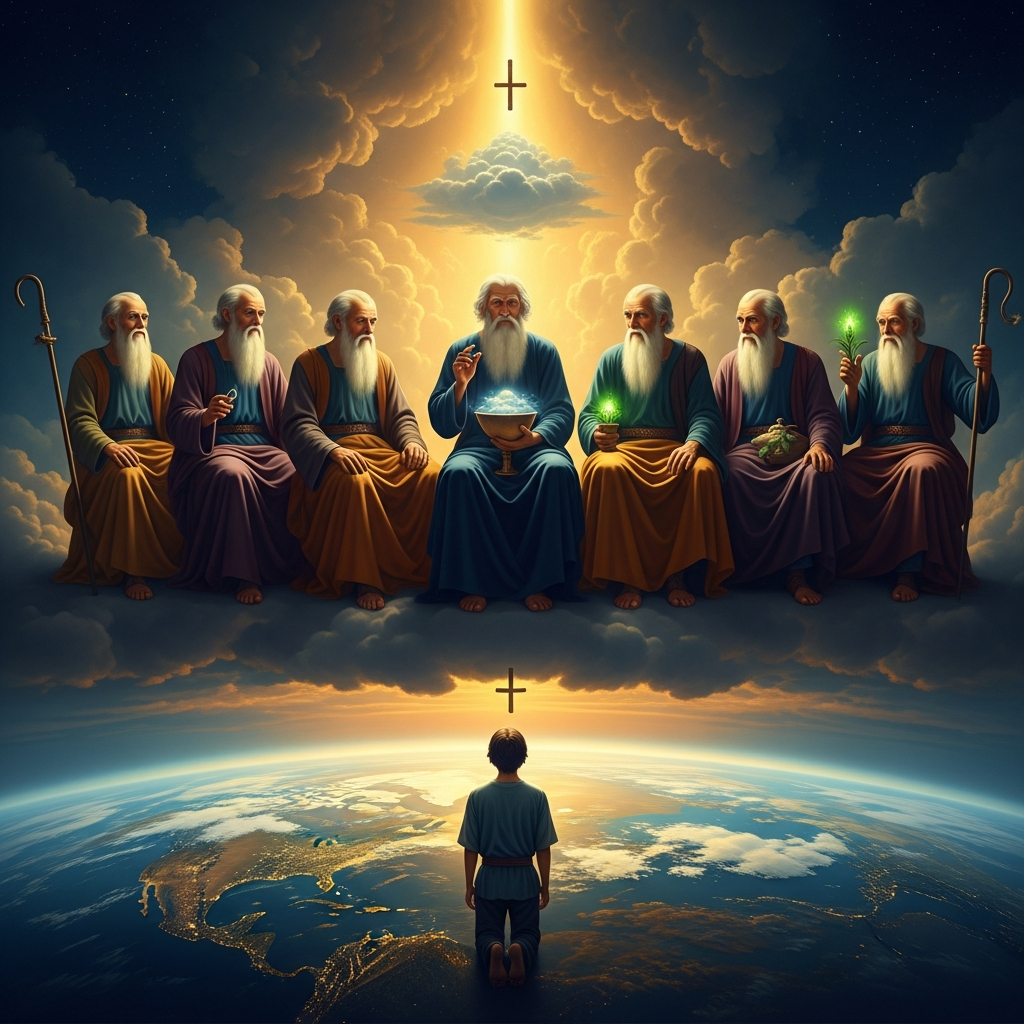
He is taken up into the clouds, in the vision. Six old men are seated there — the Grandfathers, the powers of the six directions including the sky and the earth — and they address him in a formal assembly, one by one, giving him specific gifts: a cup that contains the sky, from the west; a herb so green it glows, from the north; a peace pipe, from the east; a red stick, alive and growing, from the south; from the sky, an eagle feather and a bright red road; from the earth, a small holy man who shows him the power that is under the earth.
The vision proceeds in images that are both specific and dreamlike: a bay horse, a black road of difficulty running east to west, a red road of good running south to north, a sacred hoop of the people, a flowering tree at the center of the hoop. The Grandfathers tell him that these are his to use for the people. They tell him specific things about what is coming — the difficulties the Lakota will face, the way the sacred hoop will be broken, the possibility of its repair. They show him the whole arc of what his life will mean, in the compressed, non-sequential time of vision.
He comes back from the vision with all of this inside him, and he is nine years old, and he does not know what to do with it.
The young man on the hill in 1872 does not have Black Elk’s vision. He has his own, which arrives differently.
What arrives is not a grand council of cosmic beings in a cloud. What arrives is a hawk.
It lands on the edge of his circle and remains there, which is not what hawks do. It looks at him with the sideways regard of a bird, which sees each eye separately, and in that regard he understands something about the relationship between the visible world and the world that underlies it — not as a theological proposition but as a direct perception, the way you might understand a word in a foreign language not by translation but by finally hearing it correctly. The hawk is not showing him the sacred world. The hawk is showing him that the world he already lives in is the sacred world, seen from one angle only.
The hawk stays for a time that cannot be measured in ordinary terms.
When it leaves, he lies back in his circle and looks at the sky and understands that the vision has been given and that it is his, and that no one else will understand exactly what it means because it is addressed to him specifically, encoded in a language that is his language alone.
This is what the holy man tells him when he comes back down the hill: you are not required to explain the vision. You are required to live it.
He descends on the fourth morning.
The holy man is waiting at the bottom, as arranged, with water and a small amount of food. They sit together and the young man tells the holy man what came in the four days — not everything, and not the inner meaning, but the outward form: the hawk, the quality of the waiting, the moment when the asking stopped being addressed to anything in particular and became simply the condition of his being on the hill.
The holy man listens without comment for a long time. Then he says: that was the right kind of asking.
The young man is hungry and exhausted and he has been in one place on a hill without food or water for four days and he carries in him the hawk and the understanding that arrived with the hawk. He does not feel certain about very much. But he feels that the vision is his now and that he has received something that will require the rest of his life to unpack.
This is what Black Elk says, in the account recorded by John Neihardt and corrected and expanded by Raymond DeMallie: the vision comes before the understanding of the vision. You are given the content and then you live into the meaning. The hanbleceya is not the moment of completion but the beginning of a much longer inquiry. You go up to the hill to receive. You come down from the hill to understand what you received. The understanding takes a lifetime.
Black Elk told Neihardt, near the end of his life, that he thought the vision had failed — that he had not brought the tree back to bloom, had not healed the sacred hoop of the people, had not done what the Grandfathers showed him he was supposed to do.
Neihardt believed otherwise. So did the generations of readers who have carried the book.
DeMallie’s edition of the original notes shows Black Elk more complex than Neihardt’s account suggests: a man who became a Catholic catechist, who participated in both ceremonial worlds, who held contradictions that neither tradition alone could resolve.
This is also a vision. The man who contains contradictions and continues — who does not resolve them by abandoning one side but lives in the tension between them for an entire life — may be doing exactly what the Grandfathers showed him, in the part of the vision that does not translate easily into words.
The hawk landed and looked and left. What it left behind was the rest of a life.
Scenes
A young man alone on a hilltop in the Black Hills at night
 Generating art…
 Six old men seated in a cloud above the earth, facing the cardinal directions and the above and below
 Generating art…
 The Black Hills at the first light of dawn, seen from a high ridge
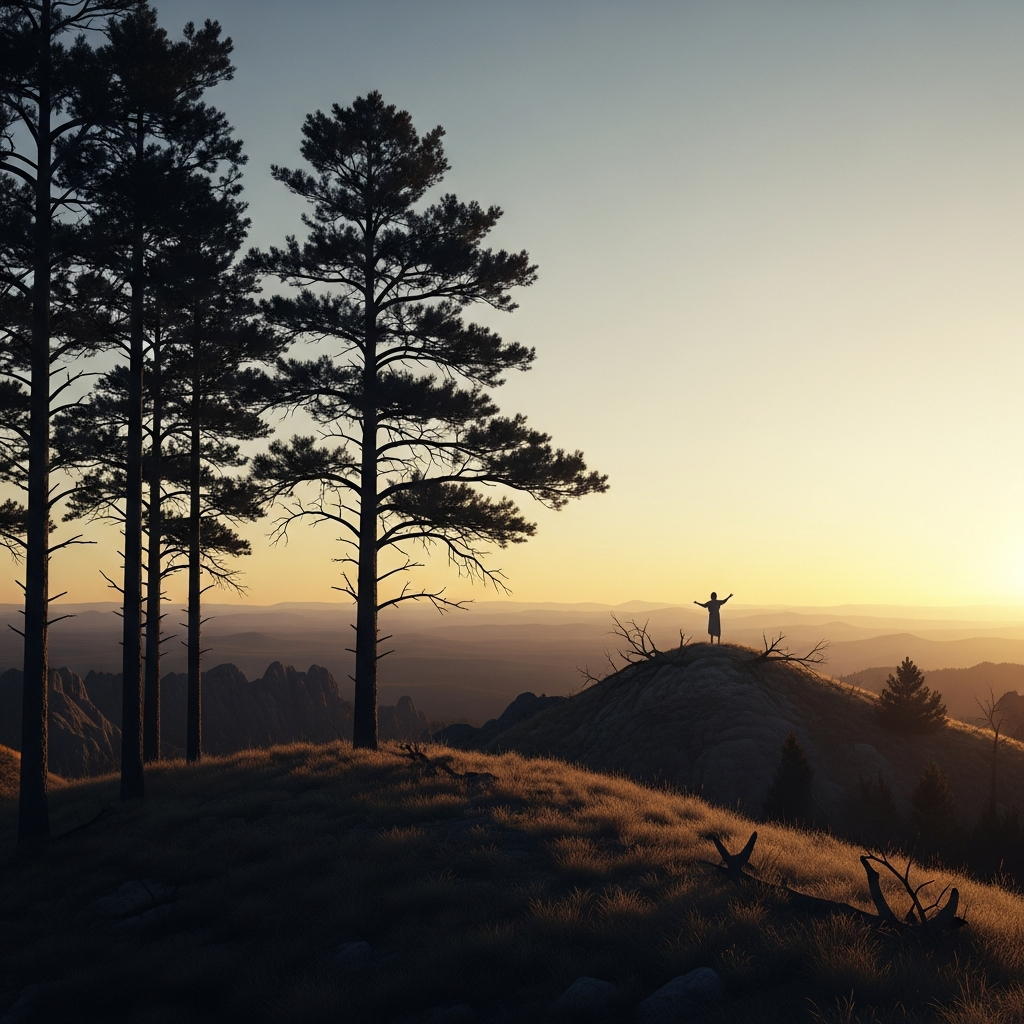 Generating art…
 Echoes Across Traditions
Entities
- Black Elk
- the Grandfathers
- the Thunder Beings
- the Morning Star
Sources
- John G. Neihardt, *Black Elk Speaks: Being the Life Story of a Holy Man of the Oglala Sioux* (William Morrow, 1932; University of Nebraska Press, 2000)
- Raymond J. DeMallie (ed.), *The Sixth Grandfather: Black Elk's Teachings Given to John G. Neihardt* (University of Nebraska Press, 1984)
- Vine Deloria Jr., *God Is Red: A Native View of Religion* (Fulcrum Publishing, 1973; 3rd ed. 2003)
- Joseph Epes Brown, *The Sacred Pipe: Black Elk's Account of the Seven Rites of the Oglala Sioux* (University of Oklahoma Press, 1953)
- Clyde Holler, *Black Elk's Religion: The Sun Dance and Lakota Catholicism* (Syracuse University Press, 1995)