Combat Profile
Wild Fury
Enkidu channels primal rage to devastate foes with overwhelming physical force, growing stronger as civilization recedes from his form.
Feral Bond
Enkidu communes with beasts and wild places, granting him natural resilience and the ability to understand the language of all creatures.
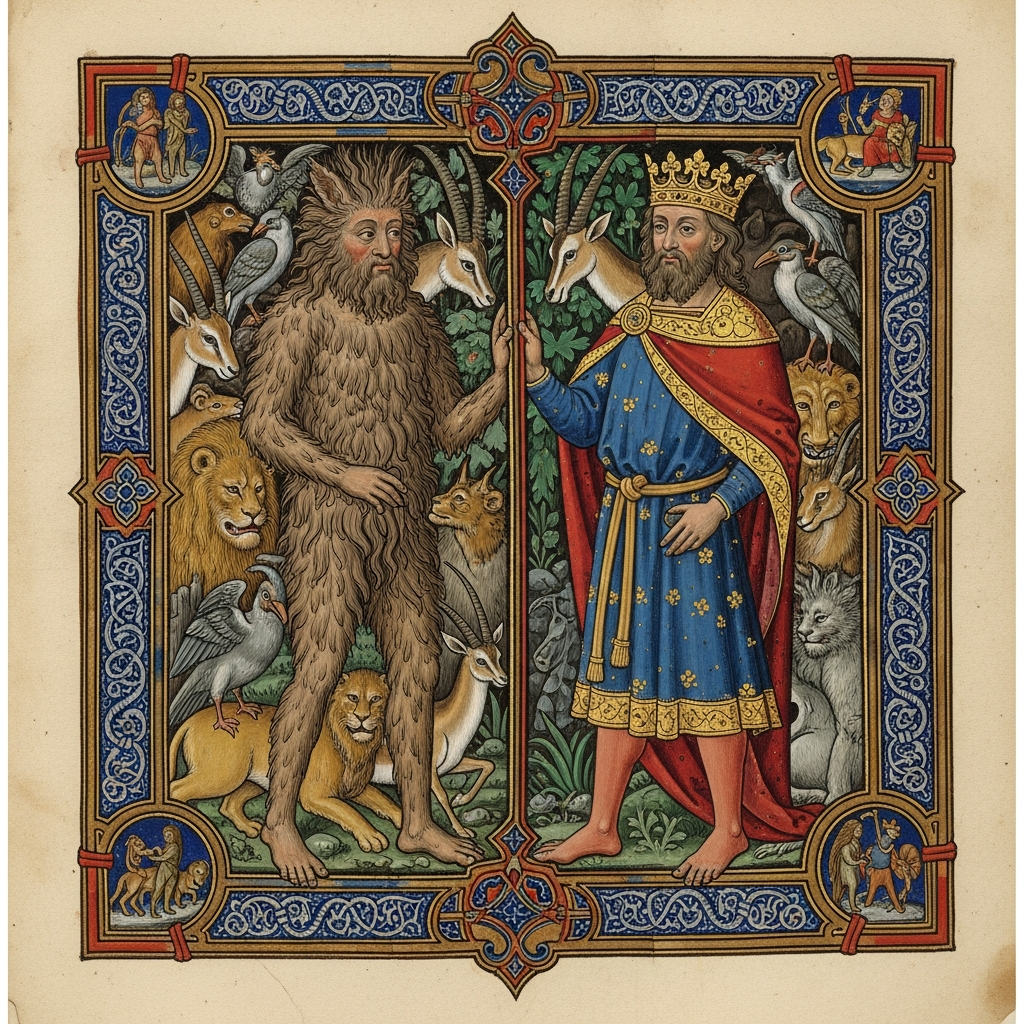
“Aruru washed her hands, pinched off clay, and threw it into the wilderness. She created Enkidu, a hero, a zikru of Ninurta. His whole body was shaggy with hair, he had a full head of hair like a woman.” — Gilgamesh I
Enkidu is the Mesopotamian Adam. The goddess Aruru creates him from clay in the wilderness (Epic of Gilgamesh I), where he lives naked among the animals, drinking at their watering holes, knowing nothing of civilization. He is then “civilized” by a woman — the temple priestess Shamhat, who sleeps with him for six days and seven nights (Epic of Gilgamesh I), after which the animals flee from him and he gains wisdom but loses his primal innocence. This is Eden in explicit, unflinching terms: a being shaped from earth, placed in a natural paradise, innocent of knowledge, and then irrevocably changed through a woman and the acquisition of consciousness (Epic of Gilgamesh I-II; Genesis 2:7). Even the consequence mirrors Genesis: Enkidu gains wisdom but is cut off from the natural world and eventually dies (Epic of Gilgamesh VII). Where Adam loses Eden, Enkidu loses the steppe. Both stories say the same thing: knowledge costs innocence, and innocence costs immortality (Epic of Gilgamesh I-VII; Genesis 3).
1 min read
Epic of Gilgamesh I-VII