Rabia al-Adawiyya and the Two Buckets
Late Umayyad and Early Abbasid period, Basra - c. 717-801 CE · Basra, in the marshlands of southern Iraq — slave market, caravan city, and the unlikely cradle of Islamic mysticism
Contents
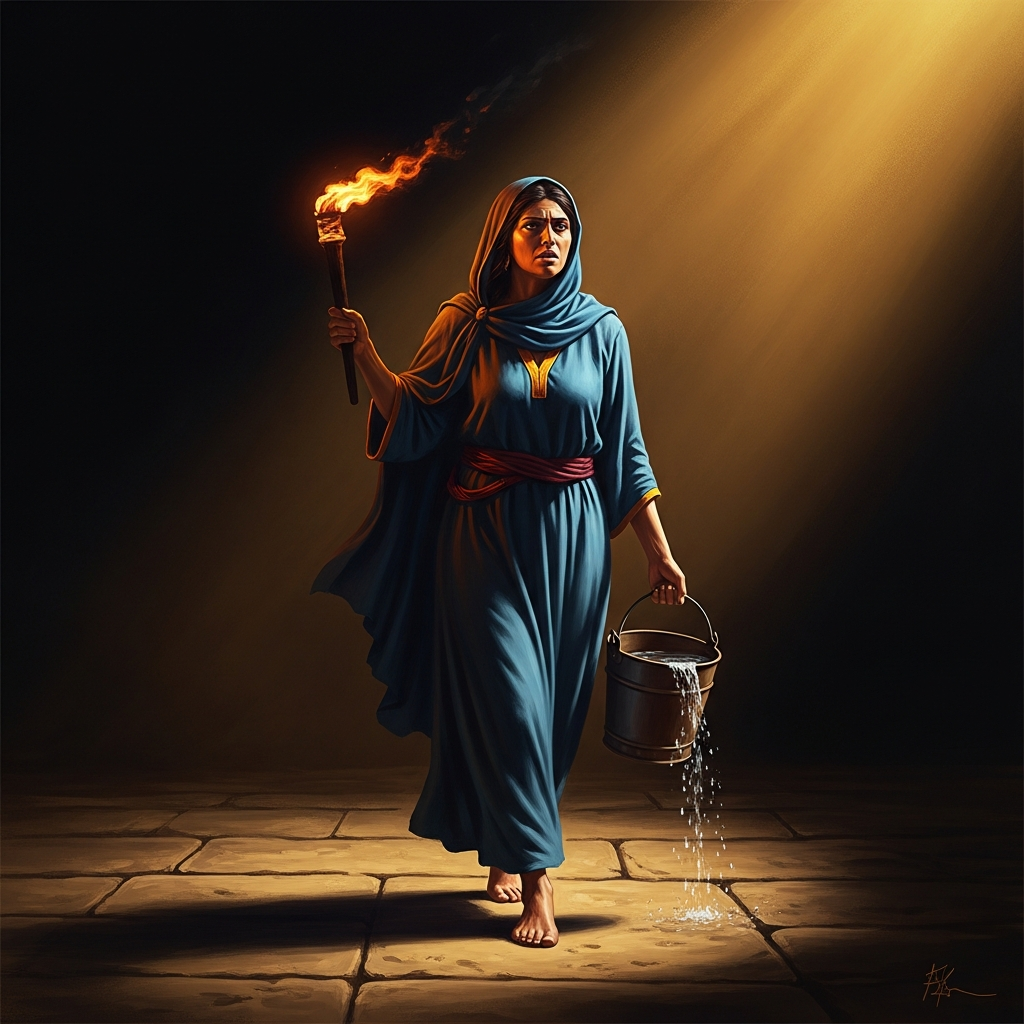
Basra, 8th century. A woman walks the streets of the city with a bucket of water in one hand and a burning torch in the other. The water is to extinguish hellfire. The torch is to burn down paradise. What she is clearing away is the last impurity in religion: the motive.
- When
- Late Umayyad and Early Abbasid period, Basra - c. 717-801 CE
- Where
- Basra, in the marshlands of southern Iraq — slave market, caravan city, and the unlikely cradle of Islamic mysticism
It is the hour when the market is loudest, the worst possible time to make a theological argument.
She does not wait for a better time. She walks out of her room — the bare room with the brick pillow and the reed mat and the clay jug, the room she has had since her master freed her, the room she has refused to trade for any of the better rooms offered by Basra’s wealthy — and she picks up two things. A bucket of water, drawn from the canal. A torch, lit from the fire she keeps for the night vigils.
The stones of the Basran street are too hot for sandals. She goes without sandals.
She has been building to this for years. It has been arriving in the form of prayers, said in the dark, said in the desert beyond the city walls, said in the intervals between water-carrying, which was her work before her master freed her.
The prayer goes like this:
O God, if I worship Thee in fear of hell, burn me in hell. If I worship Thee in hope of paradise, exclude me from paradise. But if I worship Thee for Thine own sake, withhold not from me Thine eternal beauty.
She has been saying this for twenty years, in private, to no audience except the God she is addressing. It is the most radical sentence in early Islamic theology, and it is spoken by a woman in a slave’s room, not in a madrasa, not in a mosque, not in the court of the caliph.
Today she takes it outside.
The merchants stop watching their scales. The water-sellers set down their skins. A boy with a basket of dates freezes in the middle of the street.
Mother Rabia, where are you going with fire and water in the heat of the day?
She does not slow down. To set paradise alight, she says. And to put out the fires of hell.
The crowd that follows her to the canal is not large at first. Two students of Hasan al-Basri who recognize her from the mosque vigils. An old woman who shared bread with her once. By the time she reaches the water, people are shouting the question.
She turns. The torch flares in the desert wind. The bucket sloshes.
I want to set fire to paradise, she says, and pour water on hell. So that the veil of these two may be lifted from the people’s hearts. So that we may see who worships God for God’s own self, and who worships only for reward and fear.
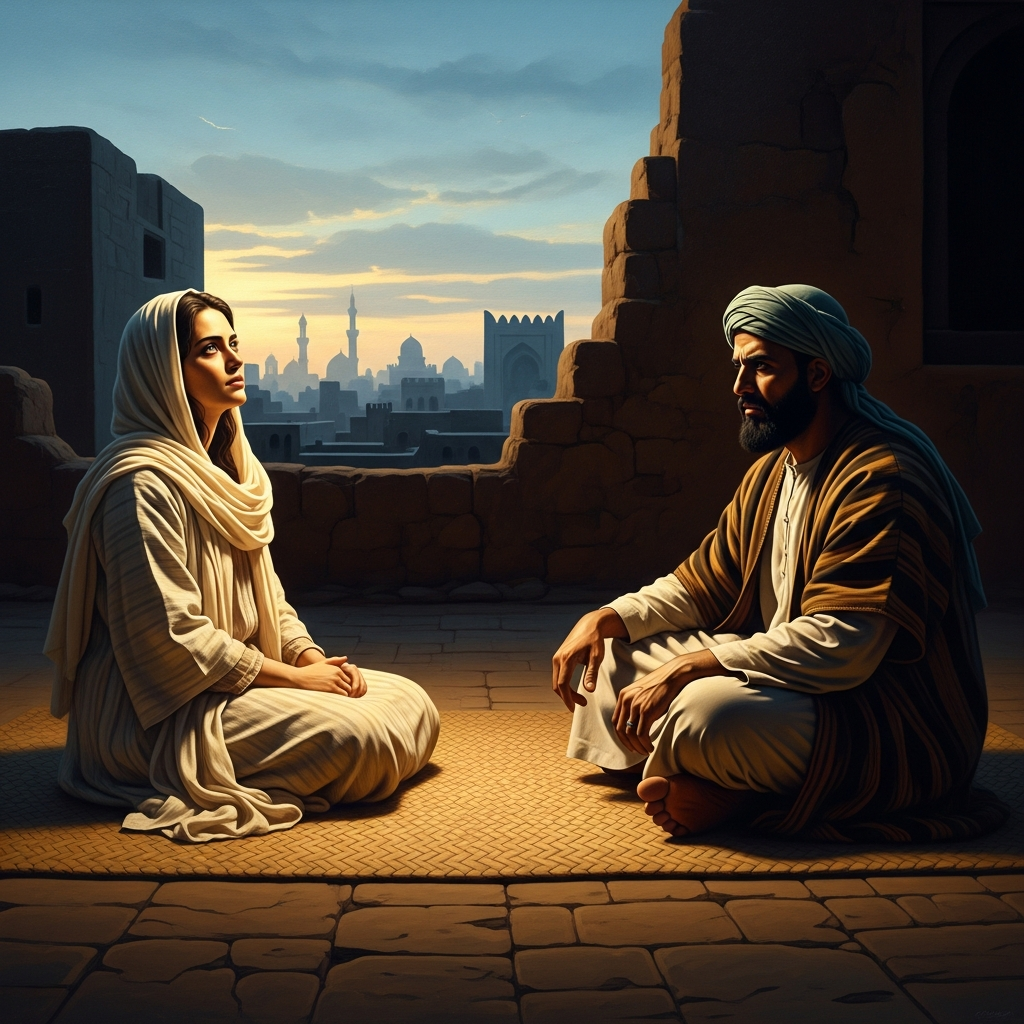
Hasan al-Basri heard her say a version of this one evening on a rooftop in Basra.
Hasan is the great preacher of the city — the man who has spent decades teaching Basra to weep over its sins, to tremble before divine justice, to stand in the mosque with the vivid picture of hell in mind and let the fear of it drive the prayer. He is also a genuine mystic, one of the first to teach the tawakkul — the radical trust in God — that will become central to Sufism. He respects Rabia. He is also slightly afraid of her.
He sits on one end of the rooftop mat. She sits on the other. Below them, Basra makes its nighttime sounds. Between them the theological distance is more than the length of the mat.
Do you not fear the punishment of God? he asks her.
I love Him too much to fear Him, she says. The love that fears its object is not yet love — it is still hope dressed as devotion.
He is quiet for a long time. Then: Do you not hope for His mercy?
Of course, she says. But I hope for it because He is merciful, not because I want to be rescued. The man who hopes for mercy in order to arrive safely at the Garden is still doing the arithmetic of reward. I want to stop the arithmetic.
Hasan writes down what she says. His students copy it. It travels north with the caravans.
The theology she is constructing with her two buckets is not comfortable and is not meant to be.
Religion, as it is generally practiced in Basra and everywhere else, runs on the exchange. You pray, you fast, you give alms, and God credits the account. You sin, you confess, you repent, God debits less than you owe. The Garden is the return on the investment. The Fire is the penalty for default. The system is rational. The system is, in its way, just. The system is also, Rabia is saying, a kind of spiritual commerce in which God is the merchant and you are the customer and love is not required by either party.
She is not saying the Garden does not exist or the Fire does not exist. She is saying that if your relationship to God is structured by them — if you would love Him less without the Garden, or cease to love Him if the Fire were real — then you have not yet arrived at love. You have arrived at a transaction that resembles love.
The sentence that stops the merchant in the street and makes the student sit down in the dust is not the sentence about the fire or the bucket. It is the sentence underneath: because He is. She loves God because God is. Not because God rewards. Not because God forgives. Because there is a Being that is the source of all being, and the correct response to such a Being, in Rabia’s understanding, is not calculation. It is the total gift of the self with no return expected.
She tips the bucket into the canal. The water disperses, gone in seconds under the Basran sun.
She holds the torch over the water. The flame hisses, gutters, dies in a thread of black smoke.
The crowd watches. Nobody is quite sure what they have seen. A performance. A teaching. A woman who is slightly mad from the years of prayer and asceticism and the heat of a bare room. A saint.
She turns and walks back the way she came.
The boy with the dates will tell the story to his grandchildren. The students of Hasan al-Basri will write it down tonight and argue about it for years. One of them will eventually say: she has done what the theologians have been trying to do with arguments — she has separated the love from the transaction. She has shown the love by itself, without the scaffold of reward and punishment, in the middle of the street in the heat of the afternoon.
The Sufi orders that emerge from Basra and Khorasan and Baghdad over the next two centuries will argue about many things. They will not argue about Rabia. They will quote her. Every order, every tradition within the tradition, every teacher who comes after her will cite the prayer about the fire and the garden. Rumi will write about the love that burns every reason for loving. Al-Hallaj will stand on the gallows and smile, which is the same gesture. Ibn Arabi will spend a hundred chapters on the divine love as the cause of creation.
All of them are writing her prayer in longer forms.
She lives to be old. She goes blind in one eye. She is still poor. She turns down every marriage proposal — the suitors include men of rank and reputation, and Hasan himself may have asked — with the same answer: I am not available. I am busy being married to the Truth.
When she dies, sometime around the end of the second Islamic century, she is buried outside Basra in a grave that is unmarked and soon forgotten. No shrine. No visible relic. The only thing that survives is the sentence, copied and recopied:
If I worship Thee in fear of hell, burn me in hell.
Attar tells her story in the Tadhkirat al-Awliya two centuries after her death. He places her chapter first in the book, ahead of all the male saints, with an explanation: she is first not because she is a woman or despite being a woman, but because she is the one who said the necessary thing most clearly.
The torch and the bucket are almost certainly literary. Two centuries of oral transmission reshape events into their meaning. But the prayer is hers, and it is older than Attar, and the prayer is the torch.
What she burned down in the middle of the Basran street was not paradise. What she extinguished was the model of God as merchant. And that act of clearing — that removal of fear and hope as primary motives, leaving only the love that needs no reason — is the ground on which everything that follows in Sufi theology is built.
The ground is bare because she stripped it. The bare ground is the gift.
Scenes
Under the noon sun of Basra, barefoot on the hot stones, Rabia walks with a torch in one hand and a sloshing bucket in the other, her face set like a woman with somewhere to be
 Generating art…
 On a Basran rooftop at the hour before dawn, Rabia and Hasan al-Basri sit at opposite ends of the mat, and the distinction between their theologies is visible in the quality of their silence
 Generating art…
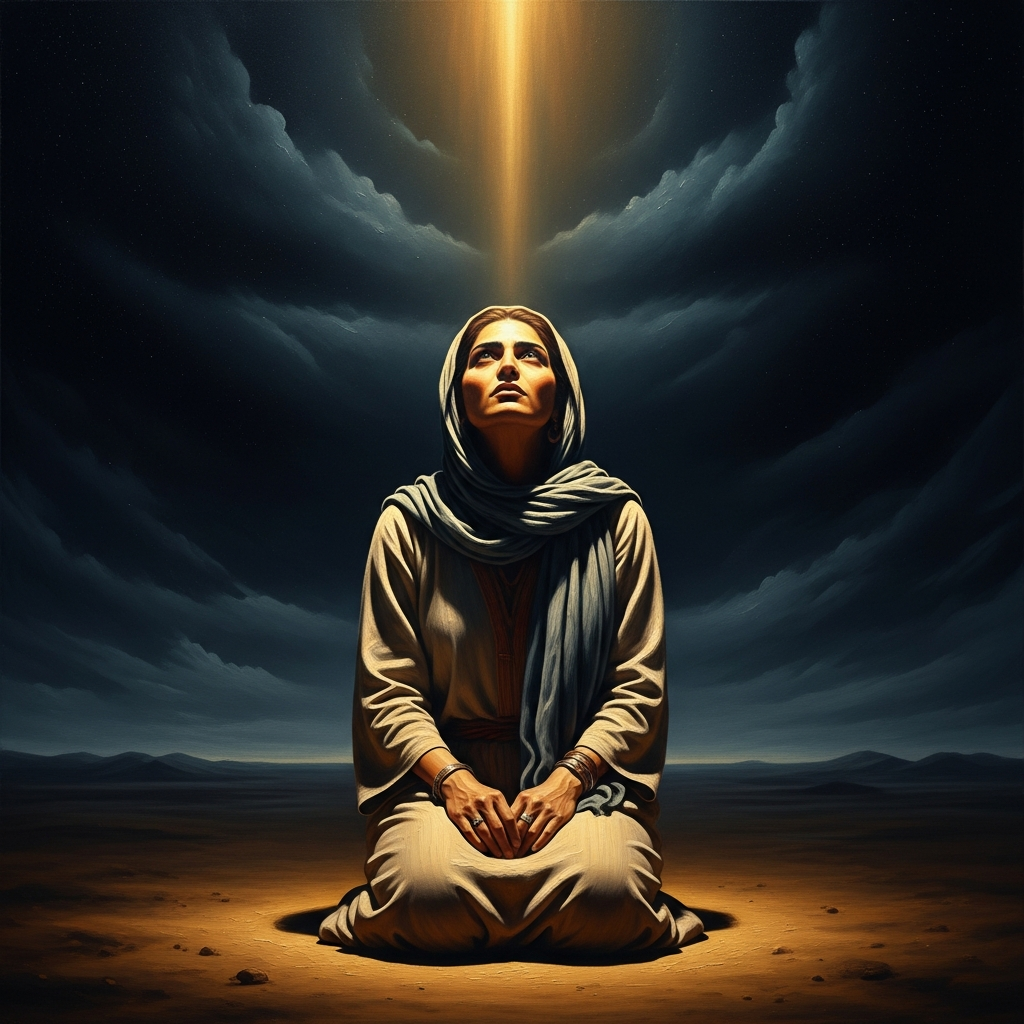
 Alone in the desert beyond Basra, Rabia kneels on the cooling sand with nothing between her and the sky, speaking to God with the directness of a woman who has removed every intermediary including reward
 Generating art…
 Echoes Across Traditions
Entities
- Rabia al-Adawiyya
- Hasan al-Basri
- the people of Basra
- the Beloved
Sources
- Farid al-Din Attar, Tadhkirat al-Awliya (Memorial of the Saints), c. 1220, the chapter on Rabia al-Adawiyya
- Margaret Smith, Rabia the Mystic and Her Fellow-Saints in Islam (Cambridge University Press, 1928)
- Annemarie Schimmel, Mystical Dimensions of Islam (University of North Carolina Press, 1975), ch. 1
- Rkia Cornell, Rabia from Narrative to Myth: The Many Faces of Islam's Most Famous Woman Saint (Oneworld, 2019)
- Michael Sells (trans.), Early Islamic Mysticism: Sufi, Quran, Miraj, Poetic and Theological Writings (Paulist Press, 1996)