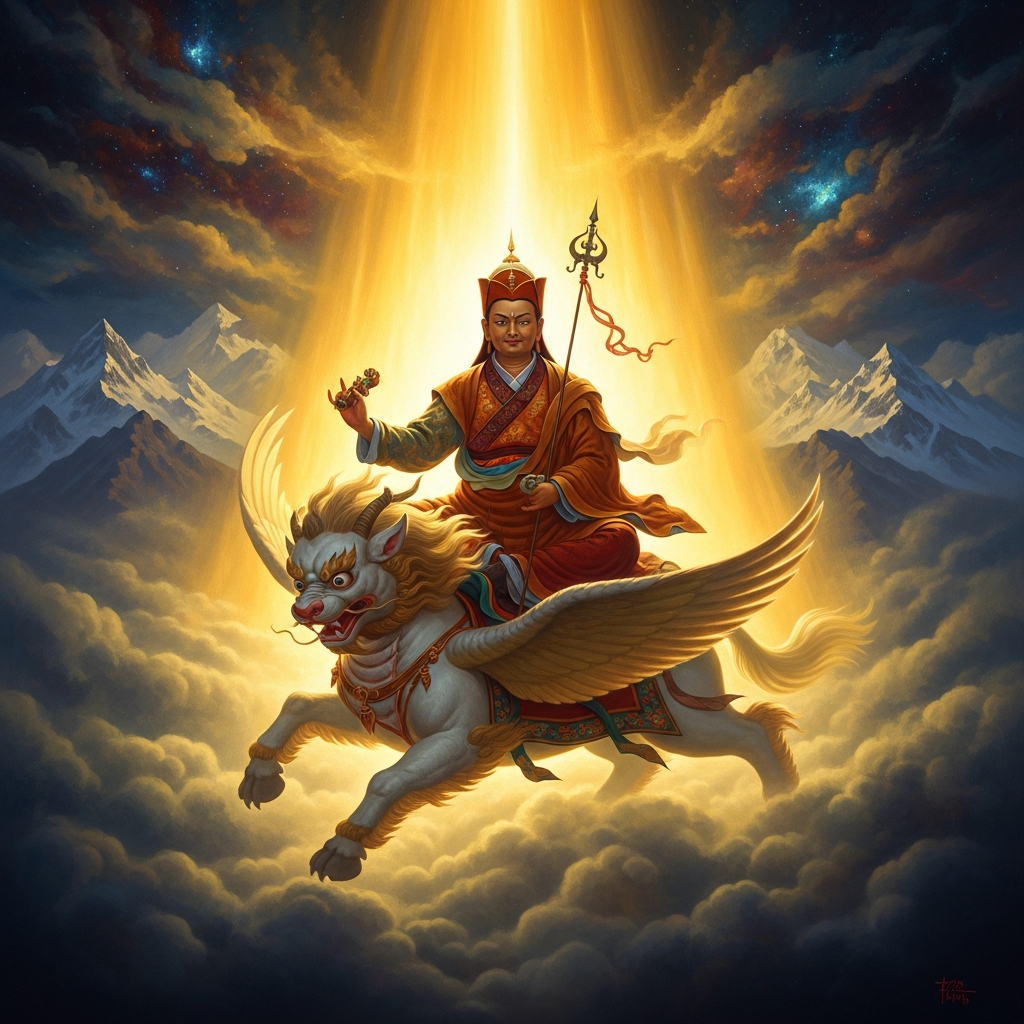
Padmasambhava Arrives in Tibet
c. 762-779 CE · the Tibetan plateau · from the Mangyul border pass to Samye Monastery in the Yarlung valley, Tibet
Contents
King Trisong Detsen summons the tantric master Padmasambhava to Tibet because local spirits are destroying the construction of Samye Monastery. Padmasambhava subjugates 108 spirits, establishes the first Tibetan monastery, initiates the first monks, and hides treasure-teachings in the earth for future discoverers.
- When
- c. 762-779 CE · the Tibetan plateau
- Where
- from the Mangyul border pass to Samye Monastery in the Yarlung valley, Tibet
The problem with building a monastery in Tibet in 762 CE is that the land was occupied before Buddhism arrived, and the occupants have opinions.
King Trisong Detsen understands this intellectually. He is twenty-five years old, the son of a Bön-influenced father, and he has decided — after reading whatever Buddhist texts reached his Yarlung valley court from China and India — that Tibet should have the dharma. He has invited the most accomplished Buddhist scholar in India, Shantarakshita the abbot of Nalanda, to come and establish it.
Shantarakshita arrives. He identifies the site for the monastery in the Yarlung valley — a flat expanse of good ground, close to the river, visible from the hills. He begins planning the construction. The ground crew starts laying foundations.
The next morning the foundations have collapsed. Lightning struck three of his translators. One of his monks has developed a fever that no medicine touches. The river has flooded the site overnight, which is not the season for floods.
The local lha — the mountain gods, glacier-spirits, lake-witches of the pre-Buddhist Bön cosmology — recognize correctly what is happening. A monastery here means the dharma here means the beginning of the end of their arrangement with the population. They respond with the tools available to them: weather, disease, structural failure, the small constant erosions of a landscape defending itself.
Shantarakshita stays for a year. Then he gives up. Before he leaves, he tells the king: there is one man who can solve this. He is from Oddiyana — the Swat Valley, northwest India. His name is Padmasambhava. He was born from a lotus. He does not negotiate with mountains. He commands them.
Padmasambhava arrives through the Mangyul pass on the western border.
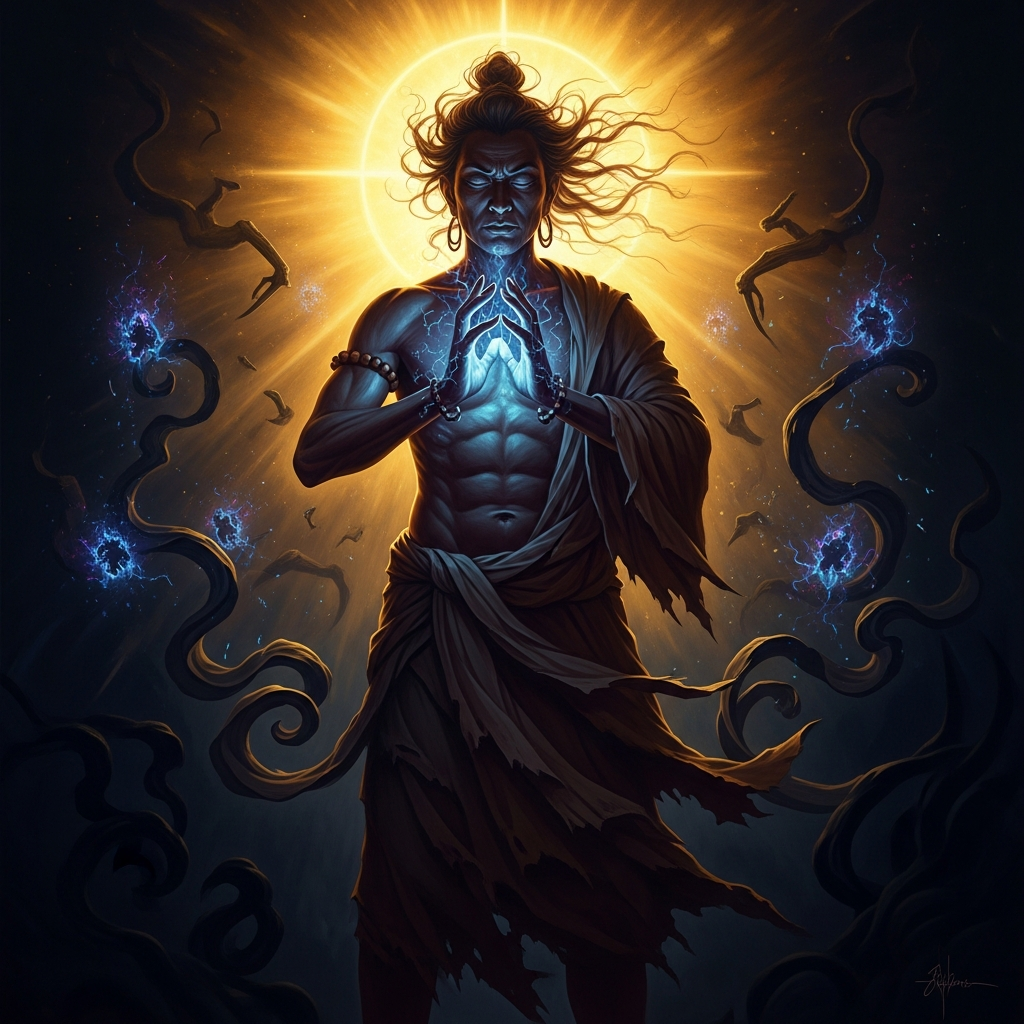
He is a figure of such peculiarity that the hagiographies spend considerable time establishing his credentials before he ever sets foot in Tibet: born spontaneously on a lotus blossom in Lake Dhanakosha, never from a womb; trained at Nalanda in both the scholastic and the wrathful tantric traditions; survived an attempt by the king of Zahor to burn him alive by converting the pyre to a lake; spent decades in cremation grounds with the great mahasiddha teachers, learning the practices that institutional monasteries do not teach. He arrives carrying a vajra — the ritual thunderbolt — and a phurba, the three-bladed ritual dagger of the tantric tradition, and the complete transmission of the Vajrayana.
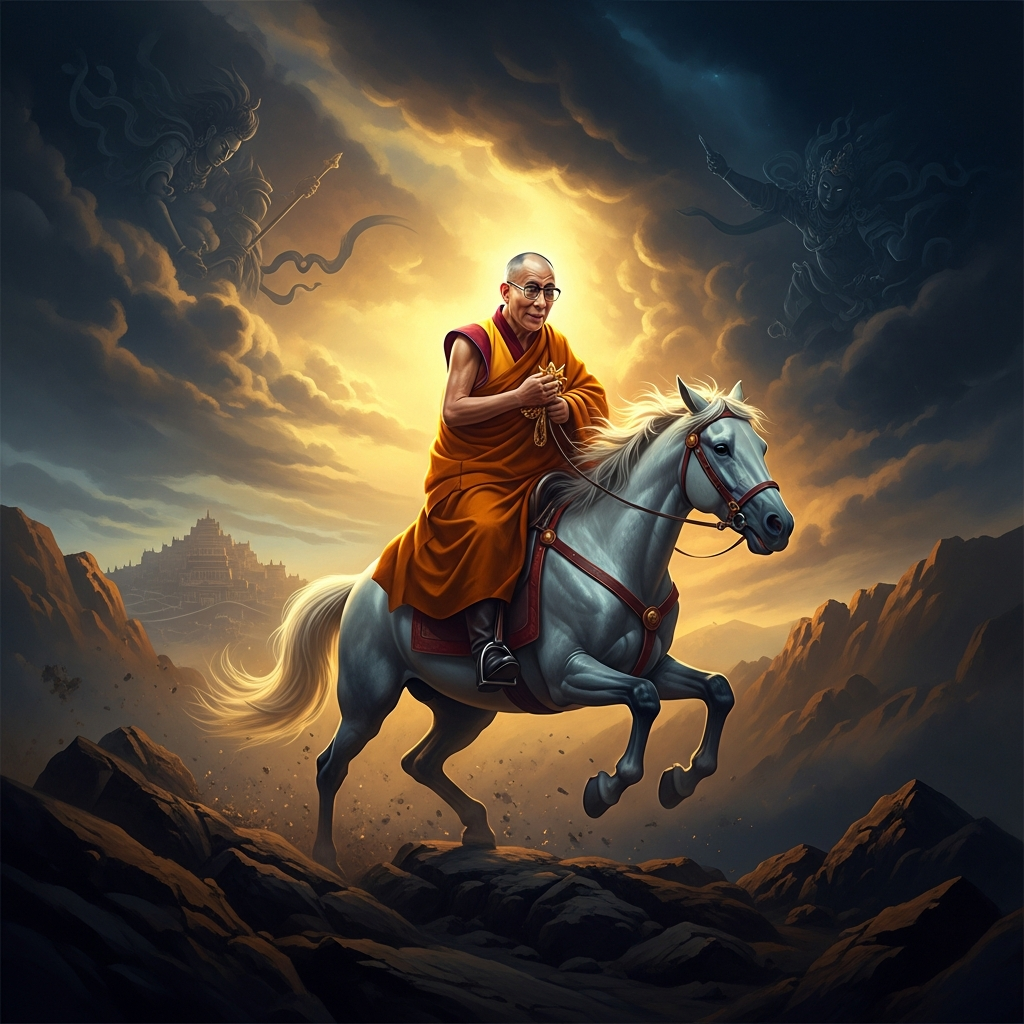
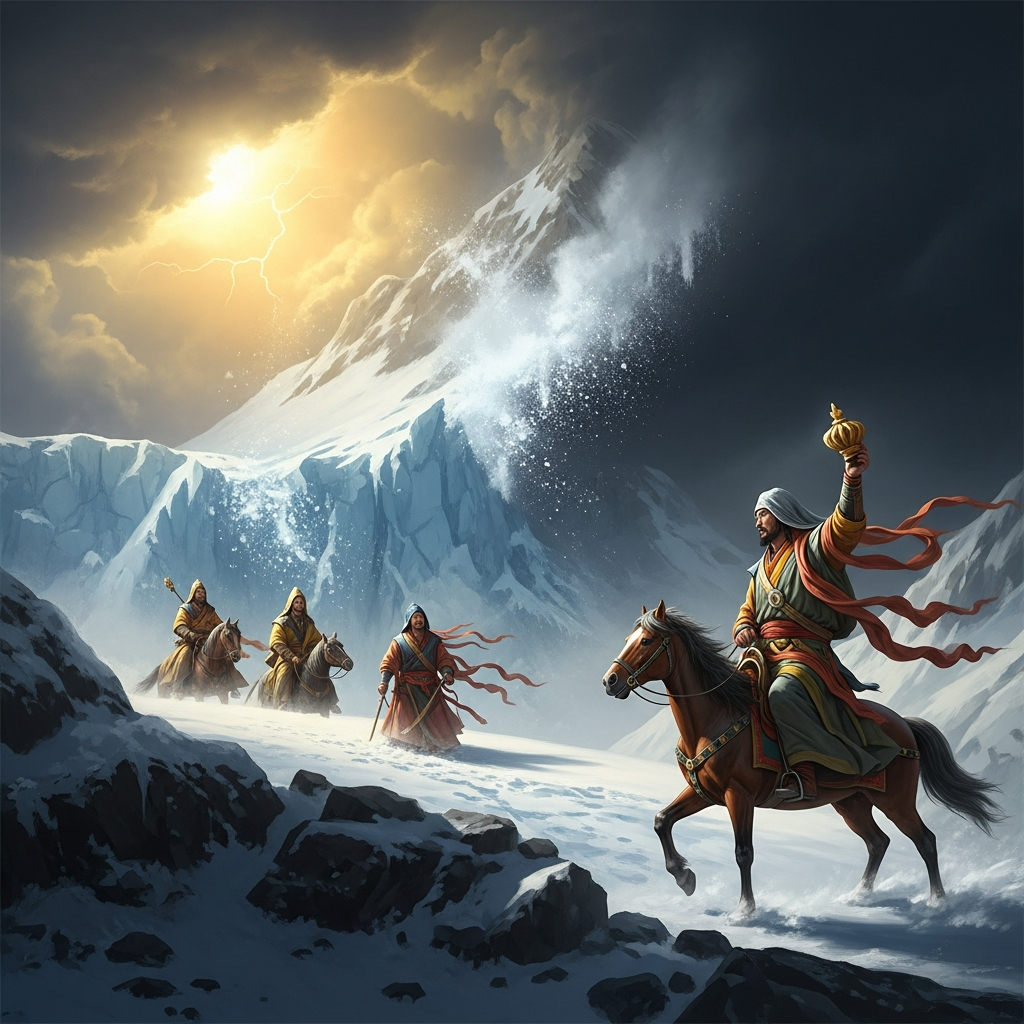
The first spirit meets him on the pass. It comes as a blizzard — a wall of weather rolling down the col at killing speed, the kind of storm that has stopped armies. He stops his horse. He chants the Vajrakilaya mantra — the syllables of the diamond dagger, the wrathful practice that can cut through spirit-matter — and points the phurba at the heart of the storm.
The texts say the blizzard freezes. Each snowflake hangs suspended. The spirit is forced into visible form and kneels in the snow.
He does not destroy it. He speaks to it: take the vow. From this moment you are the protector of this pass, not its predator. You will guard the travelers you used to bury. You will serve the dharma that has not yet arrived on this mountain. Refuse, and I will dissolve you into the syllables you came from.
The glacier-spirit takes the vow. He names it. The horse moves on.
He does this mountain by mountain, lake by lake, pass by pass across the entire plateau between the western border and the Yarlung valley.
The twelve Tenma goddesses — the great witches of the cardinal directions who have been eating travelers since before any king’s writ reached this altitude — arrange a confrontation on the slopes of Mount Hepori. They arrive in their war-form: fanged, crowned with skulls, necklaced in severed heads, riding on clouds of bone-smoke, hungry in the specific way of beings who have never been refused. They demand his liver.
He invites them to sit.
He explains, with what the texts describe as terrible patience, the arithmetic of karma: every liver they have eaten is a debt their next thousand rebirths will service. He itemizes this. He does not threaten them with destruction — he describes the consequences of their current behavior with the precision of an accountant reading a ledger back to a debtor who had not known the terms. Then he offers the alternative: take the oath. Your hunger will be redirected. You will consume only the obstacles to dharma, not its practitioners. Your mountains remain yours. Your names remain yours. You remain.
The youngest takes the vow first. The eldest takes it last. He gives each one a samaya name — a vow-name, binding them to the oath — and they are still invoked, by those names, in every Nyingma ritual today. The twelve Tenma, in their original Bön iconography of fangs and skull-crowns, now standing watch over the dharma they would have destroyed.
He reaches the Yarlung valley and the site of Samye.
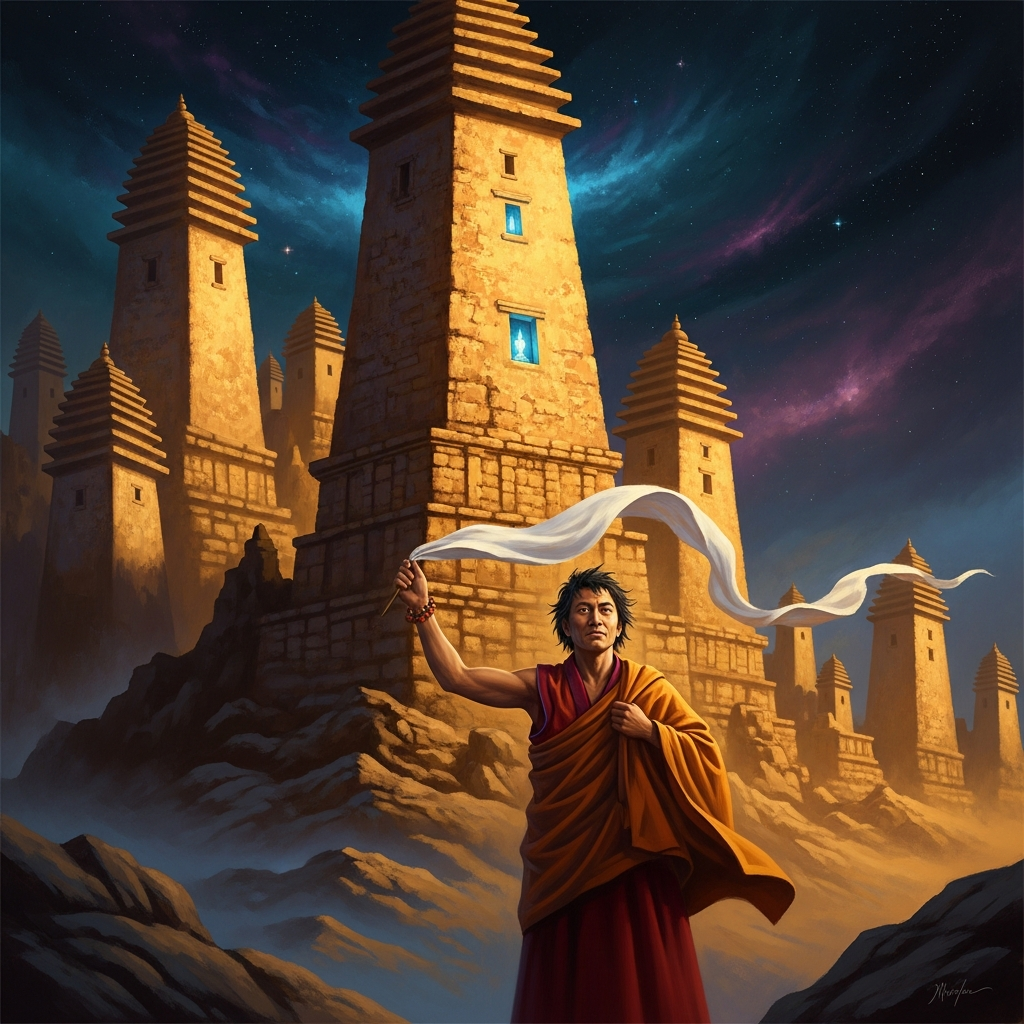
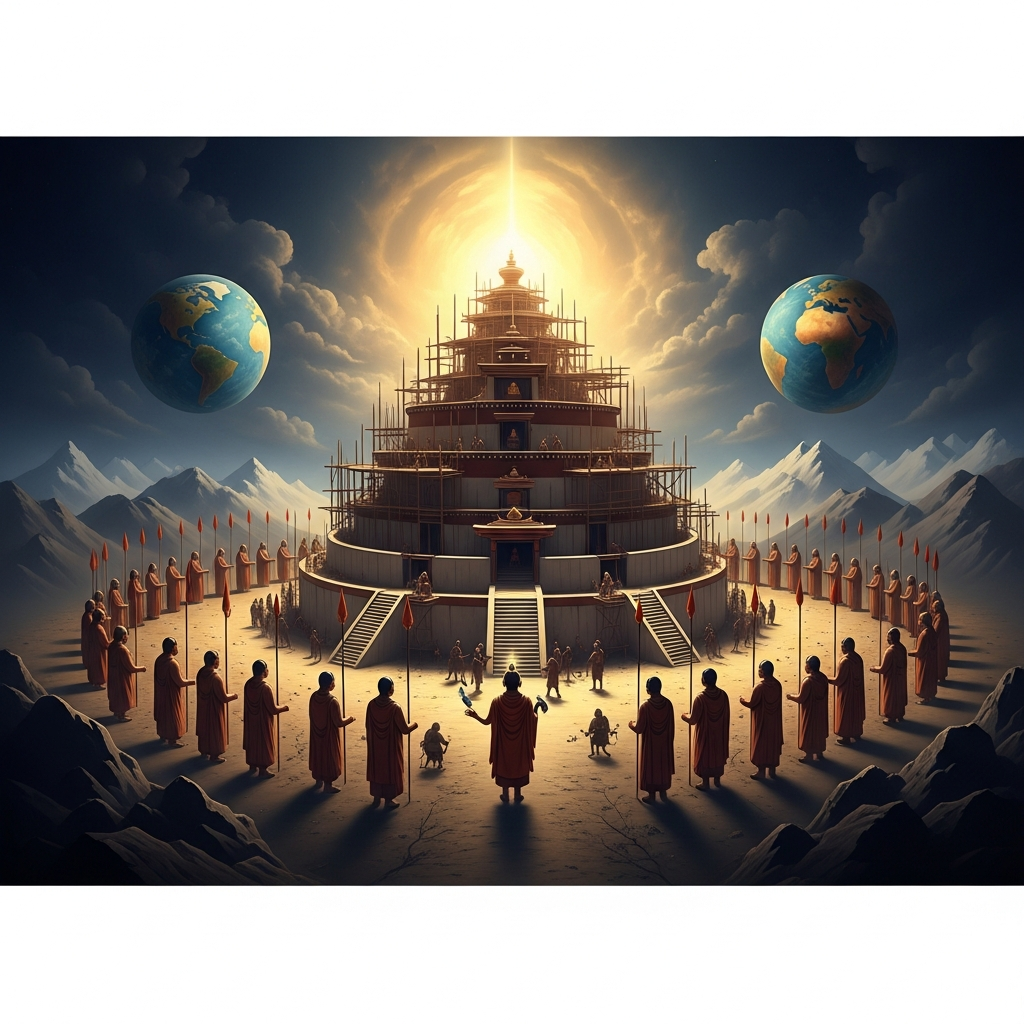
Trisong Detsen is waiting. Shantarakshita has returned from India. The three of them — king, scholar, tantric master — preside over the construction of the first monastery in Tibetan history. Padmasambhava designs it as a mandala of the cosmos: a central temple for Mount Meru at the axis of existence, four temples at the cardinal points for the four continents, eight smaller temples for the subcontinents, the whole structure oriented to the directions that now have their demon-protectors standing guard.
Construction begins. Every evening, as the workers set down their tools, Padmasambhava walks the perimeter and calls each bound spirit to its post. The mountain-gods who pulled down Shantarakshita’s foundations now hold up Samye’s walls. The construction takes approximately seventeen years. The texts say it would have taken longer, or failed entirely, if the perimeter walk had ever been skipped a night.
Samye is consecrated in 779 CE. The first seven Tibetan monks are ordained inside it by Shantarakshita. Padmasambhava names them. The lineage that begins with those seven runs, unbroken, to the present Nyingma tradition.
Before he leaves, he hides the teachings.
Not in libraries, not in texts that future scholars can find by looking — in rocks, in lakes, in the landscape itself and in the prepared minds of his students. He calls these terma, treasure-texts, and the practitioners who will find them in future centuries he calls tertons, treasure-revealers. He identifies them in advance — the karmic connections are already established, he says; the terton and the terma are matched pairs that will recognize each other across centuries when the time is right.
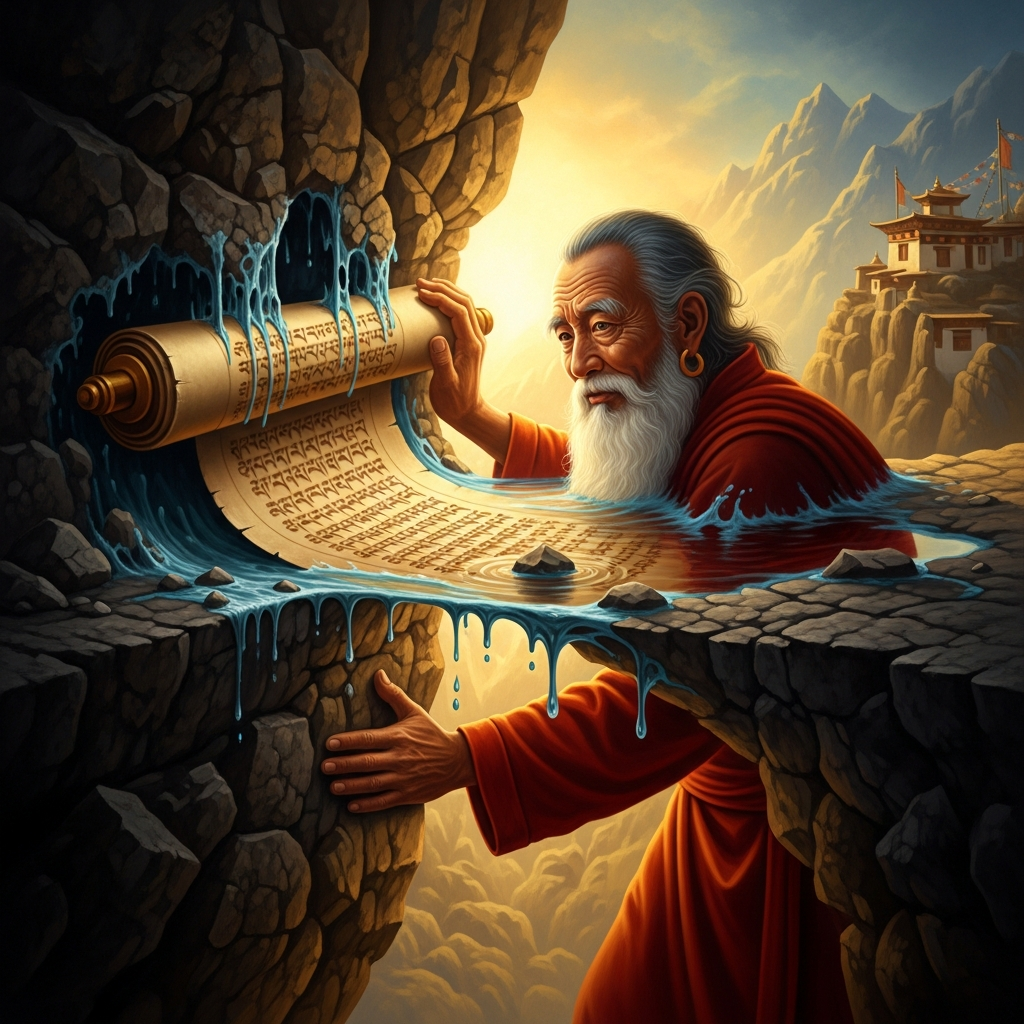
He presses a scripture into the face of the rock above Chimphu hermitage and the rock receives it. He hides a cycle of practices in the shore of a high lake that will not be found for four hundred years. He transmits a complete text on death and liberation to his consort Yeshe Tsogyal, who memorizes it and seals it in a mountain on the western plateau in 817 CE. The mountain will be excavated by the terton Karma Lingpa in the 14th century, and what emerges from it will be translated into English in 1927 as the Tibetan Book of the Dead.
He leaves Tibet, the texts agree, without dying. The horse simply walks into the air above the Gungtang plain and moves southwest toward the sky-realm of Zangdokpalri, the Copper-Colored Mountain, where he is said to still teach.
This is not a metaphor the tradition intends to soften. The Nyingma school, the oldest of the four Tibetan Buddhist schools, teaches that Padmasambhava is still accessible in the terma — that each treasure-text found by a terton is not an old teaching recovered but a live transmission received across time from a master who is still, in some sense, transmitting.
The mechanism is strange. It has, however, produced thirty-five documented major terma cycles between the 11th and 20th centuries, each one claiming to be a direct transmission from the 8th century, each one fitting, with uncanny precision, into the needs of the century in which it was found.
The demons are still under oath. The walls are still standing. The terma are still being found.
Scenes
He arrives at the Mangyul border pass on a horse the color of storm-cloud
 Generating art…
 Samye under construction: the first monastery in Tibet, built as a mandala — Mount Meru at the center, the four continents at the cardinal points
 Generating art…
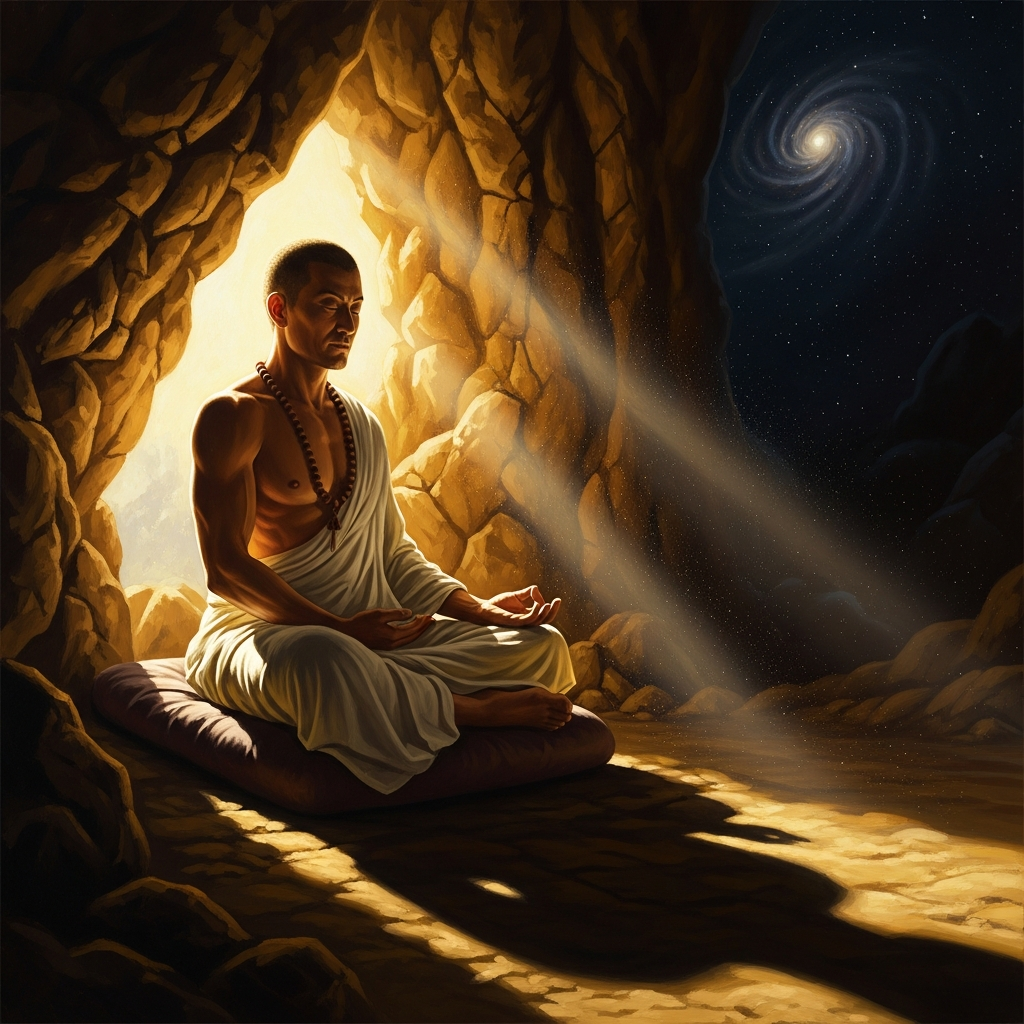
 He presses a scripture into the rock face above Chimphu hermitage, and the rock receives it like water
 Generating art…
 Echoes Across Traditions
Entities
- Padmasambhava
- Guru Rinpoche
- King Trisong Detsen
- Shantarakshita
- Yeshe Tsogyal
- the twelve Tenma goddesses
- Pehar

Sources
- *Padma Thang Yig* (the *Lotus Chronicle*, attributed to Yeshe Tsogyal, redacted 14th century by Orgyen Lingpa)
- Yeshe Tsogyal, *The Life and Liberation of Padmasambhava* (trans. Erik Pema Kunsang, Rangjung Yeshe Publications, 1993)
- Matthew Kapstein, *The Tibetan Assimilation of Buddhism* (Oxford University Press, 2000)
- Sam van Schaik, *Tibet: A History* (Yale University Press, 2011)
- Robert A. F. Thurman, *Essential Tibetan Buddhism* (HarperOne, 1995)
- Donald W. Mitchell, *Buddhism: Introducing the Buddhist Experience* (Oxford, 2002), ch. 9