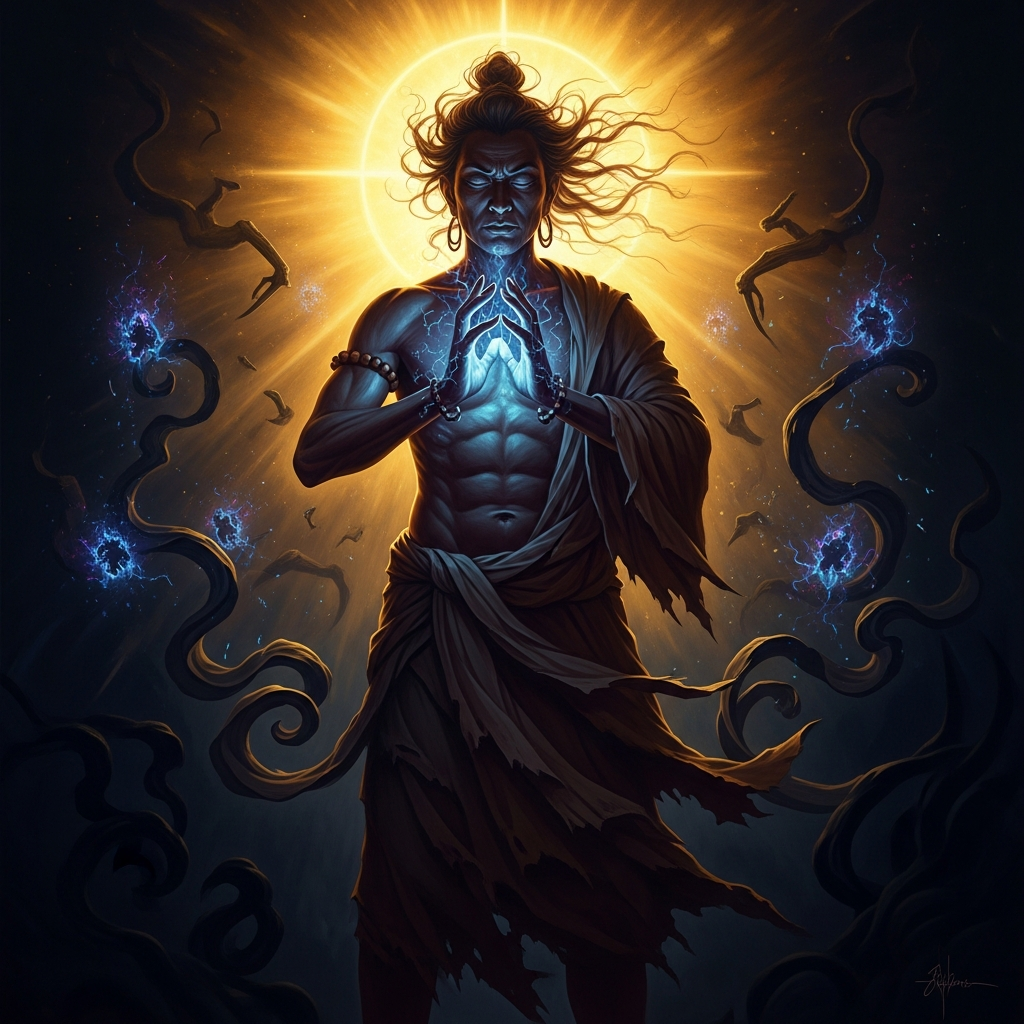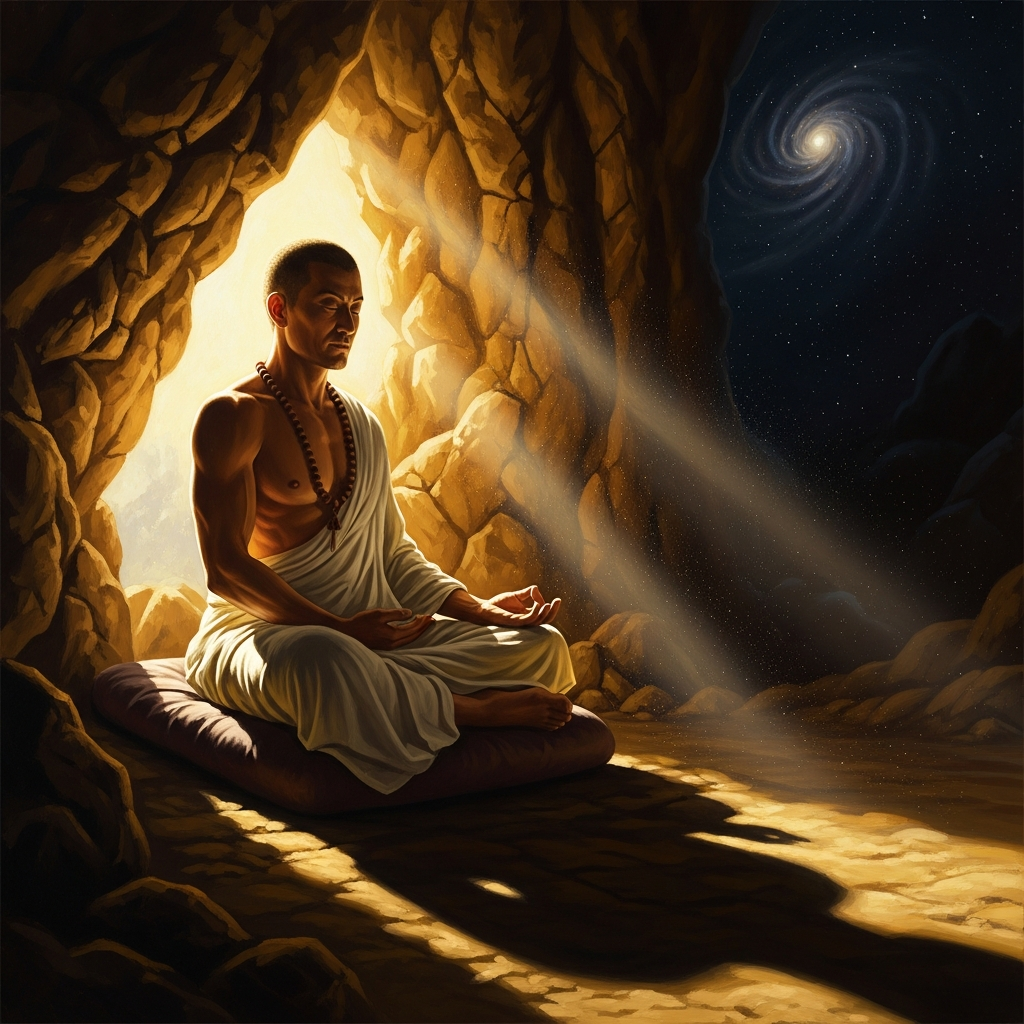
Milarepa in the Cave
c. 1092-1135 CE · the Himalayan range, central and western Tibet · Drakar Taso, Lapchi, Chubar, and other high Himalayan cave sites in Tibet and Nepal
Contents
After Marpa's initiation, Milarepa retreats to the Himalayan caves for years at a time — eating only nettles, generating yogic inner fire, composing the Hundred Thousand Songs in states of deep realization. Hunters find him and think he is a demon. He sings to them.
- When
- c. 1092-1135 CE · the Himalayan range, central and western Tibet
- Where
- Drakar Taso, Lapchi, Chubar, and other high Himalayan cave sites in Tibet and Nepal
The cave at Drakar Taso — White Rock Horse Tooth — is high enough that the air thins before you reach it, and the path above the snowline is a series of handholds cut into vertical rock by someone who was not concerned about discouraging casual visitors.
He arrives with nothing. A robe. A clay pot. The initiation Marpa gave him, held in memory. Marpa’s final instruction: practice. Don’t come back until you are done.
He does not know, at this point, how many years done will take. He suspects it will be long. He has a mountain of karma to burn through and a set of tantric practices — the Six Yogas of Naropa, transmitted through Marpa — designed to accelerate the burning. The cave is the furnace. He is the fuel.
The first years are very hard.
He eats nettles. The cave is surrounded by them — tsawa in Tibetan, a plant of no particular virtue except that it is always there and is technically edible if you boil it long enough. He boils it. He eats it. He boils it again. He has nothing to add to it — no salt, no butter, no tsampa barley — and so he eats it plain, every day, for months and then for years.
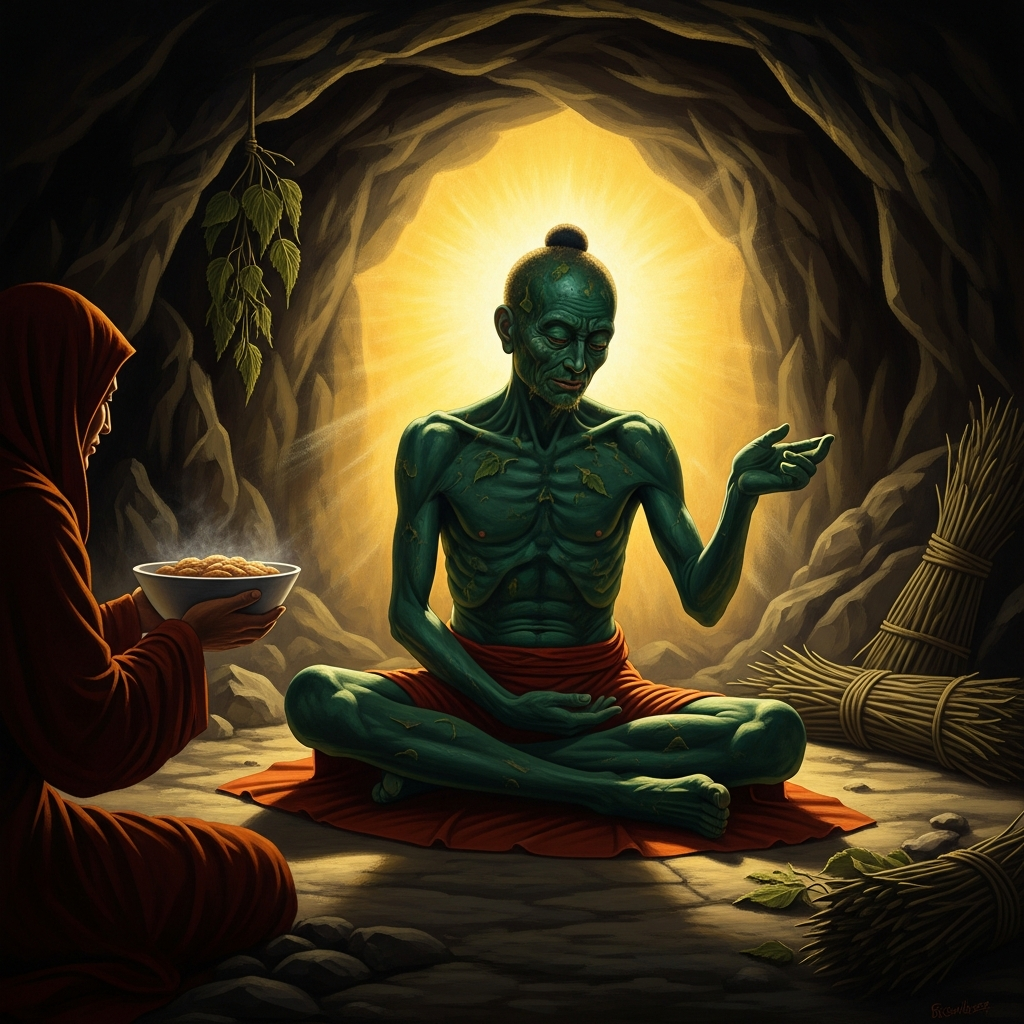
His body responds to this diet in the obvious way. He becomes thin in the specific way of a man who is consuming himself. His hair, which he does not cut, grows long and hangs in a single matted column. And his skin — this is the detail the tradition preserves with the precision of a medical observation — his skin turns green.
Not metaphorically. Green, from chlorophyll. From years of eating nothing but plants in a body that has lost the buffer of any other nutrition. When disciples eventually find him and are troubled by the greenness, he tells them it is fine. He says: the nettles are teaching me something about impermanence that eating well never would.
He learns tummo.
Tummo is the Tibetan term for one of the Six Yogas — the yogic inner fire, a set of breathing, visualization, and energy-channel practices that generate physiological heat as a byproduct of the body’s energetic systems being redirected. The Tibetan term means literally fierce woman — the inner fire is personified as a female force, a flame in the navel that rises up the central channel when the practice is working.
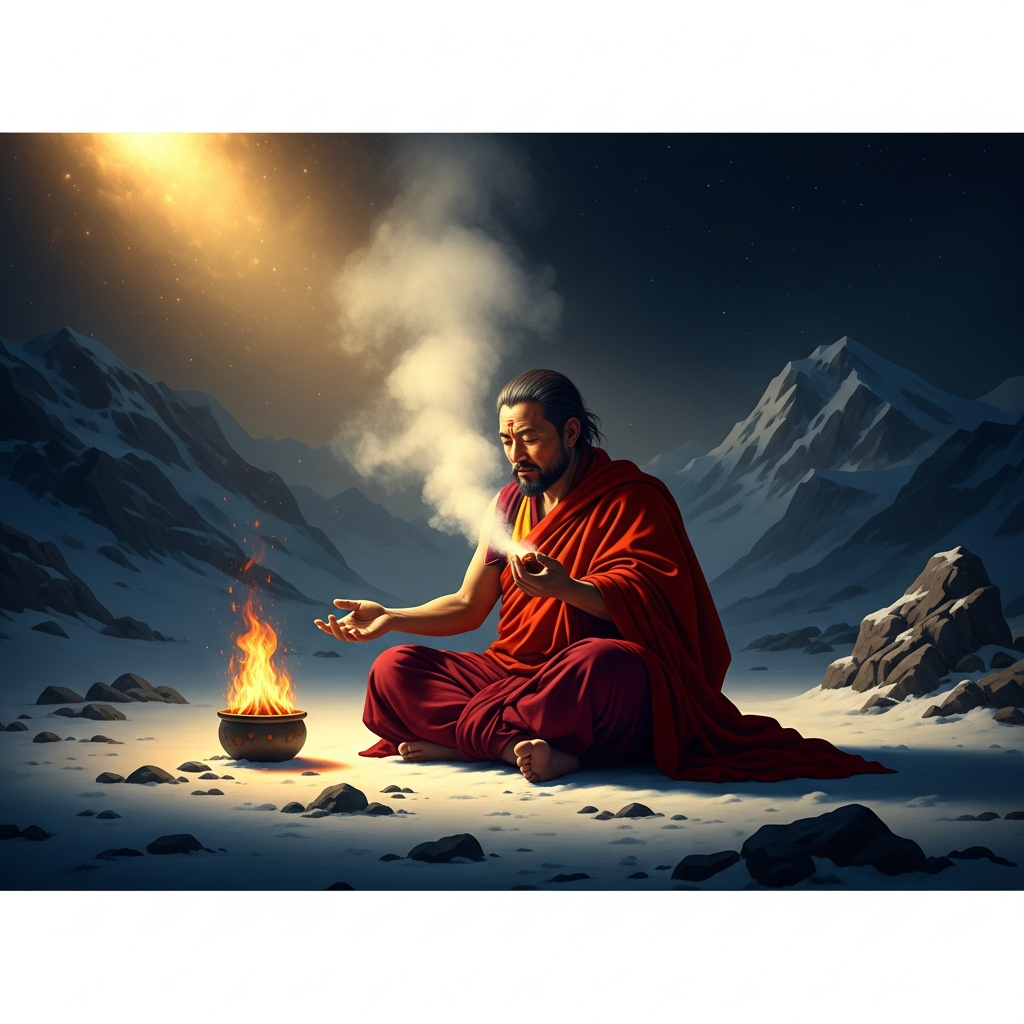
When the practice is working, the body produces heat. Measurable, external, embarrassing amounts of heat. His robe — he eventually acquires a single cotton robe, the repa, the cotton-clad one, from which the Tibetan practitioner-class repas take their name — steams in the winter cold. He sits in snowfields at altitude without moving for days at a time and the snow melts in a ring around him. He does not feel cold. He is described in the texts as sitting on a snow-covered ledge in winter with the contentment of a man sitting by a hearth.
This is not performance. The tummo practice had enough physiological reality that the 20th-century Harvard cardiologist Herbert Benson documented it in controlled conditions with Tibetan monks who could raise the temperature of their fingers and toes by up to seventeen degrees Fahrenheit through the practice alone. Milarepa’s version, practiced for years in extreme cold with minimal food, is simply further along the same curve.
He sings.
This is the thing that surprises people when they encounter the biography expecting an ascetic: the man in the cave is not silent. He is composing. The Gur Bum — the Hundred Thousand Songs — emerge from these cave years in the form of spontaneous verse: songs in the Tibetan folk-poetry tradition, doha in Sanskrit, the realization song, the song that a practitioner sings when the understanding breaks through and language suddenly has to carry a cargo it was not designed for.
The songs are about everything. They are about nettles. They are about impermanence. They are about the view from the cave mouth at dawn. They are technical descriptions of the meditation states he is passing through, rendered in the meter and imagery of Tibetan folk song because that is the only form that can hold both the precision and the joy simultaneously. Disciples come, occasionally, and he sings to them, and they write it down because the songs are clearly not ordinary poetry.
The Gur Bum, assembled after his death, runs to several hundred songs in most editions. It is the largest body of realization poetry in the Tibetan tradition and among the most widely read texts in Tibetan Buddhism. It is still sung.
The hunters find him in the ninth year of his cave practice — or the twelfth, or the fifteenth; the texts are imprecise about time in ways that may be intentional.
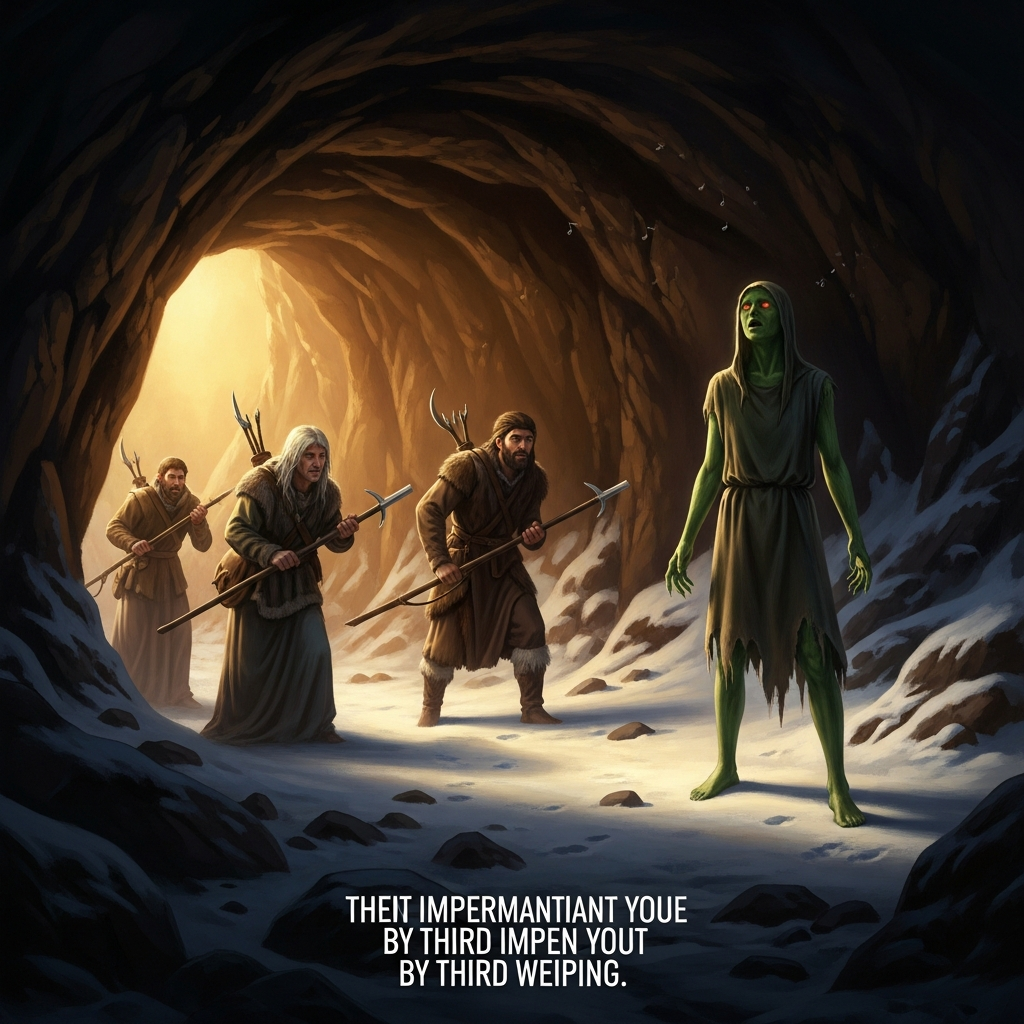
They come up the trail above the snowline following a deer and find, at the mouth of the cave, a green-skinned figure sitting motionless in a posture that no one sits in by accident. He is thin enough to count ribs. His eyes, when they open, are entirely calm and entirely present and meet theirs with an attention that is not normal. His hair hangs to his waist. He is barefoot.
One of them says: demon.
He begins to sing. The song — preserved in the Gur Bum — is addressed directly to them: hunters who have come this high above the snowline looking for something, I have something to tell you about what you are actually looking for. It is a song about impermanence. About what the deer they are chasing will not give them. About what is actually available in a life.
By the third verse the lead hunter has sat down on the snow.
They come back with food. They come back with more hunters. They come back with family members. He feeds them, when they have food to offer, and he sings to them, and eventually several of them stay. Rechungpa, one of his two principal disciples, comes this way — arrives as a skeptic, encounters the songs, and cannot leave. Gampopa, the other principal disciple, is a physician from Nyal who walks to the cave and stays for years.
The tradition calls this the natural gathering — the teacher who does not go looking for students and precisely because of this cannot be avoided by the ones who need him.
Milarepa will spend more decades in caves. He will die, according to the tradition, at the age of eighty-three or eighty-four — an exceptional age for anyone, extraordinary for a man who spent forty years at altitude eating nettles and sitting in snow. The official cause of death, in the hagiography, is poisoning by a jealous teacher who offered him curdled milk. He accepts it knowing what it is. He sings at his deathbed.
The body they cremate produces, in the smoke, a rainbow. The disciples who witness this record it with the same precision they applied to everything else: the color, the duration, the direction.
The songs continue to be sung. The cave at Drakar Taso still exists.
Scenes
His skin has turned green from years of nettles — the only food his cave offers, boiled without salt
 Generating art…
 Steam rises from his body in the high-altitude snowfield
 Generating art…
 The hunters find him at the mouth of the cave and stop dead
 Generating art…
 Echoes Across Traditions
Entities
- Milarepa
- Jetsun Milarepa
- Rechungpa
- Gampopa
Sources
- Tsangnyön Heruka, *The Hundred Thousand Songs of Milarepa* (trans. Garma C. C. Chang, Shambhala, 1999)
- Tsangnyön Heruka, *The Life of Milarepa* (trans. Andrew Quintman, Penguin Classics, 2010)
- Lobsang P. Lhalungpa, *Milarepa: The Poet-Saint of Tibet* (Shambhala, 1984)
- Reginald A. Ray, *Secret of the Vajra World: The Tantric Buddhism of Tibet* (Shambhala, 2001)
- Herbert V. Guenther, *Tibetan Buddhism in Western Perspective* (Dharma, 1977)
- Donald S. Lopez Jr., *Religions of Tibet in Practice* (Princeton, 1997)