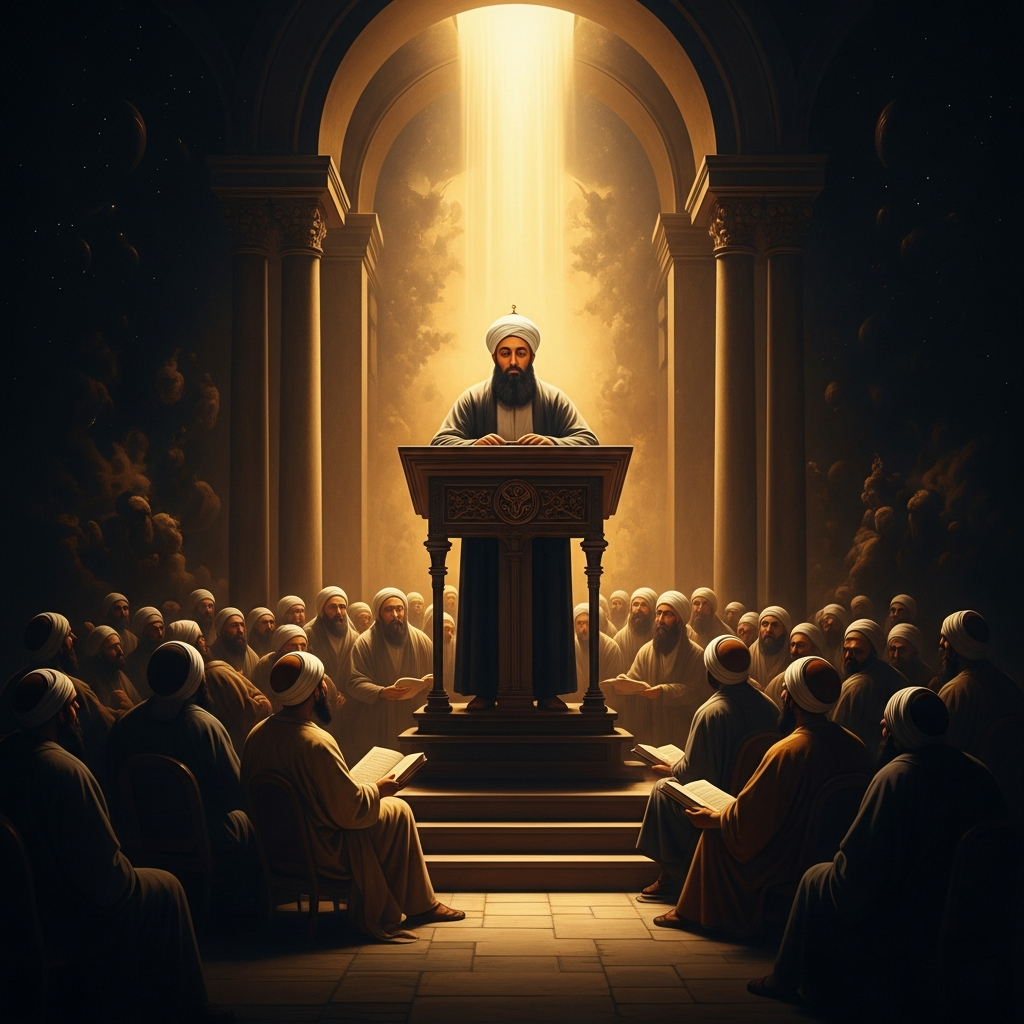
The Scholar Who Could Not Speak
Abbasid Caliphate · 1095-1106 CE (488-499 AH) · Baghdad, Mecca, Jerusalem, Damascus, Medina — the arc of the Islamic heartland from the Tigris to the Jordan
Contents
The most famous Islamic scholar in the world stands before three hundred students in Baghdad and finds that his mouth will not open — not from illness but from a truth he has been refusing: he teaches for fame, not God. He slips out of the city disguised as a traveler and does not return for eleven years.
- When
- Abbasid Caliphate · 1095-1106 CE (488-499 AH)
- Where
- Baghdad, Mecca, Jerusalem, Damascus, Medina — the arc of the Islamic heartland from the Tigris to the Jordan
He is the most famous scholar in the Islamic world, and he is thirty-seven years old, and he cannot speak.
This happens at the Nizamiyyah Madrasa in Baghdad, the greatest center of Islamic learning in the world, where he holds the senior chair. Three hundred students fill the hall. They have come from Persia, from Egypt, from al-Andalus. They copy his lectures word for word and send the copies to scholars who cannot afford the journey to Baghdad. He has written, at this point, twenty-seven books — the Incoherence of the Philosophers, which demolishes al-Farabi and Ibn Sina; the Correct Balance, a masterwork of logic; the Goals of Philosophy, a reconstruction of Aristotelian argument so accurate that later readers assume he endorses it. He is, by any contemporary measure, the most formidable intellect in the Islamic world.
He opens his mouth. The lecture he intends to give is on Islamic jurisprudence. The words are all there — he has given this lecture perhaps two hundred times.
Nothing comes out.
He closes his mouth. He waits. He tries again. He can hear the students beginning to shift on their cushions. The silence in the hall is not comfortable. It is the silence of a man who has just understood something that contradicts everything he has built his life upon.
He understands — all at once, the way a fever breaks — that he is teaching for fame. Not entirely, not exclusively, but substantially and knowingly: the applause of the hall, the copies of the lectures sent to distant cities, the title of Hujjat al-Islam (the Proof of Islam) that scholars have taken to using for him — these are what he works for. The truth is downstream of the performance.
He knows this is not new. He has known it for years. He has simply refused, until this moment, to let himself say so clearly.
The doctors find nothing wrong with his throat. He tries for two months to resume normal functioning. He cannot eat without vomiting. His digestion collapses. He grows thin enough that students begin to whisper. He writes to himself, at night, a private diagnosis: I saw that my soul was threatened with destruction if I continued in my present situation. I kept thinking of abandoning my worldly ambitions. One day I would be resolved to quit Baghdad, the next I would be abandoning my resolve. I was in that situation for six months.
In Rajab 488 AH — November 1095 CE — he tells his household he is going to Mecca.
He has no intention of returning directly. He leaves Baghdad disguised as a Sufi traveler, wearing a coarse wool cloak, carrying nothing but a small manuscript case. The family he leaves behind includes his daughter, his brother Ahmad, and debts of reputation that will take decades to settle. He does not write ahead to anyone. The rector of the Nizamiyyah disappears without a rector’s farewell.
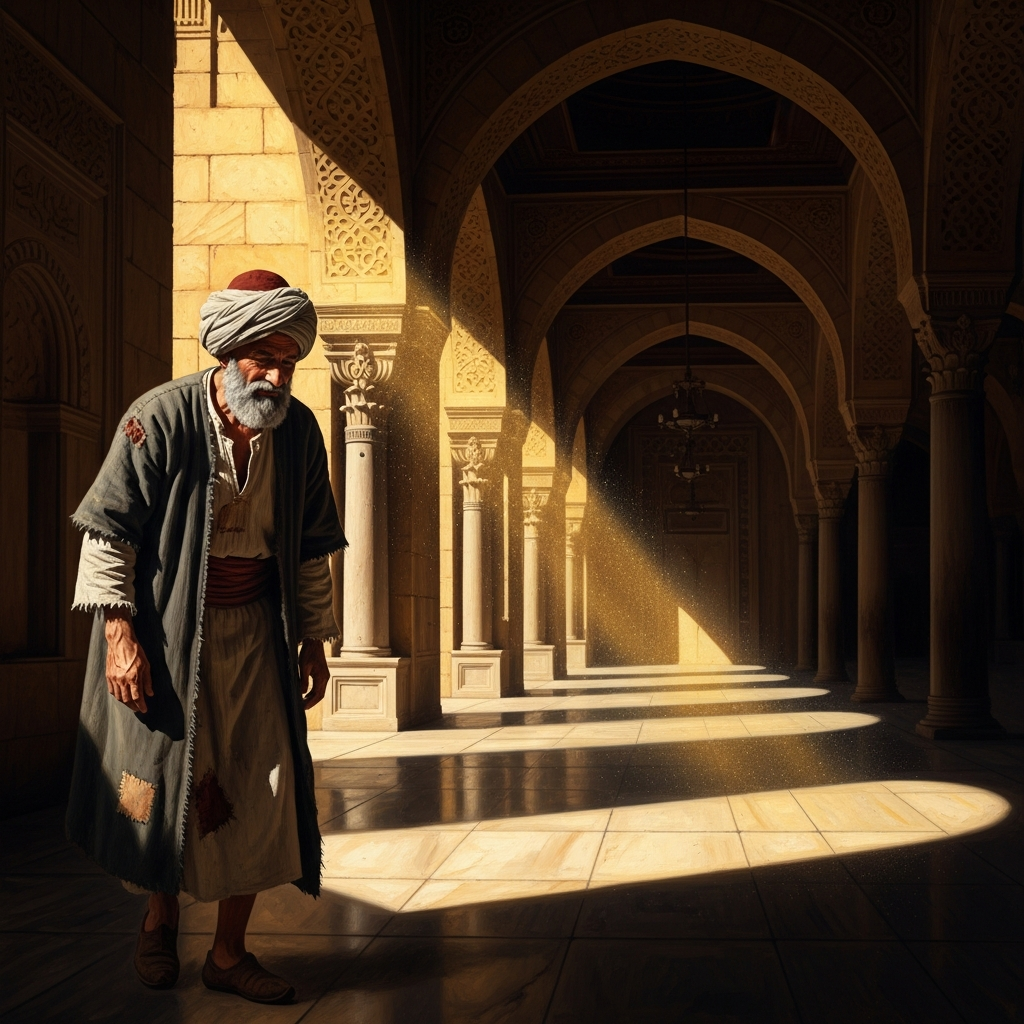
He goes first to Damascus. He enters the Umayyad Mosque — the great colonnaded prayer hall built on the site of a Roman temple dedicated to Jupiter, converted to a church, converted to a mosque — and he sits in a corner near the Qur’anic inscription on the western wall and he stays there. He learns, very slowly, what sitting still feels like when the sitting is not performance. He practices the Sufi breathing exercises. He fasts. He walks in the hills above the city at night. He is unrecognized. This, he later writes, is the most valuable thing that happens in those first months — the experience of being nobody, in a city where nobody knows that he was once somebody.
He goes to Jerusalem. He prays in the Dome of the Rock, in the presence of the Foundation Stone that holds up the world. He goes to Mecca and performs the hajj. He goes to Medina and prays at the tomb of the Prophet. He goes back to Damascus and stays longer.
For eleven years he moves through the Islamic heartland this way — madrasa to shrine to mosque to cave, the great circuit of Sufi formation that his predecessors described in their manuals but that he, the most famous scholar in the world, had never undergone. He reads what Sufi masters actually wrote, not summaries. He does what they actually prescribed, not approximations. He discovers that the intellectual analysis of mystical experience and the experience itself are related the way a map is related to the territory — formally connected, substantively different.
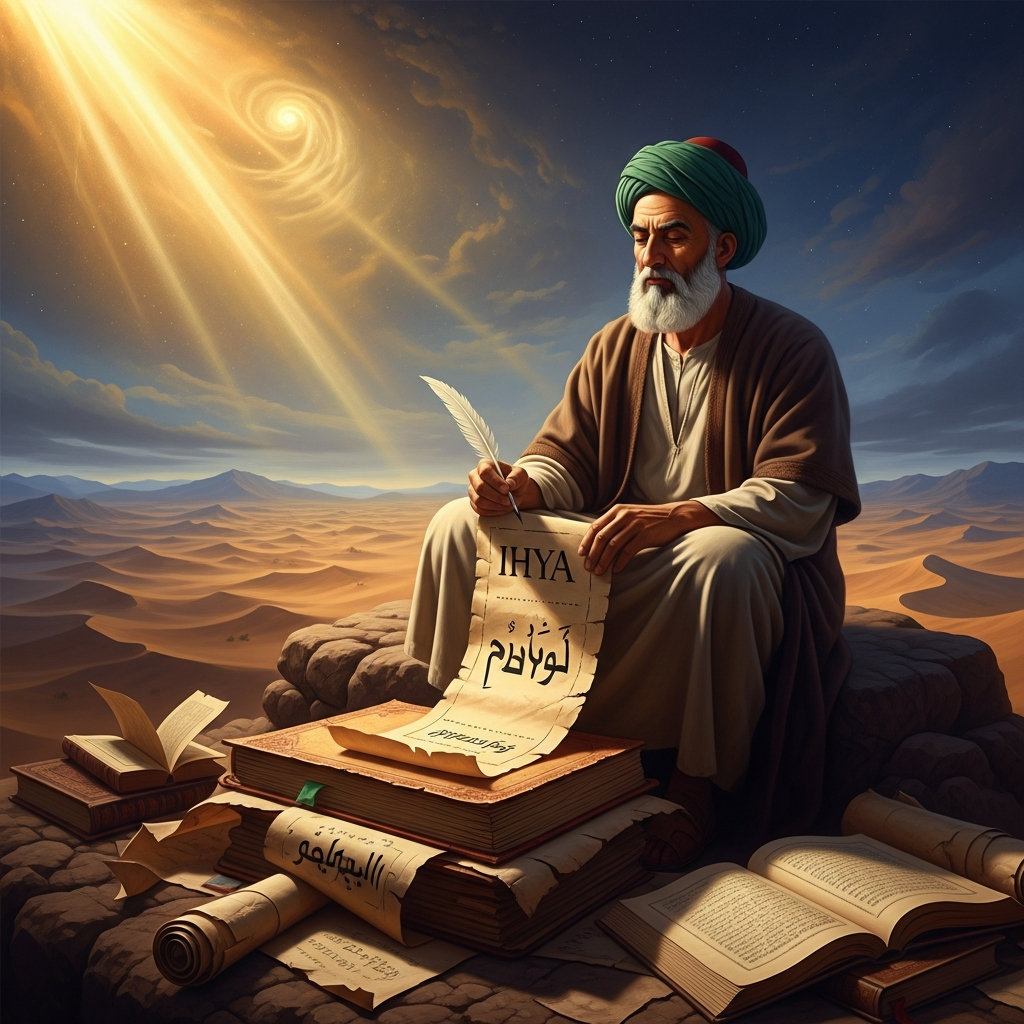
He begins to write the Ihya Ulum al-Din — the Revival of the Religious Sciences.
The project is massive: forty books organized into four quarters (acts of worship, social conduct, destructive character traits, saving character traits). Each book does something the existing literature does not do: treats law and mysticism simultaneously, as two aspects of the same practice, without ranking one above the other or reducing either to the other. The legal scholar’s precision and the Sufi’s interior attention are not enemies. They are what a complete Muslim practice looks like from outside and inside, respectively.
He returns to Tus, his hometown in Khorasan, in 1096, but does not return to institutional life for another five years.
He writes. He teaches a small circle of students who come to him, not for prestige but because they have heard something different in what he says now. He corresponds with scholars who are angry that he abandoned Baghdad, and with Sufi masters who are suspicious that a famous jurist is claiming their methods. He writes Deliverance from Error, his autobiographical account of the crisis and what lay beyond it — one of the most honest documents in Islamic literature, a philosopher’s confession in the strictest sense: what he knew, what he did not know, what the breakdown cost him, and what it gave him.
In 1106 he returns to teaching at the Nizamiyyah in Nishapur, at the request of the new vizier, Fakhr al-Mulk. He teaches for three years and then withdraws to Tus for the last time, where he dies in 1111 — fifty-three years old, surrounded by the small circle of serious students, having refused for the final decade every major institutional appointment that was offered to him.
The Ihya spreads through the Islamic world within his lifetime.
It travels into West Africa and into the Malay Archipelago. It generates commentaries in Persian, Turkish, Swahili, Urdu, Javanese. Every generation of Islamic scholars from the 12th century forward engages with it — either to endorse its synthesis, attack its Sufism, defend its law, or use it as the baseline against which new theological positions are measured. Ibn Rushd (Averroes) writes a systematic refutation of al-Ghazali’s attack on philosophy. Ibn Tufayl imagines a response to it in the form of a philosophical novel. Maimonides reads it carefully and incorporates its psychological analysis of the soul’s development into the Guide for the Perplexed. Thomas Aquinas reads it in Latin translation and quotes it in the Summa.
Three hundred years later, the great Sufi commentator Zakariyya al-Ansari writes: Whoever is not delighted by the Ihya has no life in his heart. Seven hundred years later, the Egyptian scholar Hasan al-Banna reads it in a Cairo bookshop as a young man and says it changed everything he thought he knew about what Islam required of a person.
The speech that stopped in Baghdad became a book that could not be stopped.
What al-Ghazali discovers in the Umayyad Mosque in Damascus — sitting in the corner, wearing a coarse Sufi cloak, knowing nothing about himself except that he is breathing — is not a mystical vision or a theological argument but something simpler and more durable: the difference between knowing a thing and being the kind of person who knows it, and the catastrophic gap, in his own life, between the two.
Scenes
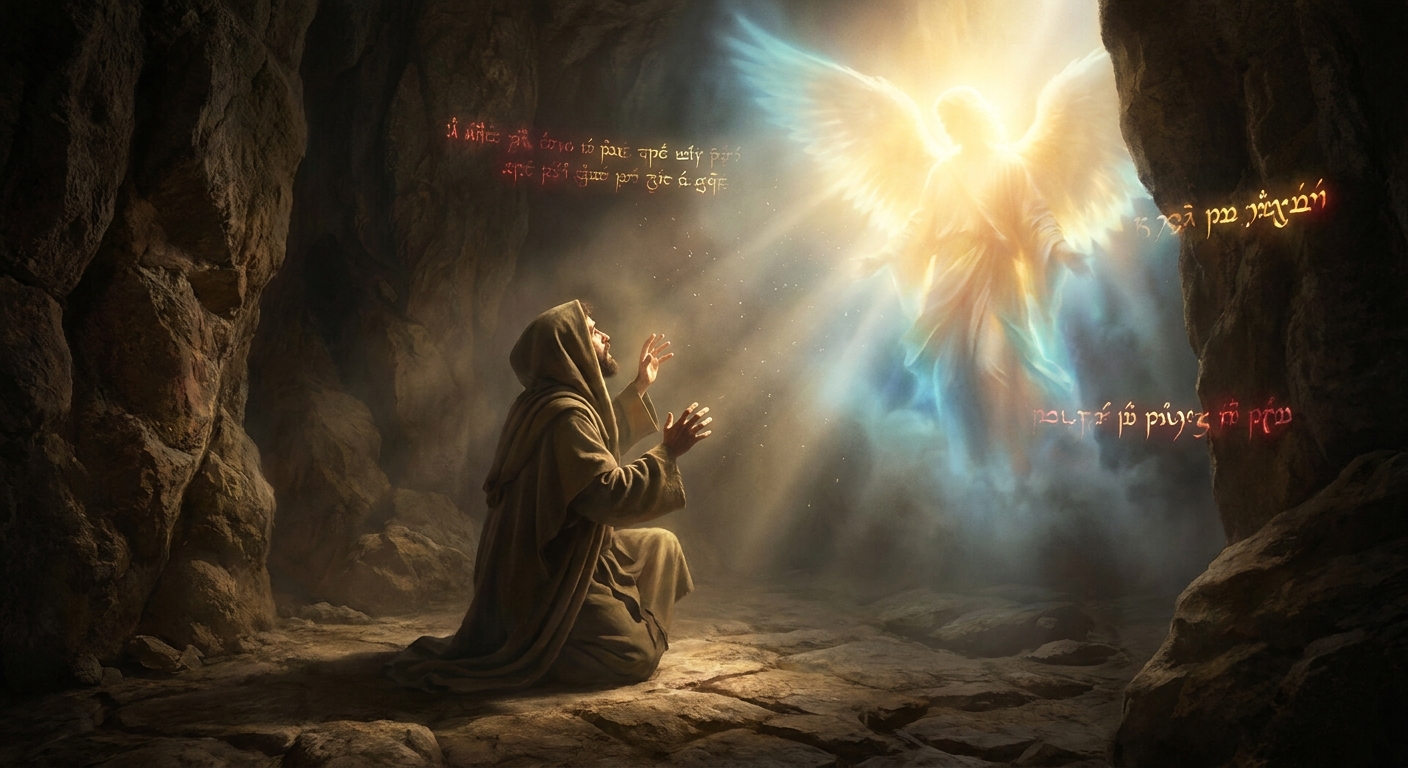
Al-Ghazali stands at the lectern of the Nizamiyyah before three hundred students and finds the words stopped in his throat — not from illness but from the knowledge, arriving all at once, that he has been performing rather than teaching
Generating art… Disguised as a Sufi traveler, the former rector of the greatest madrasa in Baghdad walks the colonnades of the Umayyad Mosque in Damascus, unrecognized, learning what silence actually contains
 Generating art…
 After eleven years of wandering prayer and desert silence, al-Ghazali writes the final pages of the *Ihya* — forty books reconciling law, theology, and mysticism — the synthesis only possible from the far side of the crisis
 Generating art…
 Echoes Across Traditions
Entities
- Abu Hamid al-Ghazali
- Nizam al-Mulk (the vizier who appointed him)
- the Nizamiyyah Madrasa of Baghdad
- the Sufi masters of Damascus and Jerusalem
Sources
- Al-Ghazali, *Deliverance from Error* (*al-Munqidh min al-Dalal*) — his own account of the crisis and its resolution, c. 1108
- Al-Ghazali, *Ihya Ulum al-Din* (Revival of the Religious Sciences), c. 1096-1111 — forty books
- Al-Ghazali, *Incoherence of the Philosophers* (*Tahafut al-Falasifa*), 1095 — written just before the breakdown
- Farid Jabre, *La notion de la ma'rifa chez Ghazali* (Beirut, 1958)
- W. Montgomery Watt, *Muslim Intellectual: A Study of al-Ghazali* (Edinburgh, 1963)
- Eric Ormsby, *Ghazali: The Revival of Islam* (Oneworld, 2008)