The City of God, Taken in Blood
July 15, 1099 CE — Friday afternoon, the third hour after noon, the day Christ died according to the crusader interpretation of the Gospels · Jerusalem — the northern wall near the Damascus Gate, the southern wall near Mount Zion, the Temple Mount, the Aqsa Mosque, the synagogue in the Jewish Quarter, and the Church of the Holy Sepulchre
Contents
July 15, 1099. After three years on the road and five weeks under the walls, the First Crusade breaches Jerusalem. Godfrey of Bouillon's siege tower bridges the northern wall at noon. Raymond of Toulouse's forces break in from the south. What follows is documented by every chronicler, Christian and Muslim and Jewish: the army kills everyone. Blood reaches the ankles in the streets near the Temple Mount. The synagogue burns with the Jewish community inside. The Aqsa Mosque becomes a slaughterhouse. The crusaders walk through the blood to the Holy Sepulchre and pray.
- When
- July 15, 1099 CE — Friday afternoon, the third hour after noon, the day Christ died according to the crusader interpretation of the Gospels
- Where
- Jerusalem — the northern wall near the Damascus Gate, the southern wall near Mount Zion, the Temple Mount, the Aqsa Mosque, the synagogue in the Jewish Quarter, and the Church of the Holy Sepulchre
The Crusade has been on the road for three years.
Pope Urban II called it in November 1095 at the Council of Clermont, in a field outside the cathedral, in front of a crowd of nobles and bishops and ordinary men with no idea that they were about to march east. Urban described the suffering of the eastern Christians under Muslim rule. He described the desecration of the Holy Sepulchre. He promised remission of sins to anyone who took the cross. The crowd erupted in Deus vult — God wills it — and the words became the war cry of the next two centuries.
Eighty thousand fighting men set out the following summer from a dozen different points across France, Germany, Italy, and Flanders. By the time the army reaches Jerusalem in June 1099, it has been reduced by Anatolian deserts, Cilician mountain passes, dysentery, plague, the year-long siege of Antioch, the famine that followed it, the spear of Longinus dug up under the cathedral floor at Antioch by a half-mad Provençal peasant named Peter Bartholomew, the battles fought against Kerbogha’s relief army, and the slow attrition of every road traveled in mail under the eastern sun. Thirty thousand men reach the walls of Jerusalem. Maybe fewer.
They have not seen the Holy City before. They have only imagined it. When they come over the last ridge on the morning of June 7, 1099, and see the walls — the white stone walls, with the dome of what they think is Solomon’s Temple rising above them in the distance — they fall on their faces in the dust. They weep. Some of them tear their clothes. Many of them have buried fathers, brothers, sons in the earth between Constantinople and here. They have come a long way.
Then they begin the work of taking the city.
The Fatimid governor of Jerusalem, Iftikhar ad-Dawla, has prepared. He has expelled the city’s eastern Christians, suspecting fifth-column sympathies. He has poisoned the wells outside the walls. He has stocked the city with food. He has reinforced the garrison. The crusaders, encamped on the rocky ground around the city in the July heat, with no water in the cisterns and no shade and the temperature climbing past forty degrees Celsius by mid-morning, begin to die of thirst.
A fleet of Genoese ships arrives at Jaffa with timber and engineers. The crusaders haul the timber up to the hills outside Jerusalem and build siege towers — three of them, four-storied, mounted on wheels, sheathed in leather to defeat fire. They build mangonels and ballistas. They dig saps. The work takes five weeks. During those five weeks the army’s discipline begins to fray, and Peter the Hermit organizes a barefoot procession around the city walls, the army marching unarmed in single file the way Joshua had marched around Jericho, blowing trumpets, expecting walls to fall. The walls do not fall. The army goes back to building.
On the night of July 13 they roll the towers into position. Godfrey of Bouillon’s tower is moved to the northern wall, near what is now the Damascus Gate. Raymond of Toulouse’s tower is moved to the southern wall, near Mount Zion. The defenders see what is coming and concentrate their forces on the towers. Greek fire is thrown. Stones are thrown. Men burn alive on the upper levels of the wooden towers. Replacements climb up. The fighting goes through the night and into the morning of July 14 and through July 14 and into the morning of July 15.
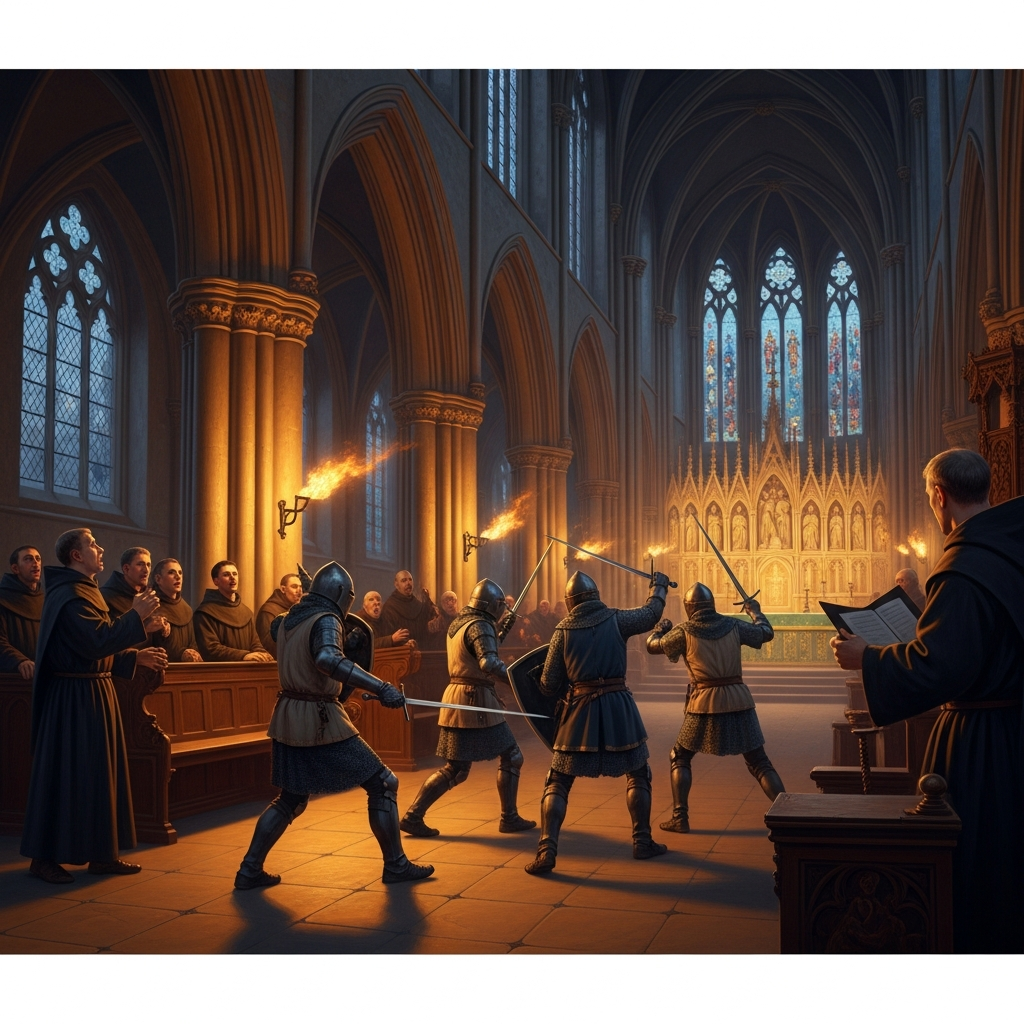
At about noon on Friday — Friday, the day of the Crucifixion, the day they have all been waiting for, the symbolic alignment they take as divine confirmation — Godfrey’s tower reaches the wall. The drawbridge drops. Two Flemish knights, the brothers Lethold and Engelbert of Tournai, are the first across. Behind them comes Godfrey himself. The defenders break and run. Within an hour the northern gate is open from the inside. The army of the cross pours through.
What happens next is described by the eyewitnesses on the crusader side without apparent shame.
Raymond of Aguilers — chaplain to the count of Toulouse, present in the city that afternoon — writes: Wonderful sights were to be seen. Some of our men, and this was more merciful, cut off the heads of their enemies; others shot them with arrows, so that they fell from the towers; others tortured them longer by casting them into the flames. Piles of heads, hands, and feet were to be seen in the streets of the city. It was necessary to pick one’s way over the bodies of men and horses. But these are small matters compared to what happened at the Temple of Solomon, a place where religious services are ordinarily chanted. What happened there? If I tell the truth, it will exceed your powers of belief. Suffice it to say that, in the Temple and porch of Solomon, men rode in blood up to their knees and bridle reins.
The Temple of Solomon is what the crusaders call the Aqsa Mosque. The defenders of the city, after the walls fall, retreat to the Temple Mount. Tancred of Hauteville accepts their surrender at the Aqsa, gives them his banner as a guarantee of safety, and posts it on the roof. He then goes elsewhere in the city. In the morning, other crusaders — without consulting Tancred — kill them all. The chroniclers note Tancred’s anger but do not suggest the men who broke the truce were punished.
The Jewish community of Jerusalem, knowing what crusading armies have done to Jewish communities in the Rhineland in 1096 — Worms, Mainz, Cologne, the chronicles of Solomon bar Simson are full of it — gather in the central synagogue. The crusaders surround the synagogue and set it on fire. The community sings the Shema Yisrael — Hear, O Israel, the Lord our God, the Lord is one — as the building burns. They die singing it. The accounts come to us from the Cairo Geniza, from refugees who escaped to Egypt and wrote home.
In the streets the slaughter continues into the evening of July 15 and through July 16. The crusaders break into houses and kill the inhabitants — women, children, the old, the sick. They break into mosques and kill those sheltering inside. They take the gold and the silver. They mark each house they have plundered with a shield or a banner so that other crusaders will not enter. By the second day the streets are clogged with bodies and the summer heat has begun to do its work. The crusaders force the surviving Muslims and Jews — those who have escaped the first wave by hiding — to drag the bodies outside the walls and burn them in great pyres in the valleys around the city. Then they kill the survivors too.
Iftikhar ad-Dawla and his immediate household, holed up in the Tower of David in the citadel, negotiate a separate surrender with Raymond of Toulouse. Raymond keeps his word. The governor and his guard are escorted out of the city alive. They are the only Muslim defenders to survive. Raymond is criticized for it by the other crusader leaders.
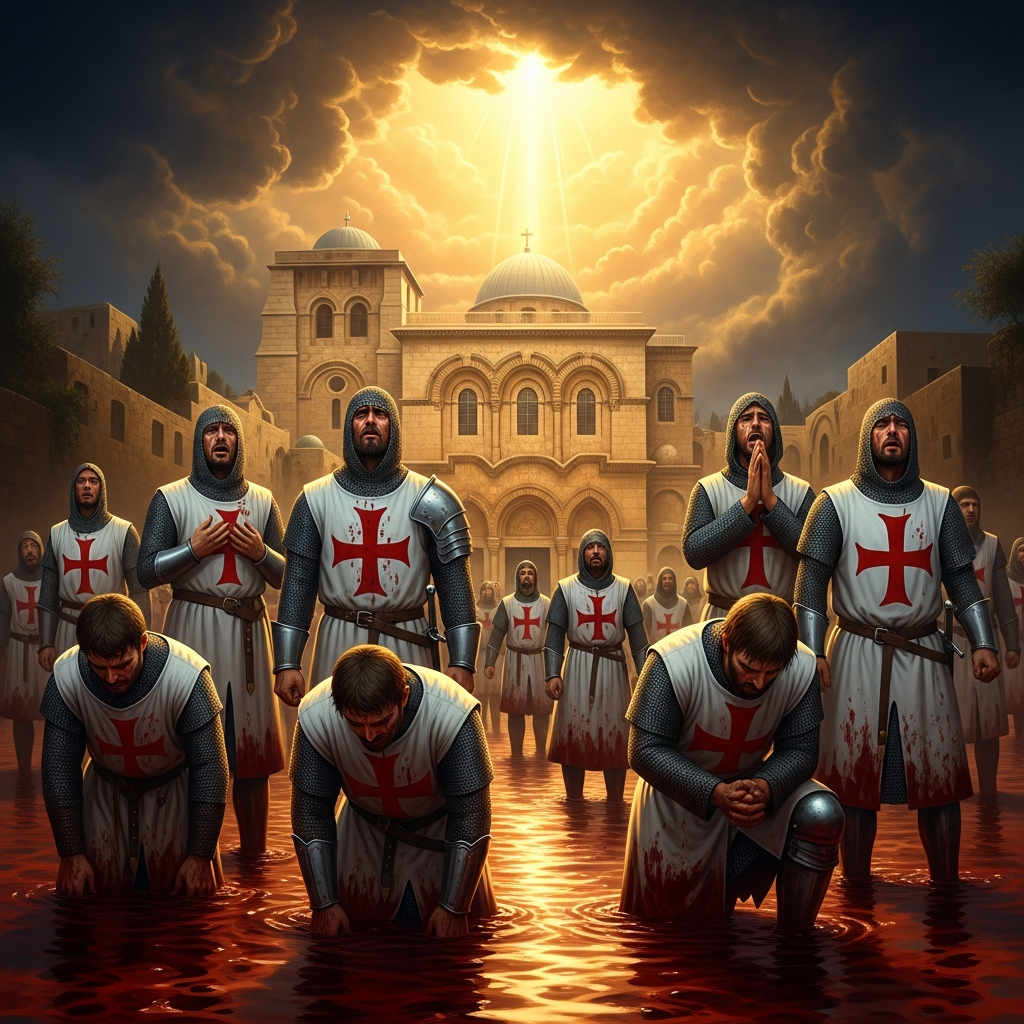
When the killing slows because the killers are exhausted and there is no one left to kill, the crusaders walk to the Church of the Holy Sepulchre.
They walk through streets in which they have to step over bodies. Their mail is splattered with blood not yet dry. Their swords are too dull to cut. They reach the church — the church built over the rock of Calvary and the tomb of Christ, the church that is the destination of the entire three-year journey, the place that is the reason they came — and they fall to their knees on the stone floor and weep. They sing the Te Deum. They thank God for the victory. The chronicler Fulcher of Chartres, present that evening, writes that it was so much an occasion of joy and exultation that none of us could remember the like, except perhaps the Resurrection morning itself.
None of them, in any source we have, makes the connection that the man whose tomb they are kneeling at had said blessed are the merciful, for they shall obtain mercy, love your enemies, pray for those who persecute you, put up thy sword into his place: for all they that take the sword shall perish with the sword. Not one source records anyone in the crusader army on July 15, 1099 looking around at the dead and asking whether the man in the tomb would have wanted this.
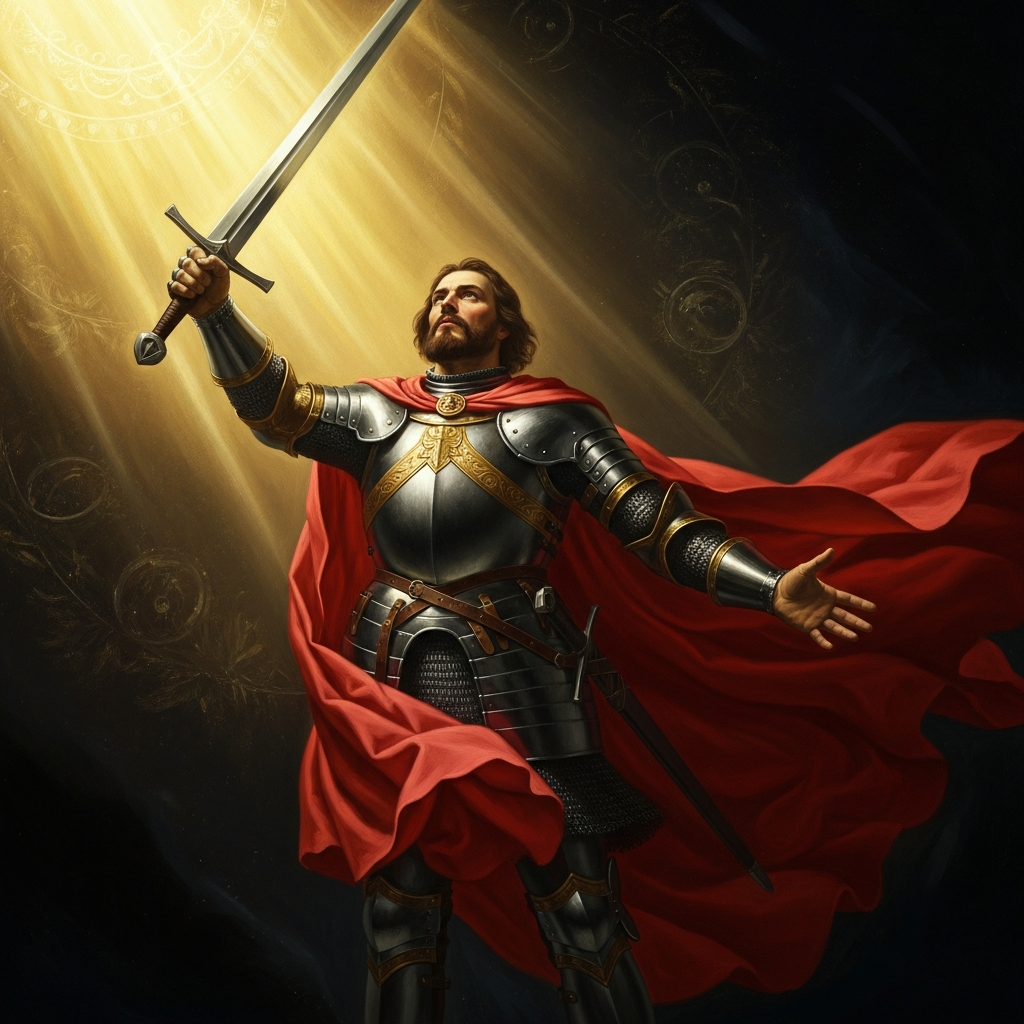
Godfrey of Bouillon refuses to be crowned king of Jerusalem. He says he will not wear a crown of gold in the city where Christ wore a crown of thorns. He takes the title Advocatus Sancti Sepulchri — Defender of the Holy Sepulchre. He dies a year later. His brother Baldwin will accept the crown the title refused.
Pope Urban II dies on July 29, 1099 — fourteen days after the city falls — in Rome. The news of the victory has not yet reached him. He dies not knowing whether his Crusade has succeeded. The cardinals who buried him would later argue about whether he had foreseen what would happen at the Aqsa Mosque, and what he would have said about it if he had.
The Kingdom of Jerusalem lasts eighty-eight years. In 1187 Saladin takes the city back. He spares the Christian civilians. He ransoms the poor at his own expense. The Muslim chroniclers, who remember 1099 in the same way Holocaust survivors remember the camps, note the contrast as a deliberate theology — this is how a holy city should be taken, Imad ad-Din writes; the Prophet’s mercy made manifest. The point is for the Christians to hear it.
The blood that the crusaders walked through to reach the Holy Sepulchre on July 15, 1099 has soaked into the foundational memory of three traditions. The Jewish liturgy commemorates the Rhineland martyrs of 1096 every year on the Sabbath before Shavuot. The Muslim memory of the slaughter at the Aqsa is one of the original wounds of the long Islamic-Christian relationship, and it was invoked explicitly by the Ottoman propagandists, by the Arab nationalists of the twentieth century, and by the salafi-jihadist propagandists of the twenty-first. The Christian theological tradition has spent nine hundred years trying to metabolize the disjunction between what was done and the man in whose name it was done, and the metabolizing is not finished.
Urban II promised remission of sins to those who took the cross. The men who walked through the blood of Jerusalem to the Holy Sepulchre on the afternoon of July 15, 1099 believed they had received it. The traditions they had murdered were less sure.
Scenes
Godfrey of Bouillon's siege tower lurches against the northern wall at noon on July 15
Generating art… By afternoon the streets near the Temple Mount run red
 Generating art…
 The crusaders walk through the blood to the Church of the Holy Sepulchre
 Generating art…
 Echoes Across Traditions
Entities
- Godfrey of Bouillon
- Raymond IV of Toulouse
- Pope Urban II
- Iftikhar ad-Dawla
- Tancred of Hauteville
- Peter Bartholomew
- the Jewish community of Jerusalem
- the Muslim defenders of the Aqsa Mosque
Sources
- Raymond of Aguilers, *Historia Francorum qui ceperunt Iherusalem* (eyewitness crusader chronicle, c. 1100)
- Fulcher of Chartres, *Historia Hierosolymitana* (eyewitness, c. 1101-1127)
- Anonymous, *Gesta Francorum* (eyewitness, c. 1100)
- Ibn al-Athir, *Al-Kamil fi al-Tarikh* (12th-century Arab historian, ed. D.S. Richards 2006)
- Solomon bar Simson, Hebrew chronicle of the Rhineland massacres of 1096 (for the Jewish memory of the Crusade)
- Jonathan Riley-Smith, *The First Crusade and the Idea of Crusading* (Continuum, 1986)
- Thomas Asbridge, *The First Crusade: A New History* (Oxford University Press, 2004)
- Christopher Tyerman, *God's War: A New History of the Crusades* (Penguin, 2006)