The Man Who Emptied Towns
1112-1153 CE · Cîteaux and Clairvaux, Burgundy, France; later the courts and councils of Europe
Contents
Bernard of Clairvaux enters the monastery of Cîteaux in 1112 bringing thirty relatives and friends he has personally recruited over the winter. Mothers hid their sons from him. He founds Clairvaux, justifies the Knights Templar, preaches the Second Crusade, and dictates eighty-six sermons on the first two chapters of the Song of Songs. He never gets further. On his deathbed, he is dictating the eighty-sixth.
- When
- 1112-1153 CE
- Where
- Cîteaux and Clairvaux, Burgundy, France; later the courts and councils of Europe
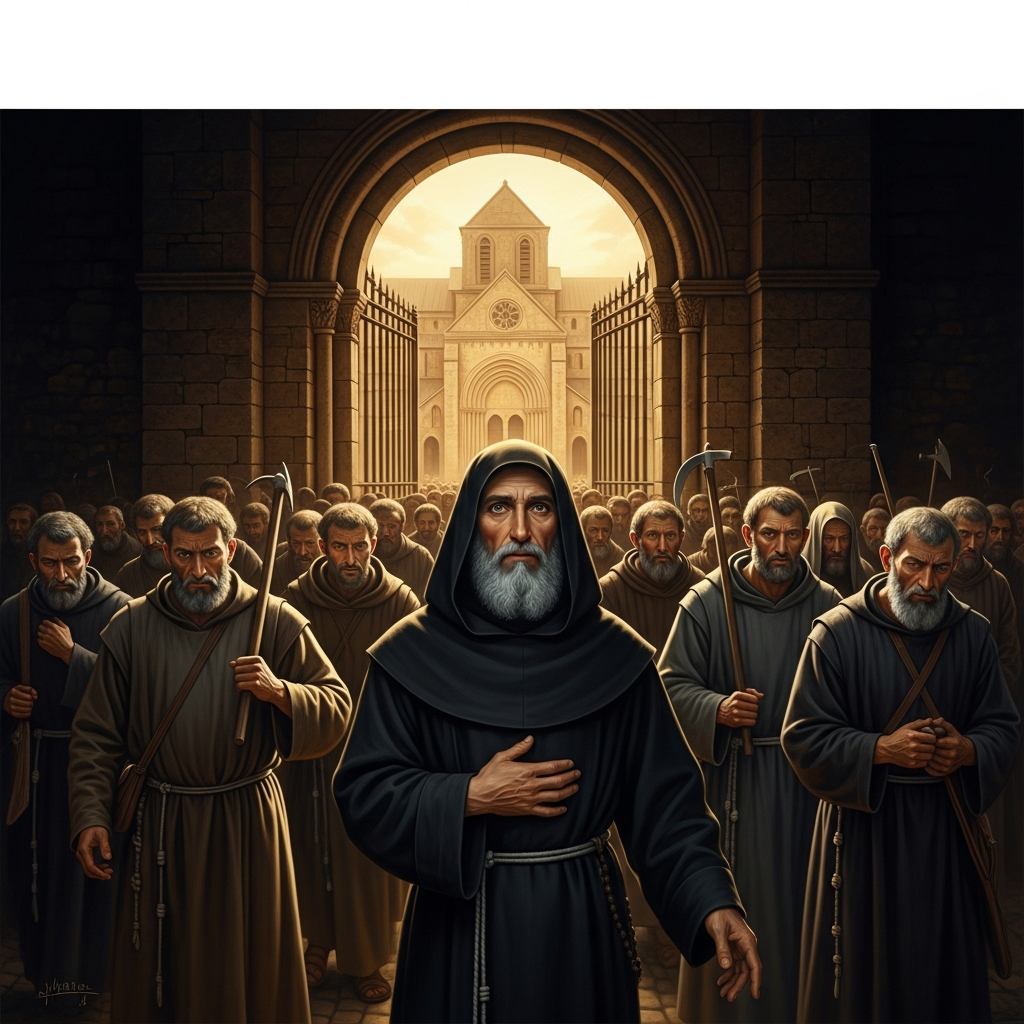
He arrives at Cîteaux in the spring of 1112 with thirty men.
This is not the arrival of a man who has decided privately to become a monk. This is the arrival of a man who has spent the winter recruiting. He has visited relatives. He has visited friends of his family. He has made the case — whatever the case was, whatever he said in those months of conversation in the castles and townhouses of Burgundy — and thirty men have said yes. His older brothers came. His uncle came. Friends from his student days came. One of them later said that they came partly because of what Bernard said and partly because they could tell that Bernard would not stop until they came.
Mothers in Burgundy that winter reportedly hid their sons when they heard Bernard was coming. Wives reportedly barricaded their husbands. This may be legend. It is also the kind of legend that clings only to people who have actually cleared a room.
The monastery he enters is Cîteaux — a reform house, founded fourteen years earlier by Robert of Molesme, then guided by Alberic and now by Stephen Harding, an Englishman of extraordinary administrative intelligence who has been trying to figure out what the Benedictine Rule requires if it is followed without exception. The answer Stephen is working out in 1112 is: very little ceremony, no elaborate decorative programs, no polyphonic music, no income from churches or tithes, manual labor, silence. The Cistercians intend to return to what was there before the medieval elaboration of the monastic life covered it over.
Bernard enters this. He is twenty-one. He brings his thirty men and places them in the care of Stephen Harding and lets Cîteaux do to him what it does to everyone: strips down, removes, simplifies. The asceticism is severe enough to damage his stomach permanently. He eats badly for the rest of his life and it does not stop him from doing anything.
Three years later, Stephen Harding sends him to found a new house.
The valley he is given is at Clairvaux. It is not a welcoming valley — it is forested, damp, unpromising. Bernard and the twelve monks who come with him clear the land and build. They are cold. They are hungry. Bernard has a talent for enduring conditions that would collapse the motivation of people with less intensity driving them, and this is one of the things that makes him impossible to live with and also impossible to look away from. He is the person who has already concluded that the physical discomfort is beside the point, which makes him both very effective and very difficult to argue with about the physical discomfort.
The house grows. Within a decade Clairvaux is sending out daughter houses. Within three decades there are more than sixty Cistercian houses founded directly or indirectly from Clairvaux. Bernard is still writing letters, still arguing cases before councils, still receiving postulants, still dealing with the administrative reality of the order he has substantially created — but the thing he does in what time remains, the thing he has been building toward since he read Augustine as a young man in Burgundy, is the sermons.
He begins the Song of Songs sermons in 1135. He will not stop them until he dies.
The Song of Songs is two chapters of Hebrew love poetry that the rabbis debated including in the canon and then kept, possibly because Rabbi Akiva, who knew everything about love, called it the holiest of all the holy writings. The Church inherited it and spent the patristic and early medieval period deciding what to do with it. Origen wrote a commentary. Gregory of Nyssa wrote another. They both read it allegorically — the Bride is the soul, the Bridegroom is God, and the erotic charge of the text is the erotic charge of the mystical relationship translated into Hebrew’s most available idiom.
Bernard reads it the same way and does something different with it.
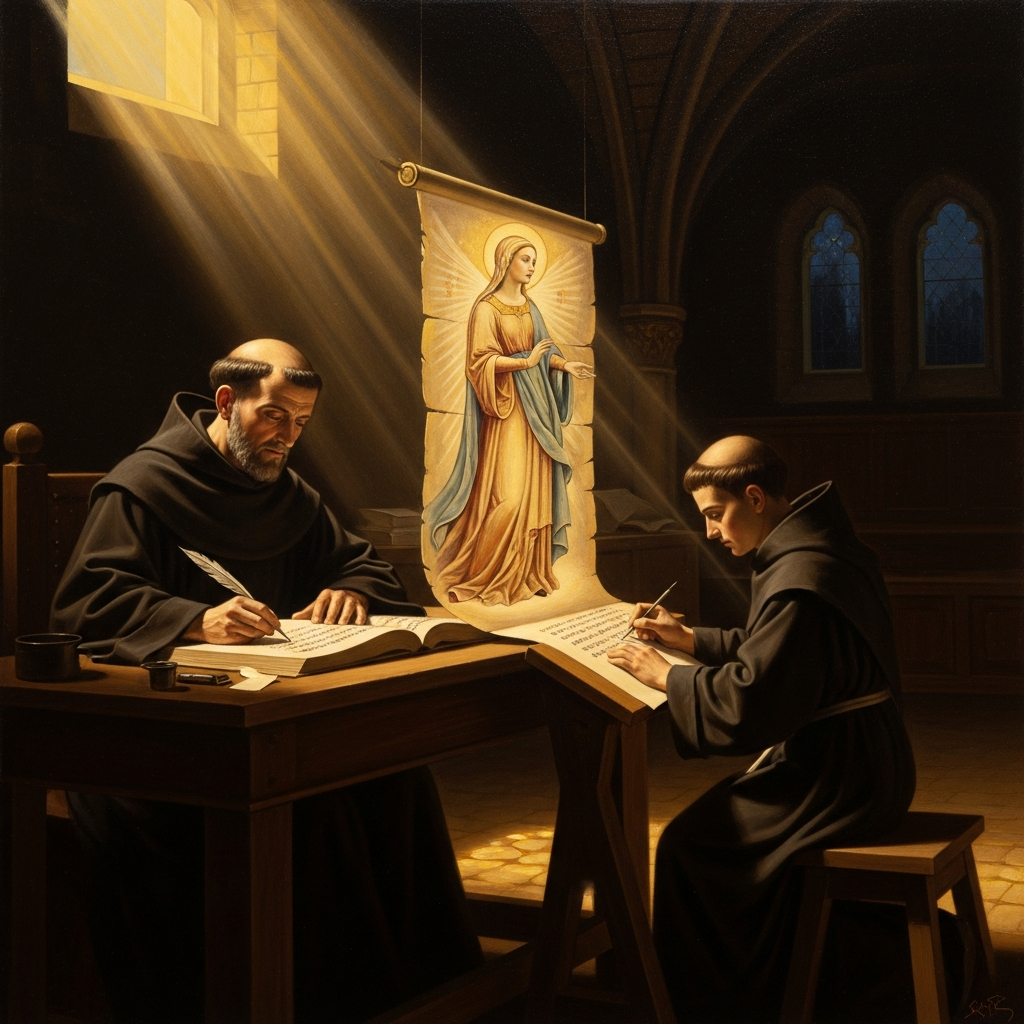
The difference is affective intensity. The patristic allegorists maintain a certain philosophical distance from the love poetry they are interpreting. Bernard collapses the distance. He preaches as the Bride. Not about the Bride — as her. He inhabits the longing, the search through the city for the Beloved, the finding, the sleeping with his left hand under my head and his right hand embracing me, the waking to find him gone, the searching again. He preaches these states not as metaphors to be analyzed but as experiences to be entered.
He is essentially teaching his monks that the highest form of prayer is falling in love with God — not the comfortable devotional attachment of routine religious life, but the consuming, disorienting, rearranging kind of love that makes everything else secondary and produces, in its absences, an ache that is itself a kind of contact.
He is also, during these same years, writing the theology that justifies the Knights Templar, preaching the Second Crusade, navigating the condemnation of Peter Abelard, settling disputed papal elections. The man who is dictating sermons on the erotic longing of the soul for God is the same man who is the most powerful ecclesiastical voice in twelfth-century Europe. He has no official position that makes him powerful. He is an abbot. He has, instead, the authority that comes from being visibly in possession of the thing everyone else is theoretically pursuing — the actual interior life, not the performance of it — and from being willing to say anything, to anyone, including popes.
His condemnation of Abelard is not his finest hour. He pushes it through the Council of Sens in 1140 by preempting the debate — a procedural move that looks very much like the behavior of a man who knows his opponent is more articulate than he is and has decided the argument is too important to risk. Abelard calls it a kangaroo court. He is not entirely wrong. Bernard wins.
He preaches the Second Crusade in 1146 with such effectiveness that he produces a wave of volunteers that the military infrastructure of the crusade cannot manage. The crusade fails catastrophically. Bernard blames the sins of the crusaders. This is not his finest hour either. He is not wrong that the interior life he cultivates in his sermons is incompatible with the violence he also endorses as God’s war. He lives with this incompatibility without apparently resolving it.
He is in his sixties and his body is finished by the asceticism and the travel and the permanent stomach damage. He is dictating the eighty-sixth sermon on the Song of Songs.
The verse he has reached is the third verse of the second chapter: His left hand is under my head, and his right hand embraces me. He has been in this verse for several sermons, working it from multiple angles, approaching what the verse describes from different positions. The left hand of the Bridegroom is under the head of the Bride: this is the posture of complete reception, of being held. The right hand embraces: this is the active love, the love that draws toward itself. He is working out what it means to be in both relations simultaneously — to be held and to be drawn, to be already in the embrace and to be still in the process of arrival.
He is writing about the moment of mystical union as a moment that is always in process, always approaching completion, never finally complete in this life. The embrace is real and already happening and also still in the future. The Bride is already in the arms of the Bridegroom and is still being drawn toward him. Bernard has been working on this paradox for eighteen years and he is still working on it when he dies.
He dies on August 20, 1153. The eighty-sixth sermon ends mid-thought. The Song of Songs has two chapters; he covered one and a half.
He never got to the verse about the voice of the Beloved leaping across the mountains. He never got to the foxes that spoil the vines. He never got to the beloved who is beautiful as Tirzah and awesome as an army with banners. He had sixteen sermons to write and he ran out of years.
The eighty-six sermons that exist are read for nine centuries and counting. What the remaining sermons would have said about the Bride and the divine Beloved who is also the Christ and also the ground of every soul that has ever felt anything — that is a silence in the tradition. Bernard left it there. Either he ran out of time to fill it or he finally arrived at the place his sermons had been describing, where there are no more words and the left hand is under your head and the right hand is embracing you, and what happens next cannot be dictated.
He recruited thirty men in a single winter and built an order and changed Europe and died still dictating the love poetry of Solomon. The embrace he was describing when he stopped is, in his theology, still in progress — the Bride still being drawn, the Bridegroom still arriving, the left hand still under the head.
Scenes
Bernard arrives at the gates of Cîteaux with thirty men he has recruited over a single winter — relatives, friends, men who were going to do other things with their lives
 Generating art…
 Bernard at Clairvaux, dictating the Song of Songs sermons — the Bride of Solomon moving through the pages toward the Bridegroom who is never fully named
 Generating art…
 The deathbed at Clairvaux in 1153 — Bernard dictating the eighty-sixth sermon, the left hand of the Bridegroom, the embrace still in progress
 Generating art…
 Echoes Across Traditions
Entities
- Bernard of Clairvaux
- Stephen Harding
- the Bride and Bridegroom
Sources
- Bernard of Clairvaux, *On the Song of Songs* (4 vols.), trans. Kilian Walsh and Irene Edmonds (Cistercian Publications, 1971-1980)
- Bernard of Clairvaux, *On Loving God*, trans. Robert Walton (Cistercian Publications, 1973)
- Brian Patrick McGuire, *Bernard of Clairvaux: His Life and Works in Context* (Routledge, 2017)
- Jean Leclercq, *Bernard of Clairvaux and the Cistercian Spirit* (Cistercian Publications, 1976)
- Gillian R. Evans, *Bernard of Clairvaux* (Oxford University Press, 2000)
- Etienne Gilson, *The Mystical Theology of Saint Bernard*, trans. A.H.C. Downes (Sheed and Ward, 1940)