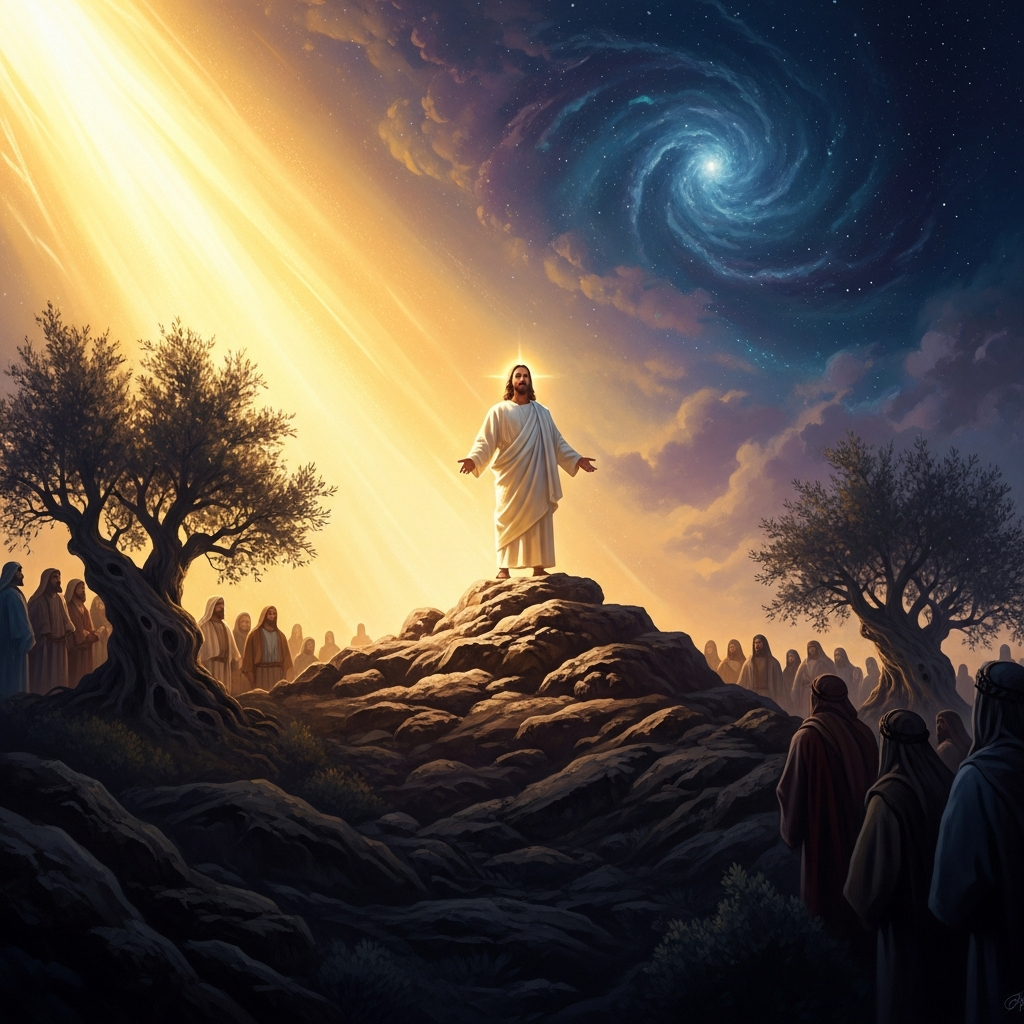
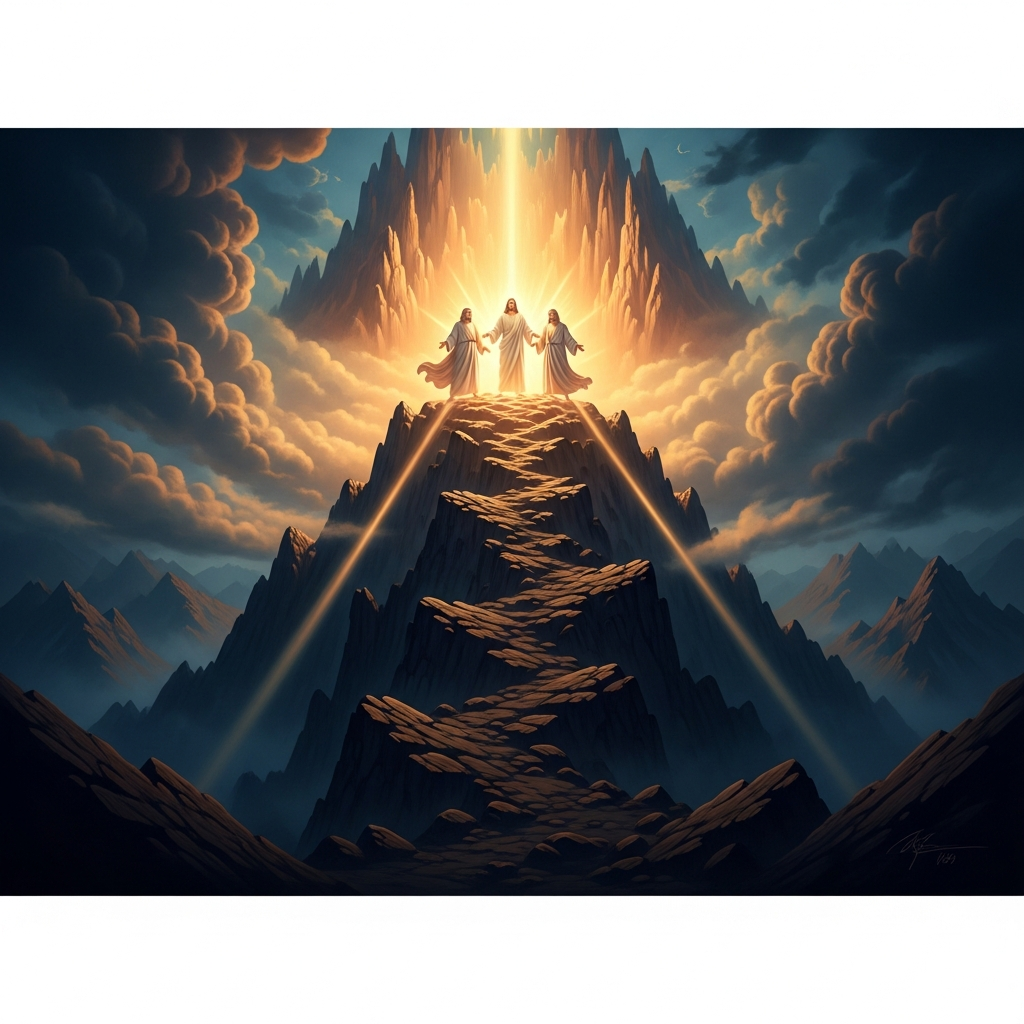
Nestor and the Tale of Bygone Years
Kiev · ~1110-1113 CE (recording events of 988) · The Monastery of the Caves (Kiev Pechersk Lavra), Kievan Rus
Contents
In a candlelit cell beneath Kiev, a monk named Nestor writes down the sentence that will define a civilization: *We knew not whether we were in heaven or on earth*. Russia is born inside that sentence.
- When
- Kiev · ~1110-1113 CE (recording events of 988)
- Where
- The Monastery of the Caves (Kiev Pechersk Lavra), Kievan Rus
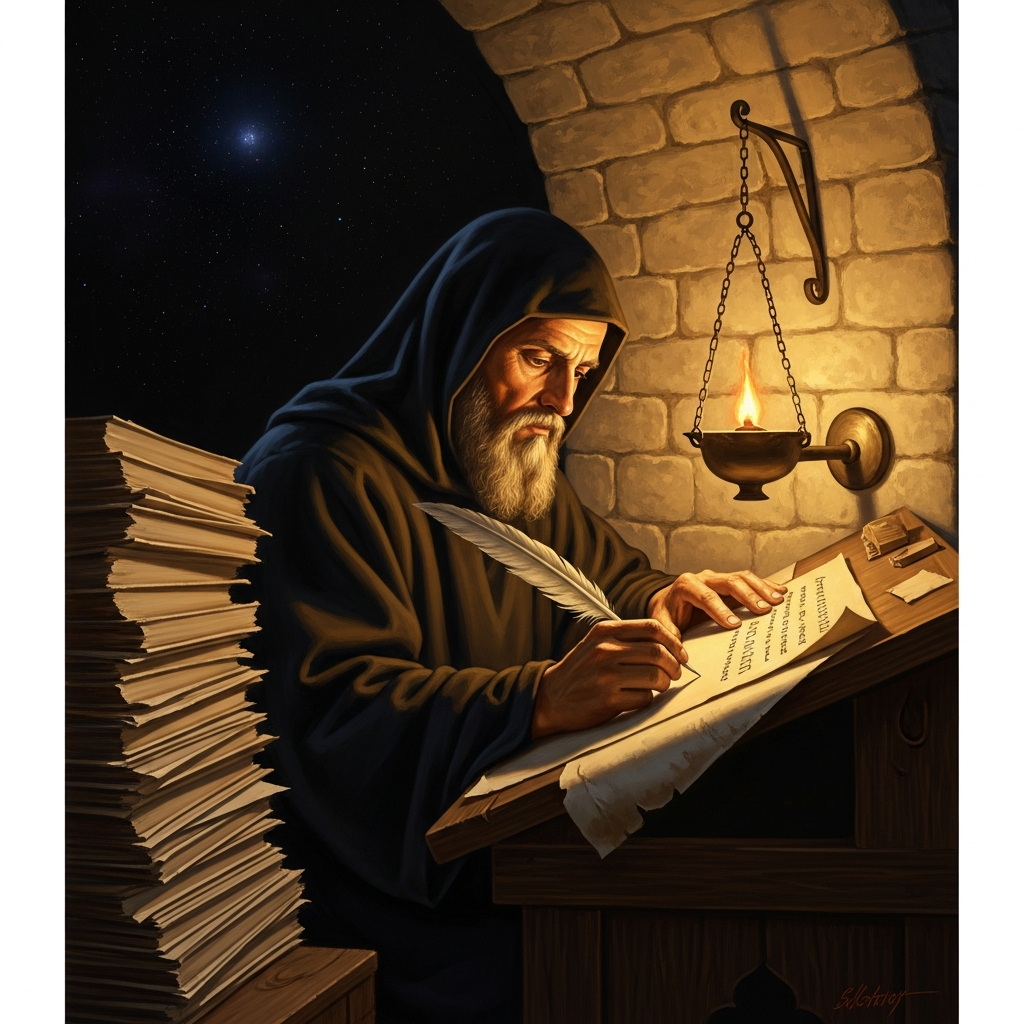
The cell is six feet by eight. Chalk walls. A window the size of a man’s head, set high. A single oil lamp on the writing desk, and a stack of parchment to the chronicler’s left, weighted with a flat stone.
Nestor is in his forties. He has been a monk at the Caves Lavra since boyhood. He has read Greek; he has read the Slavonic translations of the Greek Fathers; he has read the older Slavic chronicle that his predecessor Nikon kept and the older one before that. He has talked to old men who remember Yaroslav. He has talked to old men who remember men who remembered Vladimir.
Tonight he is writing the year 6496 from the creation of the world. By the Latin reckoning, 988 AD.
He dips the quill. He writes the title in red ink: Tale of Bygone Years.
He begins: Whence came the Russian land?
He has to start before Vladimir. He starts with Noah’s three sons, dividing the earth. He moves through the apostles — Andrew the First-Called, who travels the Dnieper and prophesies that a great city will rise on the hills of Kiev. He moves through Rurik, called from across the sea by quarrelling Slavs who say our land is great and rich, but there is no order in it; come and rule over us.
He arrives, finally, at Vladimir.
Vladimir, in 987, is a problem. He is a pagan prince of a pagan kingdom. He has erected six wooden idols on the hill above his palace — Perun with the silver head and golden moustache, Khors, Dazhbog, Stribog, Simargl, Mokosh — and his people have been sacrificing to them, sometimes with human blood. Vladimir has eight hundred concubines and an appetite for war. He is also forty years old and he has begun, in the sources Nestor is reading, to ask the question Nestor finds most interesting: which faith is true?
Nestor describes the embassies in patient sequence.
The Bulgarian Muslims come first. Vladimir hears them out. He is told there is no wine in their faith. Drinking, Vladimir replies, is the joy of the Russians; we cannot exist without it. He sends them home.
The Khazar Jews come. They explain that Jerusalem was taken from them because of their sins. Vladimir asks where their homeland is now. They say they are scattered. And you would have us scattered also? he says. He sends them home.
The Latin Christians come from Germany. Vladimir listens politely and finds their liturgy plain. Our fathers accepted nothing from you, he says. He sends them home.
Then he does the thing the chronicle remembers him for. He sends ten of his own boyars — wise men, good men, men whose judgment he trusts — to look. Go and inspect each faith, he says. Worship with each in turn. Come back and tell me what you have seen.
They go. Nestor describes the journey. They sit in mosques in Bulgaria and find no joy. They sit in synagogues in Khazaria. They visit Latin churches in Germany. They sail, finally, to Constantinople, the City of Cities, the Queen, the Second Rome.
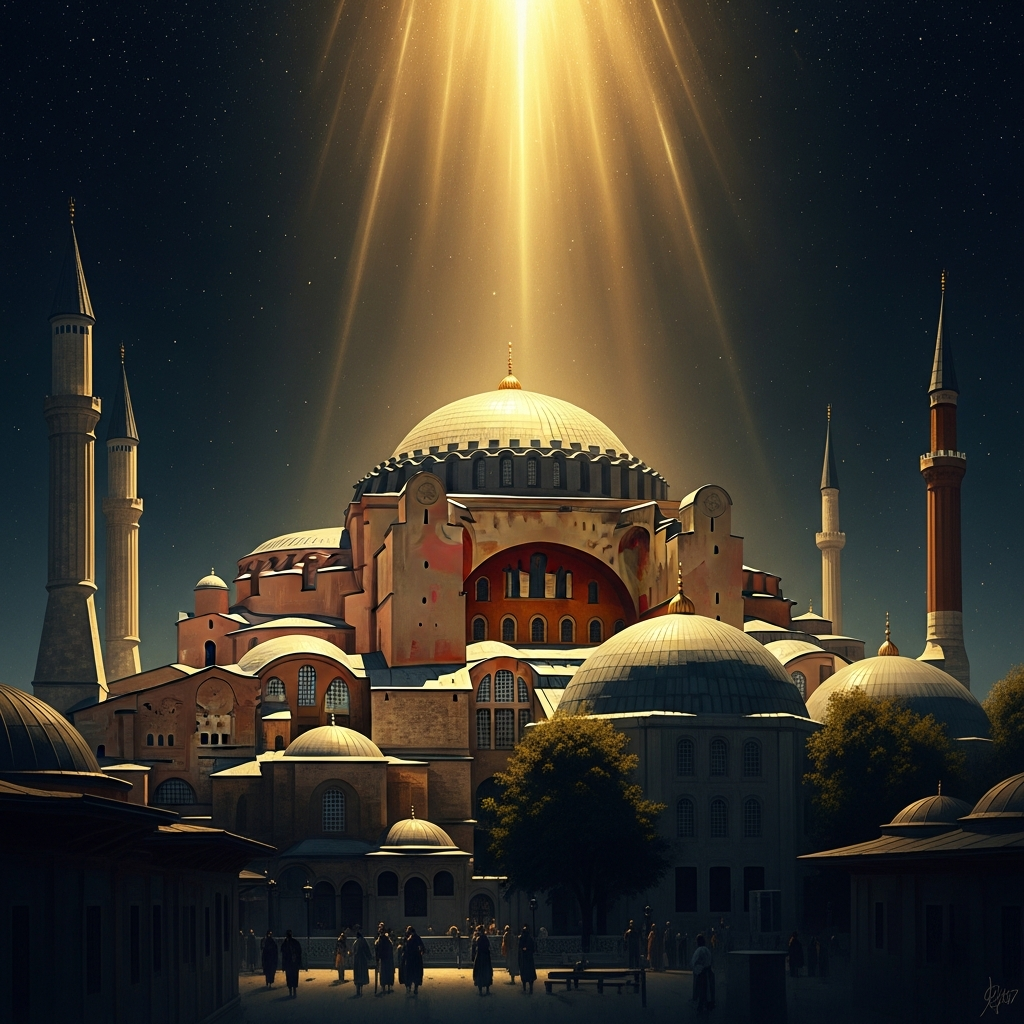
The Patriarch is told they are coming. He prepares the Divine Liturgy at Hagia Sophia for them. The full one. With every deacon, every choir, every censer. The dome of the Great Church is a hundred and eighty feet above the floor. The mosaics are gold. The candles are uncountable. The chant rises and the smoke rises and the morning sun comes through the high windows in shafts a man could climb.
The boyars stand in the nave. They do not move for the entire liturgy. They do not speak.
When they return to Kiev, Vladimir asks them what they saw. Nestor sets down the sentence carefully, in his clearest hand:
We knew not whether we were in heaven or on earth, for surely there is no such splendor or beauty anywhere upon earth. We cannot describe it to you; only this we know, that God dwells there among men.
Vladimir is convinced. There are political calculations too — Nestor is honest about them. The Byzantine emperor, Basil II, needs military help; he offers his sister Anna in marriage if Vladimir converts. A purple-born princess is not nothing. The deal is struck.
In 988 Vladimir is baptized at Cherson. He marries Anna. He returns to Kiev a Christian.
Nestor describes what happens next in two scenes the Russian people will memorize.
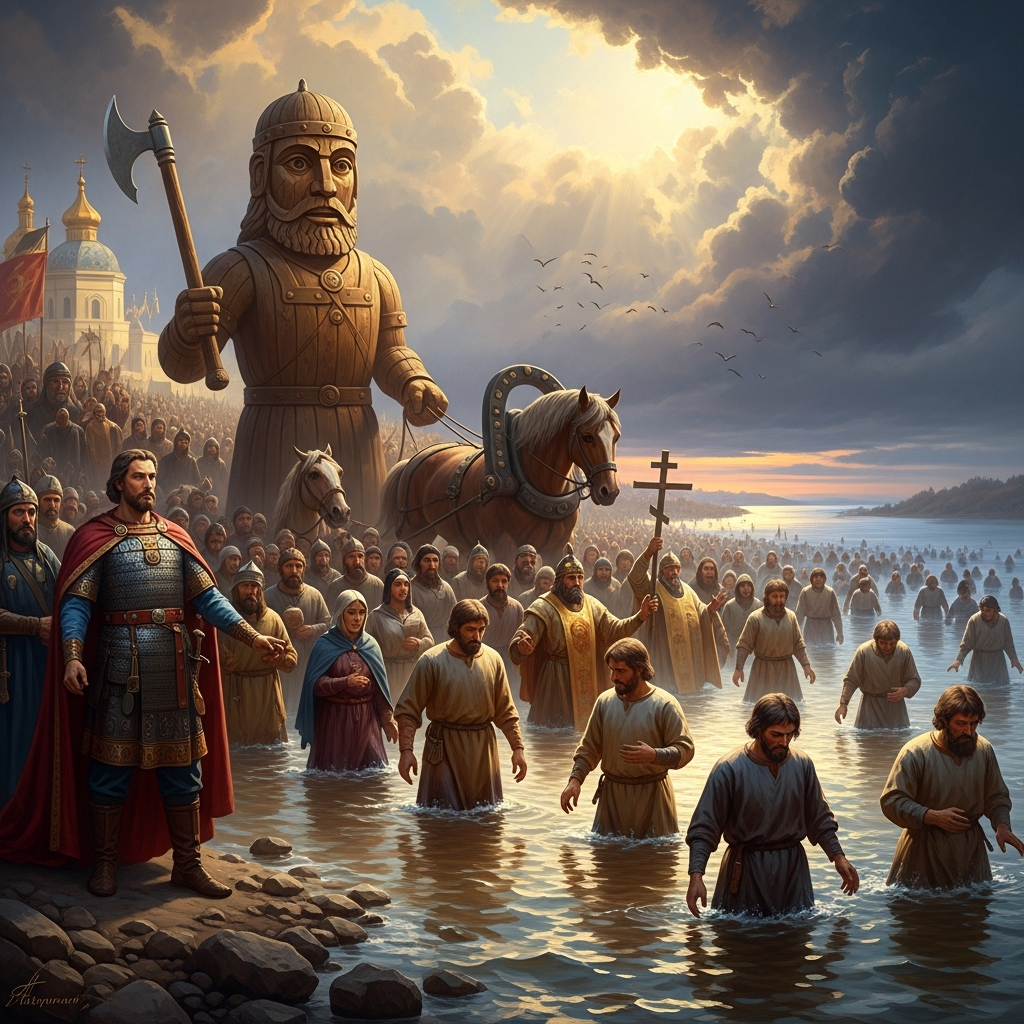
First: Perun. The wooden idol with the silver head is pulled down from the hill. They tie it to the tail of a horse. The horse drags it through the streets and twelve men beat it with sticks the entire way. They throw it into the Dnieper. Vladimir orders soldiers to push it back into the current every time it tries to come ashore, until it has passed the rapids and is gone forever down the river toward the sea.
Second: the baptism. Vladimir issues a decree. Every man, woman, and child in Kiev is to come to the river. They come. Nestor writes: some stood in the water up to their necks, others up to their breasts, and the younger near the bank; some held babes in their arms. The priests stood on the shore and read the prayers. The river was full of people. The people were full of weeping and singing.
The land, in that hour, was no longer Rus the pagan. It was Rus the Christian.
Nestor sets the quill down. The lamp is low. He has been writing since vespers; the matins bell will ring soon. He covers the parchment with a clean cloth, weights the corners, and rises stiffly from his stool.
He does not yet know that what he has written will be copied for nine centuries. He does not know that Russian schoolchildren in 1900 will memorize the emissaries’ sentence. He does not know that the manuscript he is laboring on will survive the Mongol burning of Kiev because a copy will already have been made at Vladimir-Suzdal, and another at Novgorod, and another at the monastery of the Holy Trinity, and that from those copies the entire self-understanding of a people will descend.
He knows only that he has done the work he was given. He blows out the lamp.
The cell is dark. Above him, in the chapel, the bell begins to ring.
Nestor’s chronicle is the moment Russian history becomes self-aware. Before him there are events; after him there is a story, and the story has a shape, and the shape is conversion. Every later Russian self-understanding — the Third Rome, Holy Russia, the Slavophile dream, even the Soviet rewriting that tried to deny it — is in conversation with Nestor’s opening question: whence came the Russian land?
The emissaries’ sentence is almost certainly idealized. It is also almost certainly true at some level — Hagia Sophia really did do that to people. The Norman ambassador Liudprand of Cremona, two generations earlier, had described the same vertiginous awe. The Greeks knew exactly what they were doing.
The chronicle was completed around 1113. Nestor died not long after. His grave is in the Caves Lavra, where pilgrims still light candles. The cell is gone. The chalk is gone. The book remains.
Scenes
The Caves Lavra, Kiev, ~1112 — Nestor at a slanted writing desk in a chalk-walled cell, quill scratching, oil lamp guttering, parchment piled to his elbow
 Generating art…
 Hagia Sophia, Constantinople, 987 — Vladimir's emissaries standing under the great dome during the Divine Liturgy, looking up at the gold mosaics, smoke from the censers turning shafts of sun visible
 Generating art…
 The Dnieper River, Kiev, 988 — Vladimir on the bank, the wooden idol of Perun being dragged through the streets behind a horse, thousands of Kievans wading into the cold river to be baptized
 Generating art…
 Echoes Across Traditions
Entities
- Nestor the Chronicler
- Prince Vladimir of Kiev
- Vladimir's emissaries
- Perun (the discarded god)
Sources
- *The Russian Primary Chronicle: Laurentian Text*, trans. Samuel Hazzard Cross & Olgerd P. Sherbowitz-Wetzor (1953)
- Simon Franklin & Jonathan Shepard, *The Emergence of Rus 750-1200* (1996)
- Donald Ostrowski, *Muscovy and the Mongols* (1998), Appendix on the PVL transmission
- Dmitri Likhachev, *The Tale of Bygone Years* (Russian critical edition, 1950)
- Timothy Ware, *The Orthodox Church* (1964), ch. on the conversion of Russia