Contents
The 'Rose of Baghdad' — already the most famous preacher in the Islamic world — receives the initiatic cloak that transforms his personal path into a transmissible tradition, founding the Qadiriyya: the oldest and most widespread Sufi order on earth.
- When
- c. 1128 CE
- Where
- Baghdad, Abbasid Caliphate
He arrives in Baghdad at eighteen with nothing.
This is not a poetic nothing — it is the literal nothing of a young man from Gilan province in Persia who has walked a long distance with whatever a student of that era carried: a few coins, letters of introduction to teachers, and the kind of determination that looks, from the outside, like it cannot possibly be enough.
It is 1095 CE. Baghdad is the center of the Islamic intellectual world — the Abbasid caliphate has been hollowing out for two centuries, but the city itself remains brilliant, contested, and dense with competing schools of law, theology, and mystical practice. A young man from the provinces with something to say would have to say it very clearly to be heard here.
Abd al-Qadir al-Gilani is heard.
He studies the Hanbali legal tradition under Abu Said al-Makhzumi, then theology, then the works of al-Ghazali, who has recently published the Ihya Ulum al-Din — the Revival of Religious Sciences — and changed the terms of debate between orthodoxy and mysticism so thoroughly that even the orthodox Hanbalis are absorbing it. Abd al-Qadir absorbs it all and adds something the scholars cannot quite account for: a quality of presence.
He begins to preach.
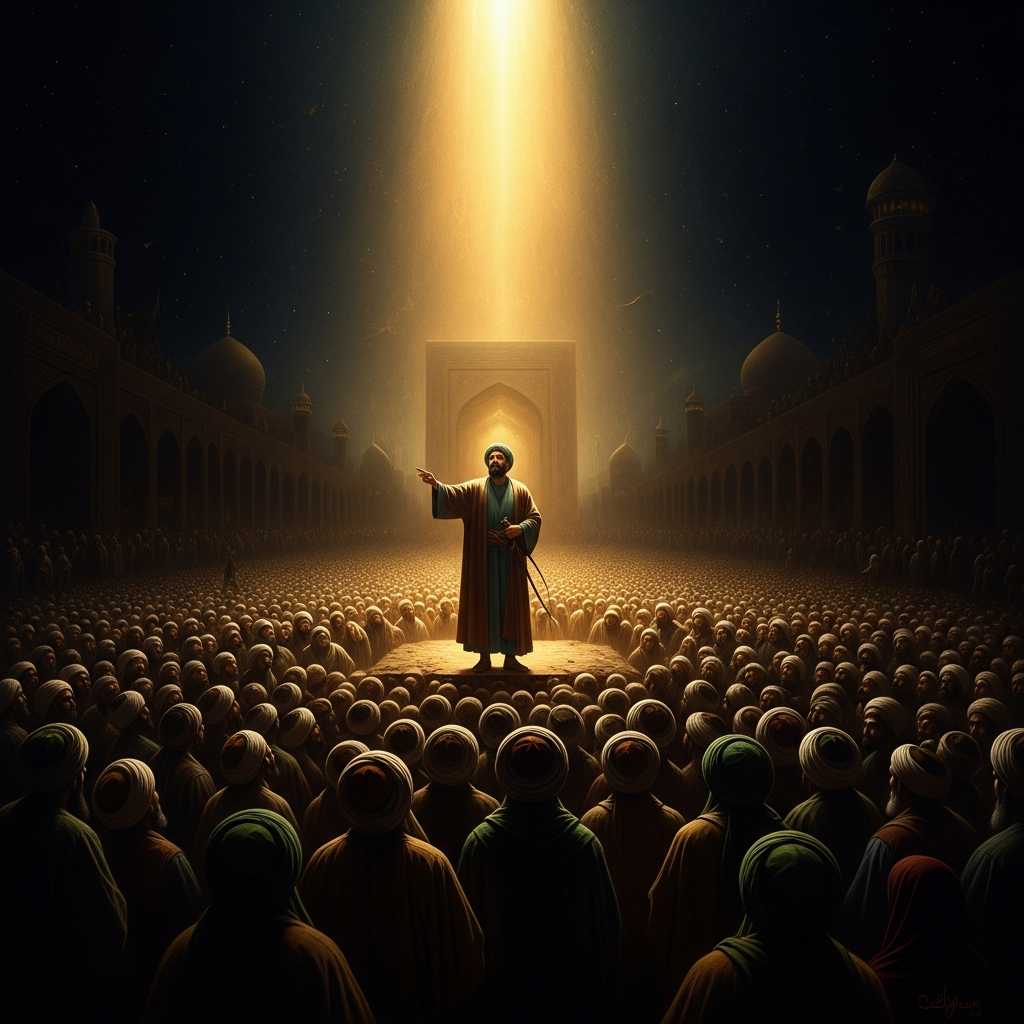
The first audiences are small — this is how it always begins, the intimate gathering in a borrowed room, the speaker still finding the register his voice wants to live in. But within a few years the small rooms are insufficient. Within a decade the gathered audiences are too large for any indoor space in Baghdad, and he preaches in the open air outside the Rusafa gate, the crowd arranging itself in concentric circles that block the streets and cause the city’s traffic to route around them.
His sermons are preserved. Reading them now, seven centuries later, the quality that draws the concentric crowds is not immediately obvious on the page — he is learned, clear, morally direct, occasionally devastating, but so were a dozen of his contemporaries whose assemblies held a hundred people. What he has that they do not have is something the Arabic sources call jadhb: magnetism, drawing-power, the capacity to pull at a person’s center of gravity and reorient it without the person’s prior consent.
He converts people in the act of arguing against him. This is recorded not as miracle but as simple observation. A theologian comes to dispute his doctrine of divine nearness, structures his counterarguments on the walk over, delivers the first one — and finds himself, somewhere in the middle of Abd al-Qadir’s response, no longer disputing but assenting. He writes about it afterward with evident bewilderment.
He is fifty years old when the cloak comes.
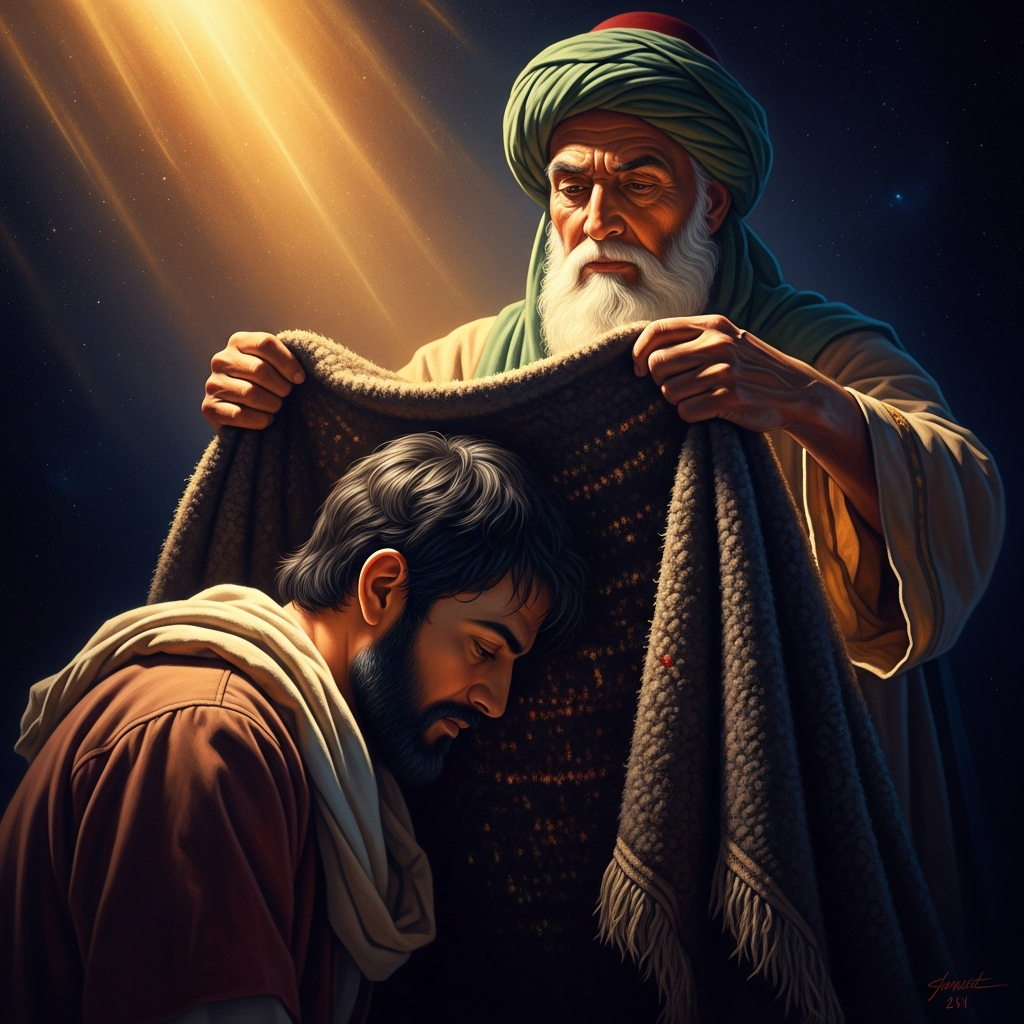
The khirqa — the patched wool garment of the Sufi, worn as a sign of renunciation and initiatic belonging — is not a new institution. The masters of the previous generations had given it to their most advanced students as a marker of authorization: you have been with me long enough and gone deep enough that what I carry can be transmitted to you, and through you to others who will come after. The chain of transmission is what gives the practice its authority — it reaches back, from hand to hand, to the first generation, and through them to the Prophet.
Abd al-Qadir has been teaching for twenty years. He has the learning, the following, the reputation. What he does not yet have, formally, is the chain.
The transmission — recorded in multiple lineages, though the precise details are disputed — comes from a master in the line that runs through Hasan al-Basri back to Ali ibn Abi Talib back to the Prophet. The cloak is placed on Abd al-Qadir’s shoulders in a Baghdad courtyard, by old hands, with words that have been spoken in the same form for three hundred years.
He receives it and understands immediately what has changed.
Before the cloak: he is a preacher. A great preacher — the greatest of his generation in Baghdad, perhaps the greatest preacher in the Islamic world — but a preacher is a man whose teaching ends when he does. The audience disperses after the sermon. They carry what they have heard, but they carry it as information, as inspiration, as an experience they may or may not revisit. The relationship terminates when the man terminates.
After the cloak: he is the link in a chain.
This is not a subtle distinction. It is the structural difference between a lecture and an initiation — between knowledge transferred and capacity transmitted. The khirqa does not mean that his doctrine is now correct, or that his spiritual insight is now validated by authority. It means that whatever he carries can now be passed on in the specific form that makes it survive him.
He begins, that year, to teach differently.
The open-air sermons continue — he will preach until near the end of his life, and the crowds do not thin. But alongside the preaching a new structure grows: the halqa, the circle of initiated students who meet not to hear a sermon but to practice the dhikr — the remembrance of God, the rhythmic repetition of divine names that is the core Sufi discipline — and who receive from him not just doctrine but transmission. They become, in the technical sense, his spiritual children.
He gives them the khirqa when they are ready. They go to other cities, other provinces, other continents. They give the khirqa to their students. The circle expands the way a pebble expands in water: not by the pebble moving, but by what the pebble set in motion.
He dies in 1166 CE, at eighty-eight, having spent nearly seventy years in Baghdad. His school — the madrasa he built near the Rusafa gate — continues. His sons continue teaching in it. His khirqa has been transmitted to hundreds of students, who have transmitted it to thousands.
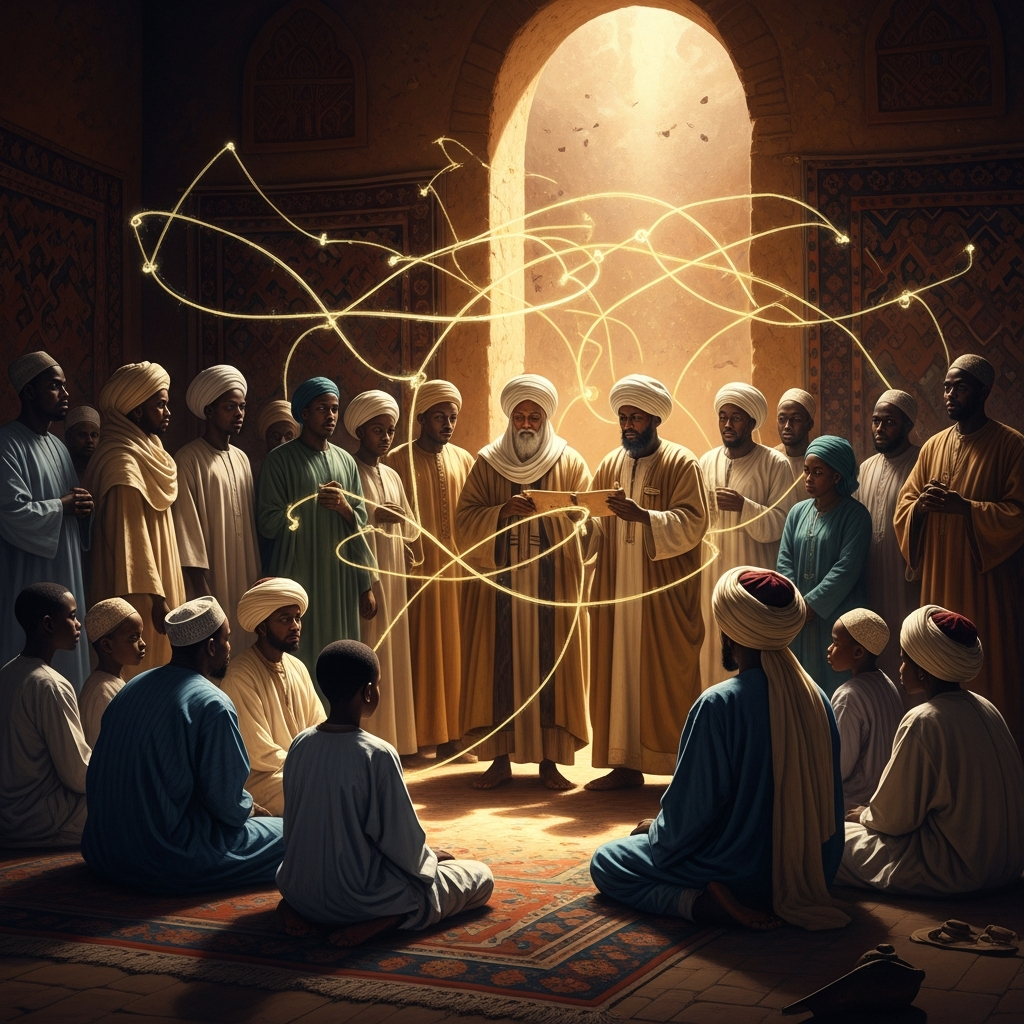
Within two generations the Qadiriyya has reached Persia and Syria. Within a century it is in Egypt and the Maghreb. By the thirteenth century Qadiri shaykhs are initiating students in the Swahili coast. By the fourteenth century in West Africa. By the fifteenth in South Asia, where the order becomes one of the most powerful religious institutions on the subcontinent.
The order never has a central authority after Abd al-Qadir. There is no Qadiri pope, no institutional headquarters, no mechanism for enforcing doctrinal uniformity across the branches. What holds it together is the chain: every initiated member can trace the line of hands back, through documented links, to the man who preached outside the Rusafa gate. The authority is genealogical, not institutional. The khirqa is the proof.
The Qadiriyya today has more initiated members than any other Sufi order — estimates range from tens of millions to a hundred million, though the methodology of counting initiates in a tradition with no central registry makes precision impossible. What is clear is the geography: from Senegal to Indonesia, from the Kurdish highlands to the Nigerian delta, the chain of the khirqa runs unbroken.
Abd al-Qadir al-Gilani is venerated in all these places with a devotion that can seem excessive to outsiders and feels, to insiders, like the minimum appropriate response to what he represents. He is not venerated for his doctrine, which is fairly standard Hanbali-Sufi synthesis. He is venerated for the fact of the chain — for having been the man through whom a particular transmission passed, and having been large enough to pass it on without losing it. The founding of an order is not the founding of a dynasty. A dynasty requires an heir who inherits the power. An order requires a teacher who gives the power away.
He gave it away completely. This is why it is still moving.
Scenes
The aged master places the wool cloak — khirqa — over Abd al-Qadir's shoulders in a Baghdad courtyard, completing a chain of transmission that reaches back to the Prophet through Ali
 Generating art…
 Abd al-Qadir preaches to thousands in the open air of Baghdad — no hall can hold the crowd, so the crowd arranges itself around him, filling the streets in every direction
 Generating art…
 A Qadiriyya initiation ceremony in West Africa, eight centuries after the founding — the chain of transmission unbroken across a hundred languages and forty countries
 Generating art…
 Echoes Across Traditions
Entities
- Abd al-Qadir al-Gilani
- Ahmad ibn Rifai
- Yusuf al-Hamadani
Sources
- Abd al-Qadir al-Gilani, *Al-Fath al-Rabbani* (The Sublime Revelation)
- Abd al-Qadir al-Gilani, *Futuh al-Ghayb* (Revelations of the Unseen)
- J. Spencer Trimingham, *The Sufi Orders in Islam* (Oxford, 1971)
- Ahmet Karamustafa, *Sufism: The Formative Period* (Edinburgh, 2007)
- Annemarie Schimmel, *Mystical Dimensions of Islam* (UNC Press, 1975)