A Feather on the Breath of God
1141 CE, Disibodenberg, Rhineland · Benedictine monastery of Disibodenberg, on the Nahe River, Germany
Contents
A forty-two-year-old German abbess has been carrying secret visions since childhood. Then a tongue of living flame descends into her brain and she hears the command she has dreaded and longed for: write what you see. Over ten years, Hildegard of Bingen pours out the first theology a woman is authorized to publish in the Western church.
- When
- 1141 CE, Disibodenberg, Rhineland
- Where
- Benedictine monastery of Disibodenberg, on the Nahe River, Germany
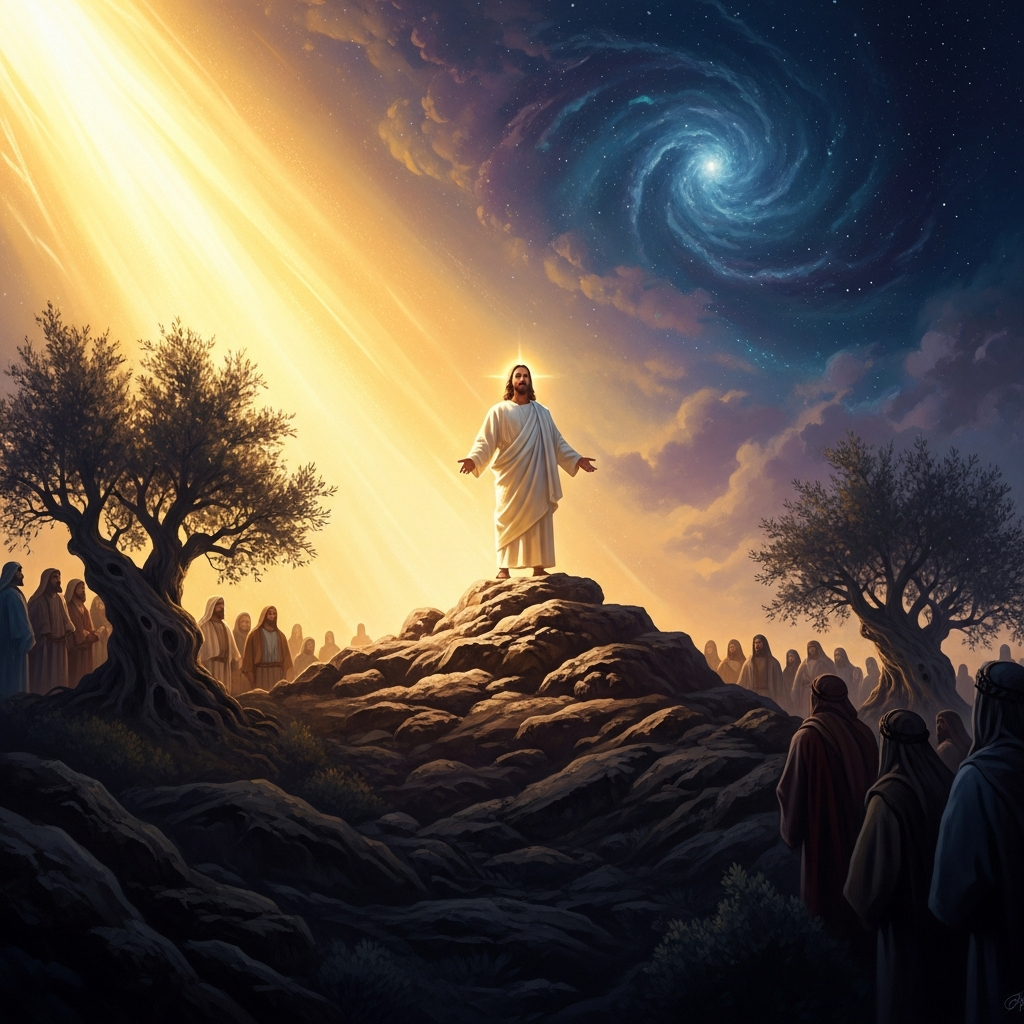
The child Hildegard is five years old when the light arrives for the first time.
She is sitting in a meadow near the Bermersheim farmhouse. The sky is ordinary. Then, without announcement, it is not: the air fills with a brilliance she cannot look at directly but can see entirely, a radiance that presses through her closed eyelids and illuminates the underside of the world. She tells no one. She has learned, even at five, that this is not the kind of thing you tell. She files it away inside herself like a document in a language no one around her reads, and waits.
She waits for thirty-seven years.
At eight she is given to the anchoress Jutta of Sponheim as an oblate — a child-gift to the church, the tenth child of a noble family, the tithe of flesh. Jutta is brilliant and self-mortifying; she fasts her body to the edge of damage and prays in a cell attached to the Benedictine monastery of Disibodenberg. Hildegard grows up beside her, learning Latin, learning the Psalter, learning the way a woman moves through monastic space — always slightly sideways, always with lowered eyes, always with the deference of the admitted guest.
She takes vows. She keeps seeing the light. She asks Jutta about it once, obliquely, and reads in Jutta’s face that Jutta has no idea what she means. She does not ask again.
She begins to understand, in the slow way that takes decades, that the light is specific. It comes with content. It is not illumination in general but illumination of something in particular — a structure, a correspondence, a doctrine she has not read in any book but that the light holds up for her examination like a text. She describes it later as seeing everything at once: the order of the universe, the architecture of salvation, the relationship between the soul and its maker laid out in shapes that combine theological precision with the overwhelming color of stained glass.
In 1136, Jutta dies and Hildegard is elected magistra of the small community of nuns at Disibodenberg. She is thirty-eight. She runs the house with a firmness that surprises everyone, including herself.
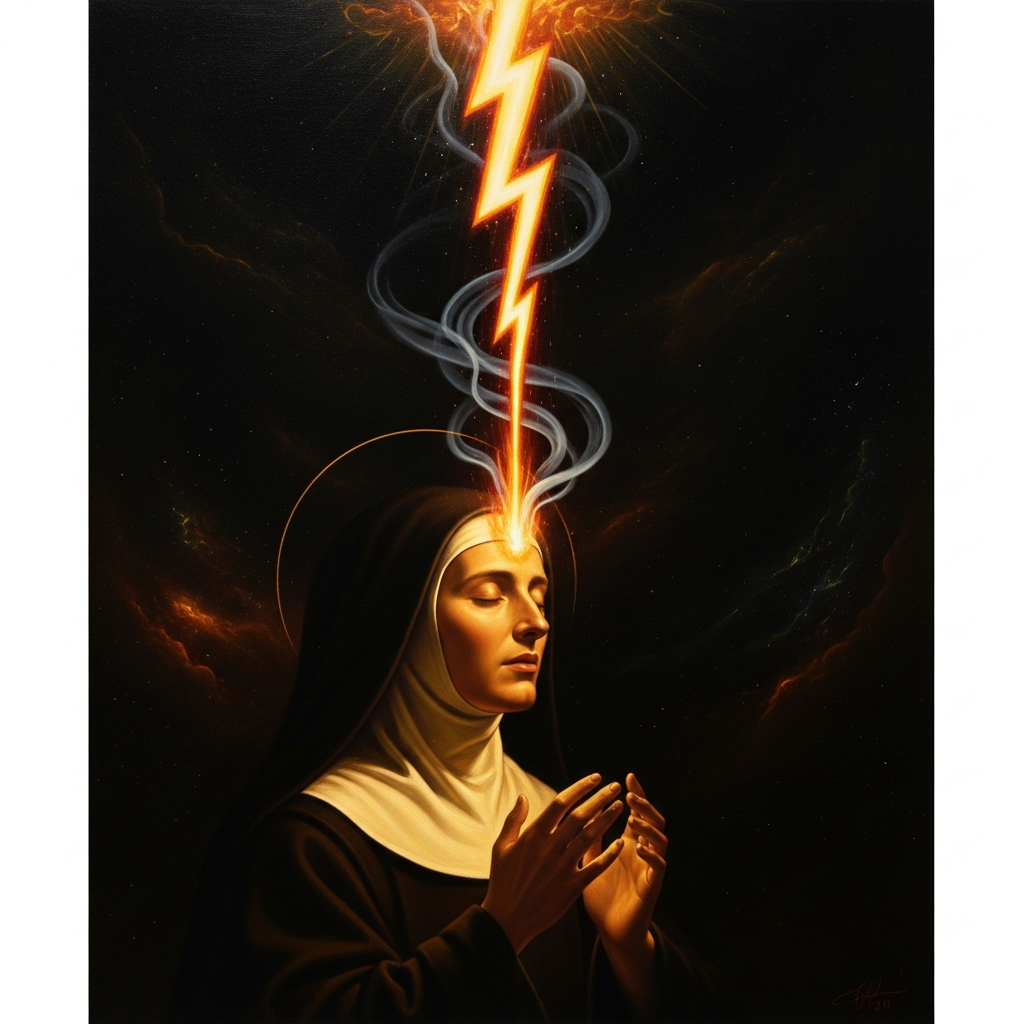
Three years later, in 1141, she is lying ill — she is often ill; the illnesses have accompanied the visions since childhood, as if the body flags its overload — when the light comes differently. Not the usual sidelong illumination. This time it descends.
A tongue of fire, burning and not burning. It enters through the crown of her skull. It fills the space behind her eyes. It illuminates everything at once the way lightning illuminates a landscape, except the lightning does not stop. She hears, inside the illumination, a voice that is not a voice she can locate anatomically: Write what you see.
She has heard this command before, in softer forms. She has declined it before, in softer forms. Now there is nothing soft about it.
She is terrified. Not of the voice but of herself — of the presumption, of what will happen when the monks of Disibodenberg discover that their abbess has been receiving direct divine revelation since she was five and writing nothing. She confides in the one person she trusts: Volmar, her confessor, a monk of Disibodenberg who has been her teacher and her correspondent for twenty years. She shows him the notes she has been making privately, the fragments, the illegible shorthand of visions she was not ready to publish.
Volmar reads them. He looks at her with an expression she will describe, in the Scivias prologue, as recognizing. He tells her she must write.
She is also helped by Richardis von Stade, a young nun of noble family who becomes her secretary and her confidante — the one who copies the drafts, who catches Hildegard when the visions arrive during office and leave her momentarily elsewhere. Together, the three of them — the abbess, the monk, the young secretary — spend ten years producing the Scivias.
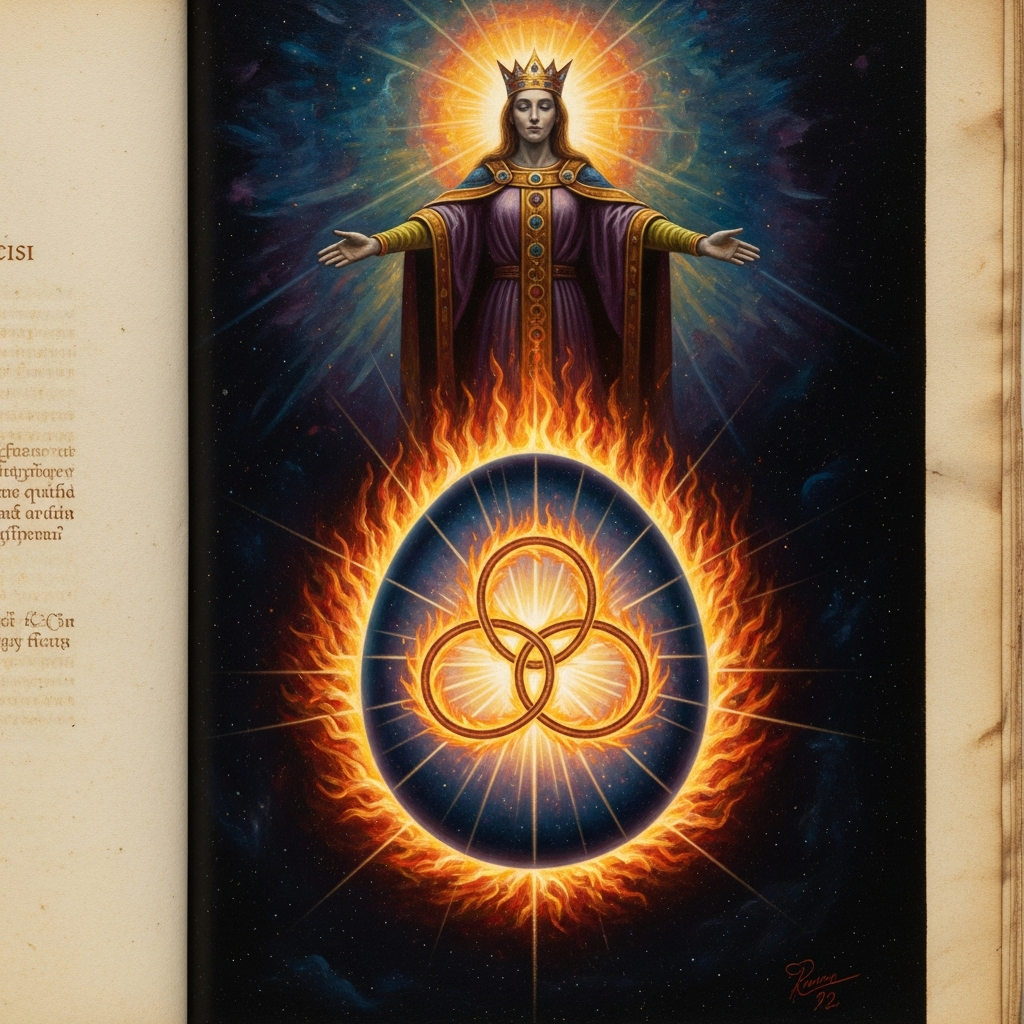
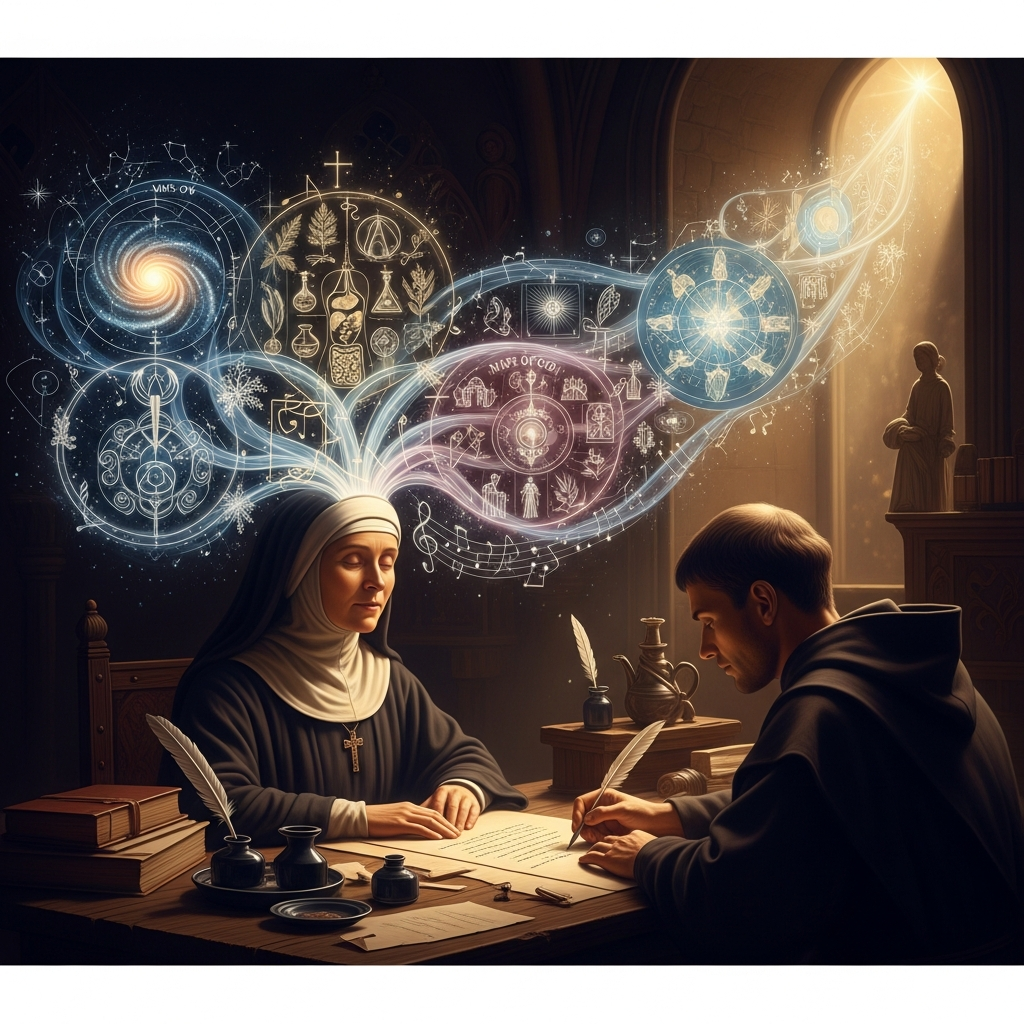
The visions pour out in shapes that have no precedent in the theological literature Hildegard has been trained on. There is a woman, enormous, robed in white, standing in the universe: Ecclesia, the Church, a crowned cosmic figure who is at once an institution and a person. There are interlocking rings of fire that are, simultaneously, the Trinity. There is a cosmic egg — the universe as an egg held in a flame, with the winds at its four corners and the regions of the saved and the damned visible in cross-section. There are diagrams that are also hymns.
She writes the Trinity as music. Not as a metaphor for music. As the claim that the divine nature is fundamentally harmonic — that the relationship between the three persons is a chord, that creation is God singing, that the human soul is a note that does not know it is part of a larger composition. She writes this in Latin, carefully, in language that is both theologically precise and so strange that Volmar keeps asking her to confirm that she means exactly what she is writing. She always does.
Her Latin is idiosyncratic. She has been educated, but not in the schools. She writes with an energy that rides over grammatical convention the way a river rides over its banks. Volmar smooths it. She revises his smoothing back toward roughness. The final text is hers.
In 1147, Bernard of Clairvaux — the most powerful churchman in Europe, the man who launched the Second Crusade, the man who ended Abelard’s career — reads a sample of the Scivias at the Synod of Trier. He approves it. Pope Eugenius III reads another sample. He approves it. He authorizes Hildegard to write and publish.
No woman has ever received this authorization before. Hildegard does not celebrate. She is already working.
Over the next thirty years, she founds two monasteries, writes two more major theological works, composes 77 liturgical songs that are in a mode she has invented — wider in range than any contemporary music, stranger in melodic shape, with an ecstatic leaping quality that later musicologists will spend decades trying to categorize. She writes medicine. She writes natural science. She writes letters to four popes, two Holy Roman Emperors, the King of England, Bernard of Clairvaux, and anyone else she thinks needs correcting.
She undertakes four preaching tours of the Rhineland, speaking in public — something women do not do — with the authority of the papal authorization behind her. She denounces corrupt clergy to their faces. She tells an abbot that his monks are living badly and he should be ashamed. He is.
She dies on September 17, 1179, at the age of eighty-one, in her own monastery at Rupertsberg, near Bingen on the Rhine.
At the moment of her death, her nuns report seeing two streams of light cross the night sky above the monastery.
She has described herself, in one of her letters, as a feather on the breath of God — carried, not driving; lifted, not flying under her own power. The image is true and also not quite true. The feather, in her case, was made of something that did not blow away. It stayed where the breath set it down, wrote what it saw, and argued with emperors until there was nothing left to argue.
Hildegard is the medieval church’s proof that the vision refuses to stay silent forever — that the thirty-seven years of waiting make the flood larger, not smaller, and that the woman who keeps the fire banked will eventually build a larger fire with it than any monk who let his burn freely from the beginning.
Scenes
The tongue of living flame descends into Hildegard's mind — not burning, but illuminating everything at once, like lightning held still
Generating art… A page from *Scivias*: the cosmic egg, the Trinity as interlocking rings of fire, Ecclesia standing crowned in the universe
 Generating art…
 Hildegard at the writing desk in Rupertsberg, dictating to Volmar — the visions flowing out as music, as medicine, as maps of God
 Generating art…
 Echoes Across Traditions
Entities
- Hildegard of Bingen
- Volmar of Disibodenberg
- Richardis von Stade
- the Living Light
Sources
- Hildegard of Bingen, *Scivias* (1141-1151), trans. Columba Hart and Jane Bishop (Paulist Press, 1990)
- Hildegard of Bingen, *Liber Divinorum Operum* (c. 1163-1174)
- Hildegard, *Symphonia armonie celestium revelationum* (collected songs, 12th c.)
- Sabina Flanagan, *Hildegard of Bingen: A Visionary Life* (Routledge, 1989)
- Barbara Newman, *Sister of Wisdom: St. Hildegard's Theology of the Feminine* (University of California Press, 1987)
- Fiona Maddocks, *Hildegard of Bingen: The Woman of Her Age* (Doubleday, 2001)