Suryavarman Dedicates Angkor Wat
c. 1150 CE · Khmer Empire at apex · Angkor (Yasodharapura), Khmer Empire — modern Siem Reap, Cambodia
Contents
c. 1150 CE. King Suryavarman II raises the largest religious structure ever built — a stone Mount Meru with five towers, a moat the size of a lake, and a half-mile gallery carved with the gods churning the ocean for the elixir of immortality.
- When
- c. 1150 CE · Khmer Empire at apex
- Where
- Angkor (Yasodharapura), Khmer Empire — modern Siem Reap, Cambodia
The king is dying.
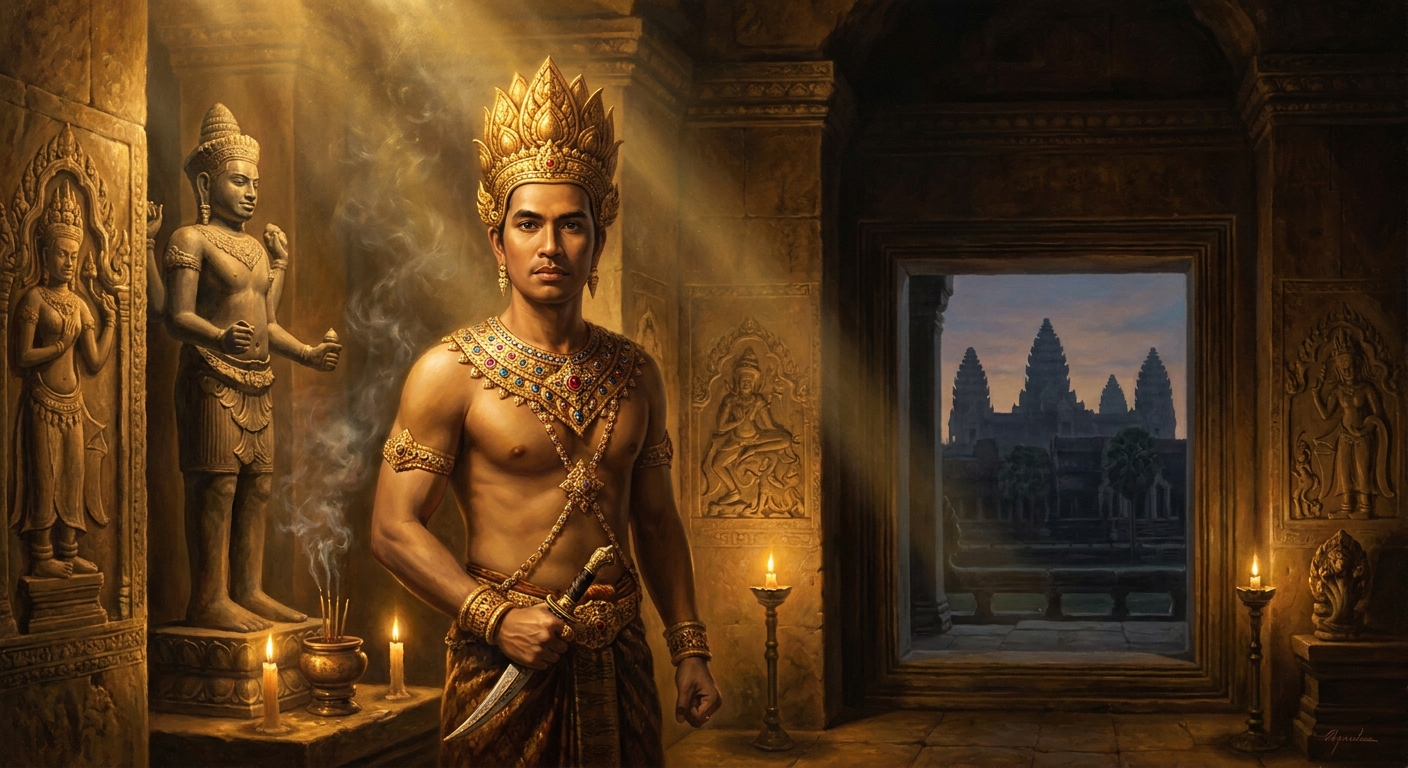
He is not old. He is in his early forties, perhaps, by the calculation of the surviving inscriptions. He has reigned for nearly thirty years. He has fought the Cham to the east and the Dai Viet to the north. He has reorganized the bureaucracy, taken the title Paramavishnuloka — He who is in the supreme world of Vishnu — and commissioned a temple that thirty thousand workers have been building for thirty-two years.
The temple is not finished. It will not be finished in his lifetime. The northeast gallery has not yet been carved. Some of the lintels are still rough. But the central tower stands, the moat is full, the causeway is set, and Vishnu has been installed at the axis of the world.
Suryavarman II calls his court priest. He requests, while he can still walk, to make the dedication.
He approaches from the west.
This is the strange thing about Angkor Wat — the thing the foreign visitors will keep noticing for centuries. Khmer temples face east, toward sunrise, toward life. Angkor Wat faces west, toward sunset, toward the realm of the dead and the heaven of Vishnu. The king has built his temple to be a tomb. He will be installed inside it when the time comes.
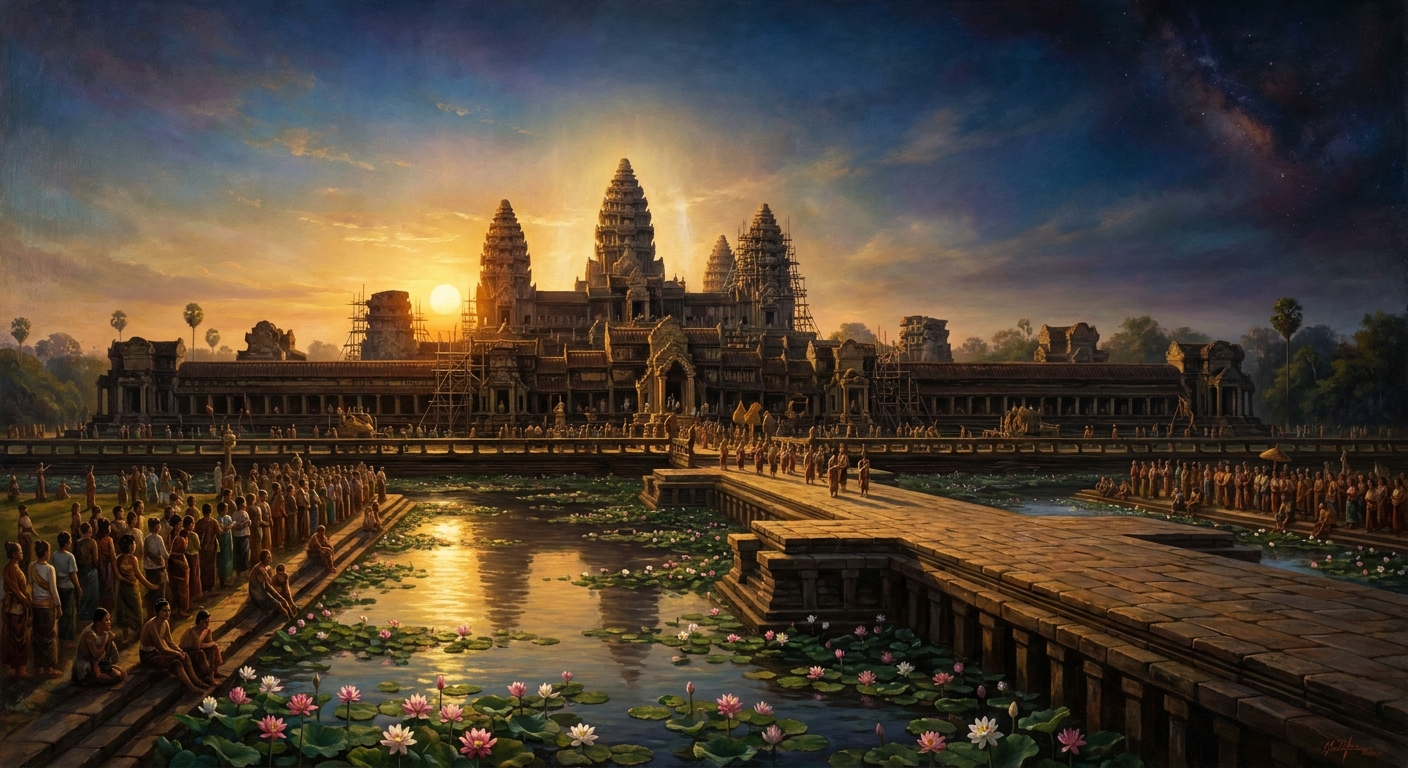
The causeway is two hundred meters of dressed sandstone, balustraded with naga-serpents whose seven-headed hoods rise at the bridgeheads. He crosses the moat. The moat is two hundred meters wide and five kilometers in circumference; it holds the temple inside an artificial square ocean — the cosmic sea around Mount Meru, the salt water that surrounds the continent of Jambudvipa, the ring of formlessness around the form-world.
He passes through the western gopura. The first gallery opens around him, and the bas-reliefs begin.
Eight hundred meters of carved stone.
Each gallery wall is a continuous bas-relief two meters tall, running the full perimeter of the third enclosure — eight hundred meters in total, more than a kilometer if both sides are counted, the largest continuous bas-relief on earth. The southern wall shows the Battle of Kurukshetra from the Mahabharata. The western wall shows the Battle of Lanka from the Ramayana. The northern wall shows Vishnu in his cosmic battles. The eastern wall, the wall the king has come specifically to inaugurate, shows the Samudra Manthana — the Churning of the Ocean of Milk.
He stops in front of it.
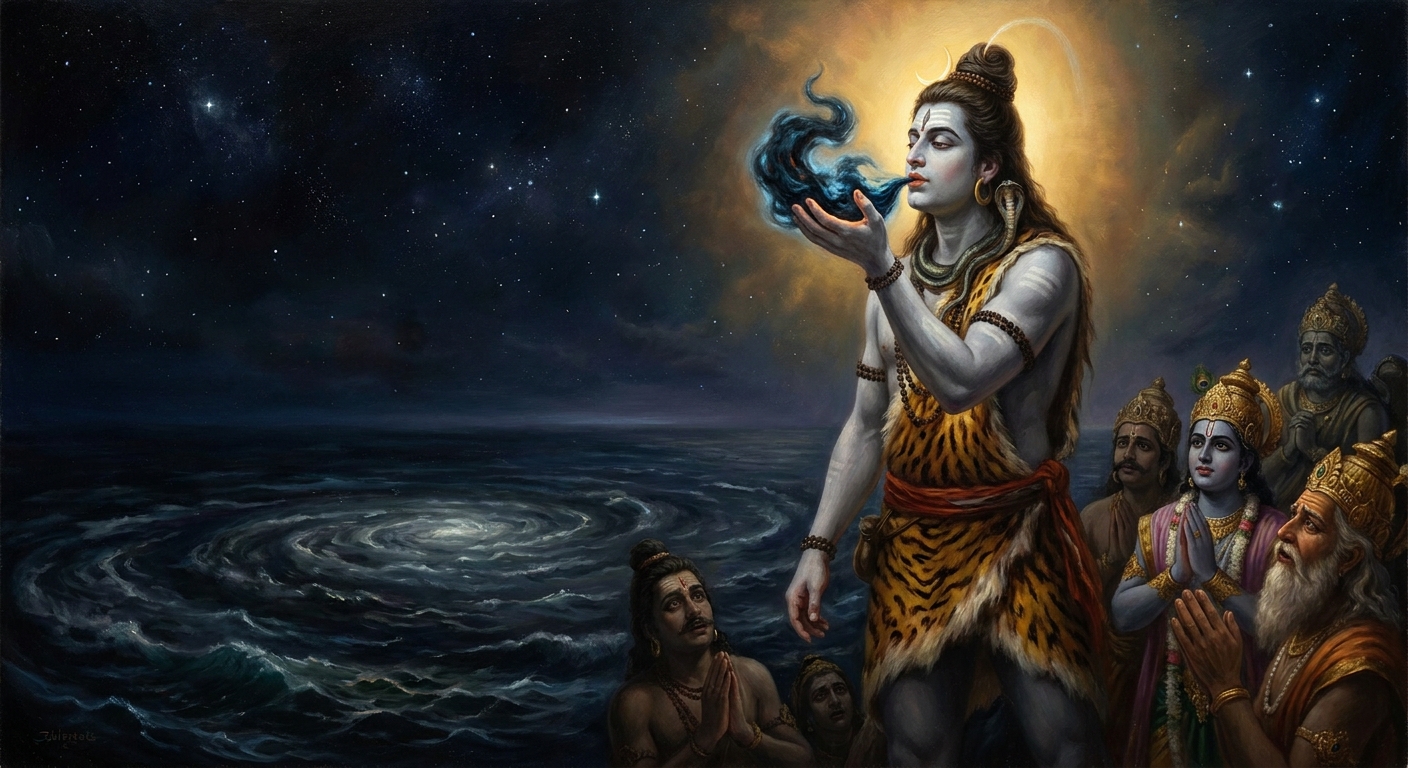
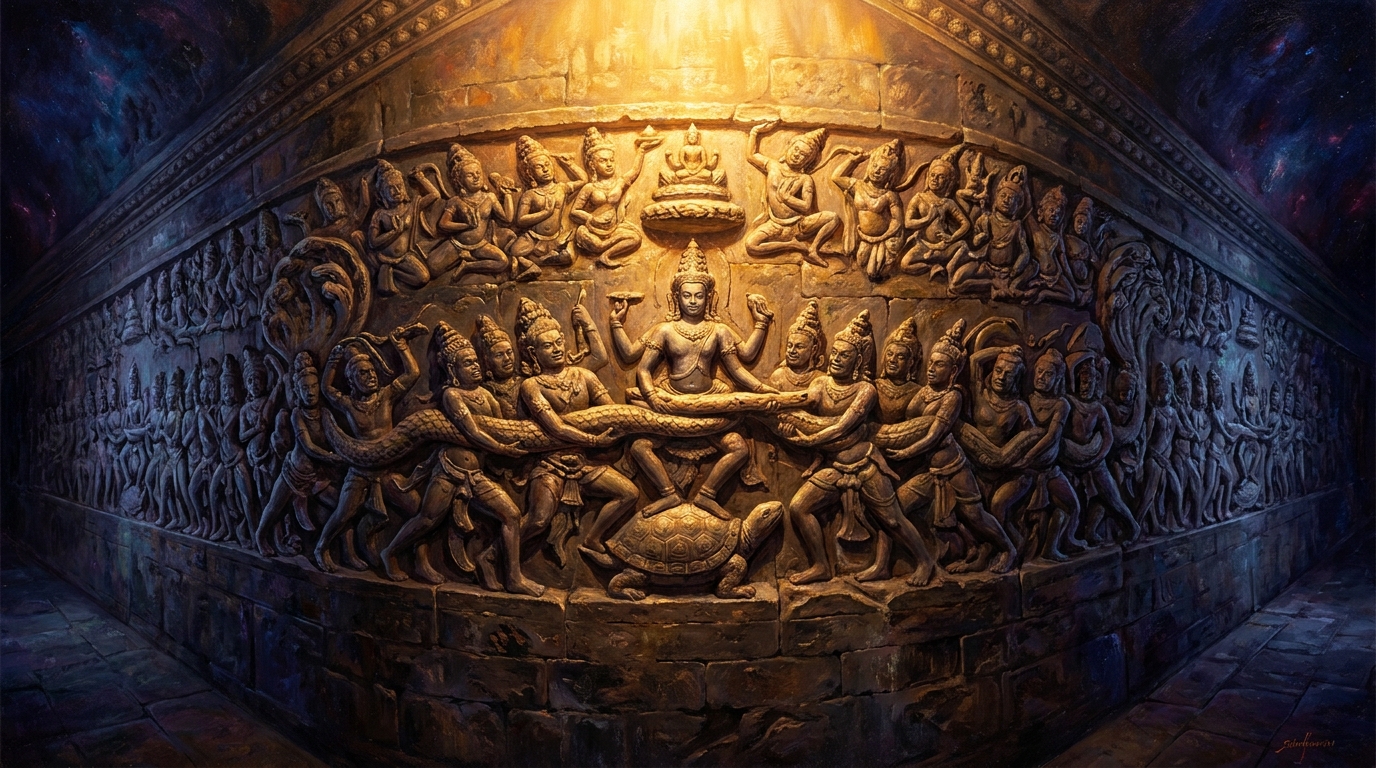
The relief is forty-nine meters long. Eighty-eight asuras on one side, ninety-two devas on the other, pulling the serpent Vasuki who is coiled around Mount Mandara at the center. The mountain is being used as a churning pole. The serpent is being used as a churning rope. They have been pulling for a thousand years and the ocean has begun to give up its treasures — the wish-granting cow, the moon, the celestial physician, and finally amrita, the elixir of immortality, in a golden vessel held by Dhanvantari.
Vishnu is at the center, four-armed, holding the axis steady. He is also below it, in his turtle avatar Kurma, supporting the mountain on his back. He is also above it, in a smaller register, presiding. The relief shows him three times in the same scene because the doctrine requires him three times — sustainer below, churner at center, witness above.
Suryavarman, who has taken the name He who is in the supreme world of Vishnu, looks at the god he intends to merge with after death.
He keeps walking.
Through the second gallery, with its libraries flanking the cruciform cloister. Through the third gallery, with its seven-tiered terraces. Up the central staircase — so steep it must be climbed on hands and feet, a deliberate forcing of the body into a posture of devotion. The pilgrim cannot ascend Angkor Wat upright. The architecture refuses it.
At the top, the central tower.
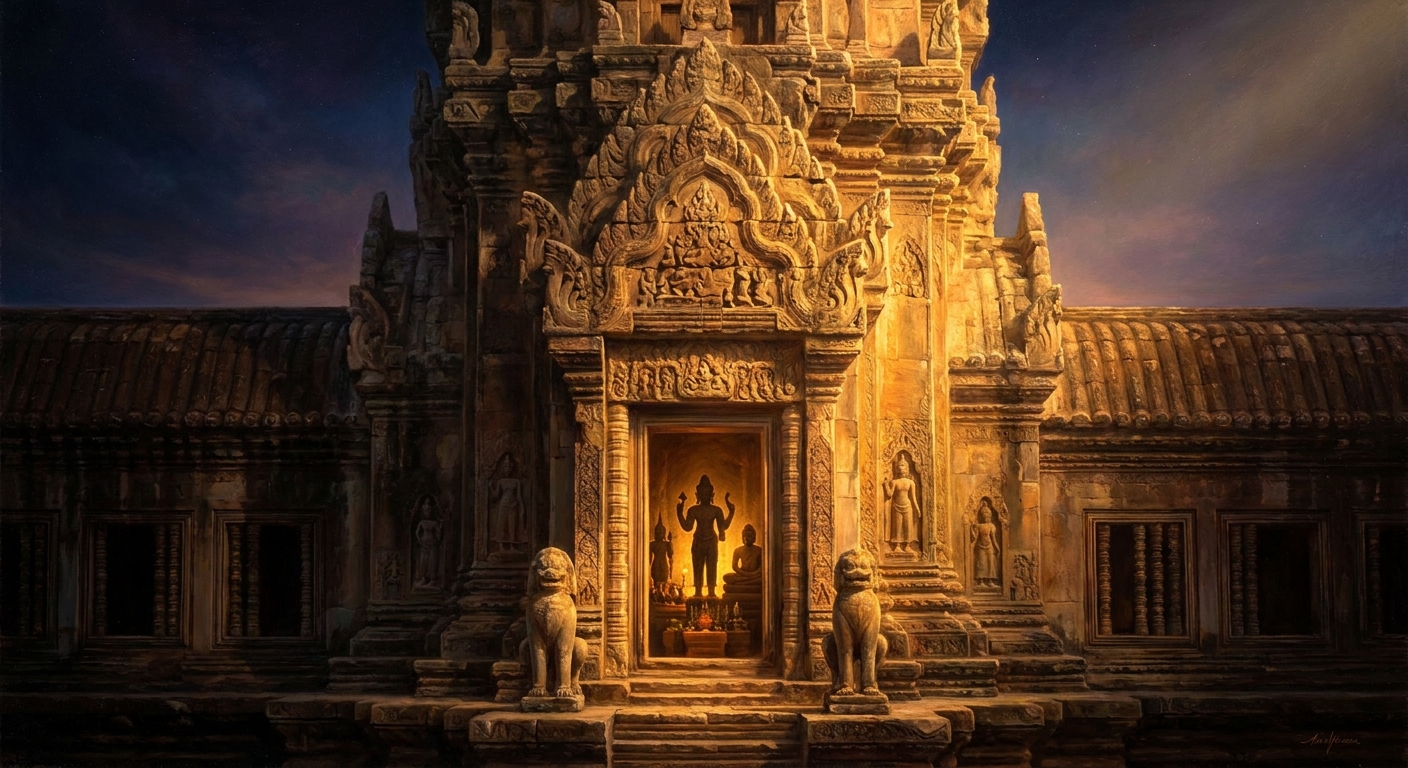
The sanctuary is small, considering the scale of the monument around it. A square chamber, originally housing a Vishnu image — perhaps the gold-plated reclining Vishnu the inscriptions describe, perhaps an image of Suryavarman himself in the form of Vishnu, the deva-raja doctrine made literal. The king who is also the god, installed at the axis of the cosmos he has built to scale.
He kneels. The court priest performs the consecration. The mantras pass through the chamber and out into the four directions. The temple is now active — alive in the technical sense the Sanskrit inscriptions intend, a working machine for the maintenance of the cosmos and the merit of its founder.
Two centuries later, the country converts.
Theravada Buddhism arrives from the south, from Sri Lanka by way of the Mon kingdoms, and sweeps the Khmer world. The kings who follow Suryavarman’s line gradually abandon the Vishnuite cult of the deva-raja. The state shifts. Angkor Wat does not get demolished. It does not get abandoned. It gets converted — Buddha images installed in the galleries, the central sanctuary refitted with seated Buddhas, the bas-reliefs of Vishnu’s avatars left in place because the Khmer have decided, sensibly, that a building is not a doctrine.
The carvings stay. The ocean is still being churned on the eastern gallery. Vishnu is still holding the mountain. But monks in saffron now walk the causeway, and the chants are in Pali, and the offerings are flowers and incense rather than the goat-blood and rice-wine of the older cult.
The temple has changed religions without changing stones. It is the kind of thing a sandstone monument can do.
In 1296 CE the Chinese envoy Zhou Daguan arrives.
He stays a year. He writes the only contemporary description of Angkor at its peak — the markets, the festivals, the king’s procession on a gold palanquin shaded by twenty white parasols. He describes Angkor Wat as the funerary temple of a king named Lu Ban, which is a Chinese folk-name for Suryavarman, garbled across two centuries. He notes that the temple is still maintained, still active, still the center of the city’s ritual life.
A century and a half later the Khmer abandon Angkor for Phnom Penh. Disease, drought, the rising power of the Thai to the west — the causes are debated. The temple does not empty. Buddhist monks remain. The jungle starts to take the outer galleries. The moat becomes a wetland and then a moat again, depending on the season.
Henri Mouhot, a French naturalist, will rediscover it for the West in 1860 and write that one of these temples might take an honorable place beside our most beautiful buildings. The locals, who have been worshipping there for seven hundred years, will not be surprised.
Suryavarman built the largest religious structure on earth and dedicated it to a god he intended to become. The doctrine of god-kingship died with the Khmer empire. The temple did not. It is still there, still oriented to the dying sun, still showing the gods and demons pulling the serpent through the ocean for the elixir of immortality.
The conversion to Buddhism is the part of the story Western tellings tend to skip. The temple has been Buddhist longer than it was Hindu. The Buddhas in the central tower have been there for seven centuries. The bas-reliefs have not changed. The doctrines have, twice. The architecture has held both, and would hold a third, if a third arrived.
This is the Khmer claim about religion: gods come and go. Stone stays. The cosmos requires a mountain at its center, and once you have built one large enough, the question of which god lives on top of it becomes, eventually, the question the next generation answers however it likes.
Scenes
The moat: 200 meters wide, five kilometers around, holding the temple inside its own square ocean
 Generating art…
 The eastern gallery's southern half: forty-nine meters of bas-relief showing eighty-eight asuras and ninety-two devas pulling the serpent Vasuki, coiled around Mount Mandara, churning the cosmic ocean for a thousand years to extract amrita, the elixir of immortality
 Generating art…
 The central tower — sixty-five meters above ground level, the still axis of the temple-mountain
 Generating art…
 Echoes Across Traditions
Entities
- Suryavarman II
- Vishnu
- Mount Meru
- Vasuki

Sources
- George Coedès, *The Indianized States of Southeast Asia* (1968) — the foundational synthesis of Khmer epigraphy and Sanskrit inscriptional history
- Maurice Glaize, *The Monuments of the Angkor Group* (1944, English translation 1993) — the standard architectural and iconographic survey
- Michael Vickery, *Society, Economics, and Politics in Pre-Angkor Cambodia* (1998) — for the political economy underpinning the temple-state
- Eleanor Mannikka, *Angkor Wat: Time, Space, and Kingship* (1996) — on the astronomical alignments and cosmographic encoding of the monument
- David Chandler, *A History of Cambodia* (4th ed., 2007)