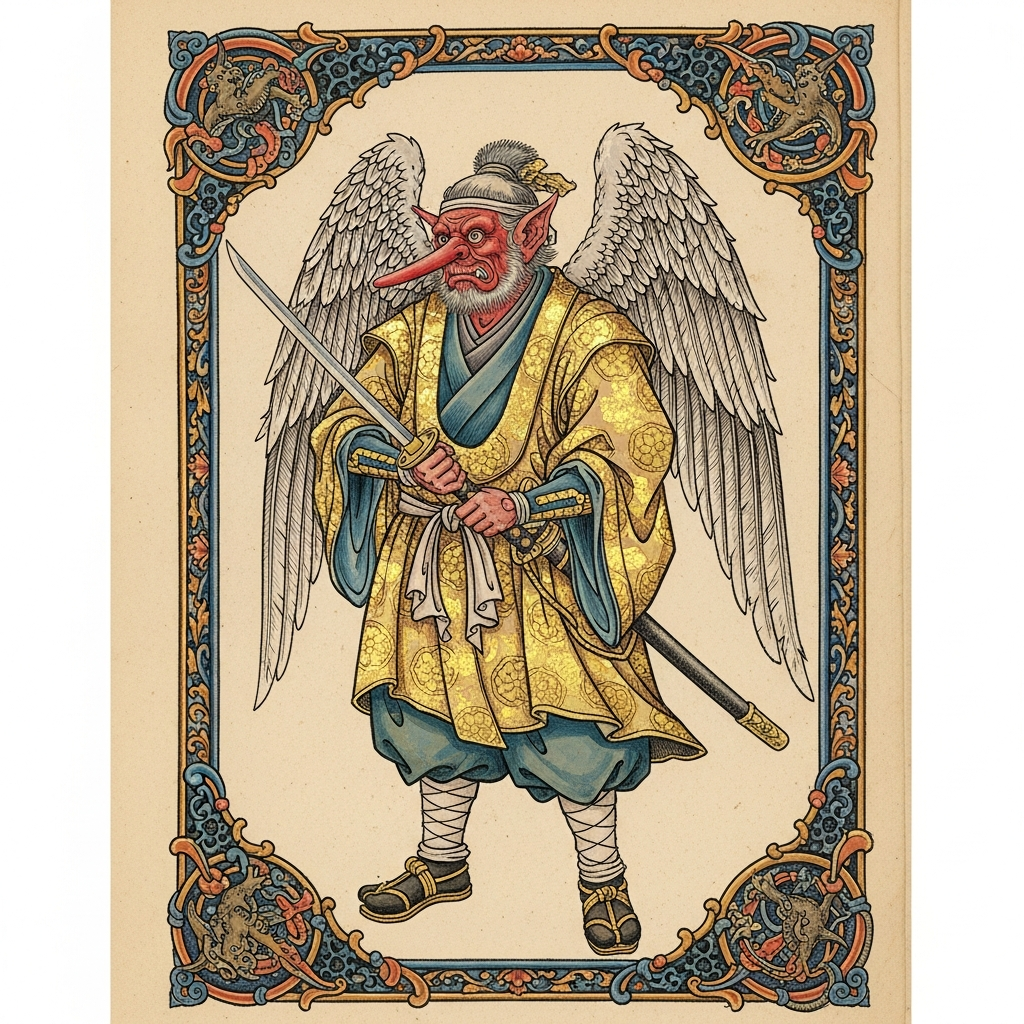
What the Tengu Teach on the Mountain
Heian period, c. 1150–1180 CE · Kurama-yama, the mountain north of Kyoto
Contents
A young warrior in Heian-period Japan climbs into the mountain seeking a master among the tengu — the half-human, half-bird spirits who are said to have taught Yoshitsune his swordsmanship. He finds something on the mountain, but it does not teach him the way he expected to be taught, and he does not learn what he thought he came to learn.
- When
- Heian period, c. 1150–1180 CE
- Where
- Kurama-yama, the mountain north of Kyoto
He goes up in the wrong season.
This is not wisdom — the mountain in late autumn, the cedars stripped and the trail iced in the mornings, the descent more dangerous than the climb — but he is seventeen and what drives him is not wisdom. He has heard the story of Ushiwakamaru, the warrior-boy who became Minamoto no Yoshitsune, who trained on Kurama-yama with the great tengu Sojobo, who came down from the mountain as the finest swordsman Japan had produced. He has heard that Sojobo taught the boy tengu-jutsu — the art of the mountain spirits, the sword technique that operates in the spaces between ordinary technique, the thing that cannot be learned from a human teacher because no human teacher carries it.
He climbs Kurama-yama with a sword, a bedroll, and the particular certainty of someone who has not yet discovered what certainty costs.
The tengu are not what the picture-scrolls make them.
He knows the picture-scrolls: the red-faced long-nosed creatures with fans and mountain robes, the birdlike spirits that abduct monks and leave them confused in distant places, the tricksters who punish arrogance and reward humility. He has studied the scrolls the way a person studies a map of a place they have not been, with faith that the map and the place share at least an approximate relationship.
The first tengu he sees is perched in a cedar above the trail and is watching him with the patience of something that does not have anywhere else to be. It has the face of a hawk and the body of a man in deep mountain robes, and it is large — larger than the scroll suggested — and utterly still in a way that makes him stop and try to determine whether what he is seeing is real or a product of elevation and insufficient food.
It blinks. Hawks blink differently from humans. The blink is a single downward movement, crisp, and it is directed specifically at him.
He bows. He does not know what else to do.
It does not acknowledge the bow. It continues watching him until he starts walking again, and then it is gone, without sound, without the cedar branch moving, without any sign of departure that he can identify.
He finds the training ground by following the sounds of wind that is not moving.
This is one of the things that cannot be explained except by its own occurrence: there are places on the mountain where the air moves in patterns that have nothing to do with weather. He has been told this by the monk at the base-temple, who told him mostly to discourage him and who failed. The sound is the sound of something practicing — the rhythm of repeated movement, the particular silence between movements that a body in practice produces, which is different from ordinary silence the way a held breath is different from an exhale.
He clears a rise and there is the great tengu.
Sojobo, or something with that name and that authority — the one the tradition calls the king of the tengu of Kurama, the one who carries a fan of seven feathers and has a white beard and eyes that are looking at the boy and through the boy simultaneously. He is seated on a flat stone. He has been there for longer than the stone, probably.
He says nothing.
The boy says: I have come to learn.
The tengu says: I see that.
He says nothing further. He sits on the flat stone with the patience of a cedar, and the boy stands on the path above him, and the afternoon begins to go.
The lesson, when it comes, is not a lesson.
This is what takes the longest to understand, and the boy does not understand it during the first week, or the second, or the month that follows the second. What he does on the mountain in those weeks: he practices the cuts he already knows, starting at dawn and stopping when the dark makes it impossible. He eats what the mountain provides — not much, and not pleasantly. He sleeps on the flat stone because the flat stone is the driest surface on that part of the mountain and the tengu, when he returns each morning before dawn, is always seated on it, which means the tengu did not leave, which means the flat stone is the tengu’s place and he is in it and this is apparently acceptable.
The tengu watches. He does not correct technique. He does not speak about technique. He does not speak about much at all, which the boy initially interprets as pedagogical rigor and later begins to suspect is simply the tengu’s natural state. The mountain spirits do not narrate. They have no interest in making their presence comprehensible. They simply are, with a completeness that makes the boy’s own presence feel approximate.
On the fourteenth day, after the boy has performed the same horizontal cut five hundred times, the tengu makes a single gesture — the fan moving half an inch in a direction the boy cannot quite parse — and something shifts in the boy’s shoulder. Not adjustment. Not correction. A release, as if something that had been braced for impact stopped bracing. The cut that follows is not technically different from the five hundred before it. It sounds different. It moves through the air differently. The difference is not describable in the vocabulary of technique.
The tengu makes no acknowledgment. He puts the fan back in his lap.
The boy does the cut again. And again. The thing in the shoulder is still released. He does not know what to call this.
He stays on the mountain through the winter.
The practice in the snow is different from the practice in the autumn — the cold removes the possibility of effort in the ordinary sense, because effort in the cold costs more than the body has to spend, and so he learns to move without trying to move, which is not the same as moving without intention. Intention remains. Intention is the only thing that remains, sometimes. The form around the intention thins to transparency.
The tengu is always there when he arrives and always there when he stops. He brings nothing to the training ground. He never demonstrates a technique. He never names what they are doing. He uses the fan — sometimes a movement that the boy’s peripheral vision catches as adjustment, sometimes a stillness that the boy learns to read as emphasis, though what it emphasizes is never the thing the boy expects.
There is a night — the coldest night of the mountain winter, the kind of cold that makes sound strange — when the boy practices alone for twelve hours in the dark because he cannot stop. Not compulsion. Something more specific: the sense that stopping would break a continuity he has been building without knowing he was building it, the way a river does not stop being a river because the part of the bank you are standing on ends. The tengu is not there that night. Or the tengu is there in the way the mountain is there. The boy does not investigate the distinction.
In spring he descends.
The monk at the base-temple looks at him the way people look at someone who has changed in ways they cannot categorize. The boy does not feel changed. He feels like himself at a different resolution — the same contents at higher definition, the edges of things more precise than they were.
He does not have words for what happened on the mountain and he does not try to find them. He has noticed that the practitioners who came down from tengu training and tried to explain it — in manuals, in letters to disciples, in the formal accounts that appear in later collections of tales — all described something different, which is either because the tengu teach different things to different students or because what happens on the mountain is not the kind of event that survives translation into language.
He carries the sword he climbed with. He is better with it. How much better, and in what specific ways, will be legible to the people he meets in the years ahead, who will notice the quality of his stillness before he moves and the quietness in the move itself, as if the sword has been told something that swords are not usually told.
He does not know what that is. He knows the mountain knows. He knows the tengu know. He has been in proximity to that knowing for a season, and the proximity left a residue.
Ushiwakamaru — who became Yoshitsune — came down from Kurama-yama and defeated the warrior-monk Benkei on Gojo Bridge in Kyoto, which is the story everyone knows. He defeated him not by matching his strength — Benkei was larger and stronger and carried seven weapons — but by moving in the spaces between Benkei’s attacks, which is a description of a specific absence where the tengu’s instruction used to be.
He later defeated the Taira at the naval battle of Dan-no-ura by reading the tide and the wind and the position of the oarsmen in a way that his advisors considered impossible, because they were reading the battle and he was reading something underneath the battle.
He died in Oshu at thirty-one, betrayed, surrounded, his family killed before him. He sat in formal posture and wrote a poem and then opened his own abdomen. The tengu did not prevent this. The training on the mountain was not protection. It was precision — the ability to do what you are going to do with complete presence until the moment when there is nothing left to do.
Sojobo is still on Kurama-yama, if you know how to find a training ground by following the sound of wind that is not moving.
The season does not matter much. Wrong seasons are often the right time.
Scenes
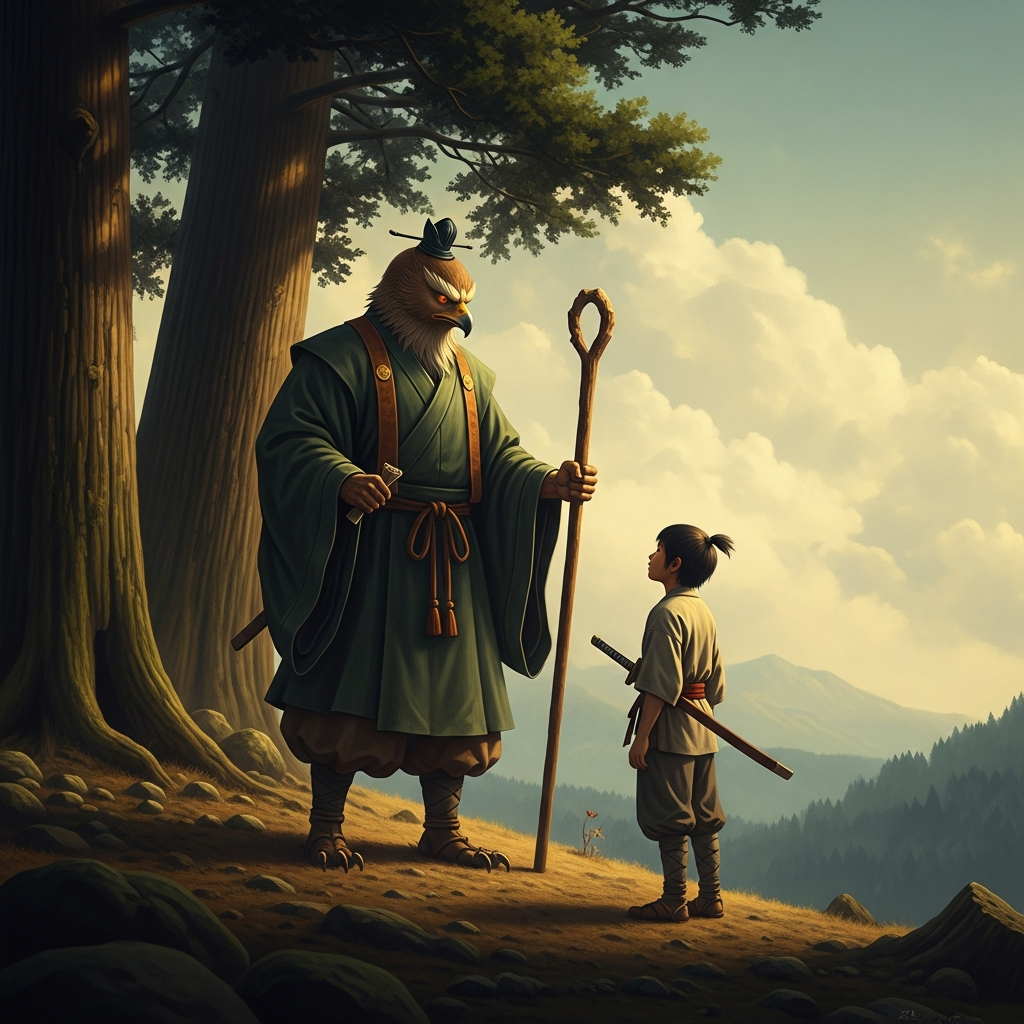
On the slope of Kurama-yama, a great tengu with the face of a hawk and robes of deep mountain-green stands before the young Ushiwakamaru with a wooden staff
 Generating art…
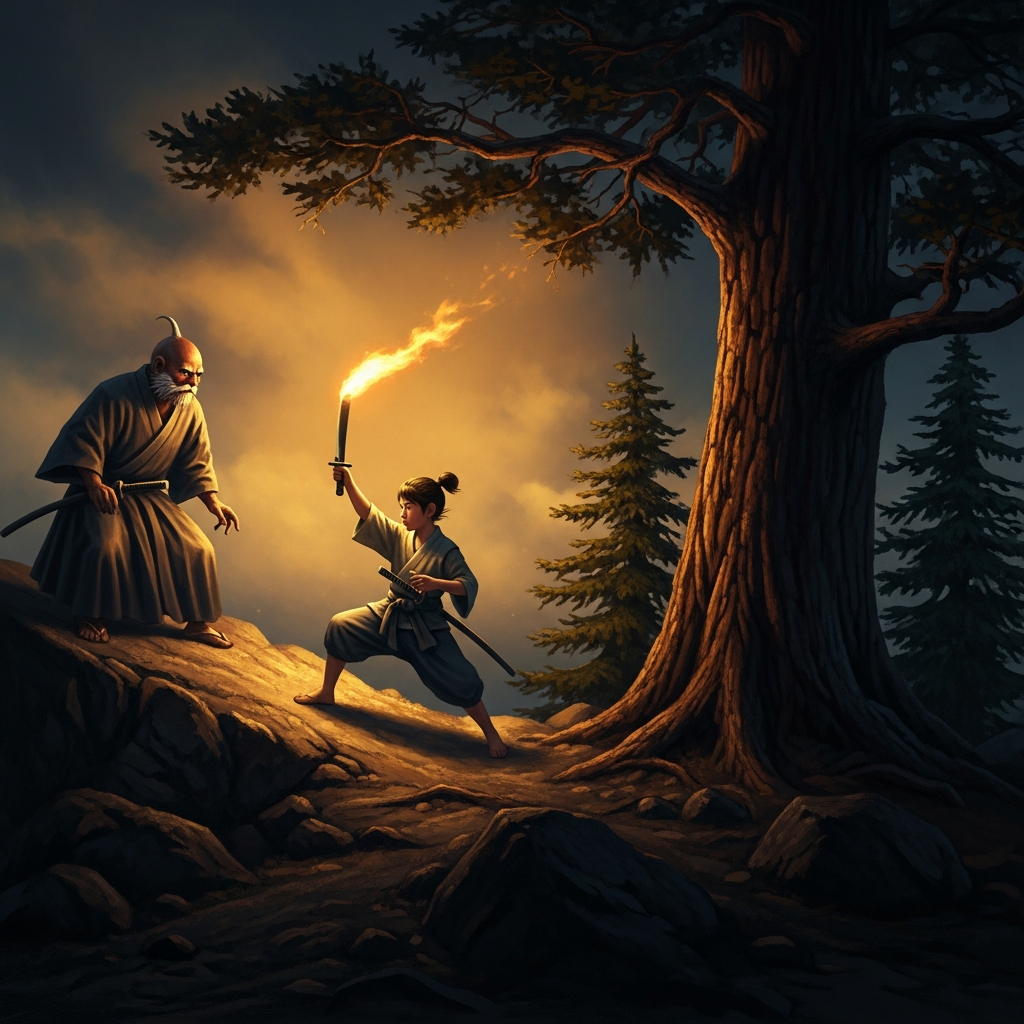
 By torchlight, high on the mountain, the boy practices the same cut for the four hundredth time
 Generating art…
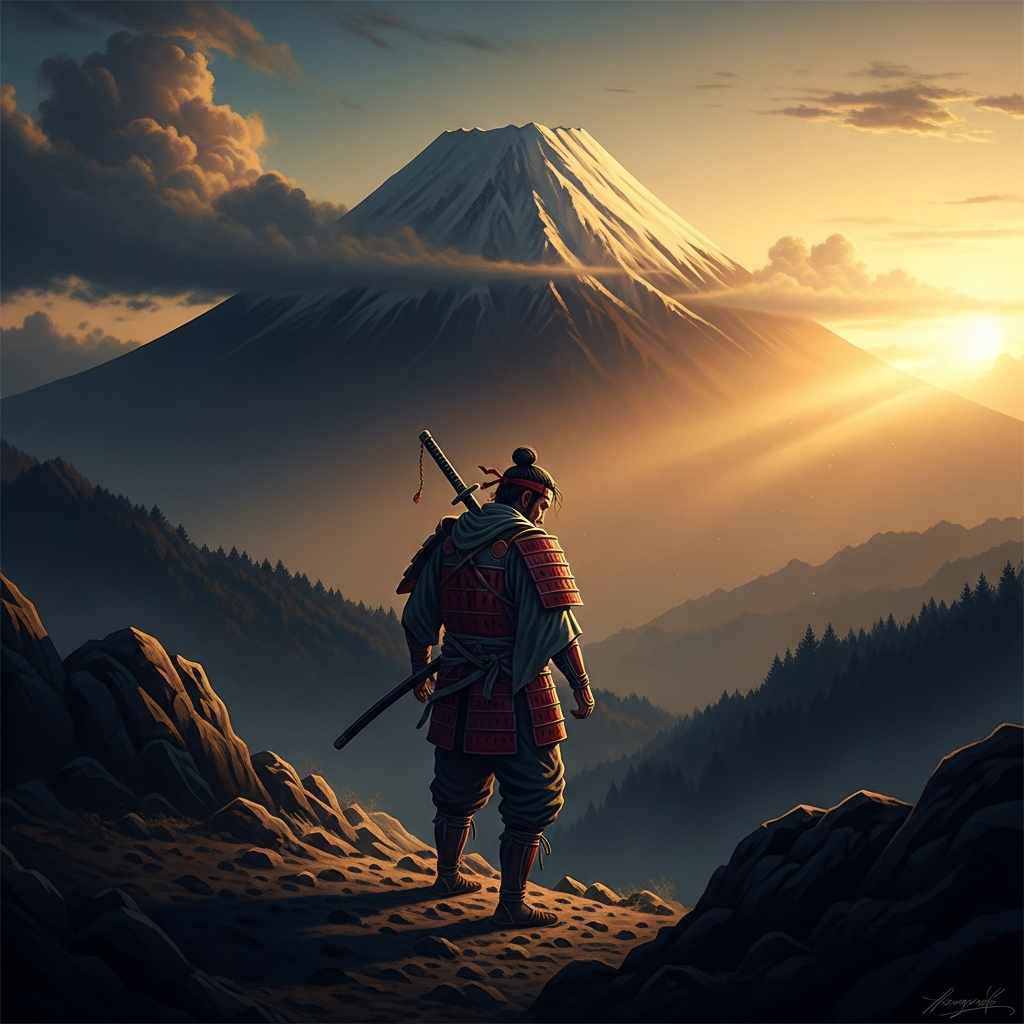
 The warrior descends from Kurama-yama at dawn, sword at his back
 Generating art…
 Echoes Across Traditions
Entities
- Tengu
- Sojobo
- Minamoto no Yoshitsune

Sources
- Carmen Blacker, *The Catalpa Bow: A Study of Shamanistic Practices in Japan* (Allen and Unwin, 1975)
- Royall Tyler, *Japanese Tales* (Pantheon Fairy Tale and Folklore Library, 1987)
- Donald Keene, *Seeds in the Heart: Japanese Literature from Earliest Times to the Late Sixteenth Century* (Columbia University Press, 1999)
- Haruo Shirane (ed.), *Traditional Japanese Literature: An Anthology, Beginnings to 1600* (Columbia University Press, 2007)
- Joseph Kitagawa, *Religion in Japanese History* (Columbia University Press, 1966)