The Commentator
Almohad Caliphate · 1169-1198 CE · Córdoba, Seville, Marrakesh — the western Islamic world at its intellectual peak, across the Strait from a Christian Europe hungry for what it has forgotten
Contents
A royal physician and judge in Córdoba is commissioned by a caliph to explain Aristotle clearly — and produces the three-tiered commentary that sparks the intellectual revolution in Christian Europe called Scholasticism. Thomas Aquinas will call him simply 'the Commentator,' without a name, as though there could be no other.
- When
- Almohad Caliphate · 1169-1198 CE
- Where
- Córdoba, Seville, Marrakesh — the western Islamic world at its intellectual peak, across the Strait from a Christian Europe hungry for what it has forgotten
Ibn Tufayl is seventy years old and he has a problem he cannot solve.
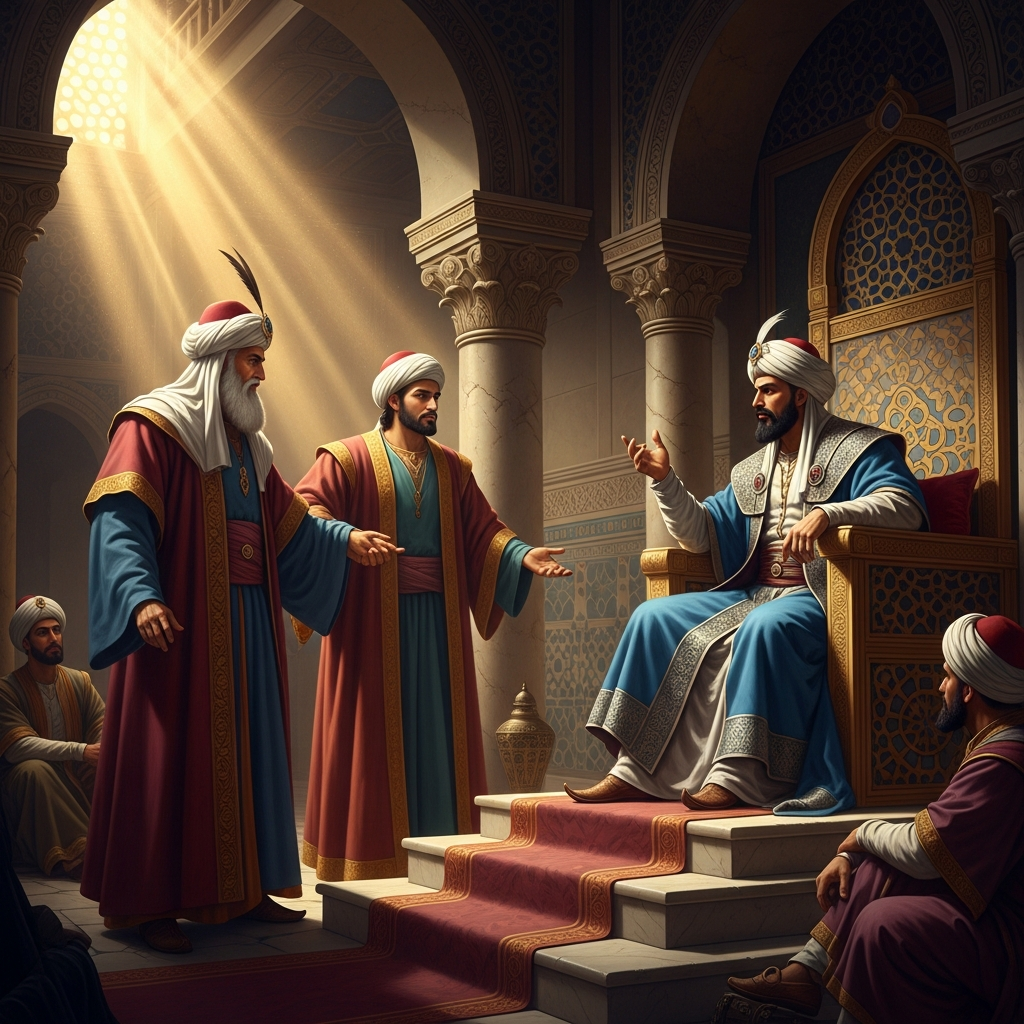
The problem is Aristotle. The caliph Abu Yaqub Yusuf — a serious reader, educated beyond the usual run of Almohad rulers — has been complaining for years that the Arabic translations of Aristotle are incomprehensible. Not because Aristotle is too difficult but because the translators were too literal, importing Greek syntax into Arabic sentence by sentence until the result is a text no Arabic reader can follow without already knowing what it says. The caliph wants someone to write clear, honest explanations of what Aristotle is actually arguing. Ibn Tufayl is too old to do it himself.
So he brings to court a younger man: Ibn Rushd, the royal physician and chief judge (qadi) of Seville, forty-three years old, trained in medicine and law and Islamic theology and philosophy, from a family of distinguished Cordoban jurists going back three generations. He is, in Ibn Tufayl’s opinion, the only man in the Islamic west with the combination of philosophical mastery and Arabic prose clarity the project requires.
The caliph asks Ibn Rushd, directly, whether Aristotle thought the heavens were eternal or created. Ibn Rushd freezes — this is a question on which the wrong answer can end a career or a life. He speaks cautiously. The caliph answers him with a detailed philosophical argument from memory, quoting Ibn Tufayl and al-Farabi. Ibn Rushd realizes he is talking to a man who has done the reading. He relaxes. The commission is given.
He writes three commentaries on every Aristotelian text.
This is the structural innovation that makes his work uniquely useful: a short commentary for students (the jami’, or epitome), a medium commentary for advanced students (the talkhis, or paraphrase), and a long commentary for specialists (the tafsir, or full explication). The short ones present only Aristotle’s conclusions. The medium ones trace the argument. The long ones quote Aristotle’s text sentence by sentence and then reason through each sentence with full philosophical precision, adding objections, responses, comparisons with other passages, and Ibn Rushd’s own analysis.
He produces this apparatus — at three levels of depth — for the Organon, the Physics, the De Caelo, the Meteorology, the De Anima, the Metaphysics, the Nicomachean Ethics, the Rhetoric, and the Poetics. The total output runs to hundreds of thousands of words. He produces it while serving simultaneously as the chief judge of Seville and Córdoba and as the caliph’s personal physician — in the intervals between court sessions and medical consultations, on journeys between cities, at night when the palace is quiet.
He also writes the Decisive Treatise — the argument, addressed to Islamic jurists, that philosophy and Islamic law are not merely compatible but that the Qur’an actually commands the educated to practice philosophy, because Aristotle’s rational inquiry is precisely the “examination of existing things” that the Qur’an repeatedly enjoins.
His central philosophical claim is double and interlocking.
First: Aristotle’s reason and Islamic revelation point to the same truths, approached from different directions. Philosophy arrives by demonstration. Revelation arrives by persuasion and imagery, for the majority of believers who are not trained philosophers. The truth is one; the methods differ. This is not compromise — it is Ibn Rushd’s reading of how human knowledge actually works, how the same cosmic reality shows different faces to different kinds of mind.
Second: Ibn Sina got Aristotle wrong. The claim matters enormously because Ibn Sina is the dominant philosophical authority in the Islamic world, and al-Ghazali’s devastating attack on philosophy in the Incoherence of the Philosophers targets specifically Ibn Sina’s Aristotle. Ibn Rushd writes the Incoherence of the Incoherence — a systematic refutation of al-Ghazali, point by point — arguing that al-Ghazali has defeated a distorted Aristotle and left the real one untouched. The real Aristotle, properly read, has no conflict with revealed religion. He is simply the human intellect’s greatest achievement, and to attack him is to attack the intellect itself.
The claim will get him in serious trouble. But for now the caliph is on his side.
The caliph dies. His son Yaqub al-Mansur is less interested in philosophy and more interested in political stability.
In 1195, Averroes is seventy years old and the Almohad dynasty is under pressure from the Christian kingdoms of the north, from internal religious conservatives, and from its own political contradictions. The conservatives have been arguing for years that the philosopher-physicians who write about the eternity of the world and the intellect’s unity are apostates. The caliph finds it politically useful to agree with them.
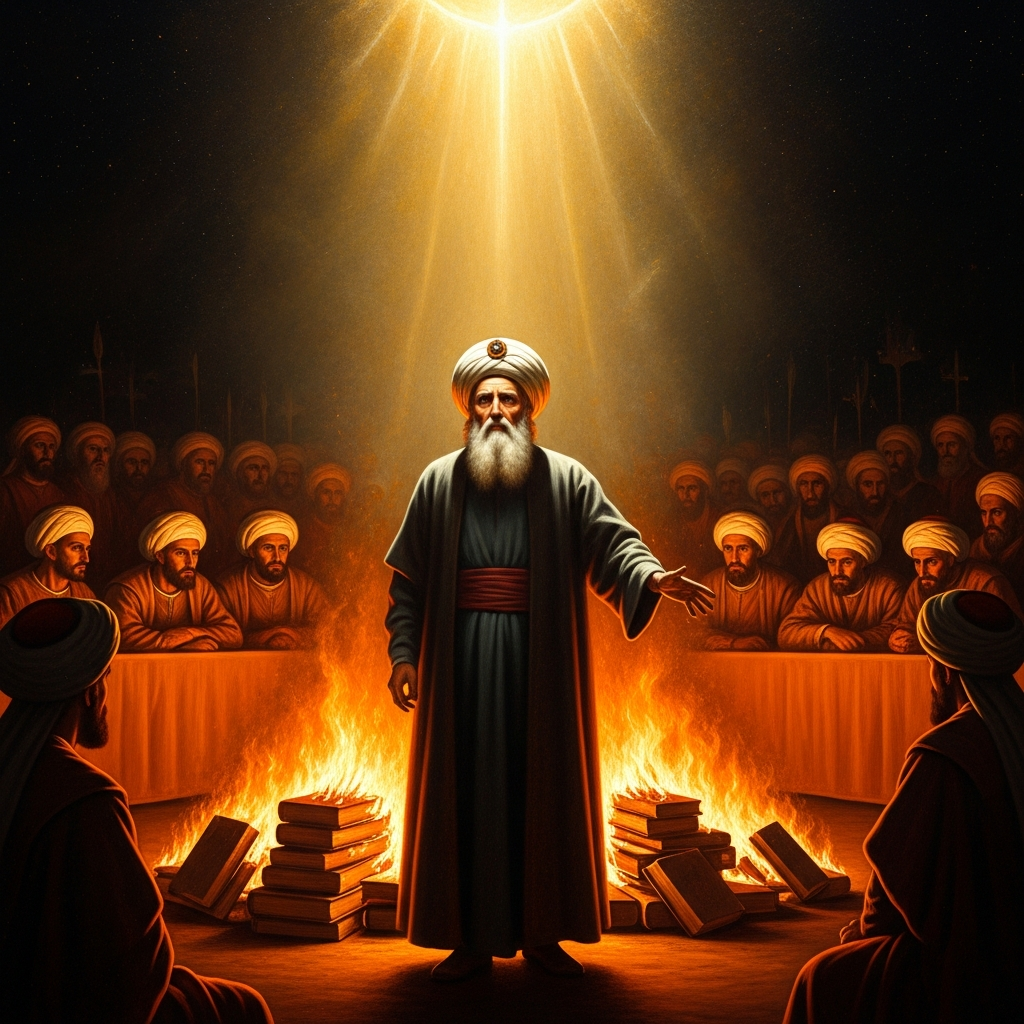
Averroes is summoned to Marrakesh. His books are condemned. He is stripped of his positions and exiled to Lucena — a small town near Córdoba, historically a Jewish community, where the citizens are least likely to be inflamed by the presence of a condemned philosopher. His books are prohibited in the Almohad territories, with a special exemption for medicine (the caliph still needs physicians).
He writes to friends in the east that he understands what has happened: The people of our time are not ready for philosophy. He does not recant anything. He waits.
He is rehabilitated two years later, in 1197, when the political pressure eases. He dies in Marrakesh in 1198, shortly after his rehabilitation — as if the wait itself was the last thing holding him together.
He does not know about the translations. He does not know that Michael Scot is already in Toledo, translating his De Anima commentary from Arabic into Latin. He does not know that within fifty years of his death his long commentary on the Metaphysics will be the required text in the arts faculties of Paris and Oxford. He does not know that the students who read it will call him Commentator without qualification — the same honorific reserved in Arabic scholarship for the greatest of explainers — and that the opposition to his doctrine of the unity of the intellect will fill the agenda of the University of Paris for fifty years.
He does not know about Thomas Aquinas, who in the 1260s will quote him on virtually every page where Aristotle is the subject, call him simply the Commentator, disagree with him on the intellect, and agree with him on almost everything else.
The condemnation in Marrakesh is not the last word: the condemnation in Paris, issued by the Bishop Étienne Tempier in 1277 against 219 propositions of radical Aristotelianism derived from Averroes, outlasts the dynasty that burned his books by three centuries and the civilization that produced him by two — the final proof that an idea can survive everything except the people who stop thinking it.
Scenes
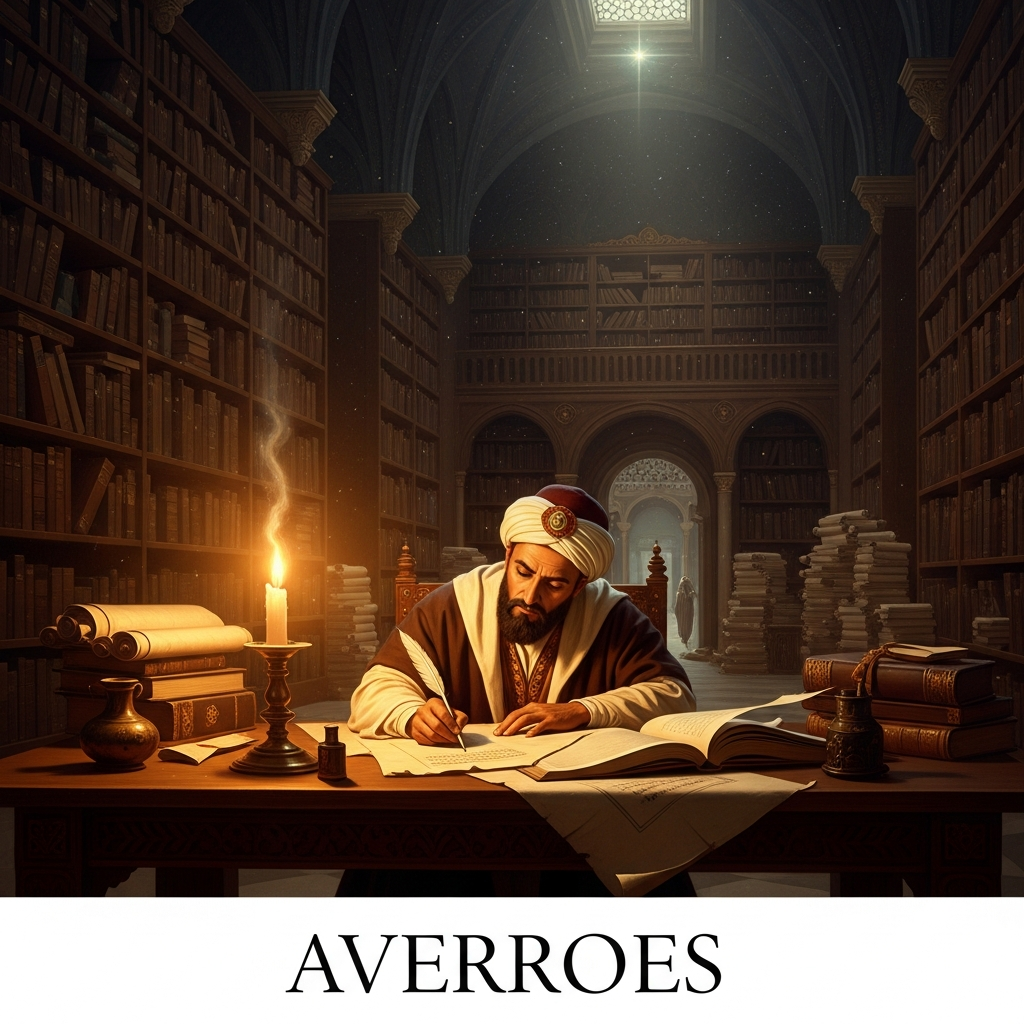
In the Córdoba library by candlelight, the royal physician and chief judge of Andalusia writes the long commentary on Aristotle's *Metaphysics* — the text that will reach Paris in Latin and ignite the Scholastic revolution
Generating art… Ibn Tufayl brings his younger colleague into the presence of Caliph Abu Yaqub, who complains that existing translations of Aristotle are too obscure — and commissions Ibn Rushd to write something a rational man can understand
 Generating art…
 The elderly Averroes stands before the Almohad council in Córdoba as his books are condemned and burned — the rationalist whose influence will outlast the empire that burned him by eight centuries
 Generating art…
 Echoes Across Traditions
Entities
- Ibn Rushd (Averroes)
- Abu Yaqub Yusuf I (Almohad Caliph)
- Ibn Tufayl (the intermediary philosopher)
- Thomas Aquinas (the inheritor)
- the Almohad court
Sources
- Ibn Rushd, *Tafsir ma ba'd al-Tabi'a* (Long Commentary on the Metaphysics) — the definitive Latin *In Aristotelis Metaphysicorum* libros
- Ibn Rushd, *Fasl al-Maqal* (the *Decisive Treatise*) — his argument for the compatibility of philosophy and Islamic law
- Roger Arnaldez, *Averroes: A Rationalist in Islam* (Notre Dame, 2000)
- Oliver Leaman, *Averroes and His Philosophy* (Clarendon, 1988)
- Dag Nikolaus Hasse, *Success and Suppression: Arabic Sciences and Philosophy in the Renaissance* (Harvard, 2016)
- Ibn Tufayl, *Hayy ibn Yaqzan* — the philosophical novel written by Averroes's mentor, which frames the question Averroes spends his life answering