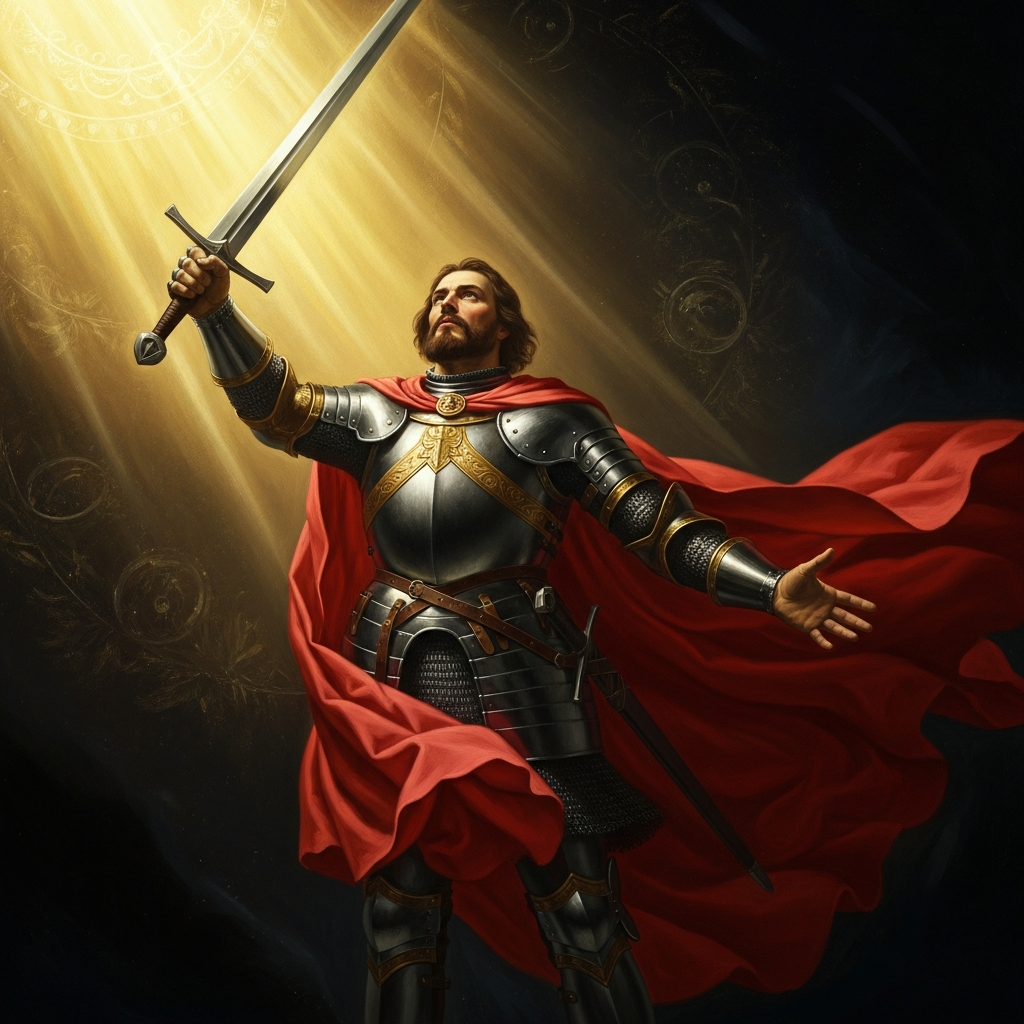
Becket in the Cathedral
December 29, 1170 CE — Tuesday after Christmas, the Feast of the Holy Innocents kept the day before · Canterbury Cathedral, Kent, England — the northwest transept, now called the Martyrdom
Contents
December 29, 1170. Four knights ride to Canterbury through the winter dusk with swords beneath their cloaks. Henry II of England has spoken in rage about a turbulent priest, and they have heard him. They find Archbishop Thomas Becket at vespers. He refuses to flee. He turns toward the altar and receives the blows on the cathedral floor — four swords, his skull split open before his monks. Within three years he is a saint. The king walks barefoot to his tomb.
- When
- December 29, 1170 CE — Tuesday after Christmas, the Feast of the Holy Innocents kept the day before
- Where
- Canterbury Cathedral, Kent, England — the northwest transept, now called the Martyrdom
The trouble has been building for six years.
Thomas Becket was the king’s man. That is the central fact, and it is what makes the rest unbearable to Henry. They had been close — close in the medieval sense that means they hunted together and drank together and kept their political accounts together — and Henry had elevated his chancellor to the See of Canterbury in 1162 expecting a compliant archbishop who would let the crown reach freely into the church’s revenues, the church’s courts, the church’s appointments. Henry was wrong about that. The minute Becket put on the pallium he became a different man — or perhaps the man he had been hiding even from himself — and the conflict began the same week.
The Constitutions of Clarendon in 1164 were the open break. Henry wanted clergy who committed crimes tried in royal courts after they had been degraded in church courts. Becket would not agree. He fled to France. King Louis VII sheltered him for six years at Pontigny and Sens. The Pope, Alexander III, balanced between them, neither willing to abandon the archbishop nor able to confront the king. There were attempts at reconciliation. There was a public meeting at Fréteval in July of 1170 that looked, briefly, like it had ended things. Becket returned to Canterbury at the start of December, riding through the autumn fields with the relief of a man who has been homesick for six years.
Then he excommunicated the bishops who had crowned Henry’s son in his absence. The news reached Henry at his Christmas court in Normandy on Christmas Day. Henry roared. The exact words have come down in many versions — who will rid me of this turbulent priest? what miserable drones and traitors have I nourished and brought up in my household, that they let their lord be treated with such shameful contempt by a low-born clerk? — and four knights heard them and rode for the coast.
They cross to England separately. They meet at Saltwood Castle on the night of December 28. They are tired, and angry, and well-armed. Reginald FitzUrse, Hugh de Morville, William de Tracy, Richard le Breton — knights of the king’s household, men whose careers are tied to the king’s favor, men who believe they have been given an order that does not need to be written down to be understood.
They reach Canterbury in the early afternoon of December 29. They leave their armor in the courtyard. They go in cloaks, swords hidden, to the Archbishop’s hall. Becket is at table after dinner with his clerks. They demand that he absolve the bishops. He refuses. They demand that he leave the kingdom. He refuses. The argument escalates. They go back to the courtyard for their weapons.
The monks, sensing what is coming, beg Becket to flee through the cloister to the cathedral. He goes — but not to flee. He goes because vespers is starting, and because he intends to be where an archbishop should be at vespers, in the cathedral, at the altar.
The monks try to bar the cathedral door behind him. He stops them. It is not right to make a fortress of the house of prayer, he says. The Church of God is not a castle. Open the door.
The light is failing.
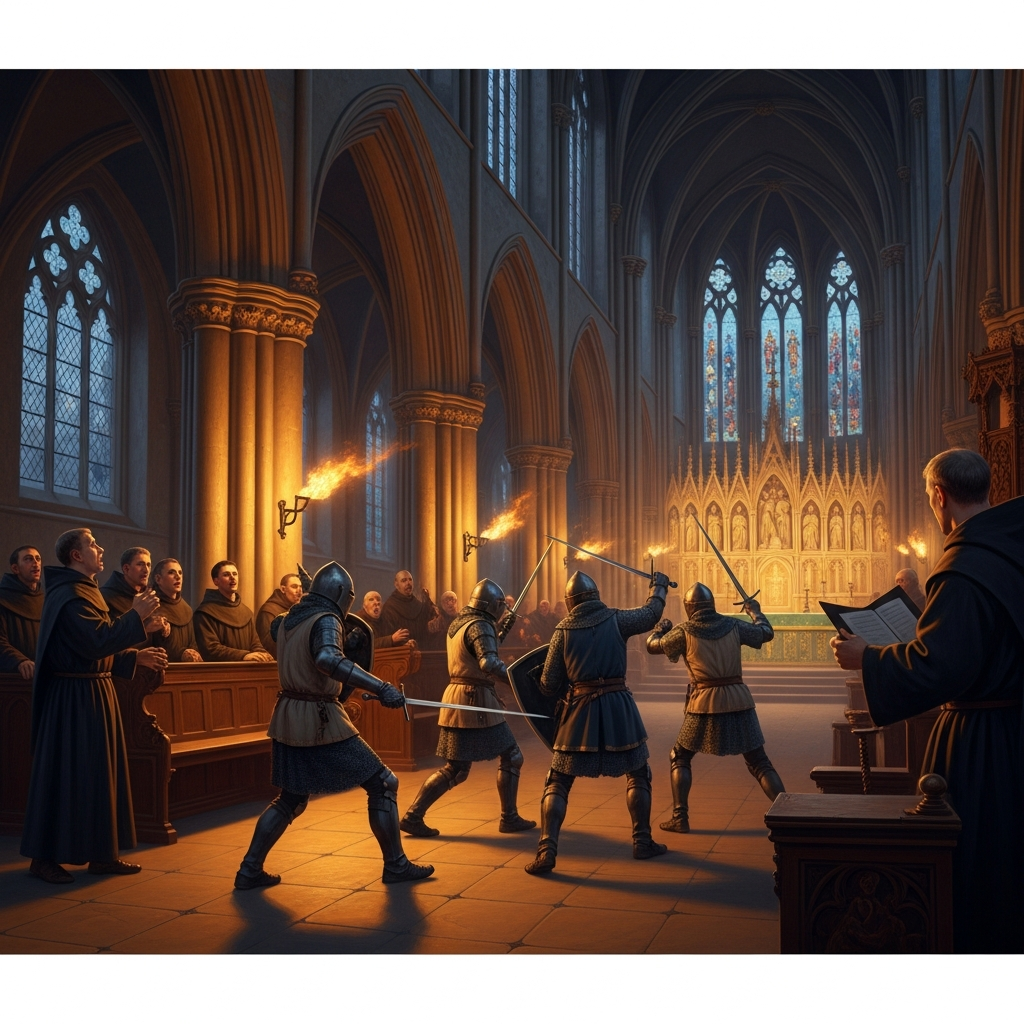
December 29 in southern England in 1170 means dusk arrives before five. The cathedral is lit by candles at the high altar and by what little gray light still comes through the high windows in the transepts. The monks are in choir. The vespers psalms have begun. The voices are reaching the antiphon when the four knights come in through the cloister door, mail clinking, swords now openly drawn, their breath visible in the cold air.
Where is the traitor? FitzUrse calls, and gets no answer. Where is the archbishop?
Becket steps out from behind a column. I am here, he says. No traitor — but priest of God. What do you want?
They tell him. They want him outside the cathedral. They want him absolving the bishops. They want him dead, though they will not say it yet because killing an archbishop in a cathedral at vespers is not what they came intending to do, only what they came prepared to do if he would not bend.
He will not bend. He has rehearsed this in the six years of exile. He has read Cicero on the duty of the magistrate and the lives of the early martyrs and the Psalms that the church reads on the feasts of the slain witnesses, and he has decided what he will do if it comes. He says: I am ready to die for my Lord, that in my blood the Church may obtain liberty and peace.
FitzUrse strikes first. The flat of the sword catches the back of Becket’s head — a warning blow, perhaps, or the moment before resolve, in which a man who has not yet killed an archbishop measures whether he will. Edward Grim, a visiting clerk from Cambridge, throws his arm up and takes the second blow on his own arm; the bone breaks. The third blow finds Becket’s head. He falls to his knees. For the name of Jesus and the protection of the Church, he says, I am ready to embrace death. The fourth blow takes the crown of his skull off entirely. The fifth, struck by Le Breton with such force the sword breaks against the pavement, scatters the contents of the skull across the floor of the transept.
A subdeacon named Hugh of Horsea — the chronicles refuse him a Christian name — puts his foot on the dead archbishop’s neck and uses the point of his sword to drag the brain across the stones, so that the desecration is complete and the murder cannot be undone by mercy.
Then the four knights and the subdeacon walk out of the cathedral, mount their horses, and ride for the coast.
The monks come out from where they have hidden.
They find their archbishop dead beside the column. They find Edward Grim cradling a broken arm and weeping. They find that the body, when they lift it, has been wearing under the clerical robes a hair shirt full of vermin — the secret penitential garment Becket has worn for six years and never told anyone about, not even his confessor in some accounts. The discovery alone would have made him famous. The blood on the pavement makes him a saint.
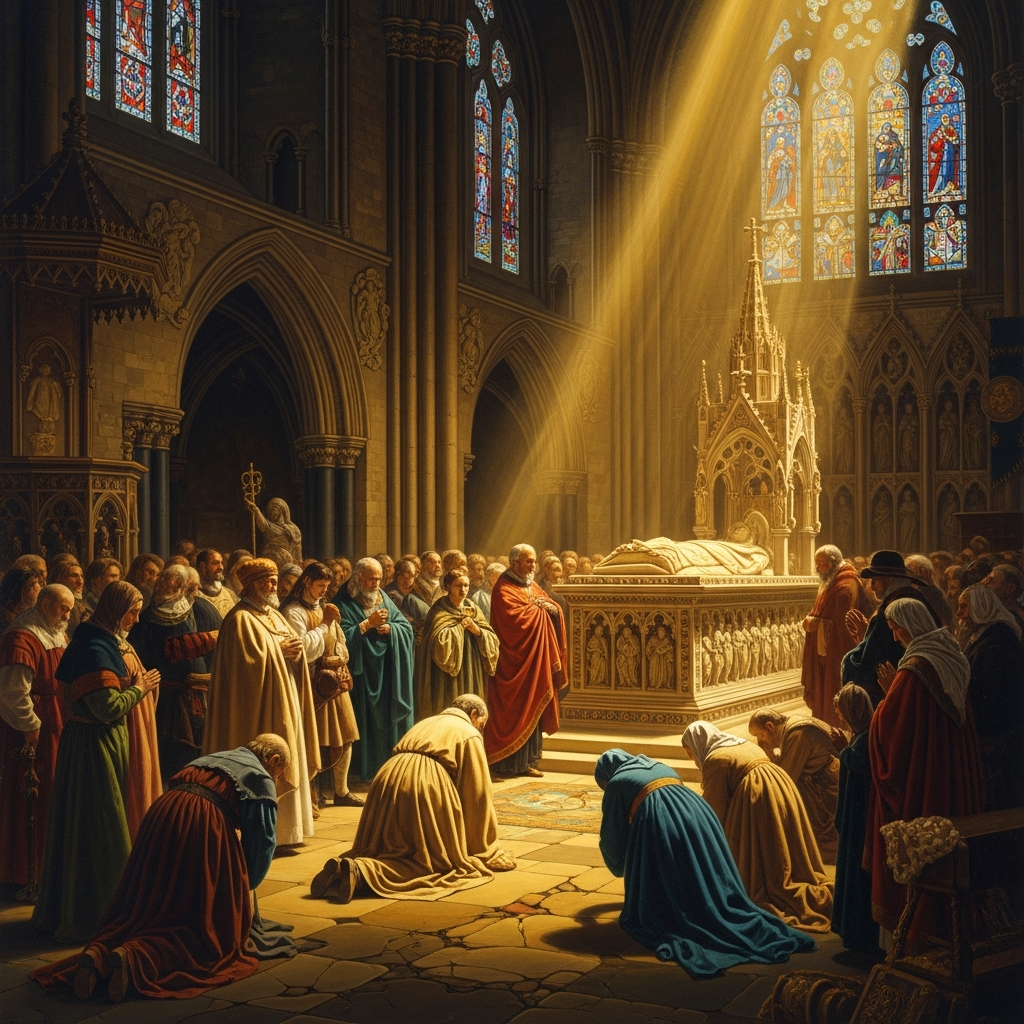
They begin, that very night, to collect the blood. They use cloths. They use small phials. The blood mixed with water — aqua sancti Thomae — will heal the sick of England for two centuries. By morning the first miracles are reported. By the spring there are dozens. By 1173 there are hundreds, and Pope Alexander III, who has read the dossier and wept, canonizes Thomas Becket on Ash Wednesday of that year, the fastest canonization the medieval church will manage for a non-papal candidate.
Henry II is in Normandy when the news reaches him. He is reported to have shut himself in his room for three days and to have refused food. Whatever the truth of the rage he had spoken, he has not actually wanted this — has not understood that words spoken in fury would be carried out by men who took them as commands. But he is also a king, and kings calculate.
In July 1174, three and a half years after the murder, Henry rides to Canterbury. At the city gate he dismounts. He removes his shoes. He walks barefoot through the streets to the cathedral, the stones cutting his feet. He enters the crypt where Becket’s body lies. He kneels. He confesses, in front of the bishops and the monks and the citizens of Canterbury, that his rash words caused the death. Each of the bishops present strikes him five times with a rod. Each of the eighty monks of Canterbury strikes him three times. He is then left to pray at the tomb through the night, on the stone floor, fasting.
The next day Scottish forces invading the north of England are unexpectedly defeated and their king captured. Henry hears the news on the road south. He attributes it to the saint. The political point is now made on both sides — the king has bent, the saint has rewarded him — and the cult of Becket is now untouchable.
Within a generation Canterbury Cathedral is rebuilt to accommodate the pilgrim traffic. The eastern arm — the Trinity Chapel and the Corona — is constructed specifically as a pilgrimage path leading to the shrine of St. Thomas. Stained glass windows the size of barns are filled with miracle scenes. The shrine itself, when it is finished in 1220, is covered in gold and jewels donated by kings and merchants from across Christendom. The Regale of France — the largest ruby in Europe — is given by Louis VII, the king who had sheltered Becket in exile, the one foreign king who had loved him.
The pilgrim road from London becomes the most traveled in England. Pubs and inns line it. Stories are exchanged on it. Two hundred years after the murder, Geoffrey Chaucer will gather a fictional company of pilgrims at the Tabard Inn in Southwark and send them riding toward the shrine, telling each other tales to pass the time, and the Canterbury Tales will fix the road and the destination in English memory forever.
The four knights — FitzUrse, de Morville, de Tracy, le Breton — are sent on penitential pilgrimage to the Holy Land by Pope Alexander. They are forbidden to set foot in any church. They are forbidden to marry. They are required to fast on bread and water on the anniversary of the murder for the rest of their lives. None of them leaves a substantial mark on history afterward. They become a footnote, the way most violence becomes a footnote when the victim becomes a saint.
The cathedral keeps the place. The flagstone where Becket fell is worn into a depression by the knees of seven hundred years of pilgrims. In 1538, Henry VIII will order the shrine destroyed, the bones scattered, the gold seized, the saint’s name erased from the calendar. The pilgrims will keep coming anyway. The depression in the stone is still there.
Scenes
Four knights burst into Canterbury Cathedral on a December evening, swords drawn, mail glinting under torchlight
Generating art… Becket refuses to run
 Generating art…
 Within a year miracles are reported at the tomb
 Generating art…
 Echoes Across Traditions
Entities
- Thomas Becket
- Henry II of England
- Reginald FitzUrse
- Hugh de Morville
- William de Tracy
- Richard le Breton
- Pope Alexander III
- King Louis VII of France
Sources
- John of Salisbury, *Historia Pontificalis* (eyewitness account of the period leading to the murder)
- William FitzStephen, *Vita Sancti Thomae* (c. 1173) — eyewitness account by a clerk in Becket's household
- Edward Grim, *Vita S. Thomae* (c. 1172) — Grim was struck by the first sword while shielding Becket
- Frank Barlow, *Thomas Becket* (University of California Press, 1986)
- John Guy, *Thomas Becket: Warrior, Priest, Rebel, Saint* (Random House, 2012)
- T.S. Eliot, *Murder in the Cathedral* (Faber, 1935) — for reception history