The Border Between Waking and Dreaming
1173-1232 CE · Jingo-ji → Kōzan-ji, Togano-o, Kyoto mountains, Japan
Contents
Myōe Shōnin keeps a dream diary for over forty years, argues with the Buddha in his sleep, receives corrections to his daytime understanding from nighttime sources, and cuts off his ear as an offering — and wakes to find it gone. The story asks: if waking life is itself a dream, what did he actually do?
- When
- 1173-1232 CE
- Where
- Jingo-ji → Kōzan-ji, Togano-o, Kyoto mountains, Japan
He begins the journal at eighteen.
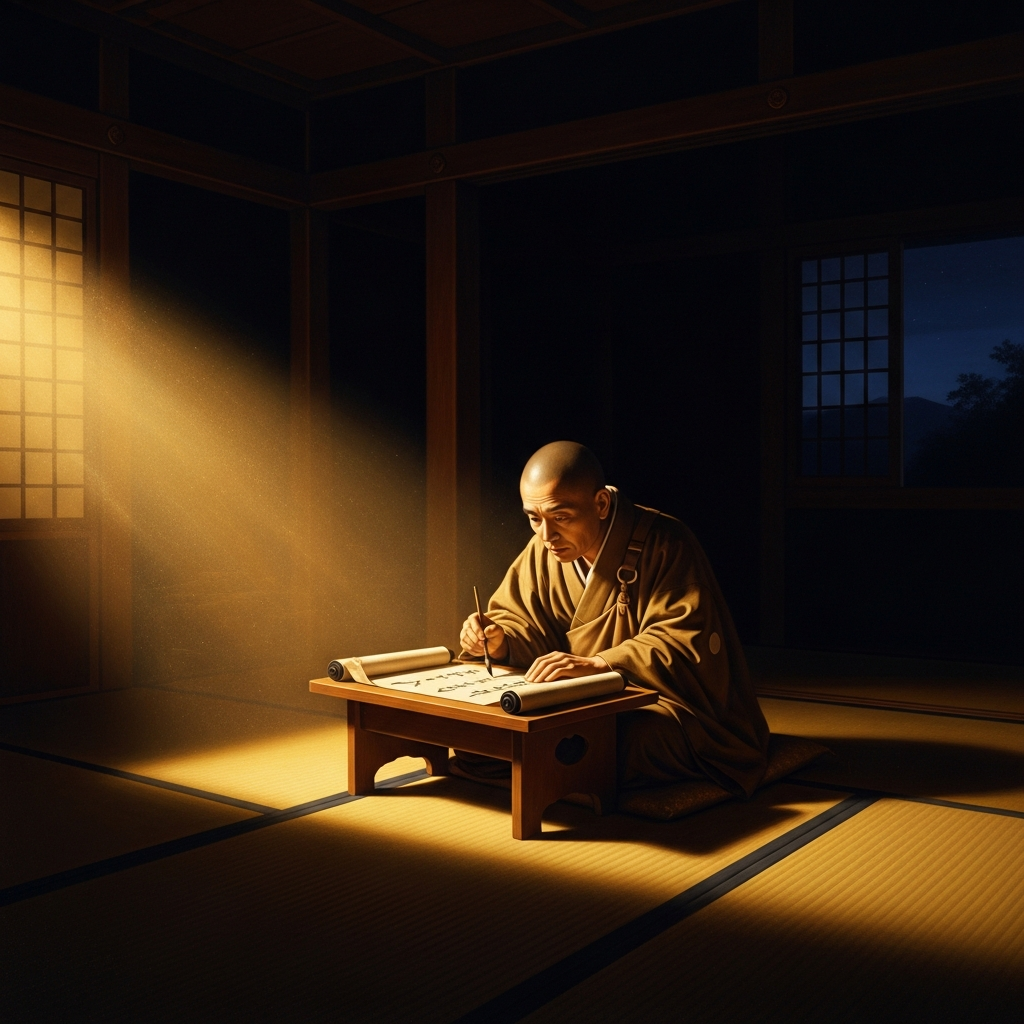
The year is 1191. He is a student at Jingo-ji, on the mountain west of Kyoto, studying the Kegon school’s doctrines under the master Mongaku and the broader tradition of Shingon esoteric Buddhism that permeates the mountain temples of the capital region. He has been having unusual dreams since childhood — dreams that feel architecturally different from ordinary dreams, that have a quality of instruction or encounter that he cannot attribute to the residue of daily thought. He begins writing them down. He does not yet know he will continue for forty years.
The Yume no Ki — Dream Journal — begins as a record. It becomes a practice. He learns, across years of close attention, how to hold awareness in the transition between waking and sleep, how to enter the dream state with enough continuity of attention to remember it fully on waking, how to respond to what he encounters in dreams with the same deliberateness he brings to waking Buddhist practice. He does not distinguish between the validity of a dharma teaching received in meditation and one received in a dream. He tests them both against the tradition. He applies them both to his daily practice. He records the results.
The dreams are not pleasant.
He dreams of the Buddha, but these are not comfortable visions. The Shakyamuni who appears in Myōe’s dreams is demanding, specific, and occasionally corrective. In one dream the Buddha shows him a passage in a sutra and tells him that his daytime interpretation of it is wrong. Myōe wakes, reviews his commentary, and finds that the dream-correction holds up against the text. He amends the commentary.
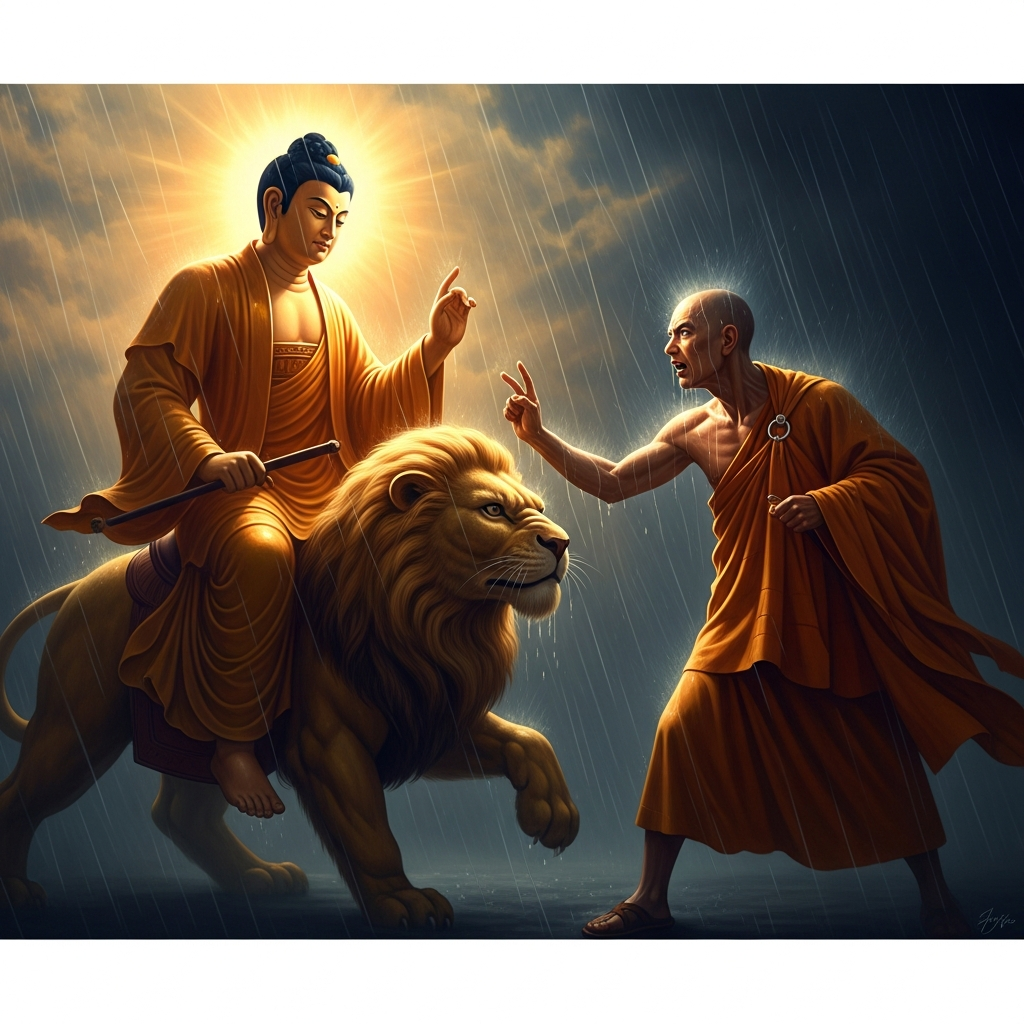
In another dream he is in the presence of the Bodhisattva Monju — Mañjuśrī, the bodhisattva of wisdom, who carries a sword for cutting through delusion. It is raining in the dream; he is in the courtyard of a temple he cannot identify. Monju is giving a teaching on the nature of emptiness — śūnyatā, the foundational Mahayana doctrine that all phenomena arise dependently and have no fixed essence. Myōe listens and then, with the directness that characterizes his dream-self, disagrees.
He argues. He cites texts. He presses the bodhisattva of wisdom on a point about whether emptiness applies to the buddha-nature itself or whether the buddha-nature occupies a different logical register. Monju does not yield. They argue for what feels like an hour, in the rain, in the courtyard of the unidentified temple. Myōe wakes still formulating his counterargument.
He writes the dream down, fully, including the argument. He returns to his notes on emptiness. The place where Monju would not move turns out to be, on his daytime review, the place where his own understanding was thinner than he had realized. He adds a marginal note: revisit this.
He loves Shakyamuni in a way that is personal and not abstract.
This is the fact that most distinguishes Myōe from his contemporaries. The Buddhism of his era — the newly arrived Zen schools, the Pure Land revolution of Hōnen and then Shinran, the nationalism of Nichiren’s emerging movement — are all oriented toward something other than the historical Buddha as a person: toward the formless buddha-nature, toward Amida’s vow, toward the Lotus Sutra as doctrinal absolute. Myōe’s devotion centers on Shakyamuni himself, the man who sat under the tree in Bodh Gaya in the fifth century BCE, who gave specific teachings to specific people, who had a particular face and voice and manner of moving.
He wants to go to India. He applies to the imperial court for travel permission. The application is refused on the grounds that the journey is too dangerous. He applies a second time. Refused again. He receives a message from the Kegon deity Zenmyō — in a dream — telling him that he should remain in Japan, that his practice is here. He complies, but barely. He builds a shrine to the Buddha at Kōzan-ji and performs the rites associated with the Buddhist holy sites in India before its images, as if the physical distance could be reduced by the intensity of address.
His veneration extends to the Buddha’s hair. He obtained what was believed to be a hair of the Buddha’s head — such relics circulated in Japanese temple culture, their authenticity unknowable and their power undiminished by the unknowing — and kept it in a small reliquary that he wore against his skin. He speaks of the Buddha as if he has just left the room. The mourning in his writing is not the abstract mourning of someone living sixteen centuries after a figure he has only read about. It is the mourning of someone who met the person in dreams and knows the absence is recent.
He makes the offering in a dream.
The precise dating is uncertain — it falls somewhere in his early adulthood, before he settles permanently at Kōzan-ji. He is in the middle of an intensive period of devotional practice, long meditation sessions with little sleep, the kind of practice that thins the membrane between waking and dreaming until they are a continuous fabric rather than distinct states.
In the dream, he stands before the Buddha. The Buddha is asking him — or the dream has arranged itself so that he feels he is being asked — what he will offer. A teaching, a sutra, a verbal acknowledgment is not enough; he wants to offer something that cannot be mistaken for abstraction. He wants to offer the kind of thing that costs something.
He takes out a blade.
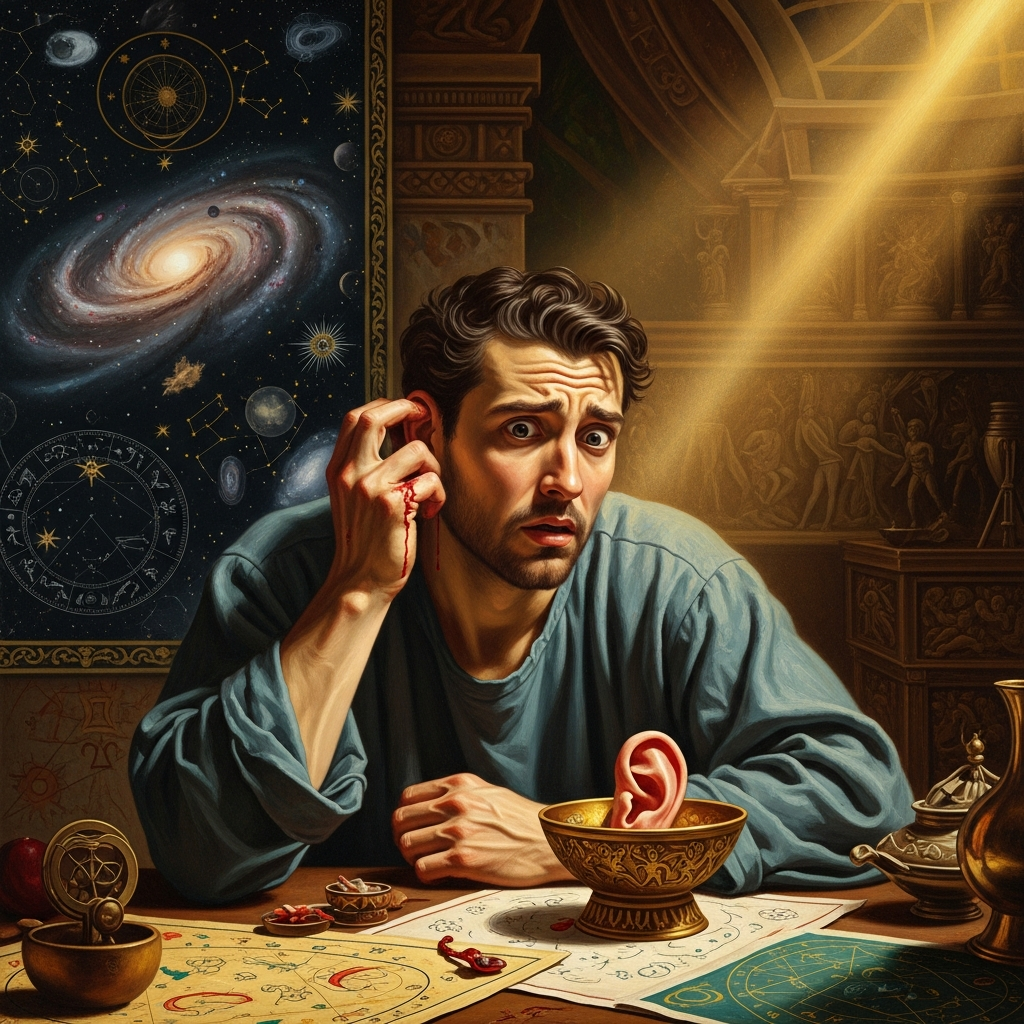
He cuts off his right ear.
In the dream, the act is clean and complete, the offering extended, received, accepted. He wakes in the dark.
His right ear is gone.
The wound is real. He does not pretend otherwise. He is looked after by the monks at his temple, who understand that something has occurred but who are not entirely sure in which direction causality runs. Did he cut his ear off in the night in a state of religious transport, and the dream was the registration of the act? Did the act occur in the dream, and the waking body — obedient to the dreaming self in a way that waking volition is not — executed it? Did both happen simultaneously, in the one world that contains all states?
Myōe does not choose between these interpretations. He records all of them in the journal and declines to adjudicate. The ear is gone. The offering was made. Whether the boundary between the waking state and the dream state was crossed or whether it turns out there is no boundary — that is a question the journal records without answering, because the journal is a record, not a verdict.
He wears the absence for the rest of his life. He does not replace the ear with a prosthetic. The portraits painted after his death — the famous painting at Kōzan-ji showing him meditating in the pine tree — show the missing ear. Later commentators will notice that the portraits showing the missing ear are different from portraits painted before the incident, and they will use this discrepancy as evidence that the incident was physically real rather than metaphorical. As if the question were still open. As if the portraits would settle it.
He continues the journal until 1232, the year he dies at fifty-nine. The final entry is dated a few weeks before his death. It records an ordinary dream — the Buddha walking through a courtyard, turning briefly toward him, then continuing. Myōe watches him go and does not call out.
The journal contains over four hundred dreams across more than forty years. It is the longest continuous record of Buddhist dream experience in Japanese history. It was used by later Kegon scholars as a doctrinal source — evidence that the distinction between waking insight and dream insight is not doctrinally established, that consciousness in any state can be the vehicle of the dharma if the mind attending it is sufficiently awake.
Myōe does not resolve the question the ear-cutting raises because the question is the point. If the Mahayana teaching is taken seriously — if ordinary waking experience is itself a kind of dream, a construction of consciousness rather than a window onto fixed reality — then the boundary that makes the ear-cutting strange is already dissolved. He was always in both states. The offering was always in both directions.
What he spent forty years practicing, in the journal, was the discipline of the border. Most people cross the border twice a day — into sleep, into waking — without noticing. Myōe noticed every time. He brought back what he found there. He applied it to the daytime. He let the daytime inform the dreaming. He built a practice out of the crossing itself.
His ear is still in the portrait. The journal is still in the archive at Kōzan-ji. The Buddha he followed into the dream is still walking through the courtyard, still turning briefly, still continuing.
Scenes
Kōzan-ji, before dawn
 Generating art…
 In the dream: the Bodhisattva Monju appears in the rain and disputes the nature of emptiness
 Generating art…
 The morning after
 Generating art…
 Echoes Across Traditions
Entities
- Myōe Shōnin
- Shakyamuni Buddha
- Monju Bodhisattva
Sources
- Myōe, *Yume no Ki* (Dream Journal, maintained c. 1191-1232)
- George Tanabe, *Myoe the Dreamkeeper: Fantasy and Knowledge in Early Kamakura Buddhism* (1992)
- Robert Morrell, 'Kamakura Buddhism and the Dream Diary of Myōe Shōnin,' *Japanese Journal of Religious Studies* (1985)
- Fabio Rambelli, *Buddhist Materiality: A Cultural History of Objects in Japanese Buddhism* (2007)
- Paul Groner, *Ryōgen and Mount Hiei* (2002)