Honen and the Name That Saves Everyone
1175 CE (Hōnen's spiritual breakthrough); 1207 CE (his exile) · Mount Hiei → Kyoto → the roads and villages of medieval Japan → Tosa Province in exile
Contents
A monk who has memorized the entire Buddhist canon reads one sentence in a Chinese commentary, leaves Mount Hiei, and goes down to the farmers and the prostitutes and the soldiers with a four-word prayer that he says is enough.
- When
- 1175 CE (Hōnen's spiritual breakthrough); 1207 CE (his exile)
- Where
- Mount Hiei → Kyoto → the roads and villages of medieval Japan → Tosa Province in exile
He is born into violence.
The year is 1133. His father is a provincial official in Mimasaka province, in central Japan, and one night when the boy is eight years old a rival official’s men break into the house and kill his father in front of him. The dying man — Tokikuni — looks at his son and says one thing before he dies: do not seek vengeance. The wheel of revenge has no end. Become a monk. Pray for me. Pray for my killer.
The boy is sent to a temple in the mountains. He is given to a monk named Kankaku. By the time he is fifteen he has been moved to Mount Hiei, the great Tendai monastic center north of Kyoto, the institutional heart of Japanese Buddhism. He receives the name Honen-bo Genku — Hōnen for short, Source of the Dharma. He is, by every account, the most brilliant student his teachers have seen.
He memorizes the Lotus Sutra before he is twenty. He memorizes Tendai philosophy. He memorizes the entire Tripitaka, in Japanese pronunciation of Chinese characters, before he is thirty. The library at Hiei has every Buddhist text the imperial court has been able to import from China across five hundred years; Hōnen reads it. Several times. He becomes known in the monastic world as the wisdom of the dharma made flesh. Junior monks come to him for instruction; senior monks come to him for clarification on points the older commentaries dispute.
And he is privately, in his cell, in despair.
He cannot do it.
The Buddhism of Mount Hiei is the Buddhism of the bodaishin — the awakened mind, cultivated by long meditation, by the mastery of subtle metaphysics, by the gradual purification of consciousness across many lifetimes. It is rigorous. It is beautiful. It is also, Hōnen realizes by his late thirties, beyond him. I have read everything, he writes in his private notes. I have done everything. I cannot generate the bodhisattva mind. I cannot produce a single moment of pure awareness that is not contaminated by self-clinging. I am exhausting the practices and reaching the bottom and there is no enlightenment at the bottom. There is only me, the same me, with more techniques.
He believes — as much of medieval Japanese Buddhism believes — that the world has entered the mappo, the latter days of the dharma. The historical Buddha lived too long ago. The truth has decayed. The capacities of human beings have decayed. The traditional practices that worked for the disciples of the Buddha himself no longer work for monks twenty centuries later, because the human material is no longer there. The bell still rings. The sutras are still chanted. But no one is becoming enlightened anymore.
This is not a crisis of faith. This is a crisis of technique. Hōnen believes the Buddha’s teaching. He cannot find a method that works.
In 1175, when he is forty-three years old, he reads a sentence.
The book is the Kanmuryōjukyōsho — the Commentary on the Sutra of the Contemplation of Amitayus — by the seventh-century Chinese Pure Land master Shandao. Hōnen has read this book before. He has read it many times. He reaches a passage he has read perhaps fifty times in his life:
Whether walking, standing, sitting, or lying down, single-mindedly and without interruption invoke the name of Amida Buddha. This is the karmic activity that conforms to the original vow of that buddha. To do so is to be assured of rebirth in the Pure Land.
The candle on the desk does not move. The room does not change. But Hōnen, sitting at his low table at Mount Hiei in the spring of 1175, sees what the sentence has been saying all along. The karmic activity that conforms to the original vow. The vow Amida Buddha made before becoming a buddha — vow eighteen of forty-eight, sworn aeons ago when he was the bodhisattva Dharmakara — was that any being who calls his name with sincere mind would be reborn into his Pure Land at the moment of death. The Pure Land is not the goal. The Pure Land is the antechamber. From the Pure Land, enlightenment is guaranteed. The hard part is getting in. And the door, Amida swore, is opened by the name.
Not by meditation. Not by learning. Not by ritual. Not by the cultivation of the bodaishin. By the name.
Namu Amida Butsu. I take refuge in Amida Buddha.
Hōnen reads the sentence again. He reads it a third time. He gets up from his desk and walks out of his cell into the corridor of the Kurodani hermitage at Hiei, and the floorboards are the same, and the lanterns are the same, and the wind in the cedars outside is the same, and everything is different. Forty-three years of reading have arranged themselves around a single line.
He goes back to his cell. He sits down. He says the name. Namu Amida Butsu. He says it again. He says it a third time. He says it for the rest of the night, and through the next morning, and into the following evening. The accumulation of doubt across his entire life — the doubt that he could ever, despite his learning, become a buddha — falls away. Not because he has solved it. Because he has been told, by a sentence in a seventh-century commentary, that he does not have to solve it. The vow has already been made. The name is the latch.
He cannot stay on the mountain.
If the nembutsu is enough, then everything Mount Hiei is doing — the ranks, the years of training, the philosophical commentaries, the literacy required to read the sutras — is at best a beautiful elaboration and at worst an obstacle. The poor cannot afford the mountain. The illiterate cannot read the sutras. The women are not allowed past the nyonin kekkai, the woman-barrier that ringed all major Japanese monasteries. The lepers are not allowed near the gates at all. If the dharma is the property of the mountain, then the dharma has abandoned three-quarters of the people who need it. If the dharma is the name, then the dharma is in everyone’s mouth.
He leaves Hiei in 1175. He goes down into Kyoto. He sets up a small hermitage at Yoshimizu, on the eastern slope below the city. He begins to teach.
His audience is what shocks the establishment.
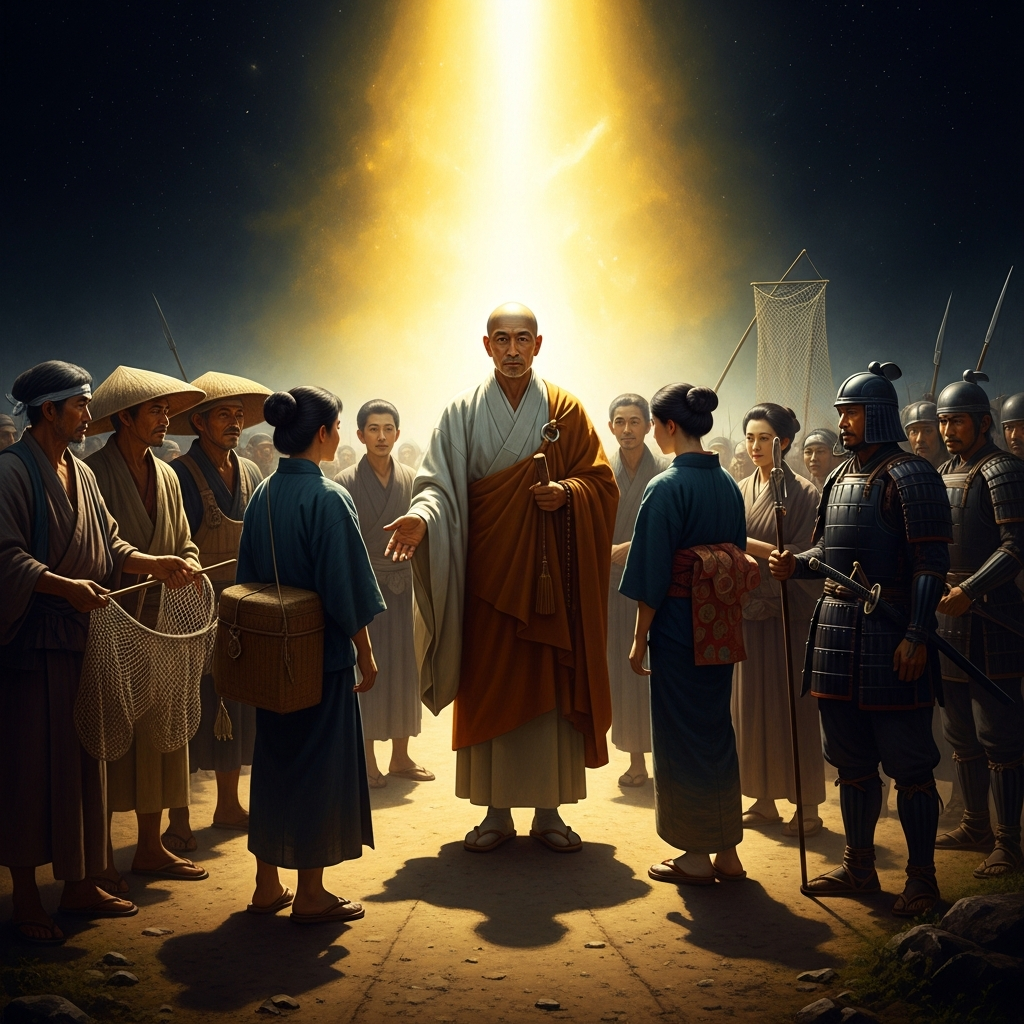
The aristocrats of Kyoto come to listen — Hōnen’s reputation as a scholar precedes him; the regents and the imperial consorts attend his sermons. But so does everyone else. Farmers from the rice paddies of Yamashiro. Fishermen from Lake Biwa. Soldiers between campaigns. Merchants. Servants. Prostitutes from the licensed quarters who have been told for centuries that the karma of their profession placed them outside any possible path. Lepers. Hōnen receives them all. He gives them the nembutsu. He teaches them the six syllables. He tells them, in plain Japanese — not Sino-Japanese, not the Chinese of the sutras, plain spoken Japanese — that Amida Buddha vowed long ago to save them, and that the saying of the name is the mechanism by which the vow operates in their lives.
A prostitute named Tomoe comes to him weeping. I cannot become a nun. I cannot leave my work — my family will starve. The other temples will not see me. Is there nothing for me? Hōnen looks at her. Continue your trade, he says. Say the nembutsu while you do it. Amida’s vow is not contingent on your social station. It is contingent on the name.
The story spreads. The aristocratic Buddhists are appalled. The other schools are appalled. He is telling prostitutes that they can be reborn in the Pure Land without leaving the brothel. He is telling soldiers that they can keep killing. He is telling fishermen that they can keep fishing. The objection is not made up; Hōnen is in fact telling people that, at the level of the nembutsu, the prior moral conditions on rebirth that the established schools insist upon are not the conditions Amida swore to. The Buddha’s vow is unconditional. The name works.
His student Shinran will later make the radical version of this even more explicit: if a good man can be saved, how much more so an evil one. The famous reversal in the Tannishō, written down by Shinran’s disciple — the line that has scandalized commentators for seven hundred years — flows directly from what Hōnen taught at Yoshimizu in the 1180s and 1190s.
He writes the Senchakushū in 1198.
It is the founding document of Jōdo-shū. The full title is Senchaku Hongan Nembutsu Shū — Passages on the Selection of the Nembutsu in the Original Vow. Its argument is that, of the many practices the Buddha taught, the nembutsu is the one Amida specifically selected in his original vow as the practice through which beings would be reborn into his land. The other practices are not wrong. They are not enough. They are not what was sworn to. The nembutsu is. Hōnen circulates the text only privately at first, knowing the established schools will move against him if it is published widely. He is right.
In 1204, the monks of Mount Hiei petition the imperial court to ban the nembutsu. Hōnen replies with the Seven-Article Pledge, a document signed by his senior disciples promising not to slander other schools, not to fall into antinomian excess, not to reject the moral precepts. It is a holding action. The court accepts it. The pressure subsides briefly.
In 1206, two of his disciples are accused — perhaps falsely, perhaps not — of an inappropriate relationship with two ladies-in-waiting at the imperial court. The retired emperor Go-Toba is enraged. The two disciples are executed. Four others, including Shinran, are exiled. Hōnen himself, seventy-five years old, defrocked of his monastic standing, is sent to Tosa Province on the southern coast of Shikoku.
He goes without complaint.
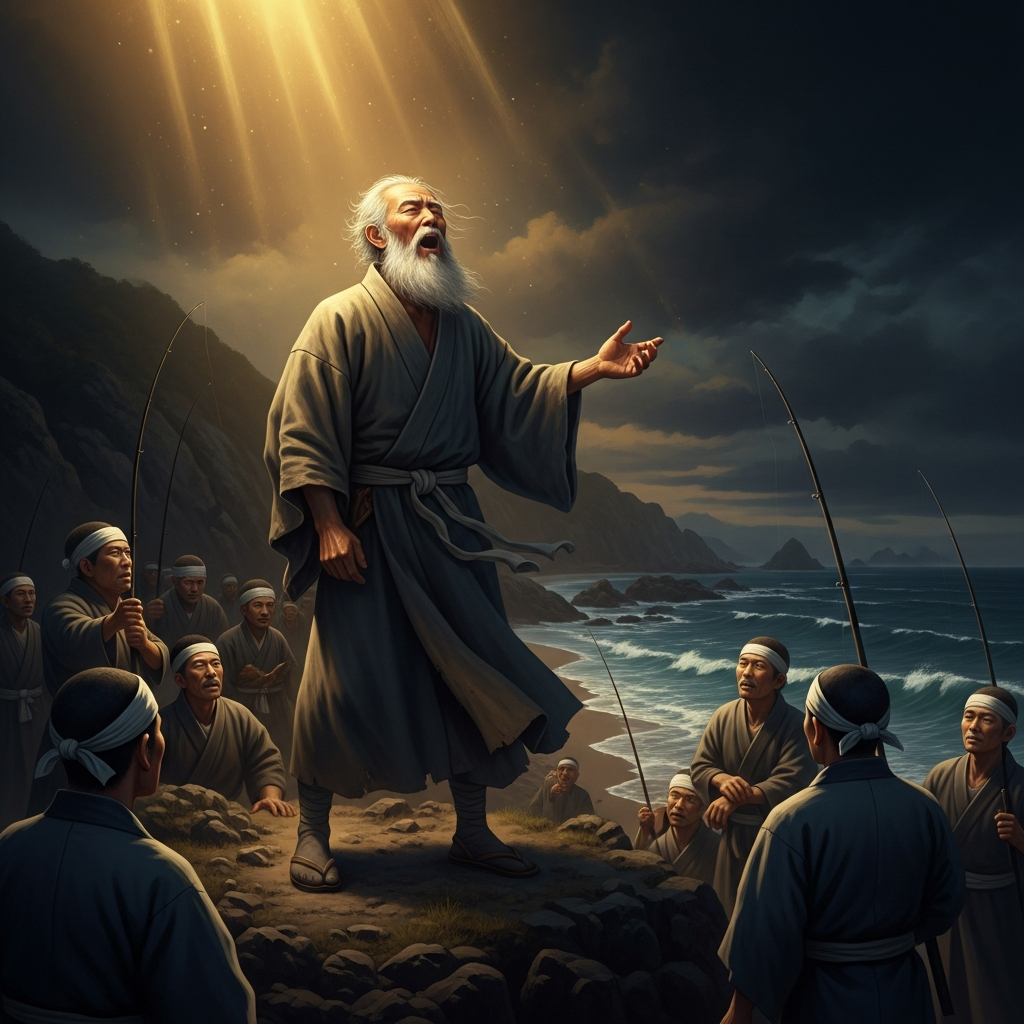
He says the nembutsu in the cart that takes him south. He says it on the boat across the inland sea. He arrives in Tosa, an old man without a monastery, without a robe, without a community. He is settled in a fishing village. He begins, the next morning, to teach the fishermen the name.
He stays in exile for almost five years. The fishermen of the southern coast learn the nembutsu from him. They teach their children. The exile that was supposed to silence him spreads the practice into a region the established schools had never reached. By the time the imperial court relents and allows him to return to Kyoto in 1211, Tosa has become a center of Pure Land devotion that will last for centuries.
He returns to Kyoto in February 1211. He is seventy-nine. He is dying. He moves into a small hermitage in the eastern hills. His disciples gather. He continues to teach for two more months.
On the twenty-fifth day of the first month of 1212, he asks his disciples to recite the nembutsu with him. They begin. He joins them. The chanting goes on through the night. Toward dawn, he stops chanting, lies down on his side in the position the historical Buddha lay down in to enter parinirvana, and stops breathing. The disciples keep chanting until the sun rises.
His successor, Shinran, will take the doctrine further.
Shinran will argue that the nembutsu itself is not the work of the practitioner but the gift of Amida; that even the desire to say the name is given by the buddha; that the ego cannot, by definition, contribute anything to its own salvation, and that therefore the more strenuously one tries to earn rebirth the more thoroughly one has misunderstood the vow. The radical line is jinen honi — naturalness, of itself, the way it is. Shinran will found Jōdo Shinshū, the True Pure Land School, which today is the largest Buddhist denomination in Japan.
Hōnen would not have used Shinran’s vocabulary. He was, to the end, a teacher of the simple practice — say the name, with sincere mind, as often as you can, until you die. But the seed of the radical version is in him. The vow is the door. The name is the latch. You did not build the door. You did not forge the latch. You only have to put your hand on it.
The Hōnen story is a story about the cost of accessibility.
A man who could read every sutra in the Tendai library reads instead a single sentence and decides that everything he was reading was preparation for the sentence. A man who could have ended his life as the most honored scholar at Mount Hiei chooses instead to end it as a defrocked exile in a fishing village in Tosa. He does this because he believes — having tested it on himself, having tested it on the prostitutes and the soldiers and the lepers — that the dharma is not the property of the trained. It is in the name. The name is in everyone’s mouth.
Eight hundred years later, the nembutsu is still being said. By an old farmer in Niigata at his wife’s grave. By a businessman in Osaka before bed. By a fisherman on the southern coast before he goes out in the morning. Namu Amida Butsu. Six syllables. The latch.
Scenes
1175
 Generating art…
 Hōnen on the road
Generating art… 1207
 Generating art…
 Echoes Across Traditions
Entities
- Hōnen
- Shandao
- Shinran
- Amida Buddha
- the aristocratic critics of Mount Hiei
Sources
- Hōnen, *Senchakushū* (1198) — *Passages on the Selection of the Nembutsu in the Original Vow*
- Mark Blum, *The Origins and Development of Pure Land Buddhism* (2002)
- Allan Andrews, *The Teachings Essential for Rebirth: A Study of Genshin's Ōjōyōshū* (1973)
- Joji Atone and Yoko Hayashi, *The Promise of Amida Buddha: Honen's Path to Bliss* (2011)
- Sōho Machida, *Renegade Monk: Hōnen and Japanese Pure Land Buddhism* (1999)