The Conference of the Birds
1177 CE (Attar's Mantiq ut-Tayr composed) · Persia (modern Iran) — and the seven allegorical valleys beyond the mountain Qaf
Contents
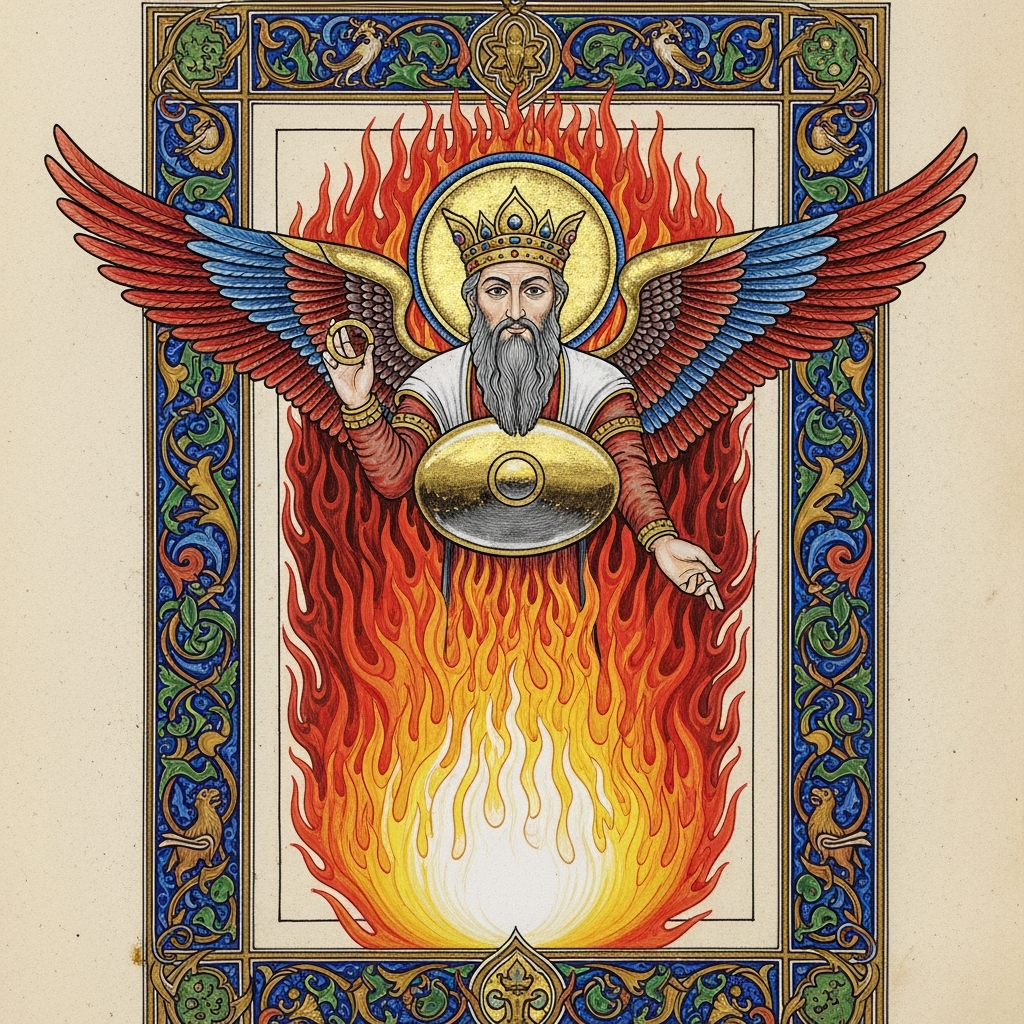
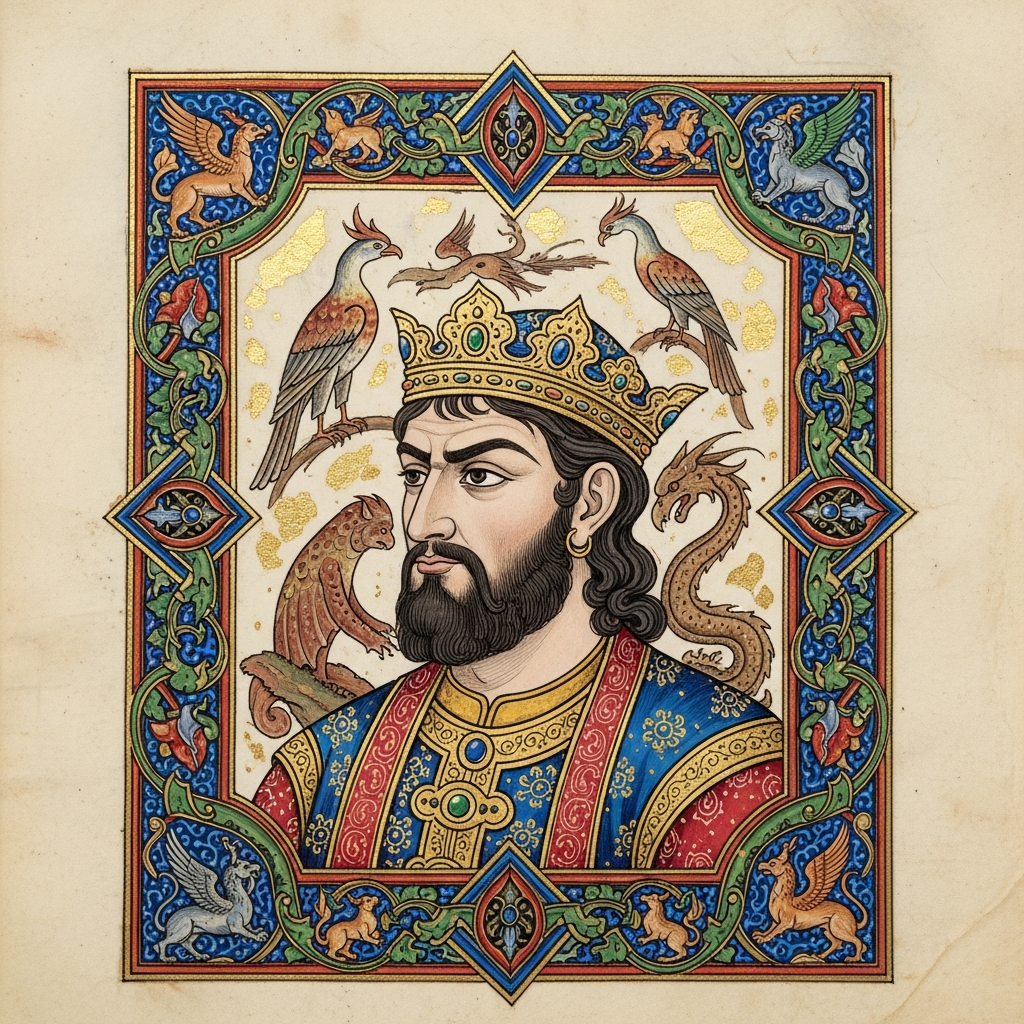
Thirty thousand birds set out across seven impossible valleys to find the Simurgh, the mythical king of birds. Only thirty survive. When they arrive at the Simurgh's court, they discover that the word for what they sought has been their own name the entire time.
- When
- 1177 CE (Attar's Mantiq ut-Tayr composed)
- Where
- Persia (modern Iran) — and the seven allegorical valleys beyond the mountain Qaf
At the beginning, there are thirty thousand birds.
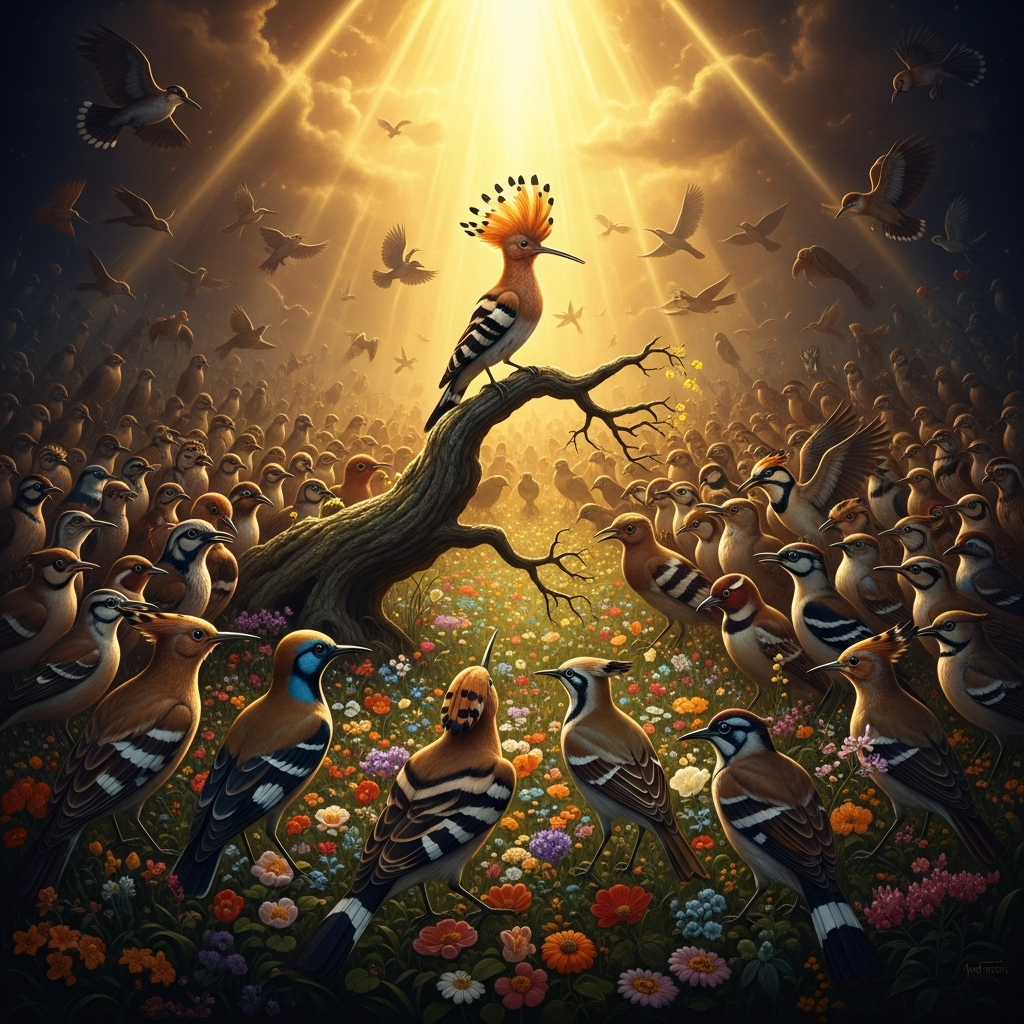
This is not metaphor. Attar means every kind of creature that has ever divided the air with its wings: eagles and sparrows, peacocks and owls, the mythical huma whose shadow bestows kingship, the qataqa who drinks only rainwater falling directly from the sky. Every bird with a grievance and an excuse. Every bird with a reason it cannot leave the life it has.
The hoopoe calls them to order. It is the hoopoe’s right — Solomon’s messenger, the bird that carries words between kings and the divine, the only creature in creation that can navigate toward Qaf, the mythical mountain at the edge of the world where the Simurgh lives. The hoopoe has made the journey before. It knows what it costs.
We are going to find the Simurgh, the hoopoe announces. The king of birds. The one who rules all birds by virtue of a feather that once fell on China and whose image ten thousand painters have spent their lives failing to render. We are going to present ourselves at his court.
The birds say: We have reasons.
The nightingale has the rose. This is the nightingale’s whole story — the Persian image of the lover destroyed by beauty, the bird who circles the red flower in a delirium of impossible longing, composing music from its own suffering. I cannot leave the rose, the nightingale says. The rose is everything. Without the rose, the music stops, and then what am I?
The hoopoe says: The rose lasts a week. What you’re calling love is a cage with petals.
The hawk cannot leave the king’s fist. The king is the hawk’s entire identity — the jesses, the hood, the moment of release, the return. A hawk without a king is just a bird. The hawk explains this. The hoopoe listens. The hoopoe says: You are describing slavery and calling it purpose.
The parrot cannot leave its mirror. The peacock cannot leave its feathers. The heron cannot leave the sea. The owl cannot leave its ruins. Each bird has arranged its desire around a single object, and each bird has made the object the size of the world so the world cannot be seen around it.
The hoopoe does not argue. The hoopoe says: Come or don’t come. But do not mistake the thing you cannot leave for the thing you love.
Thirty thousand birds begin to walk.
The first valley is the Valley of the Quest. Here the birds discover that wanting something is different from wanting to pay for it. Here the birds discover that the journey has no guarantee. They have left the rose, left the king’s fist, left the mirror and the ruins and the sea, and they are walking toward a mountain no map includes. They walk on faith or they do not walk.
Thousands turn back. The weak and the comfortable and the ones who realize, in the first valley, that they wanted the idea of the journey but not the journey itself.
The second valley is Love. Here the remaining birds go mad. Love, Attar writes, is not the pleasant feeling the word suggests in ordinary speech. Love is a consuming fire that does not ask permission before it burns. Love removes every criterion except itself. In this valley, birds go blind. Birds walk off cliffs. Birds who had been sane and purposeful for decades become incapable of explaining why they are walking. They are walking because they are walking. No other reason serves.
The third valley is Understanding. The fourth is Detachment — the terrifying place where the birds learn to want nothing, which is the prerequisite for wanting everything correctly. The fifth is Unity, where the distinction between birds begins to blur, where the flock stops being thirty thousand separate creatures and becomes a single moving thing.
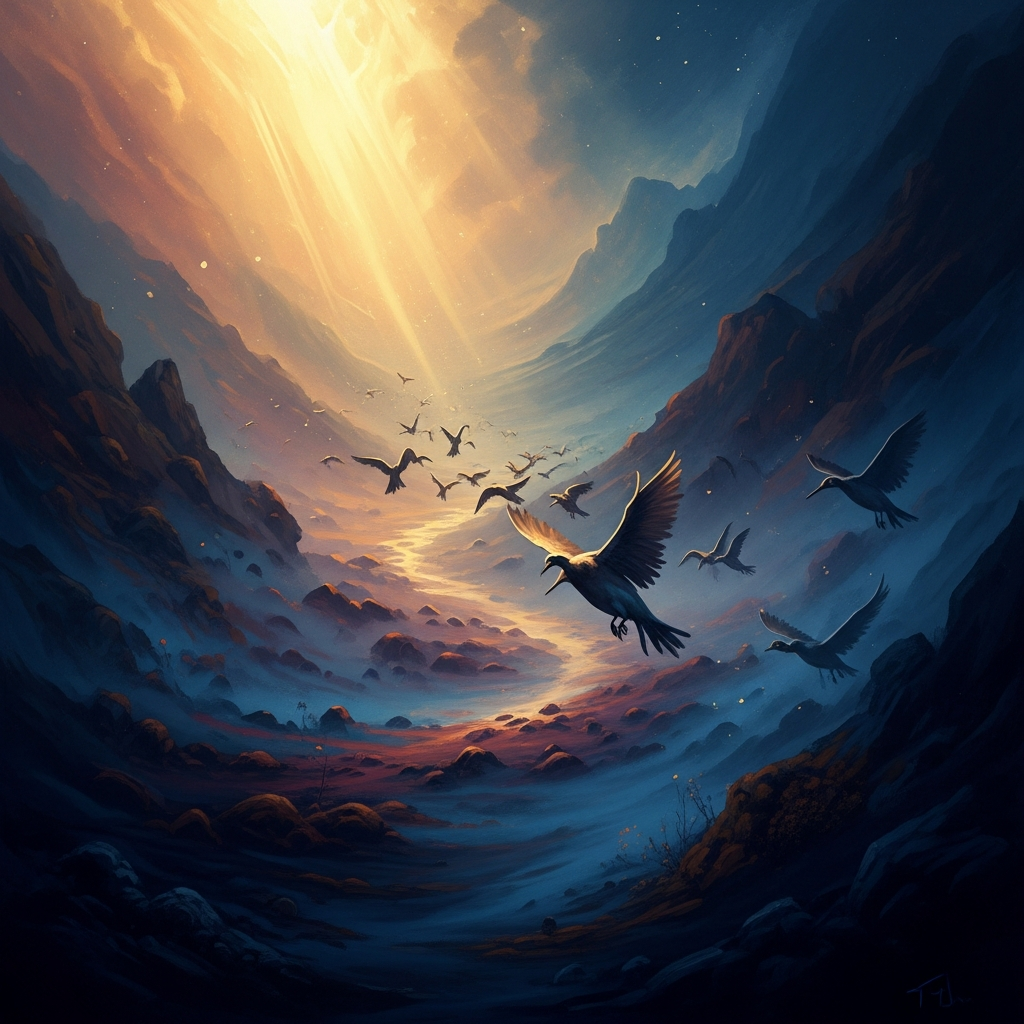
The sixth valley is Bewilderment. Nothing survives the Valley of Bewilderment intact. There is no map. There is no forward. There is no memory of why they started. Some birds land and cannot get up again. Some birds begin flying in circles and do not notice. Some birds die of the not-knowing.
The seventh valley has no name in the poem that translates correctly. Attar calls it the Valley of Poverty and Annihilation — fana — the Sufi technical term for the dissolution of the self that is the prerequisite for union. You cannot enter the Simurgh’s court carrying a self. The self is the one thing that cannot pass the gate.
Thirty birds arrive.
Not thirty thousand. Thirty. The number is the poem’s hinge, the moment everything that seemed metaphorical turns out to have been literal. Thirty birds — filthy, feathers torn, wings barely capable, the long survivors of six hundred pages of Attar’s verse — stand at the threshold of the court of the king of birds.
They have come this far expecting a throne. A presence. A face behind the veil. Something outside themselves to justify what they have lost on the way.
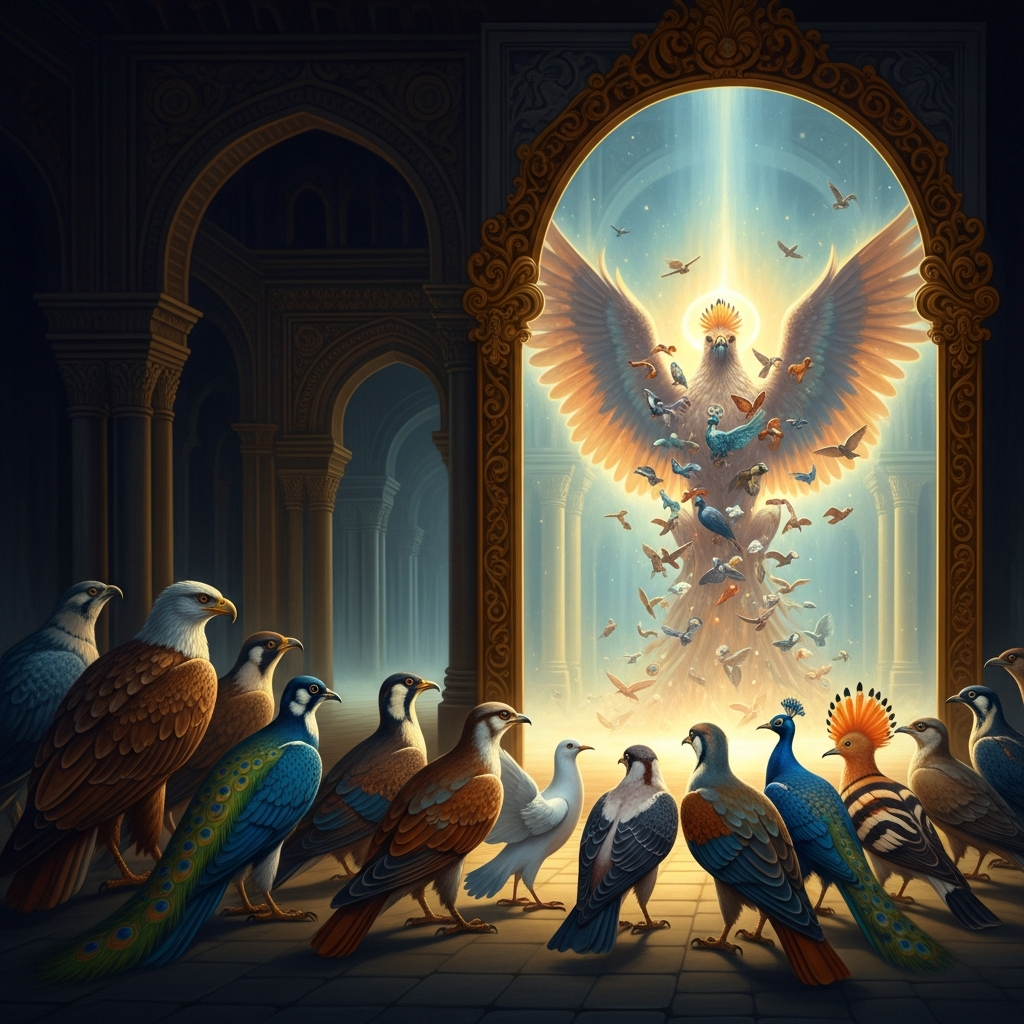
The court does not give them a presence. The court gives them a mirror.
In the mirror: thirty birds.
The word for what they sought — Simurgh — means, in Persian, thirty birds. Si is thirty. Murgh is bird. The name of the divine king, the lord of all creation’s winged things, is not a proper name. It is a headcount. It is the exact number that survived.
The birds look into the mirror. They look at each other. They look back into the mirror. They are both things simultaneously. They are the thirty birds who made the journey. They are the Simurgh. They were always the Simurgh. You cannot seek God and not be God. The seeking is the finding. The finding was always the seeking.
Attar finishes the poem by noting that this is not a comfortable teaching.
It does not mean the journey was unnecessary. It means the journey was the transformation, and the transformation was the point, and the point was always inside the travelers. The nightingale who left the rose has become something the rose could not have made it. The hawk who left the king’s fist has discovered that it was always the one releasing, never the one released.
The thirty thousand who turned back are not damned. But they did not find out what they were made of, which is the other name for not finding God.
Attar himself is a pharmacist’s son from Nishapur. He spends his whole life in a pharmacy, grinding medicines, watching sick people come and go, and at night he writes. He writes the Conference of the Birds and then keeps going — thousands more verses, other epics, a biographical dictionary of Sufi saints. He is very old when the Mongols reach Nishapur in 1221. A Mongol soldier, the story goes, asks what he is worth in ransom. Someone offers a sack of straw and the soldier laughs and takes it. A second person offers a sack of silver and Attar says: Do not sell me for that. I am worth more. The soldier kills him.
Whether this is true, no one is certain. What is certain is that Attar understood something about the relationship between the seeker and the sought that he could only say in a poem about birds.
The Simurgh is not hiding. The Simurgh has never been hiding. It is the name for what you become when you survive the seven valleys, and you cannot know that name in advance because naming it in advance is what the Valley of Bewilderment is designed to take away.
Thirty thousand birds began. Thirty arrived. Attar does not call this failure. He calls this the correct number.
Scenes
The hoopoe addresses the assembly of birds — thirty thousand species gathered in the meadow of color and scent, every kind of winged creature the world contains, each with an excuse for staying
 Generating art…
 The surviving birds cross the Valley of Bewilderment, where identity dissolves and the travelers can no longer remember why they began — or who they were before they did
 Generating art…
 Thirty birds stand at the threshold of the Simurgh's court and see, in the mirror of divine light, thirty birds: themselves, transfigured
 Generating art…
 Echoes Across Traditions
Entities
- The Hoopoe
- The Nightingale
- The Simurgh
- Farid ud-Din Attar
- The Thirty Birds
Sources
- Farid ud-Din Attar, *The Conference of the Birds* (*Mantiq ut-Tayr*), trans. Afkham Darbandi and Dick Davis (Penguin Classics, 1984)
- Farid ud-Din Attar, *The Conference of the Birds*, trans. Sholeh Wolpé (W. W. Norton, 2017)
- Annemarie Schimmel, *Mystical Dimensions of Islam* (University of North Carolina Press, 1975)
- Shahram Shiva, *Rumi's Untold Story* (Hohm Press, 2003)