Ferdowsi and the Sultan's Silver
1010 CE (Shahnameh completed) · Tus and Ghazni — the poet's hometown and the sultan's capital, a world apart
Contents
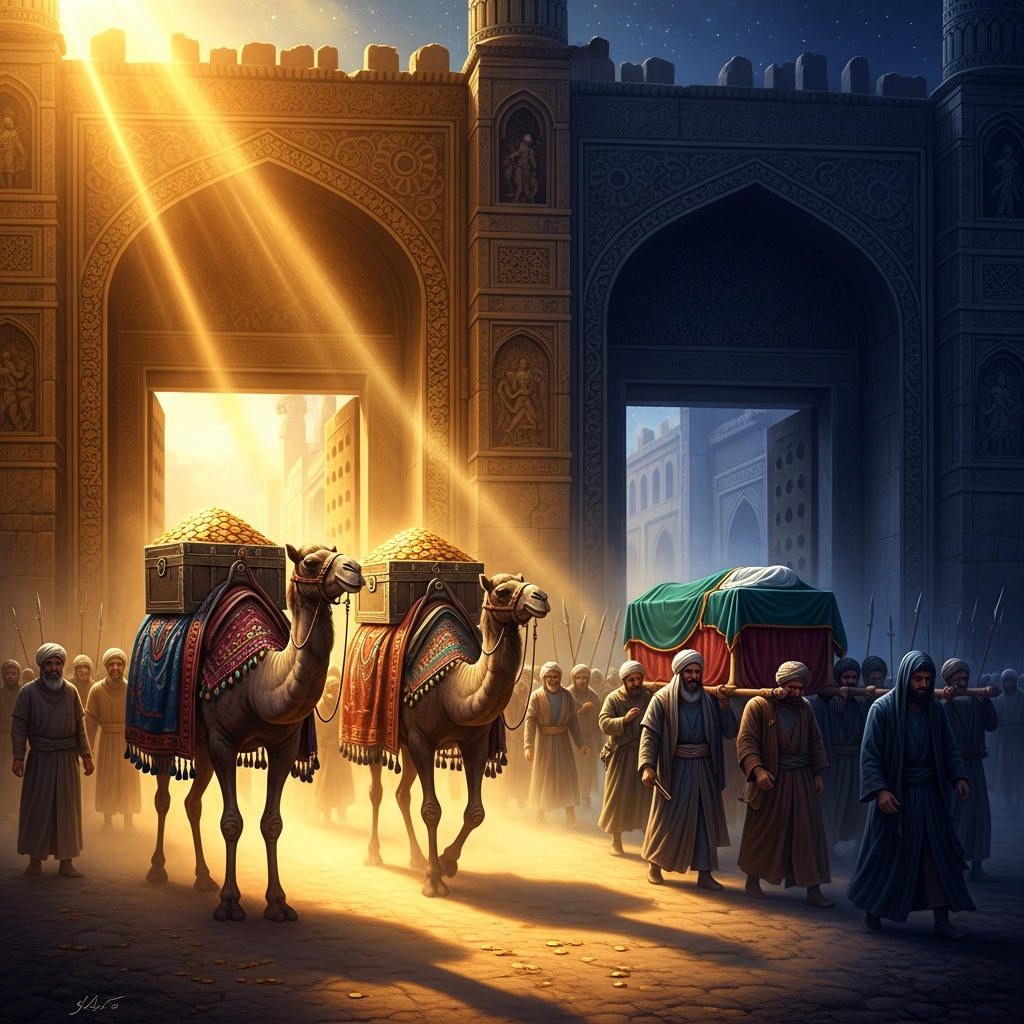
A poet spends thirty years preserving the Persian language in sixty thousand couplets, under the patronage of a sultan who promised gold and delivered silver. The gold arrives on the day of the funeral. It enters by one gate. The body exits by the other.
- When
- 1010 CE (Shahnameh completed)
- Where
- Tus and Ghazni — the poet's hometown and the sultan's capital, a world apart
He starts the poem in 977 CE, when he is thirty-five years old.
He finishes it in 1010, when he is sixty-eight. Thirty-three years of work. Sixty thousand couplets. The entire mythological history of Iran from the creation of the world to the Arab conquest of 651 CE — kings, heroes, demons, dragons, wars without mercy, loves without hope, the full catastrophe of a civilization trying to remember itself before the memory is gone.
He is doing it because the memory is almost gone.
The Arabs have been in Iran for three centuries. The caliphate has made Arabic the language of religion, of administration, of commerce, of prestige. Persian still lives in the villages, in the homes, in the mouths of women telling their children stories at night, but it is not the language of power. Its literature is fragmentary. Its mythological tradition is scattered across oral sources, partial manuscripts, regional memories that disagree with each other. Another generation and the Rustam stories will be the same as the Gilgamesh stories — known once, known everywhere, then lost entirely and only recoverable in pieces two thousand years later.
Ferdowsi is a dehqan, a minor landowner of the old Iranian aristocracy — the class that still remembers the pre-Islamic civilization, that still knows the stories, that still names its children after Rustam and Sohrab and Siavash instead of Muhammad and Ali. He is not a court poet. He has no imperial patron. He begins the Shahnameh because someone has to, and he is the one who can.
He does not begin it alone.
There is an earlier poet named Daqiqi who started the project and was killed by his own slave after writing only a thousand couplets. Ferdowsi incorporates Daqiqi’s couplets into the poem — attributes them correctly, names him, mourns him — and continues. This is a Persian literary gesture of enormous dignity: the dead poet is not erased. He is honored by being made part of what he could not finish.
Ferdowsi works from the Khvatay-Namak, the Sassanid royal chronicles translated into Arabic after the conquest and back into Persian for him by local scholars. He works from oral poets he hires to recite the old stories. He works from memory, from instinct, from the sense a man gets after thirty years of immersion in a tradition that he has become, at some cellular level, the tradition itself.
He is not paid during these years. He is paying out of his own estate. The money runs out. He sells fields. He sells his daughter’s dowry land. He keeps writing.
When Sultan Mahmud of Ghazni — the Turkish conqueror who has made himself master of Iran and Afghanistan and most of the subcontinent — hears about the great poem, he sends for Ferdowsi. Ferdowsi is nearly sixty. He is exhausted and poor and almost done. He goes to Ghazni with the manuscript.
Mahmud is not a fool. He knows what the Shahnameh is. He knows what sixty thousand couplets of Persian verse means for his own image as the patron of Iranian culture, as the legitimate heir of the tradition he has conquered. He offers Ferdowsi sixty thousand gold dinars — one per couplet. This is the deal. Ferdowsi completes the poem, presents it at court, and collects his gold.
The poem is presented. The court praises it. The sultan praises it.
Then the silver comes.
Sixty thousand silver dirhams. Not gold. The conversion rate in this period means silver is roughly twenty times less valuable than gold. Ferdowsi receives a fraction of what was promised. The chroniclers give different reasons — that the sultan’s treasurer substituted silver, that the sultan himself decided the poem was too full of pagan Iranian kings and not enough Islam, that someone at court whispered that Ferdowsi was secretly a Shia Muslim and the Sunni sultan should not enrich him.
The truth is probably all of these at once. The truth about great betrayals usually is.
Ferdowsi takes the silver. He walks to the bathhouse. He divides it three ways — one third for a beer-seller, one third for a sweetmeat-vendor, one third for the bathhouse attendant — and distributes it completely. He keeps nothing. He goes home.
Then he writes the satire.
The satire of Sultan Mahmud runs to about a hundred couplets in the version that survives, though it was probably longer. Ferdowsi begins by praising the sultan in the terms the poem requires — the world-conqueror, the sword of Islam — and then, with the precision of a man who has spent thirty-three years choosing words, he begins to remove the praise.
If the king had had a noble father, I would have had a crown of gold pressed on my head. If his mother had been a great lady, I would have been wading in silver and gold up to my knees.
He is saying: you are Turkish. Your family is not old. You have no genealogy that goes back to the Persian kings. You are an upstart who conquered what he could not create, and you know it, and that is why the poem about the kings you cannot claim was worth twenty times less when you actually had to pay for it.
The sultan is furious. He issues a warrant. Ferdowsi flees — first to Herat, then to Mazanderan, eventually to the court of the Shahanshahs of Tabaristan, who are Shia and no friends of Mahmud. He writes for them. He keeps writing.
He is old now. He is very old. He goes home to Tus to die.
The sultan reconsiders. This happens, with powerful men, when the thing they destroyed becomes famous enough that destroying it becomes an embarrassment. Mahmud hears that scholars in Baghdad are reading the Shahnameh aloud. He hears that it is being copied in Samarkand. He hears that his own satire — the hundred couplets Ferdowsi wrote about the Turkish parvenu with no lineage — is being recited at parties.
He sends sixty thousand gold dinars on a camel caravan to Tus.
The caravan enters Tus by the Rudbar gate.
Ferdowsi’s funeral cortege leaves Tus by the Reza gate.
The gold and the body pass each other at the walls of the city, going in opposite directions, and do not meet. His daughter — the woman for whose dowry land he sold everything, who is by now middle-aged herself — refuses the gold. The Ferdowsi family does not need the sultan’s gold anymore.
With the gold, eventually, a caravansary is built in the region. People sleep in it. They eat in it. They water their horses at its trough. This is, in an oblique way, exactly the use Ferdowsi would have preferred.
The Shahnameh survives everything. It survives Mahmud’s silver and Ferdowsi’s flight and the Mongol invasion that will level Tus a century later. It survives because Persian-speaking peoples copy it obsessively — not as a curiosity but as a necessity, the way you copy a deed to land you want to keep. The kings in the poem become the standard against which real kings are measured and found wanting. Rustam’s loyalty becomes the thing Iranian culture means by loyalty. Sohrab’s death becomes what Iranian culture means by tragedy.
Ferdowsi wanted to preserve a language. He did something more durable: he gave a language its self-image.
The sultan’s gold arrived on the day of the funeral because that is when it always arrives. Not because the powerful are cruel, though they often are. Because the timescale of power and the timescale of art are different things, and the powerful only understand what they have paid for after they have already paid the wrong price.
Ferdowsi spent thirty-three years writing about kings. He knew this.
Scenes
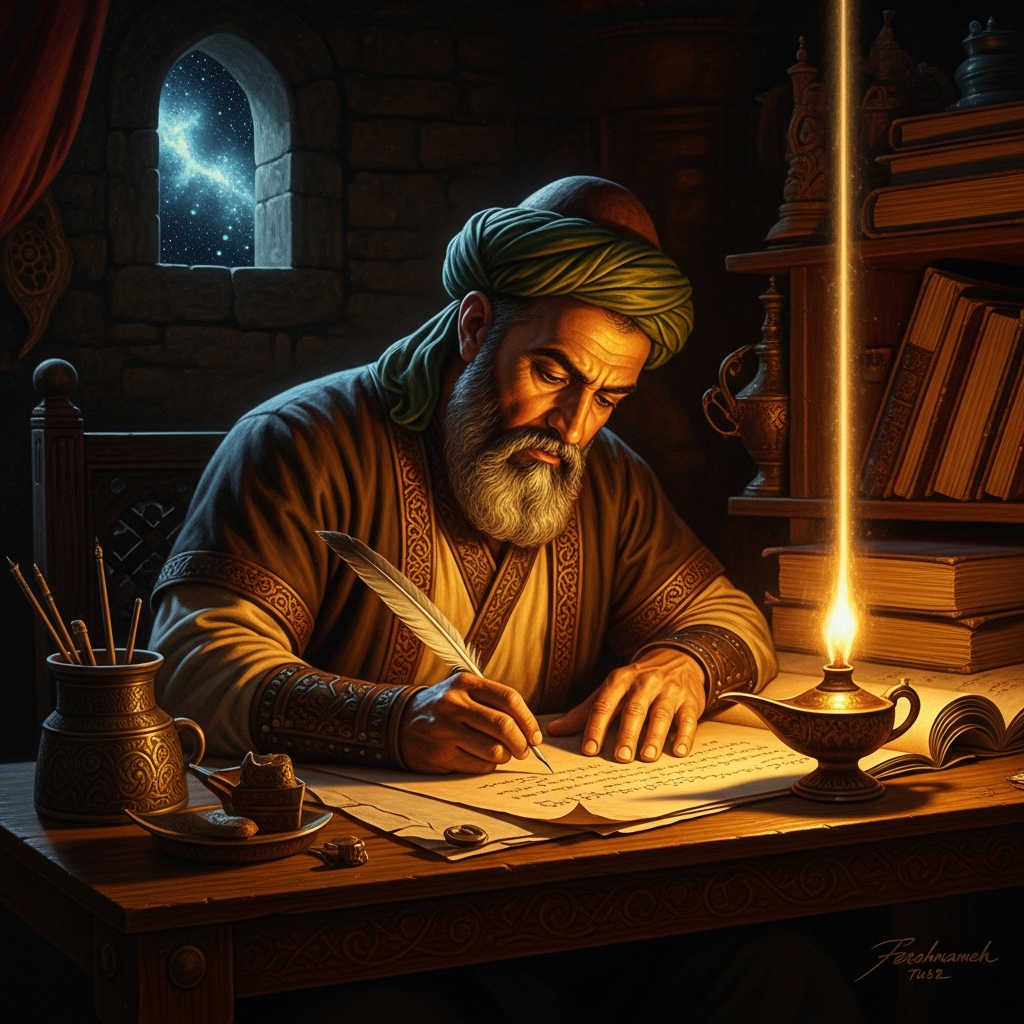
Ferdowsi composes by lamplight in Tus, thirty years of nights spent building the Persian mythological tradition against the flood of Arabization — sixty thousand couplets, one line at a time
 Generating art…
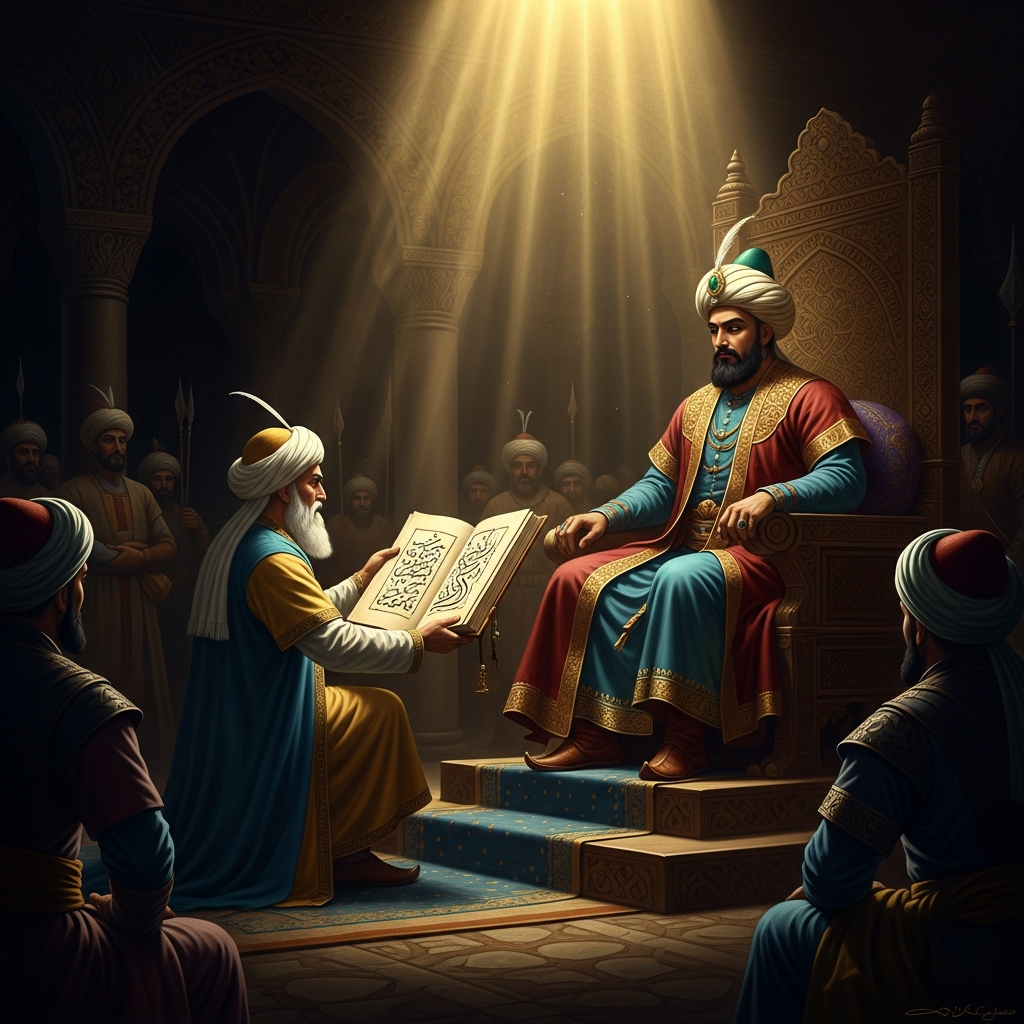
 Ferdowsi presents the completed Shahnameh at the court of Ghazni
 Generating art…
 The sultan's camel caravan bearing sixty thousand gold coins enters the gates of Tus on the same day as Ferdowsi's funeral cortege — one gate in, one gate out
 Generating art…
 Echoes Across Traditions
Entities
- Ferdowsi
- Sultan Mahmud of Ghazni
- Ayaz
- The Imam of Tus
- The Keeper of the Tus Gate
Sources
- Abolqasem Ferdowsi, *Shahnameh: The Persian Book of Kings*, trans. Dick Davis (Penguin, 2016) — includes Davis's authoritative biographical introduction
- Dick Davis, *Epic and Sedition: The Case of Ferdowsi's Shahnameh* (University of Arkansas Press, 1992)
- Shahrokh Meskoob, *Iranian Nationality and the Persian Language*, trans. Michael Hillmann (Mage, 1992)
- Nizam al-Mulk, *Book of Government* (*Siyasatnama*), trans. Hubert Darke (Routledge, 2002) — contemporary account of Mahmud's court