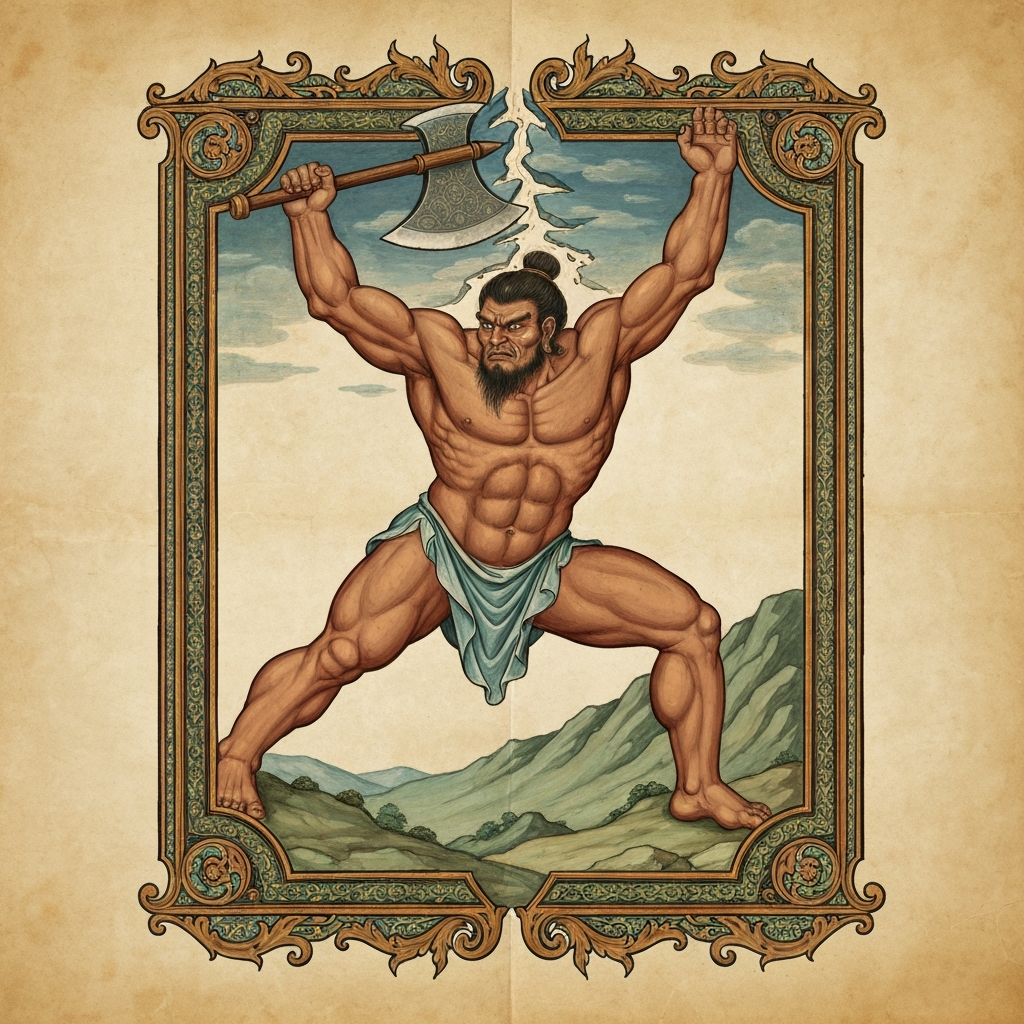
Madam White and the Monk Who Would Save the World from Her
Song dynasty setting, c. 960-1279 CE; tale codified in Feng Menglong's Stories to Caution the World, 1620 CE · West Lake, Hangzhou; the Thunder Peak Pagoda on Leifeng Hill
Contents
Bai Suzhen, the White Snake spirit, has cultivated for a thousand years on Mount Emei. She descends to Hangzhou, disguises herself as a woman, and falls in love with a pharmacist named Xu Xian. The monk Fahai, knowing she is a demon, sets out to destroy the marriage. The story does not end with his triumph. It ends with a question: whether a thousand years of spiritual practice deserves love, and whether demon is the right word for something that loves this completely.
- When
- Song dynasty setting, c. 960-1279 CE; tale codified in Feng Menglong's Stories to Caution the World, 1620 CE
- Where
- West Lake, Hangzhou; the Thunder Peak Pagoda on Leifeng Hill
The story is performed in dozens of forms. The Kunqu opera — Baishe Zhuan, The Legend of the White Snake — has been staged continuously since the Qing dynasty, the lead soprano’s white sleeves rippling in the stage lighting, the fight choreography for the battle of the flood using thirty stagehands to wave blue silk. The Peking opera version is harder and more martial. The Yue opera version from Zhejiang, closest to the story’s home in Hangzhou, is the one where the audiences cry most reliably. Television productions have aired in every decade since 1926. Each production adjusts the moral weight between Fahai and Bai Suzhen according to the concerns of its moment. The story has not settled.
The story has not settled because the question at its center — who was right? — has no answer that is not also a question about what you most want to protect.
She has been cultivating for five hundred years.
The Chinese tradition allows for this: a snake that meditates long enough on a sacred mountain, absorbing the particular spiritual force of a place, becomes something between animal and spirit. The technical term is xian — immortal, or cultivated being, a category that includes both the fully divine and the partially transformed. Bai Suzhen, the White Snake, has been sitting on Mount Emei for five centuries, absorbing dew and moonlight and the mountain’s own accumulated holiness. She is not human. She is not simply a snake either. She is a third thing, and the third thing is what the story is about.
Her companion is Xiao Qing, the Green Snake, younger by four hundred years and impulsive in the way that relative youth produces — quick to anger, fierce in loyalty, less complicated in her feelings because she has fewer centuries’ worth of cultivation to complicate them with. They descend to Hangzhou together, curious about the human world and its textures. Bai Suzhen puts on the face she has spent five hundred years assembling. It is not a disguise exactly. It is what she has become.
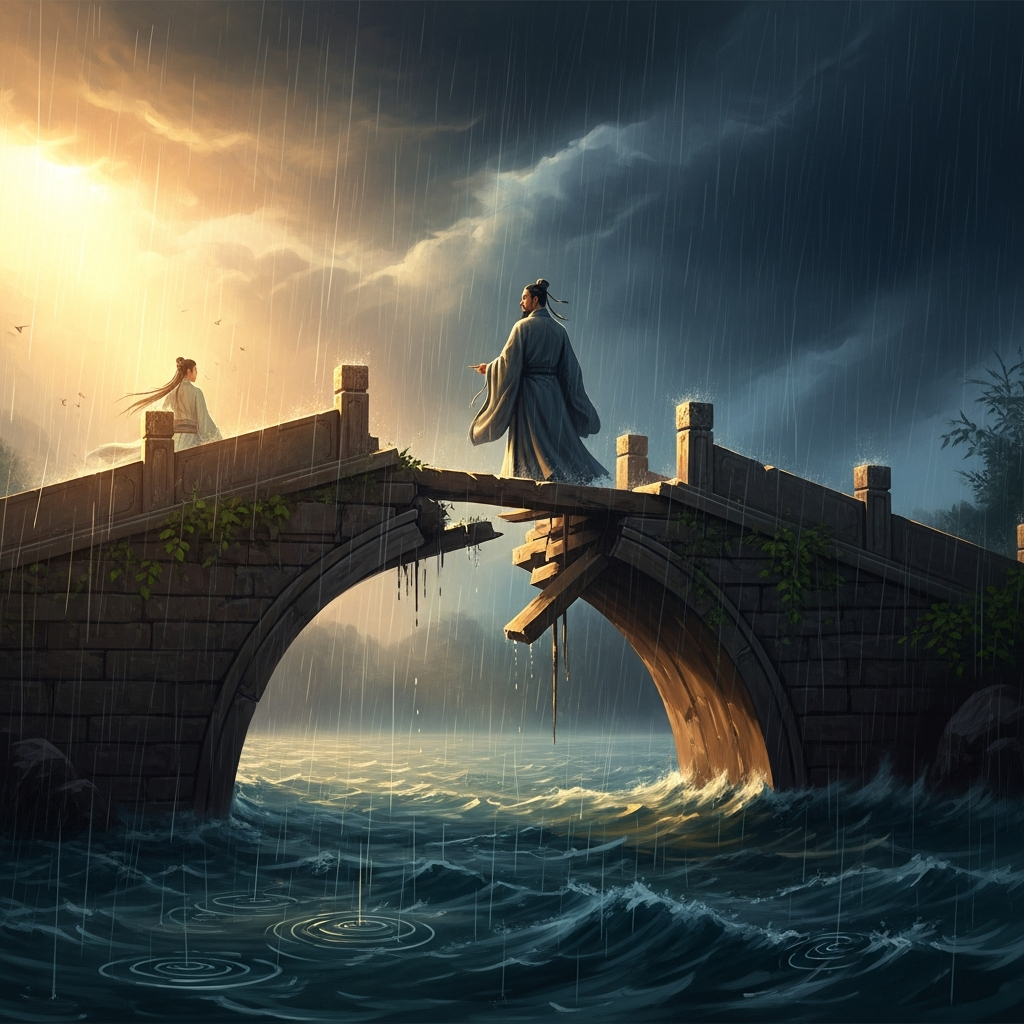
The Broken Bridge encounter is the canonical origin of their meeting, and the Broken Bridge is a real place.
It spans a section of the West Lake in Hangzhou, and in late spring when it rains suddenly, the way it does in the poem that established the narrative geography of the lake, it is the exact kind of place where a man with an umbrella and a woman without one might find themselves making a decision that defines the rest of their lives. Xu Xian — pharmacist, modest background, good-hearted in the way that the Chinese folk tradition rewards — lends Bai Suzhen his umbrella.
This is, in the grammar of the story, a declaration.
They marry. He sets up his pharmacy on the street below the hill. She helps him. Her knowledge of medicinal herbs and their interactions, accumulated over five centuries of studying the natural essences of things, makes the pharmacy one of the best in Hangzhou. She heals people. She heals people who come to the pharmacy with conditions that the standard materia medica cannot address, because she understands the spiritual dimension of illness in a way that a human pharmacist cannot.
Xu Xian does not ask how she knows what she knows. He is happy, and the text permits this happiness without irony through several chapters, because the text knows what is coming and does not rush it.
The monk Fahai arrives at the Golden Mountain Monastery when the story needs him to.
He is not a villain in the shape of a villain. This is the technical achievement of the legend. He is an abbot of genuine virtue and genuine power, a practitioner who can see through the surface of things to the categories beneath them. When he looks at Bai Suzhen, he sees a yao — a demon, a being that has transgressed the boundaries between kinds. In the Chinese religious cosmology, the category of yao is not simply evil. It is ontological disruption. It is a thing that has blurred the distinctions on which the order of the world depends.
Fahai is not wrong that Bai Suzhen is a snake spirit. He is not wrong that the boundaries she has crossed are real boundaries. He is not wrong that the disruption she represents has consequences. He tells Xu Xian this. He tells him to offer his wife realgar wine at the Dragon Boat Festival — arsenic sulfide, a mineral used in festival rituals to ward off evil, one of the substances that strips a cultivated being of its human form. If she is human, nothing will happen.
Bai Suzhen knows what the wine is. She drinks it anyway.
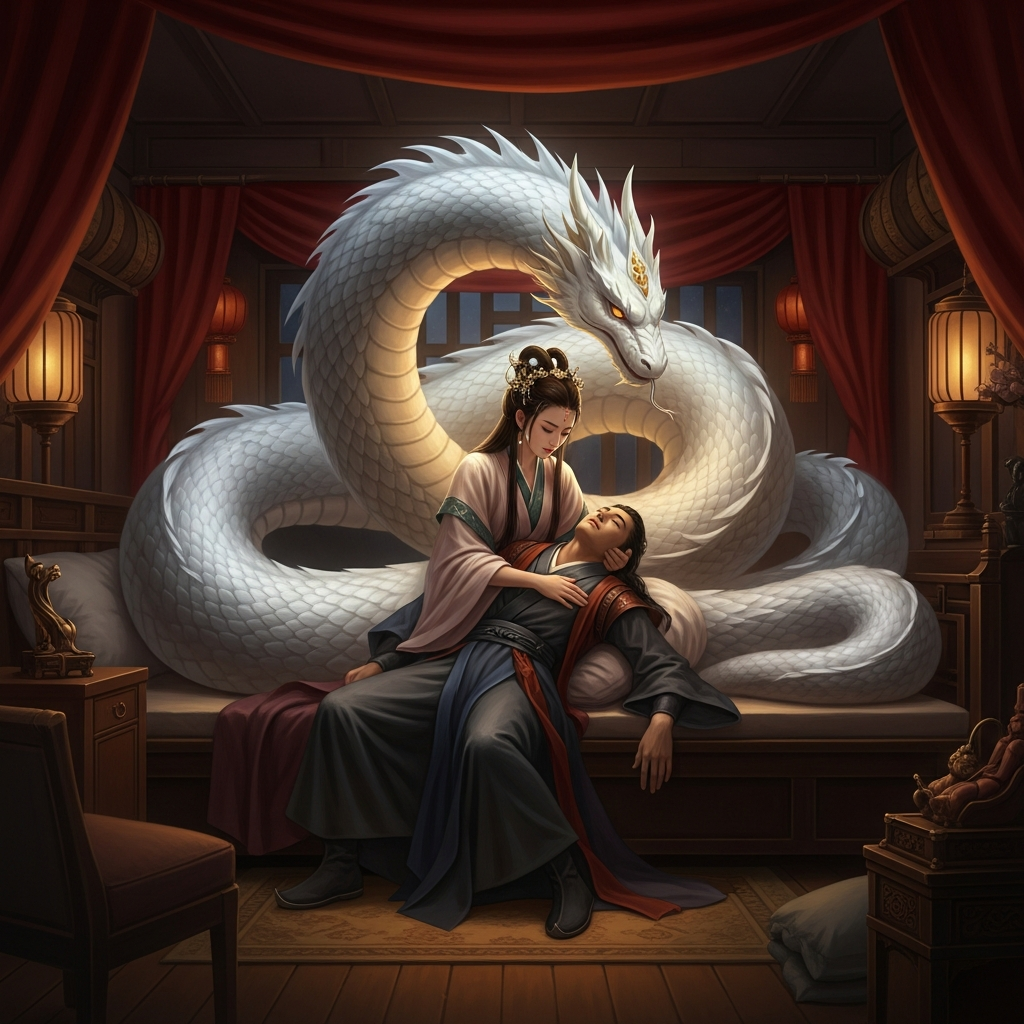
She drinks it because refusing would mean refusing Xu Xian’s trust. She drinks it because she has been accumulating virtue for five hundred years and the virtue requires honesty even when honesty is catastrophic. She drinks it and she transforms, and Xu Xian sees what she is, and his heart stops from the shock of seeing it.
She brings him back.
She travels to the mountain of the immortals — Kunlun, in the tradition’s cosmography — and steals the lingzhi, the resurrection fungus, fighting through the guardians with Xiao Qing’s ferocity and her own five centuries of accumulated power. She brings it back. She revives him.
He knows, when he wakes, what he saw. He chooses, when he wakes, to stay.
The tradition uses this moment precisely. Xu Xian has seen her true form and chosen to continue — has made the decision with full knowledge, has said, in effect, that what she is does not change what they are. The question the story then poses is whether this choice settles the matter, whether love that knows what it is loving constitutes permission for what it loves to exist.
Fahai does not accept that the husband’s choice settles it. The cosmic order, in his accounting, is not subject to individual consent.
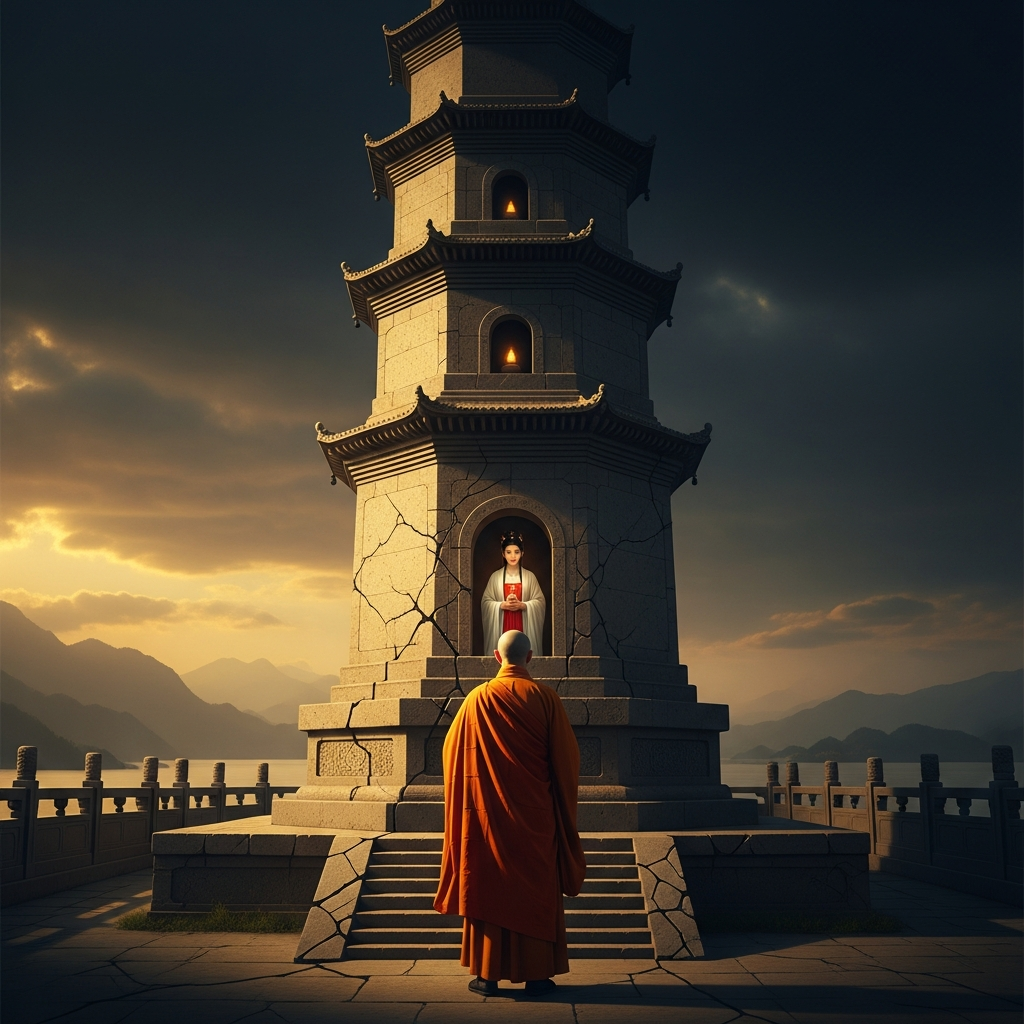
The final confrontation happens at the Thunder Peak Pagoda on Leifeng Hill.
Bai Suzhen is pregnant when the final battle begins. She has done the most human thing a body can do, and the text deploys this detail with deliberateness: her body has confirmed her human life in a way that the realgar wine and the snake form cannot negate. Fahai has taken Xu Xian into the Golden Mountain Monastery. Bai Suzhen and Xiao Qing raise an army of the sea — shrimp soldiers, crab generals, the hierarchy of the underwater realm. They flood the monastery and the land around it to get Xu Xian back. The flood kills people. Monks drown. The catastrophe she causes in trying to rescue her husband is exactly the catastrophe Fahai predicted.
Both of them are right. Both of them have produced the evidence for the other’s argument.
Her son is born. She gives him to a woman who has agreed to raise him. Fahai arrives. He has a golden bowl — the bowl of a monk of sufficient power can contain a spirit of sufficient cultivation — and he traps her in it. The Thunder Peak Pagoda is built around her, or she is sealed beneath it, or she is imprisoned within it. The versions differ in the geometry. They agree on the result: she is inside. The boundary between the human and the not-human is restored. The monk’s accounting of the world is correct again.
She is not killed. Killing is apparently not possible, or not appropriate, or not the point. The point is the pagoda.
The pagoda stood at West Lake until 1924, when it collapsed.
It had been standing for nine hundred years. It collapsed because of a long tradition of local people stealing bricks from its base — the bricks of a Buddhist pagoda that had imprisoned a snake spirit were believed to be efficacious for difficult pregnancies, for household snakes that would not leave, for a variety of conditions that the folk tradition associated with the White Snake’s powers. The tower was undermined one brick at a time across several centuries by people who were, without ever organizing around it, on Bai Suzhen’s side.
When the pagoda fell, people said she had been released. The stories told after 1924 tend toward this ending.
Her son, in the traditional version, grows up, passes the imperial examinations, and comes to Leifeng Pagoda to burn incense for his mother. His filial piety is sufficient to break the seal. She rises, white and vast, from the rubble. In most versions she ascends rather than returning to Hangzhou — she continues her cultivation. The five hundred years inside the pagoda counted.
The Chinese audience has always loved Bai Suzhen and feared Fahai and not quite condemned him. This is a more honest response than most traditions manage to their ambiguous villains.
She accumulated virtue for a thousand years before she put on a human face. She chose to drink the wine that exposed her rather than refuse her husband’s trust. She flooded a monastery and killed monks to rescue the man she loved. She gave birth to a son she could not raise. She spent five hundred years in a stone prison.
The monk who imprisoned her was trying to protect the order of the world from disruption. The woman he imprisoned was trying to love someone inside that order. The debate in China has never been settled. The question it poses — between law and love, between category and feeling — has no answer that is not also a loss.
She is still cultivating somewhere above Leifeng Hill, they say. She never stopped.
Scenes
The Broken Bridge at West Lake, Hangzhou, in sudden rain
 Generating art…
 The Dragon Boat Festival night: Bai Suzhen in her true form fills the bedroom — vast white serpent coiled in the lamplight, her scales luminous, her face human still but her body finally what it is
 Generating art…
 Fahai stands before the Thunder Peak Pagoda on Leifeng Hill at West Lake
 Generating art…
 Echoes Across Traditions
Entities
- Bai Suzhen
- Xu Xian
- Fahai
- Xiao Qing
Sources
- Feng Menglong, *Jing Shi Tong Yan* (Stories to Caution the World), story 28, 1620 CE
- Wolfram Eberhard, *A Dictionary of Chinese Symbols* (Routledge, 1986)
- Anne Birrell, *Chinese Mythology: An Introduction* (Johns Hopkins University Press, 1993)
- Pu Songling, *Strange Tales from a Chinese Studio* (John Minford trans., Penguin Classics, 2006)
- Jordan Paper, *The Spirits are Drunk: Comparative Approaches to Chinese Religion* (SUNY Press, 1995)