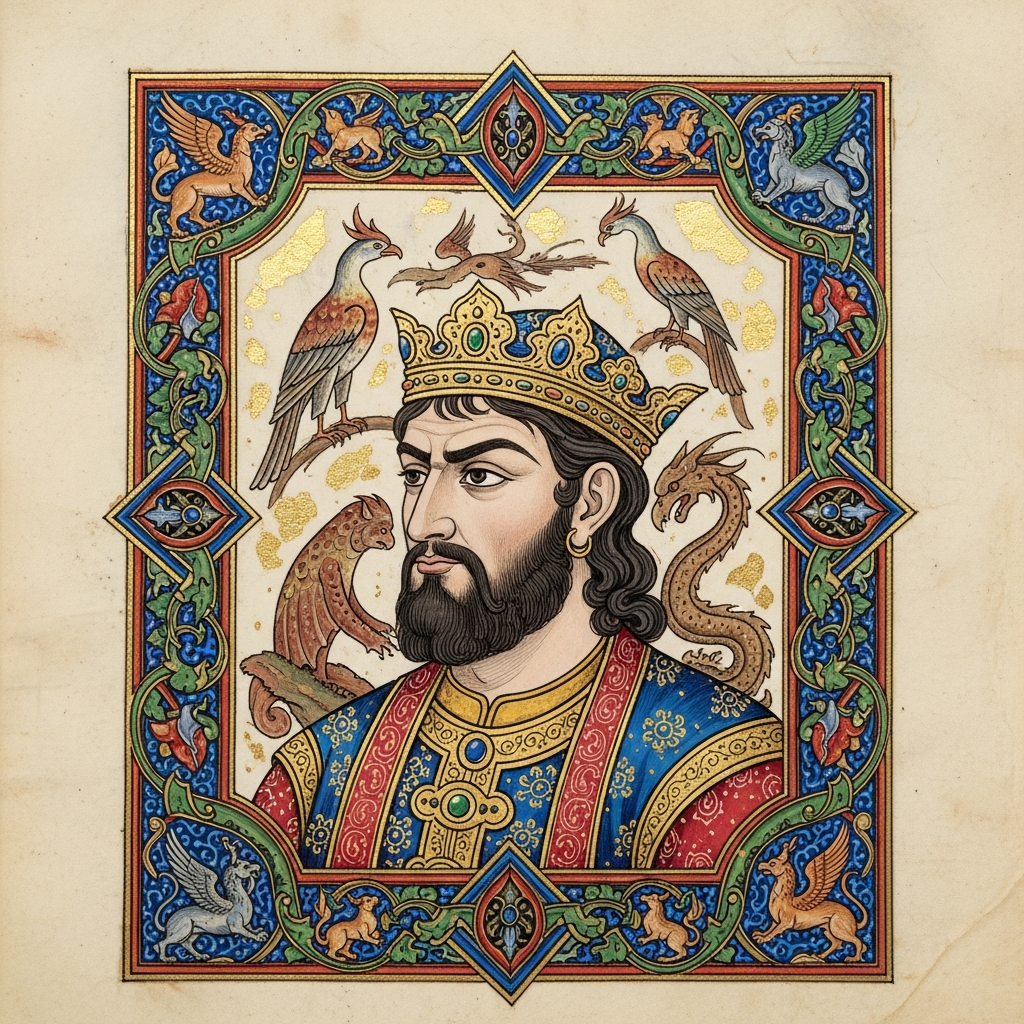
Hafez Before Tamerlane
c. 1387 CE (Timur's occupation of Shiraz) · Shiraz, Fars Province, Iran — the city of rose gardens and the tomb in Musalla
Contents
Tamerlane has conquered most of the known world and is personally offended by a single couplet. He summons the poet who wrote it. The poet's answer saves his life. The divine and the scandalous are inseparable in his mouth.
- When
- c. 1387 CE (Timur's occupation of Shiraz)
- Where
- Shiraz, Fars Province, Iran — the city of rose gardens and the tomb in Musalla
The couplet that nearly kills him goes like this:
If that Shirazi Turk would take my heart into her hand, I would give Samarkand and Bukhara for the mole on her cheek.
Tamerlane has been collecting cities for forty years. Samarkand is his capital. He has rebuilt it from the ruins of the Mongol disaster into the most magnificent city in the Islamic world — the Registan, the Shah-i-Zinda, the tilework that no one alive has surpassed. Bukhara is the intellectual heart of Central Asia, the city of ten thousand scholars. These are not abstractions to Timur. They are his. They are the things he built with forty years of campaigning and a hundred thousand dead.
And some poet in Shiraz has said he would trade them for a mole.
Timur arrives in Shiraz in 1387. The city capitulates without a fight — the sensible choice, given what he does to cities that resist. The citizens line the road. The scholars prepare speeches. The clerics prepare speeches. Hafez does not prepare a speech because Hafez does not do that kind of thing.
He is summoned to the audience tent.
He is not young. He is somewhere in his seventies, if the dates are right, and the dates are not certain — the Divan is remarkably resistant to autobiography, which is either the mark of a mystic or the mark of a very careful man, possibly both. He has survived the Muzaffarid dynasty and its internal wars, the executions, the court intrigue. He has survived being banned by the pious for writing about wine. He has survived three or four different interpretations of every poem he has ever composed.
He enters the tent.
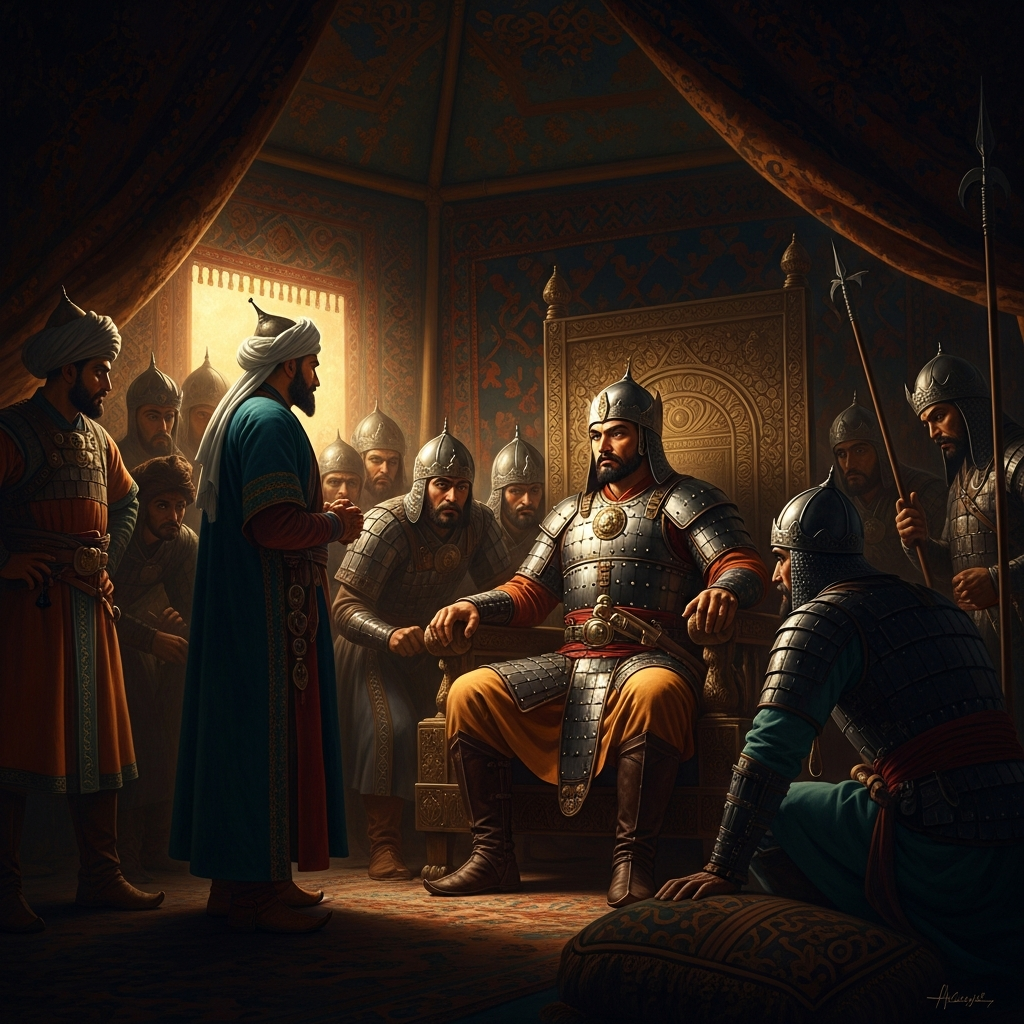
Timur is on the throne. Around him are generals who have reduced fortresses to rubble. Around the generals are men whose job is to make sure the generals’ enthusiasm for Timur is not merely professional.
Timur says: I have conquered the world with my sword. I have made Samarkand and Bukhara the jewels of civilization. And you, miserable wretch — you trade them for a mole on the face of a girl in Shiraz.
This is the moment.
Every Persian knows what happened next, though the versions disagree on the exact words — the chroniclers were not in the tent, the historians reconstructed it later, and Hafez himself never wrote about it directly, which is very Hafez. The version that survives in most accounts goes like this:
Hafez looks at the conqueror.
Hafez looks at the conqueror’s generals.
Hafez looks at the floor of the tent, which is carpeted in the Timurid fashion with silk that cost more than most villages.
He says: Your Majesty, it is by such generosity that I have been reduced to this poverty.
The tent is silent.
Then Timur laughs.
He gives Hafez a robe of honor and money for the road. He lets him go. The world-conqueror, in the end, understands a good line.
The theological dispute about Hafez has been running for six centuries and shows no sign of resolution because resolution would kill it.
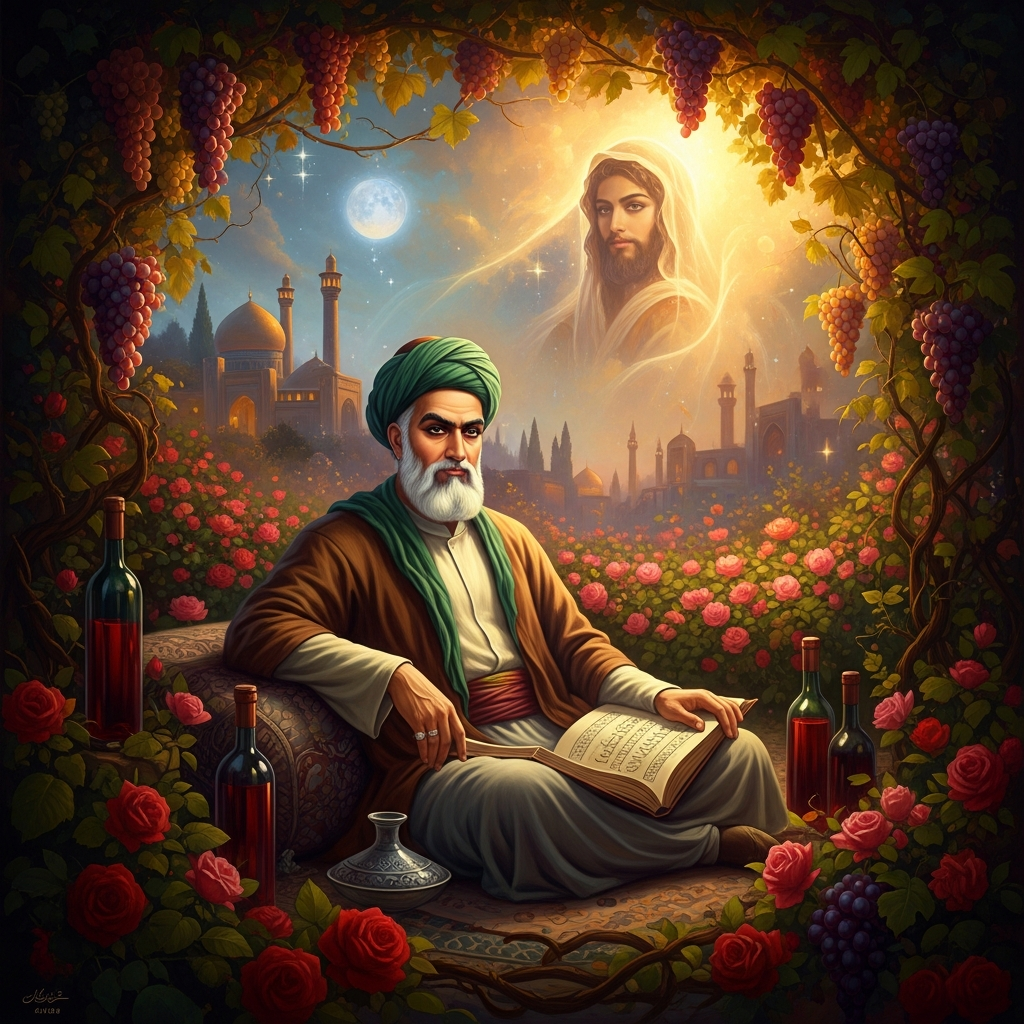
Is the wine real? In a strict religious sense, wine is forbidden. Hafez spent his life in the city of Shiraz, where wine was both legally forbidden and culturally omnipresent, a situation familiar to anyone who has lived under a law that the law-givers also break. The tavern appears on every other page of the Divan. The cupbearer is perpetual. The beloved’s hair is an ambush and her eyes are weapons and her mole — yes, that mole — is worth two imperial cities.
The Sufi interpretation, which began within decades of his death, says: the wine is fana, the annihilation of self in the divine. The tavern is the Sufi lodge where the ego is dissolved. The beloved is God — the face behind the face, the reality behind the curtain of ordinary perception. The mole is the single point of divine particularity around which the entire cosmos is organized.
The literal interpretation says: he liked wine and he liked women and he was a Persian lyric poet in the tradition that runs from Rudaki through Sa’di, and he was very good at it.
Hafez himself, asked directly — and several rulers asked directly, since the poems made theological authorities nervous and rulers liked to be reassured — always gave the kind of answer he gave Timur. The answer that is technically responsive, entirely undeniable, and leaves the questioner in a slightly different place than they expected to land.
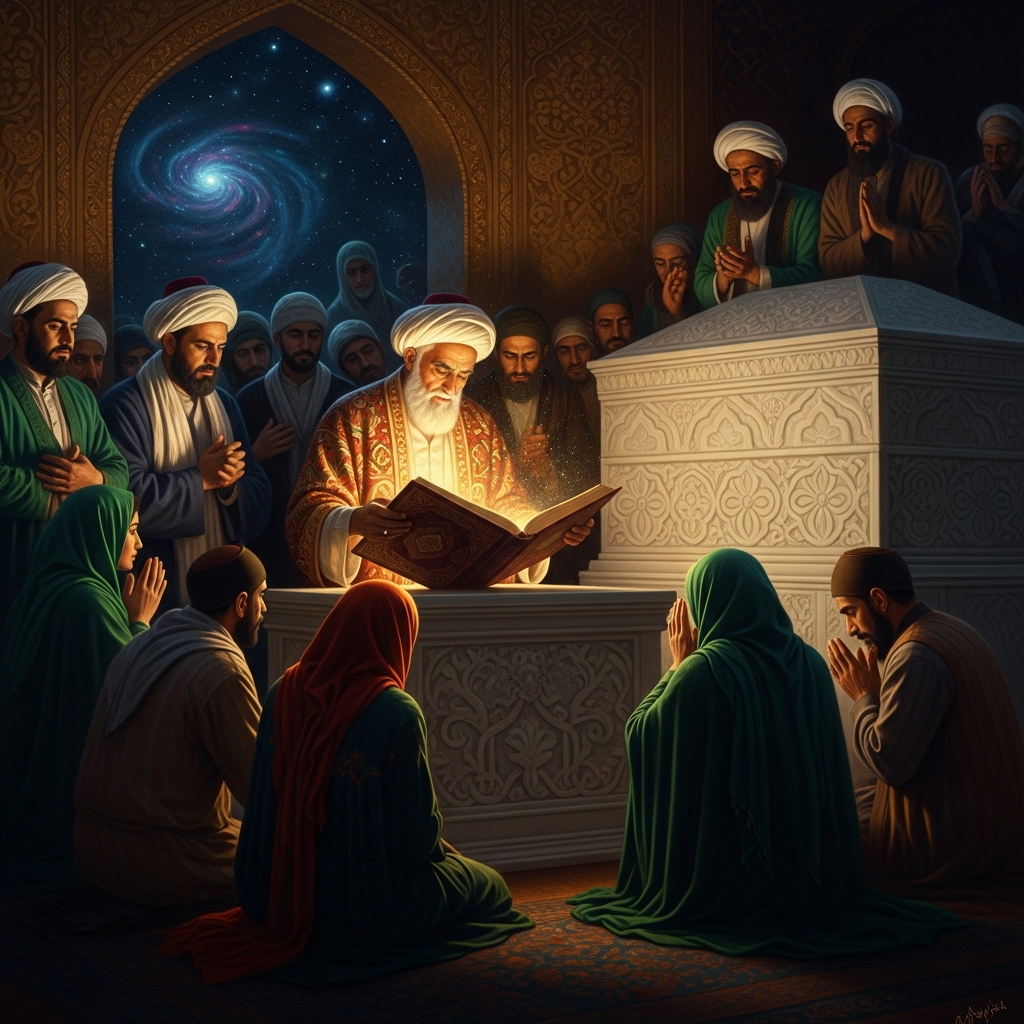
He is buried in Shiraz, in the Musalla gardens, in a tomb that becomes a pilgrimage site within decades of his death. The practice of fal-e Hafiz — Hafez-divination — is ancient and still current: you form a question in your mind, you open the Divan at random, you read the poem your thumb touches, and you interpret it as the answer. The practice has been condemned by the pious and practiced by the pious simultaneously, which is very Hafez.
Goethe discovers the Divan in 1814 through a Latin translation and is so undone by it that he writes his own West-Eastern Divan, the most serious attempt by a Western poet to think through what Hafez means. Ralph Waldo Emerson translates Hafez in Concord, Massachusetts, and finds in him what the Transcendentalists were trying to say but could not say as well. In Shiraz today, people bring their questions to the tomb on Thursday evenings, open the book, and take what the random page gives them.
He would have liked this. He wrote for exactly this use.
The couplet about Samarkand and Bukhara is, in the Divan, a ghazal that begins with the standard invocation of the beloved — the Shirazi Turk, which is not a political description but a type, the dark-eyed beauty of a particular Persian aesthetic tradition — and moves through wine and music and the incomprehensibility of love to its final couplet, which is Hafez himself:
Hafez, you were reciting poems and stringing pearls. The Pleiades have dropped your verses in its lap.
He signs himself Hafez — the one who has memorized the Quran, which is his title, his credential, the marker of his religious education — and then compares his poems to pearls given to the constellation. He is, in the same breath, the pious memorizer of scripture and the man who would trade two empires for a mole.
Tamerlane laughed because he understood. The joke is on everyone equally.
The wine is real and the wine is God and the difference between those two things is the six centuries of argument Hafez left behind him as a gift. He did not resolve the argument because the argument is the poem. The moment you decide which one it is, you have stopped reading Hafez.
He told Timur that his poverty came from his generosity. He meant it in every direction at once.
Scenes
The poet of Shiraz stands before the world-conqueror in the audience tent
 Generating art…
 Hafez in the rose gardens of Shiraz, where every wine is also God and every beloved is also the face behind the veil — the city he would trade two imperial capitals to stay in
 Generating art…
 Pilgrims open the Divan of Hafez at random at his tomb in Shiraz, using his poems as an oracle — as the poet intended and as the tradition maintains across seven centuries
 Generating art…
 Echoes Across Traditions
Entities
- Hafez of Shiraz
- Timur (Tamerlane)
- Shah Shuja
- The Beloved of Shiraz
Sources
- Hafez, *Divan*, trans. Dick Davis, *Faces of Love: Hafez and the Poets of Shiraz* (Penguin, 2012)
- Hafez, *The Green Sea of Heaven*, trans. Elizabeth T. Gray (White Cloud Press, 1995)
- Peter Avery (trans.), *The Collected Lyrics of Hafiz of Shiraz* (Archetype, 2007)
- Annemarie Schimmel, *A Two-Colored Brocade: The Imagery of Persian Poetry* (UNC Press, 1992)