
Ibn Khaldun and the Science That Did Not Exist Yet
1375-1382 CE — the years of writing the *Muqaddimah*; the journey to Cairo begins 1382 · Qalat Ibn Salama, a fortress in the Atlas Mountains of Algeria; later Tunis, Cairo, and Damascus
Contents
In a stone fortress in the Atlas Mountains, a fugitive jurist who has served and betrayed too many courts spends four years writing the first systematic theory of why civilizations rise and fall — and accidentally invents sociology, economics, and historiography four centuries before Europe gets to them.
- When
- 1375-1382 CE — the years of writing the *Muqaddimah*; the journey to Cairo begins 1382
- Where
- Qalat Ibn Salama, a fortress in the Atlas Mountains of Algeria; later Tunis, Cairo, and Damascus
He is forty-three.
He has been imprisoned twice. He has served the courts of Tunis, Fez, Granada, and Bougie, and has been driven from each of them by political miscalculations he is now able, in retrospect, to analyze. He has watched two of his patrons assassinated. He has watched his own wife and most of his children drown when their ship from Tunis went down off Alexandria. He has been, in the technical sense, a survivor: at every fork in the road of his career he has taken the one that did not get him killed, and he has watched the men who chose differently die.
Now he is fleeing again.
He is fleeing the Marinid sultan, who has decided that the jurist who served three of his rivals can no longer be trusted at court. He is fleeing the Hafsids, who blame him for an earlier desertion. He is fleeing into the Atlas Mountains of what is now western Algeria, into the territory of the Banu Arif — a Berber tribe whose chief he had once helped negotiate a peace and who now owes him hospitality.
The chief sends him to Qalat Ibn Salama.
Qalat Ibn Salama is a small stone fortress on a hill in the western Atlas. It has thick walls, a single approach, a spring, and almost nothing else. There are no scholars in the surrounding country. There are no bookshops, no madrasas, no judges’ offices, none of the network of intellectual exchange in which Ibn Khaldun has lived his entire life. There are sheep, the sky, the wind, and his family.
He arrives in 1375. He stays for four years.
What he writes in those four years is the Muqaddimah.
The Muqaddimah — the Introduction — is, in its conception, a prologue to a much larger work: the Kitab al-Ibar, the Book of Lessons, which Ibn Khaldun intends as a universal history of the Berbers, the Arabs, and the Persians. The Muqaddimah is the methodological introduction to that history. It is supposed to set out the principles by which history should be studied.
It runs to six volumes.
The methodological introduction, as he begins to write it, swells. He begins with what looks like a conventional discussion of historiography — a critique of the historians before him, who he thinks have been credulous, lazy, and propagandistic. He moves into a discussion of why historians get things wrong, and from there into a discussion of what would make a more accurate science of human society possible.
This is the move.
He calls it ilm al-umran — the science of human social organization. He says it does not yet exist. He says it is necessary. He says he is going to invent it.
He invents it.
He defines the basic terms. Umran, civilization or social organization, is the proper subject of the science. Badawa, nomadic life, and hadara, sedentary urban life, are its two fundamental modes. Asabiyya — group solidarity, kin-feeling, the cohesion of a clan or coalition — is the engine that drives historical change. The state, for Ibn Khaldun, is what happens when a group with high asabiyya conquers a group with weaker asabiyya and imposes its rule.
But — and this is the insight on which the entire system pivots — the conquering group’s asabiyya begins to decay the moment it takes power. The conquerors become urban. They become accustomed to luxury. Their children, raised in the city, do not have the desert hardness of their fathers. The wealth of the conquered fattens them. By the third or fourth generation, the dynasty’s asabiyya is gone, and the city walls and tax revenues, however formidable, cannot replace it. The new nomads — fresh from some new harsh territory, with their asabiyya still intense — appear at the frontier. They conquer the city. The cycle begins again.
He calculates the cycle. Three generations, he says. About one hundred and twenty years. The dynasty rises in the first generation, consolidates in the second, decays in the third.
He has been alive for one hundred and twenty years’ worth of dynastic decay in North Africa. He is writing about his own world.
The genius of the Muqaddimah is that it does not stop at this single insight.
Ibn Khaldun applies the same method — observation, comparison, systematization — to almost every aspect of human society. He writes a chapter on the geography of human settlement, distinguishing the seven climes of the Greek geographers but adding empirical corrections from his own knowledge of the African and Andalusian coasts. He writes on agriculture: the conditions under which it produces surplus, the relationship between irrigation and political stability. He writes on crafts and trades: how they emerge, why they require urban density, how they decay when the urban network frays.
He writes the first known economic analysis of taxation. He observes — and this anticipates the Laffer curve by six centuries — that low tax rates produce more revenue than high tax rates, because high taxes destroy the productive base. He observes that the relationship between government revenue and the economic vitality of the population is dialectical: the government that taxes too aggressively impoverishes its subjects, who then produce less, which then reduces the tax base, which forces the government to tax more aggressively. He gives examples from the Almoravid and Almohad dynasties of North Africa.
He writes on demographics. He observes that cities depend on a constant flow of immigrants from the countryside, because urban populations do not, on average, reproduce themselves. He observes that this flow stops when the city’s economy contracts, and that the city then depopulates. He observes the demographic effects of plague — and he is writing this twenty-eight years after the Black Death has killed a third of the population of his world. He has lost both parents to it.
He writes on the relationship between religion and political power. He observes — with a careful, almost neutral eye, given that he is himself a chief Maliki jurist — that religion can intensify asabiyya, but only when it is grafted onto an existing asabiyya, not when it is imposed in its absence. He uses the early Islamic conquests as the paradigm: the asabiyya of the Arab tribes, intensified by the new religion, produced an empire that reached from Spain to the Indus in less than a century. He notes that the same religion, deprived of tribal asabiyya, has not subsequently produced a comparable expansion.
He writes on knowledge itself: what the sciences are, how they are transmitted, why some periods produce intellectual flowering and others do not. He provides a sociology of education. He provides a sociology of poetry. He provides a sociology of Sufism, which he treats with surprising sympathy for a Maliki jurist.
The whole work is built on a single epistemological commitment: human society can be studied as a natural object, with regularities that can be discovered by attention, and the historian who simply transmits chronicles without asking why the events happened is not a historian but a stenographer.
He finishes the first draft in 1377 — two years after he arrives at Qalat Ibn Salama. He revises through 1379. Then his isolation ends.
The Hafsid sultan in Tunis offers an amnesty. Ibn Khaldun returns to North Africa. He spends three more years in Tunis, where he is given access to a library and revises the Muqaddimah with additional sources. In 1382 he leaves for Egypt. He never returns to North Africa.
He arrives in Cairo at fifty. He has the manuscript with him.
Cairo, under the Mamluk Sultan Barquq, is the center of the Islamic world. It is the largest city west of China. It has libraries, scholars, madrasas, and a court that pays well. Ibn Khaldun is welcomed. Within months he is appointed Grand Qadi — chief judge — of the Maliki school in Egypt. He holds the position, on and off, for the rest of his life. He teaches at al-Azhar. He completes the larger universal history of which the Muqaddimah was originally only the introduction. He is, by every external measure, vindicated.
He buries his reconstituted family. (His second wife and their children, traveling to join him from Tunis, drown when their ship sinks off Alexandria. He has now lost two families to the Mediterranean.) He continues to work.
In 1401, when Ibn Khaldun is sixty-nine, the most consequential test of his theory arrives at the gates of Damascus.
Timur — Tamerlane in the European corruption — has invaded Syria. He has already destroyed Aleppo. He has slaughtered the population of Sebastiya. He is now besieging Damascus, where Ibn Khaldun is part of the Mamluk delegation negotiating the city’s surrender.
Timur has heard of the Muqaddimah. He sends word to the city: he wants to meet Ibn Khaldun.
Ibn Khaldun is lowered by rope from the city wall.
He sits with Timur in the conqueror’s tent for forty days. The conversations — recorded by Ibn Khaldun in his autobiography, al-Ta’rif — are the most extraordinary documents we have of a working political theorist interrogated by a working conqueror. Timur asks Ibn Khaldun to describe the geography of North Africa, which he intends to invade next. Timur asks Ibn Khaldun to explain his theory of asabiyya. Timur asks Ibn Khaldun whether, in his theory, the Mongol-Turkic asabiyya of the Timurid coalition will produce the next universal empire, and Ibn Khaldun — picking his words very carefully — says that it has the potential to.
Timur lets him go. The city of Damascus, however, he sacks. The ulama and the libraries are burned. Ibn Khaldun, on his way back to Cairo, watches the smoke rise from the city he had just left.
He returns to Cairo. He writes up the encounter. He resumes his judgeship. He dies five years later, in 1406, at seventy-four, at the height of his powers, in his own bed.
The Muqaddimah sat for four centuries.
It was preserved. The manuscripts circulated within the Islamic world. Ottoman scholars cited it. The Egyptian historian al-Maqrizi, Ibn Khaldun’s student, used its method. The Andalusian and Maghrebi traditions kept reading it. But Europe did not encounter it until the seventeenth century, when an Ottoman manuscript reached the libraries of Vienna and was eventually translated into French by Silvestre de Sacy in 1806 and into German by Hammer-Purgstall in 1812. The full Rosenthal English translation only appeared in 1958.
When it appeared, the European intellectual establishment — which had spent the nineteenth century constructing the disciplines of sociology, economics, demographics, and philosophy of history — discovered that all of these had been done before, in a single book, by a single fourteenth-century North African judge writing in an Atlas mountain fortress.
Auguste Comte, who coined the word sociology in 1839, did not invent the discipline.
The discipline already existed.
Ibn Khaldun, watching his own civilization fragment under plague and invasion, had given it a name and a method, four hundred and fifty years earlier.
The civilization he was theorizing did, in fact, fall. The Mamluk sultanate would collapse to the Ottomans in 1517. The Maghreb would be carved up by European powers in the nineteenth century. The cycle of asabiyya he described would play out, more or less, exactly as he predicted.
What did not fall was the book.
The fortress at Qalat Ibn Salama is a ruin now. The walls are partial. The spring has dried. The sheep still graze the slope. A traveler who climbs to the top can stand on the same flat stone where, the local Berber tradition still holds, the judge from Tunis sat with the loose pages on his lap and watched the wind move them, and held them down, and wrote the next sentence.
Scenes
In four years of isolation at Qalat Ibn Salama in the Atlas Mountains, Ibn Khaldun writes the first systematic theory of civilizational rise and fall
Generating art… 1401 Damascus: Ibn Khaldun is lowered by rope from the besieged city wall to negotiate with Timur, who wants to talk to the man who has theorized power
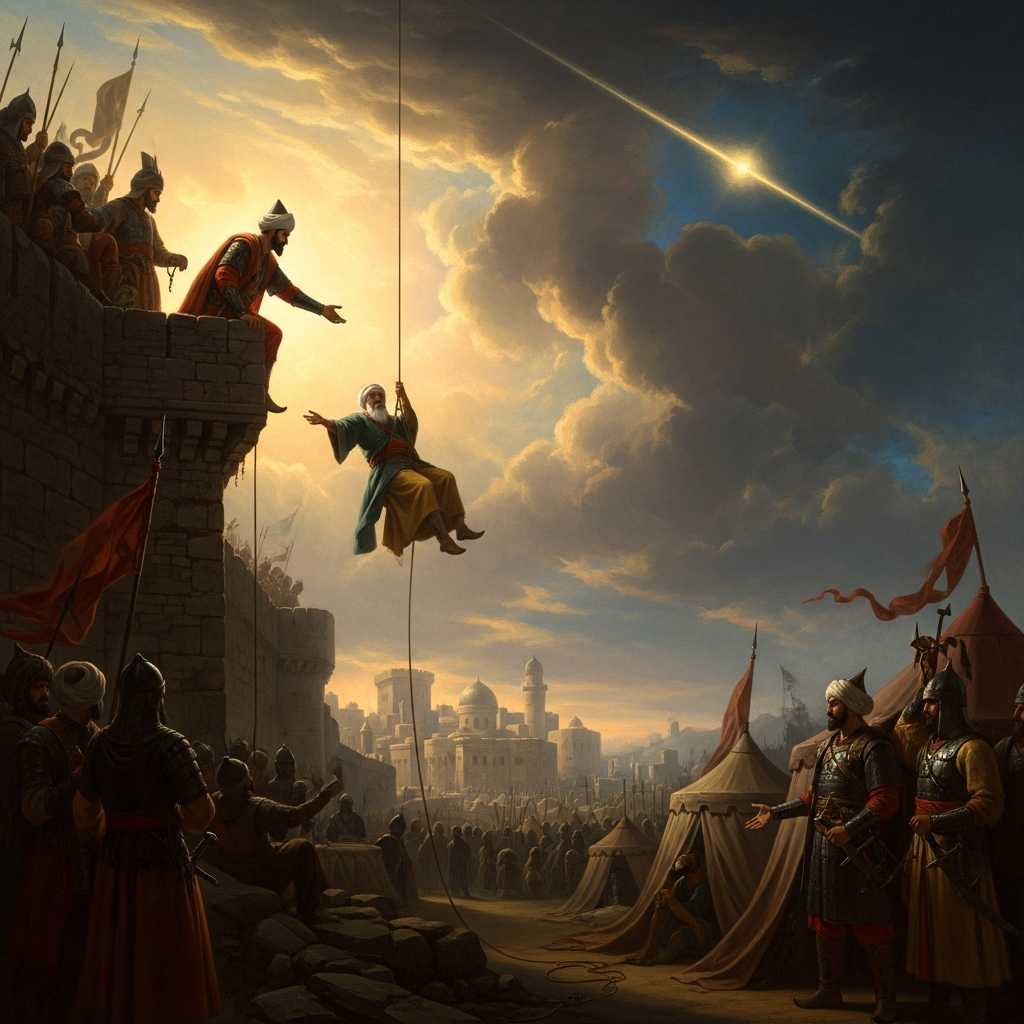 Generating art…
 Cairo in his sixties: he teaches at the al-Azhar madrasa under Sultan Barquq, presides as chief Maliki judge, and watches the order he has analyzed continue to dissolve
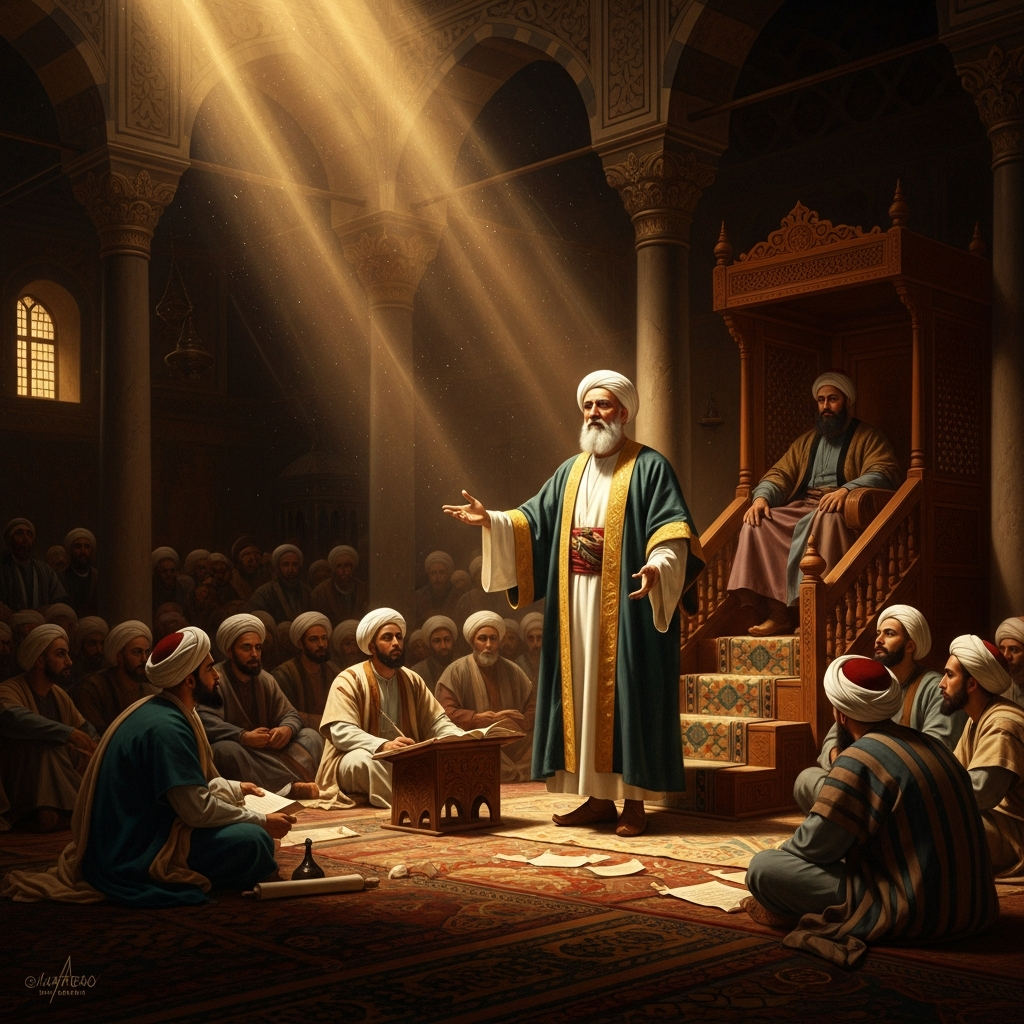 Generating art…
 Echoes Across Traditions
Entities
- Ibn Khaldun (Abd al-Rahman ibn Muhammad ibn Khaldun, 1332-1406)
- the Marinid sultan who imprisoned him
- Timur (Tamerlane)
- Sultan Barquq
- the Banu Arif tribe who shelter him at Qalat Ibn Salama
Sources
- Ibn Khaldun, *The Muqaddimah*, trans. Franz Rosenthal, 3 vols. (Princeton, 1958); abridged ed. N.J. Dawood (Princeton, 1967)
- Robert Irwin, *Ibn Khaldun: An Intellectual Biography* (Princeton, 2018)
- Ernest Gellner, *Muslim Society* (Cambridge, 1981) — using Ibn Khaldun as analytical framework
- Aziz al-Azmeh, *Ibn Khaldun: An Essay in Reinterpretation* (Frank Cass, 1982)
- Allen Fromherz, *Ibn Khaldun: Life and Times* (Edinburgh, 2010)