The Cloud Between You and God
c. 1370-1395 CE · England — possibly Nottinghamshire, possibly a Carthusian or Dominican cell
Contents
An anonymous English mystic writes a manual for contemplative prayer addressed to a young man of twenty-four. Between you and God, he says, is a cloud of unknowing that no human thought can penetrate — not theology, not scripture, not the most accurate name you have for God. The only way through is love, and love cannot be directed at a concept.
- When
- c. 1370-1395 CE
- Where
- England — possibly Nottinghamshire, possibly a Carthusian or Dominican cell
He is writing to someone he knows.
The someone is twenty-four years old. The author says so in the opening: he is writing to a special friend in God, a young man who has already passed through several stages of the spiritual life and has arrived at the threshold of what the author calls the contemplative life — the life given wholly to interior prayer. The young man has been a practitioner. He has done the ordinary devotional work: the liturgy, the lectio divina, the meditation on scripture. He has arrived at a place where that work no longer suffices. He has arrived, without knowing what to call it, at the cloud.
The author knows what the cloud is because he has been there. We do not know who he is. We do not know his name, his order, his diocese. The text circulated anonymously and the manuscripts give us nothing. He may have been a Carthusian monk — the style of life he describes matches the Carthusian cell. He may have been a Dominican. He writes in a Midlands dialect that points toward Nottinghamshire, but no monastery has been matched to the text with certainty. He has read Pseudo-Dionysius. He has read Richard of St. Victor. He has read, very possibly, the Mystical Theology of the Areopagite in the Latin translation of John the Saracen, which is the channel through which negative theology entered the English contemplative stream.
He has also, evidently, been through what he is describing. You can hear it in the text.
The cloud of unknowing is not a metaphor for difficulty. It is a precise description of a specific experience.
When you try to think about God — when you apply your most careful theological attention to the question of what God is — you can go very far. You can think about omnipotence, omniscience, perfect love, the three persons of the Trinity, the incarnation, the resurrection, the economy of salvation. You can think about God until you are exhausted. What you cannot do, by thinking, is arrive. Every concept you form of God — even the most sophisticated, even the most orthodox — is still a concept, and a concept is something your mind has made, and your mind is not God.
This is the cloud. It is not darkness in the sense of ignorance; it is darkness in the sense of the limit of a faculty. You put your mind against the cloud and the mind cannot go further. This is not a failure of theology. This is the structure of the situation.
The author’s answer is not to think harder. His answer is: stop thinking and start loving.
He calls it a blind, naked, raw impulse of love.
Not love as emotion — not the warm feeling that accompanies a successful prayer, not the satisfaction of having said the hours devoutly. Something more primitive than that, more urgent. The word he uses most often is lust in its older English sense of desire, drive, pressing-toward. A one-syllable word. He is reaching for the thing under the theological vocabulary, the undivided drive that precedes the capacity to describe it.
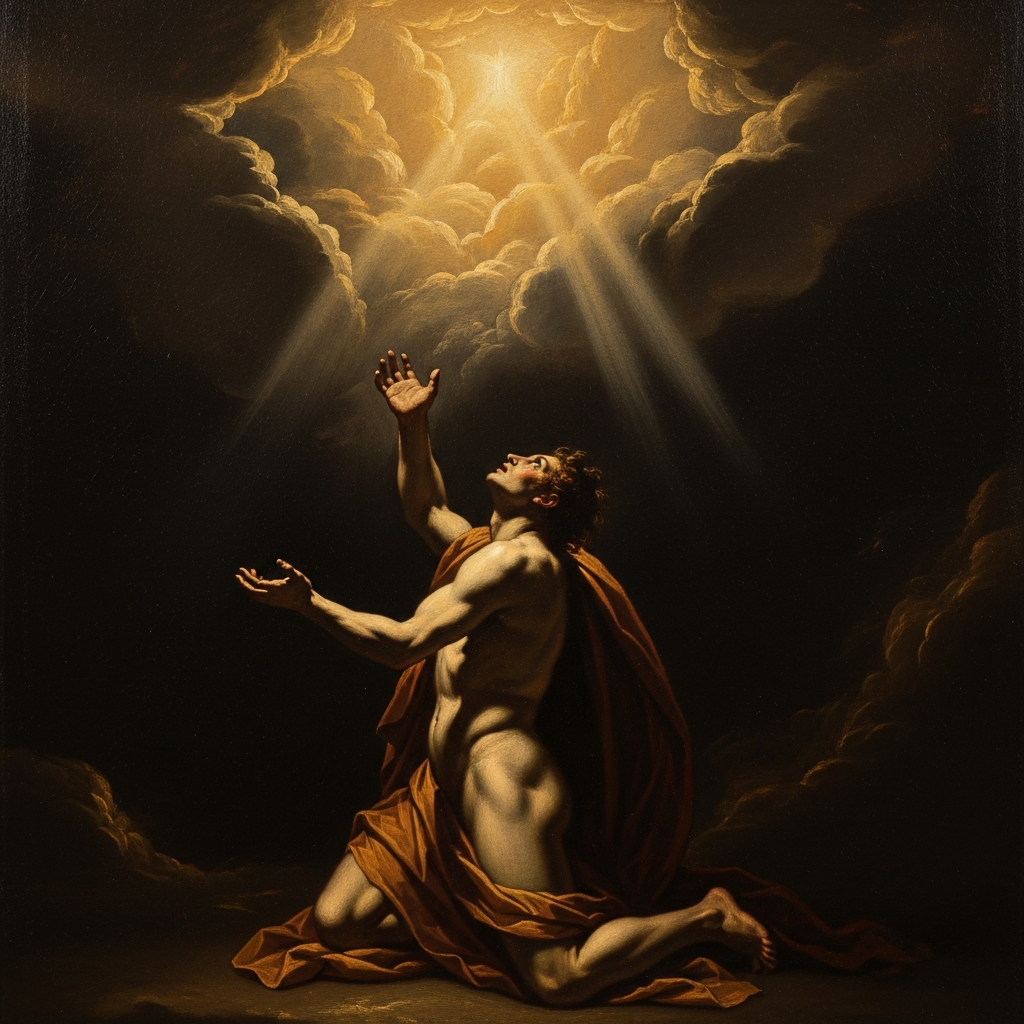
He says: take this naked blind impulse and throw it at the cloud. Do not give it an image — not the suffering Christ, not the throne of heaven, not the face of Mary. An image is a concept and a concept stays on the wrong side of the cloud. Take the undirected drive itself, the yearning without an object, and point it at what is above you.
He says: the cloud will not open by thought. But love can touch it. Love can press through what the mind cannot enter, not because love is smarter than the mind but because love is operating on a different principle — it is reaching toward the thing itself rather than toward a representation of the thing.
There is a second cloud. He calls it the cloud of forgetting.
This is the cloud that must be placed not above you but below you: beneath this cloud you press down everything you know. Not suppressed — pressed down, held there, kept behind you while the work is happening. Every thought about yourself, every thought about your spiritual progress, every thought about whether this is working, every thought about what you had for dinner. Every concept of God, which is to say every thought about God. The cloud of forgetting goes below you so that the cloud of unknowing can be attended to above.
This is the hardest part. The mind will not cooperate. It keeps sending up thoughts, including thoughts about how well the cloud of forgetting is being maintained, including thoughts about whether the impulse of love is pointed correctly, including thoughts about what Pseudo-Dionysius actually meant. He is patient about this. He says: when the thoughts come, do not fight them. Let them drift to the periphery. Return the attention to the one naked impulse. He suggests a single syllable — God, or love — as an anchor. Use the word, he says, not to think about God but to aim the impulse. Use it the way a bowman uses a notch on the arrow: not because the notch is the target, but because the alignment helps.
He is trying to describe, in words, a place where words fail.
He knows this. He flags it repeatedly. He says he cannot give instructions for what happens if and when the cloud opens, because the experience is precisely the experience of leaving the medium of instruction behind. He can describe the approach — the cloud of forgetting, the blind impulse, the single syllable — but the arrival is not something he is able to describe, because the arrival is beyond the categories of description.
This is not modesty. It is accuracy. The apophatic tradition he is working in — the tradition of Pseudo-Dionysius, of Maximus the Confessor, of Gregory of Nyssa — insists on this: that the divine is by definition beyond what any human faculty can represent, and that any mystical account that tells you clearly what it feels like to arrive has not arrived. The authors who describe the vision of God in ecstatic sensory detail are not describing what the author is pointing at. What he is pointing at is beyond sensation and beyond description. The most he can say is: go this way. Press through the cloud. I cannot tell you what is on the other side because it is not the kind of thing that can be told.
He argues, with some force, that this path is not for everyone. He says the book should not be shown to worldly men, to people who are merely curious, to those who are in the early stages of the devotional life. He is worried about the book being misread as a permission slip for spiritual laziness — a license to give up discursive prayer and just sit in the dark doing nothing, which is the secular version of his method and has nothing to do with it. He is also worried about people with unstable temperaments who will find the idea of a cloud-dissolving love so attractive that they will pursue it as an experience rather than as a practice, which is the same mistake in a different direction.
He says: this is for the one who has done all the other work and arrived at the place where the other work is not enough. If you are not there yet, the book is not for you yet.
He also cannot control who reads it. He has written it in English, not Latin, which means he has already accepted that it will escape the context he intended for it. By the fifteenth century it is circulating among the devout laywomen of the Low Countries, among Carthusian monks in England and France, among people who have never met a Pseudo-Dionysius and would not recognize the word apophatic if they encountered it. They read the book anyway. Some of them understand it.
We do not know his name. We do not know if he ever learned that the book had reached further than he intended. We do not know what he experienced when the cloud, as he says it can, opened.
What we know is the book. The manuscript tradition is robust — it was copied many times and in many hands, which means it was read, which means it was useful. Somewhere in England in the last quarter of the fourteenth century, a man who had been somewhere and could not describe where he had been sat down and tried to give directions anyway, knowing that the directions were the wrong form for the destination but that they were the only form he had.
He did not sign his name to what he wrote because the book was not about him. It was about the cloud, and the person pressing against it, and the naked impulse of love that does not know what it is reaching for but keeps reaching.
He wrote in a language that knows it cannot say the thing, and said it anyway — which is, he would probably argue, the only honest option available to someone who has been where he has been and is trying, without any expectation of success, to tell you how to get there.
Scenes
The anonymous author at his desk — he will not sign his name, because the book is not about him
 Generating art…
 A figure kneeling in the dark, the cloud above — the naked, blind impulse of love pressing upward into what cannot be known
 Generating art…
 A Middle English manuscript page — the words of the cloud, copied by hands that did not understand them, carrying them forward anyway
 Generating art…
 Echoes Across Traditions
Entities
- The Anonymous Author
- the contemplative student
- Pseudo-Dionysius the Areopagite
Sources
- *The Cloud of Unknowing and Other Works*, trans. Clifton Wolters (Penguin, 1978)
- *The Cloud of Unknowing*, ed. Patrick J. Gallacher (TEAMS Middle English Texts, 1997)
- William Johnston, *The Mysticism of The Cloud of Unknowing* (Fordham University Press, 1987)
- Bernard McGinn, *The Harvest of Mysticism in Medieval Germany*, vol. 4 of *The Presence of God* (Crossroad, 2005)
- Denys Turner, *The Darkness of God: Negativity in Christian Mysticism* (Cambridge University Press, 1995)