All Shall Be Well
May 8-9, 1373 (visions); c. 1393 (Long Text completed) · Norwich, Norfolk, England; later the anchorhold of St. Julian's Church, Norwich
Contents
In May 1373, a thirty-year-old Norwich woman lies dying and receives fifteen visions of Christ's Passion. She spends the next twenty years in a cell asking what they mean. Her answer — that God is love, not wrath; that sin is necessary and yet all shall be well — makes her the closest the medieval church comes to a non-dualist theology.
- When
- May 8-9, 1373 (visions); c. 1393 (Long Text completed)
- Where
- Norwich, Norfolk, England; later the anchorhold of St. Julian's Church, Norwich
She has asked for three things.
The first: to know what it felt like to be at the foot of the cross on Good Friday, to share Christ’s pain in her body rather than her imagination. The second: an illness in her thirtieth year severe enough to strip her of everything. The third: three wounds — contrition, compassion, and the longing for God. She has made these requests at some point before the visions; the Short Text records them as already past. She does not know they have been heard.
In May 1373 she is thirty years old and apparently dying. The priest has been summoned. He holds a crucifix before her face for her to look at as the end approaches. Her eyes fix on the crucifix. The lower part of her body is already dead to sensation. The room is dark. Her family stands at the bedside. She has made her peace. She is ready.
Then the ceiling opens.
Not literally. Not in a way that anyone else in the room perceives. The ceiling does not open; the air in the room changes. Something arrives.
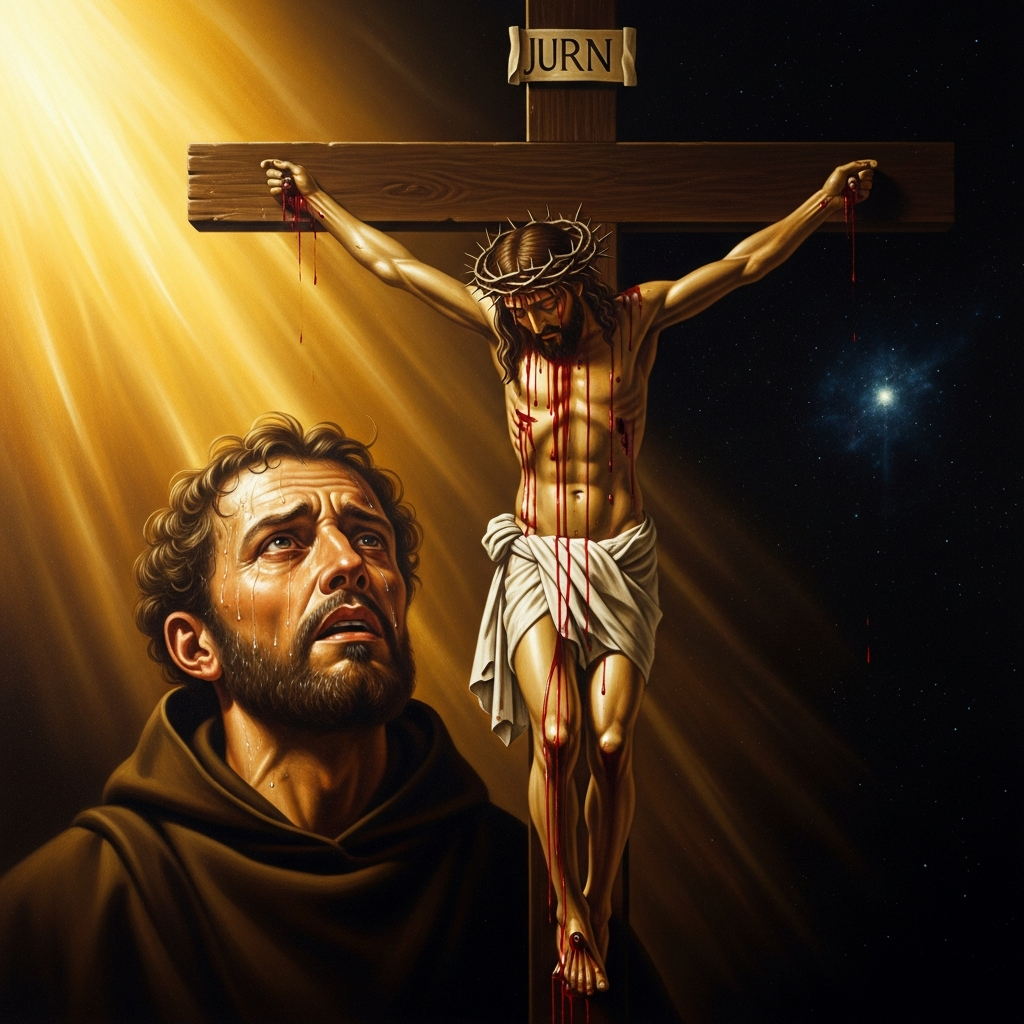
She stares at the crucifix and the crucifix becomes different. The blood — the painted blood on the figure’s head — begins to move. It runs down from under the crown of thorns, warm, brown, plentiful, not stylized, real blood behaving the way blood actually behaves: flowing along the channels of the face, pooling at the chin, dropping. She looks at this for a long time. She does not know how long.
This is the first showing. There are fifteen. They arrive over the next several hours as the illness does or does not resolve — she is unclear about this afterward; her attention is entirely elsewhere. The showings are not visions in the sense of hallucinations: she will spend twenty years distinguishing carefully between bodily visions, imaginative visions, and ghostly (spiritual) visions, identifying what kind each showing is and what conclusions can be drawn from each kind. She is, before she is a mystic, a taxonomist of her own experience.
In one of the showings, she holds in her hand a small round thing the size of a hazelnut.
She asks — in the vision, of the presence she understands to be Christ — what it is. She receives the answer: It is all that is made. She turns it in her hand, this small thing. She thinks: it should fall into nothing. It is so small. She thinks: how does it last? She receives: It lasts, and ever shall last, for God loves it. And in this she sees: all that is made is held in being by nothing but love. Not by law. Not by necessity. Not by the inertia of existence. By love, actively, continuously, which is the same as saying that if God stopped loving it for one instant it would dissolve.
She does not stop there. She keeps asking: but if God loves everything that exists, how does evil enter the picture? If love holds every atom of creation in being, what is sin? What is hell?
She asks this for twenty years.
The Short Text, written soon after the visions, is factual and cautious — what she saw, in what order, with what physical sensations.
The Long Text, written approximately twenty years later, is theology. It is the record of twenty years of asking a single question — What does it mean? — and receiving, eventually, an answer.
The answer is: Love was His meaning. Not reward. Not punishment. Not wrath. Not the measuring out of grace to the deserving. The meaning was love before the world was, and it will be love after the world ends. Sin is real — she insists on this with the force of a woman who takes human failure seriously — but sin is not in God. God does not experience sin as cause for wrath because God does not experience sin the way the sinner does. From God’s side, only love is visible. The wrath is entirely on our side of the relationship — our shame, our self-condemnation, our inability to believe we are forgiven.
She writes: I saw no wrath in God. For God’s purpose is to be good to us, and God is all goodness. God is our clothing that wraps and enfolds us for love. God is all that is good.
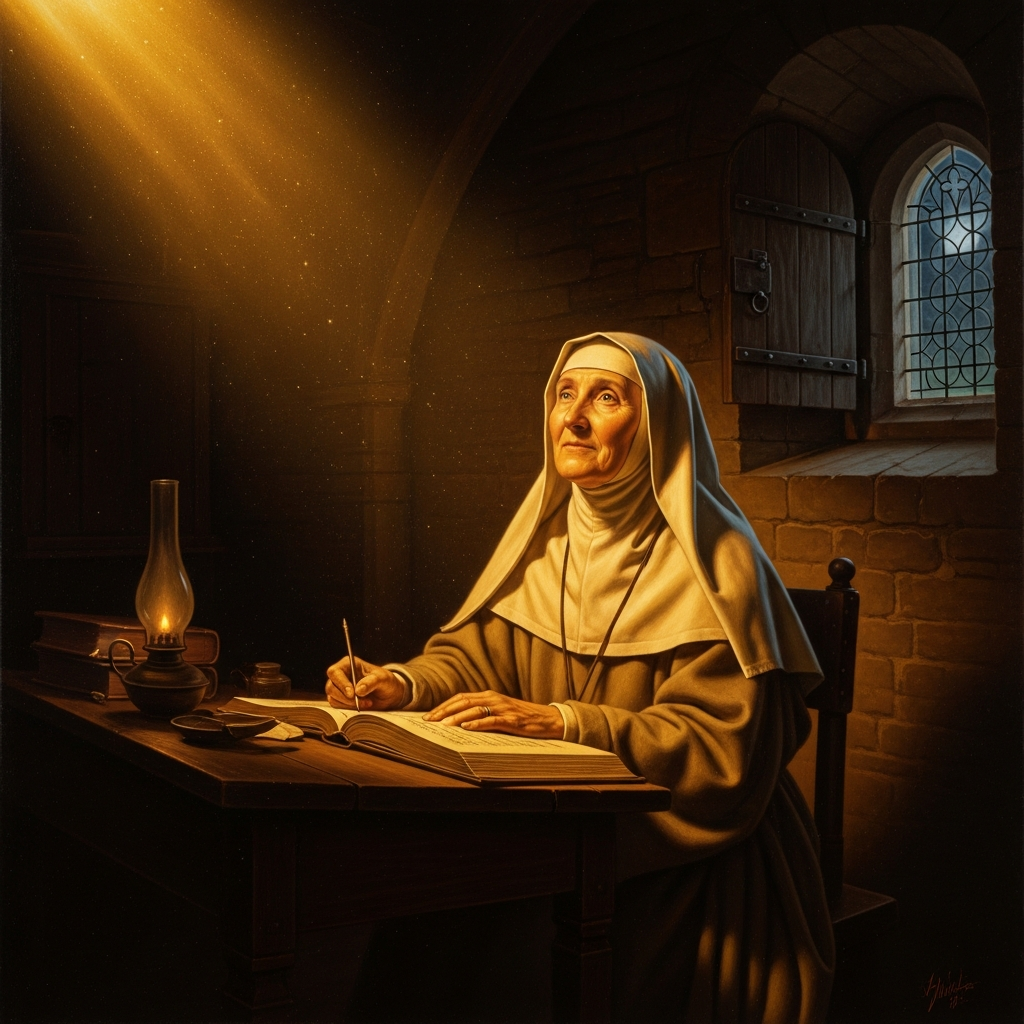
She becomes an anchoress. Sometime after 1373 she enters the anchorhold attached to the Church of St. Julian in Norwich — a small stone room, permanently sealed, with one window onto the street (for parishioners to ask for counsel) and one window onto the church interior (for the sacrament). She is walled in. She will not leave.
This is not prison. This is elected. Anchoresses are the contemplative specialists of the medieval church, the ones who agree to be dead to the world so they can be more completely alive to God. They are treated, at the ceremony of enclosure, with the same rites as the dead: the priest reads the burial service over them before the door closes. They understand what they are doing.
Julian takes the name of the church. Her real name is lost.
She has a cat. She has a maidservant who passes food through the outer window. She has the hazelnut, the fifteen showings, and twenty years of questions. She has the Long Text to write.
The most radical claim in the Long Text — the one that makes every orthodox reader nervous — is the one she calls the Lord’s answer to her question about sin.
She asks: If all shall be well, what about sin? She does not mean her own sin. She means the sin of Adam, the sin of the damned, the sin that Christ died for. She has been told by the Church that some souls are lost forever. She sees no evidence of this in her showings. She sees only love. She asks her Lord about it directly.
The answer she receives is not a theological proposition. It is a withholding with a promise: There is a deed which the blessed Trinity shall do in the last day, which deed shall honor and further, as God honors and furthers man. But what the deed shall be I wot not now, nor shall I wot until the time.
She does not know what the deed is. She is told she is not meant to know yet. She is told to trust: all shall be well, and all shall be well, and all manner of thing shall be well.
She writes this down. She spends the rest of her life trusting it.
She is still alive in 1413 — a will from that year mentions her as an anchoress at St. Julian’s. Her birth year is not known. Her death year is not known. Her real name is not known.
What is known is a book. The Revelations of Divine Love circulated in manuscript through the centuries, surviving in the library of silence in which medieval women’s writing tends to survive — barely, anonymously, in corners. In 1670 it was printed for the first time by a Cambrai Benedictine, Serenus Cressy. In the twentieth century it was rediscovered. T.S. Eliot, writing Four Quartets in the rubble of the Second World War, quotes her directly in the last section: All shall be well, and all shall be well, and all manner of thing shall be well.
He knew what he was quoting. He was quoting the only medieval theologian who had, seven centuries earlier, sat with the question long enough to receive an answer that held up under the weight of everything the twentieth century was carrying.
She asked what it meant for twenty years. The answer was love. The answer was that the meaning had always been love, even the suffering, even the sin, even the hazelnut that should have dissolved into nothing but didn’t — held in being by nothing but love, which is the same as saying it was permanent.
Scenes
The fever breaks, the cross darkens, and Julian sees the blood run down from under the crown of thorns — warm, brown, plentiful, present
Generating art… In her palm, a thing the size of a hazelnut: all that is made, held in being by nothing but love
 Generating art…
 Twenty years later, in the anchorhold at St
 Generating art…
 Echoes Across Traditions
Entities
- Julian of Norwich
- Christ Crucified
- Holy Spirit as Mother
- the Hazelnut
Sources
- Julian of Norwich, *Revelations of Divine Love: Short Text and Long Text*, trans. Elizabeth Spearing (Penguin, 1998)
- Julian of Norwich, *A Revelation of Love*, ed. Marion Glasscoe (University of Exeter Press, 1976)
- Grace Jantzen, *Julian of Norwich: Mystic and Theologian* (SPCK, 1987)
- Denys Turner, *Julian of Norwich, Theologian* (Yale University Press, 2011)
- T.S. Eliot, *Four Quartets* — 'Little Gidding' (1942), quoting Julian directly
- Brendan Doyle, *Meditations with Julian of Norwich* (Bear and Company, 1983)