Catherine and the Wedding Ring of Flesh
Carnival 1366 (vision); 1377 (return of the papacy to Rome) · Siena and Avignon
Contents
A nineteen-year-old dyer's daughter in plague-haunted Siena receives Christ in mystical marriage. The ring he places on her finger is, by her own account, his own circumcised foreskin — visible only to her. She will go on to bend a pope back to Rome and die, exhausted, at thirty-three.
- When
- Carnival 1366 (vision); 1377 (return of the papacy to Rome)
- Where
- Siena and Avignon
She is six years old when she has the first vision.
Walking home from her sister’s house in Siena with her brother Stefano, she looks up over the Church of San Domenico and sees Christ in pontifical robes, smiling at her from the air. He raises his hand and blesses her. Stefano notices nothing. She trips, walking, because she cannot take her eyes off the sky. By the time they reach home, the vision is gone, and she is changed.
Her father Iacopo Benincasa is a wool dyer. Her mother Lapa has borne twenty-five children, of whom Catherine is the twenty-fourth. The household is loud, Catholic, ordinary, Tuscan. Catherine, after the vision at six, is none of these things. She vows perpetual virginity at seven. She cuts off her hair at sixteen when her parents try to marry her off. She fasts until she can no longer keep down anything but the consecrated host.
At seventeen she becomes a Dominican tertiary — a mantellata, a laywoman in a black-and-white habit who lives at home and prays in the streets. She has no convent. She has no education. She cannot read.
Her father, alarmed, finally yields. He gives her a small room on the ground floor of the house. He forbids the family to disturb her. She enters the cell at seventeen and does not leave, except for Mass, for three years.
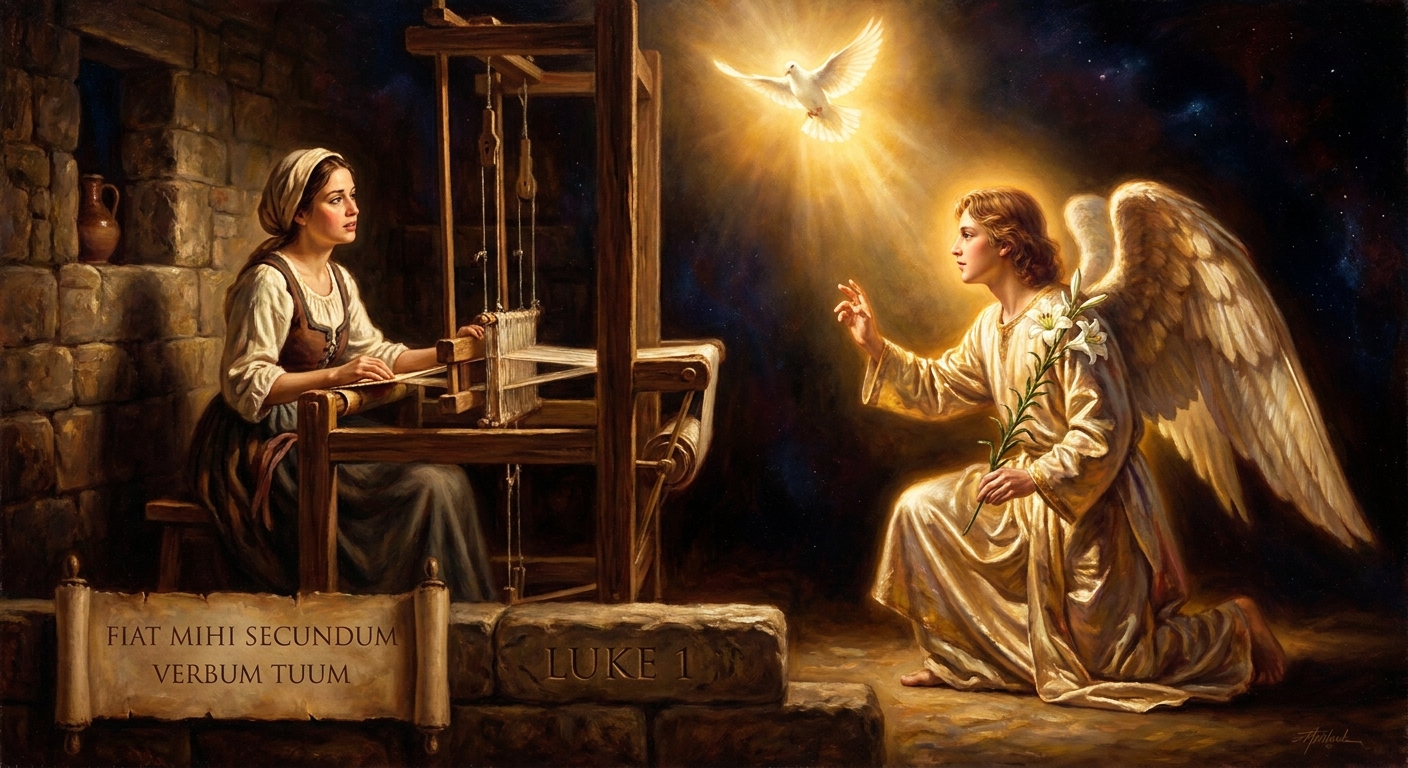
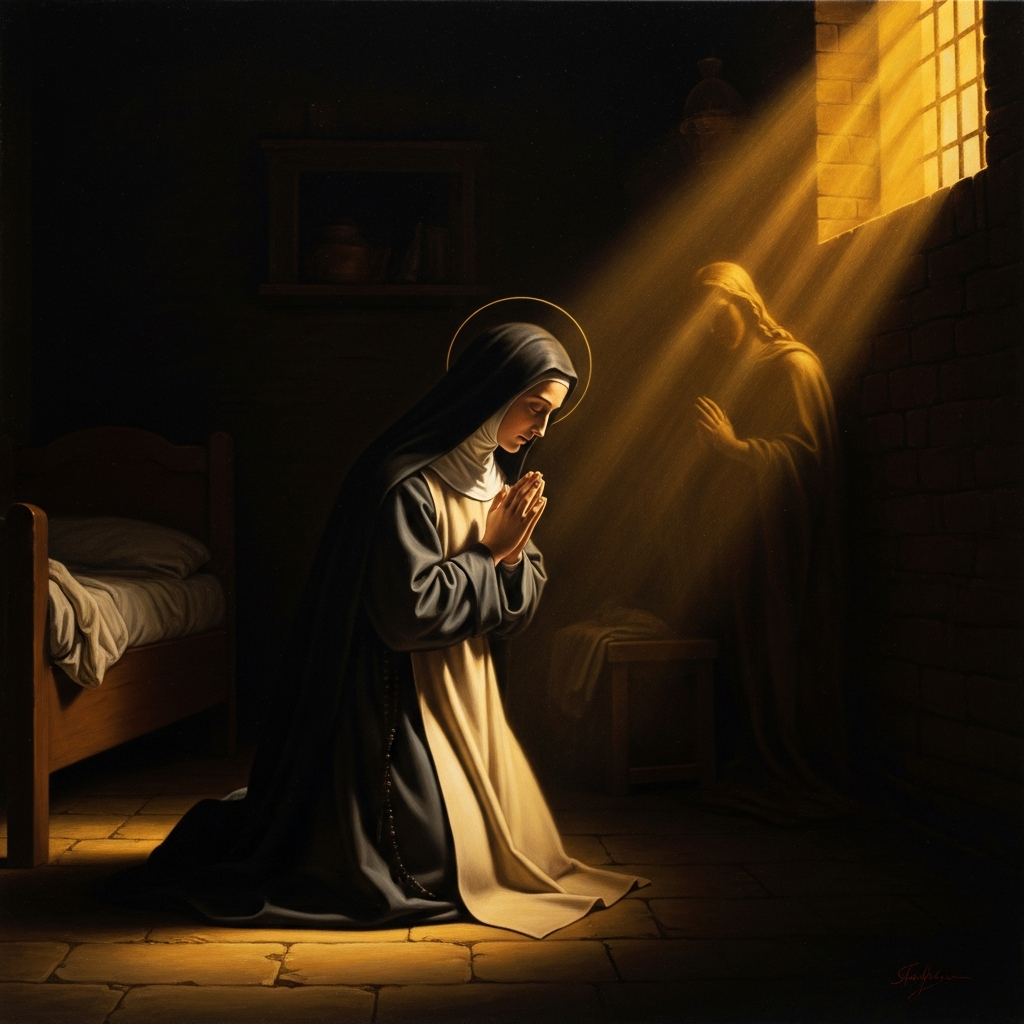
She calls it the cella interiore — the interior cell. The wooden door is the door. The stone walls are the walls. Inside, she fasts on bread and water, sleeps on a board, scourges herself three times a day with an iron chain (twice for her sins, once for the sins of the world), and prays without books because she cannot read books.
Christ visits her there. Frequently. She speaks to him, she will tell Raymond of Capua later, the way one speaks to a husband across a kitchen table.
It is the last day of Carnival, 1366. She is nineteen.
The streets of Siena are loud with masquerade. Inside the cell, she has been weeping that the world is dancing while Christ is suffering. She has prayed for years that he would establish faith firmly in her heart. She is tired. She has reached the edge of what three years of bread and chain can deliver. She asks him, plainly, to come.
He comes.
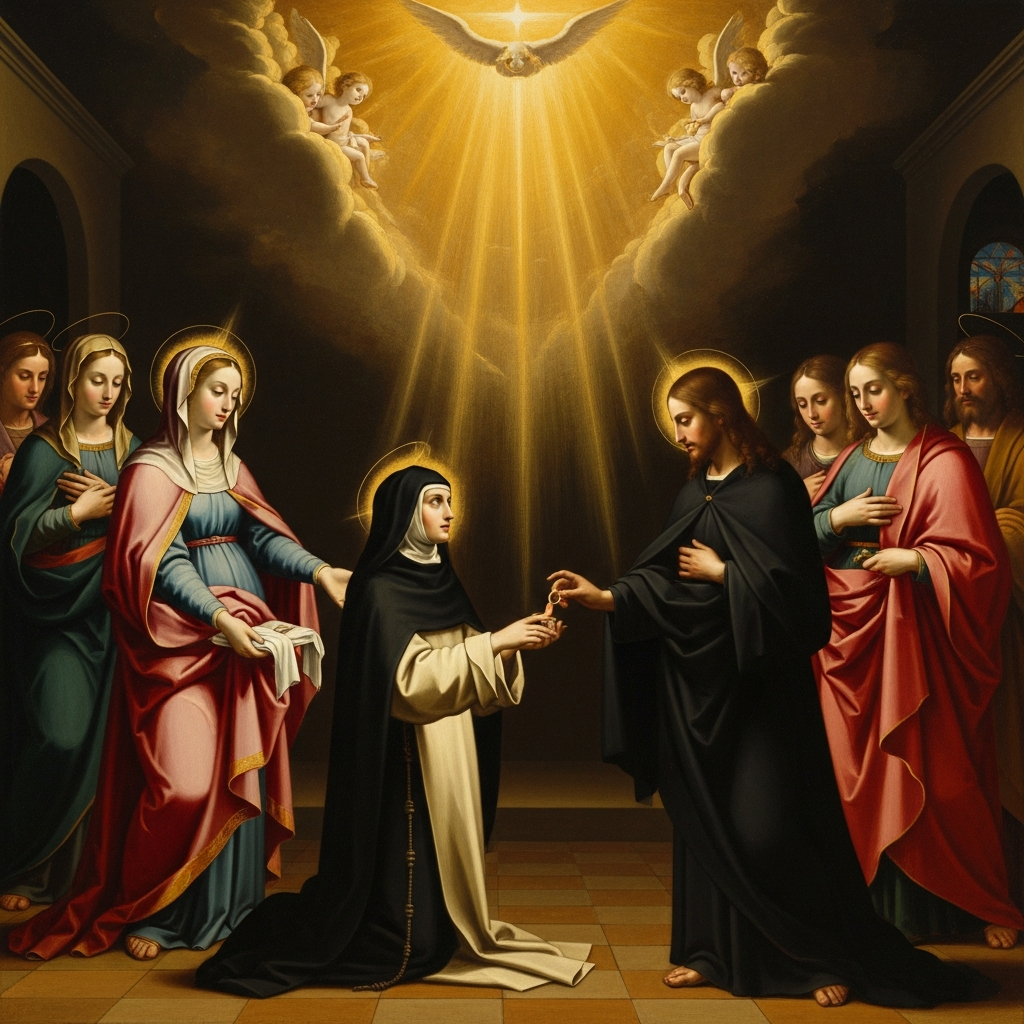
Not alone. The Virgin is with him, and Saint John the Evangelist, and Saint Paul, and Saint Dominic, and the prophet David with a harp. The cell that has held only her for three years suddenly holds a court. David plays. The Virgin takes Catherine’s hand and lifts it toward her son.
“It is my will,” he says, “to espouse your soul to me in faith.”
He produces a ring.
Raymond of Capua, writing the Legenda Major twenty years after Catherine’s death — having heard the account from her own mouth — records what she described. The ring is gold, with four pearls at the corners and a diamond at the center, visible to her alone. He takes her right hand. He places the ring on her finger. He says: Behold, I espouse you to me in faith, your Creator and Saviour. Keep this faith unblemished until you celebrate your eternal nuptials with me in heaven.
Catherine will tell other confessors, in private, what Raymond was too cautious to put in the official Life: that the ring was not gold and diamond at all. That the ring was the praeputium Christi — the foreskin removed at the Circumcision, the only piece of his body he had to leave behind on earth. That this was the only ring that could fit a marriage so total. That she could see it, and feel it, on her finger for the rest of her life. That no one else could see it.
The Tuscan tradition, which had been venerating relics of the Holy Foreskin since at least the ninth century, did not find this strange. The post-Tridentine Church did. Raymond’s official text rounded the edges. The under-tradition kept the original.
She walks out of the cell.
After three years of solitude, Christ tells her — in a subsequent vision — that the cell is no longer her vocation. She has been forged. Now she must serve. She begins by nursing plague victims at the Misericordia hospital. She buries the dead with her own hands when no one else will touch them. She feeds the poor from her family’s stores until her father — who has decided not to argue with her anymore — quietly increases the household budget.
She begins to dictate letters. She cannot write. She speaks them aloud, sometimes three at once to three different scribes, in a Tuscan that will become one of the foundational dialects of the Italian language. She writes to nuns, to mercenary captains, to prostitutes, to bishops, to the king of France, to the queen of Naples, to her own brothers, to women dying in plague, to mothers whose sons have just been beheaded.
She writes to popes.
The Avignon Captivity has been going on for sixty-eight years. Seven French popes, in a row, in a French city, under the thumb of the French crown. Rome — abandoned, depopulated, half-ruined — has been petitioning, raging, and finally despairing.
In 1376, Catherine, age twenty-nine, rides to Avignon.
She is small, illiterate, ill, vegetarian, dressed in black-and-white wool, accompanied by twenty-three followers — confessors, secretaries, women friends. She arrives at the papal palace and is granted an audience with Gregory XI, a French aristocrat-pope who has been telling himself for five years that he intends to return to Rome and has not done it.
She speaks to him in Tuscan; he speaks Latin; they translate through her confessor. She tells him what she has been writing to him for two years: that he must go back. That he is the vicar of Christ, not of France. That his cardinals are corrupt and his court is rotten and the stench reaches her even in the antechamber.
She also reveals — privately — that she knows about a secret vow he made years before, never to leave Avignon. No one knows that vow but you and God, she tells him. He breaks down.
In September 1377, Gregory XI rides into Rome.
Catherine has won.
Then he dies, and the cardinals elect Urban VI, who turns out to be a paranoid disaster, and the French faction elects an antipope, and the Western Schism begins, and Catherine — who has worked herself to the edge of her body for fifteen years to end one schism — must now fight the next one with what little she has left.
She moves to Rome at Urban VI’s request. She writes furious letters to defecting cardinals. She fasts more. She eats nothing but the Eucharist for the last months of her life.
Her body fails her in the spring of 1380. She lies on a board in a room near Santa Maria sopra Minerva. She is thirty-three years old — the age of Christ at the crucifixion, which she has noted. She prays for the Church she is leaving behind, and dies on April 29, 1380.
Her head, severed from her body in the medieval Italian fashion of relic distribution, is taken to Siena and is still there, in the Basilica of San Domenico, behind glass, blackened and small. Her finger — the one with the invisible ring — is in a separate reliquary nearby. The body remains in Rome.
She is canonized in 1461. Declared a Doctor of the Church in 1970, alongside Teresa of Ávila — the first two women so named. Co-patron of Europe (1999). Co-patron of Italy (1939).
She did not write a book. She dictated one — the Dialogue — and three hundred and eighty-two letters, and a handful of prayers. None of it would exist if she had been able to write it herself; the scribes preserved what literacy would have made her too self-conscious to say.
Catherine is the medieval claim that mystical marriage and political action are the same act.
Andal in ninth-century Tamil country, Mirabai in sixteenth-century Rajasthan, Rabia in eighth-century Basra — the female mystic married to the divine has a recurring shape: she escapes the human marriage market by making a stronger claim. The Beloved is already her husband. There is no negotiating around it.
Catherine made the claim in fourteenth-century Tuscany, with a foreskin for a wedding ring, and parlayed it into the end of the Avignon Captivity. The strangest detail in her biography — the one Raymond of Capua almost edited out — is also the one that fits the pattern. The ring had to be flesh because the marriage was flesh. Anything less would have been metaphor, and Catherine had no patience for metaphor.
She got the pope back to Rome. She wrote four hundred letters in a language she could not read. She died at thirty-three, with the invisible ring still on her finger.
The under-tradition remembers what the official one trimmed away.
Scenes
The cell — Catherine's three years of solitary prayer in her father's house, the *cella interiore*
 Generating art…
 The mystical marriage — Christ taking her hand, the Virgin presenting her, the ring of flesh placed on her finger
 Generating art…
 The ride to Avignon and the popes bent back to Rome — the political hinge that follows the vision
 Generating art…
 Echoes Across Traditions
Entities
- Catherine of Siena
- Christ
- the Virgin Mary
- Pope Gregory XI
Sources
- Raymond of Capua, *Vita Sanctae Catharinae* / *Legenda Major* (1395)
- Catherine of Siena, *Il Dialogo della Divina Provvidenza* (1378)
- Catherine, *Letters* (382 surviving letters to popes, kings, mercenaries, prostitutes)
- Suzanne Noffke (trans.), *The Letters of Catherine of Siena* (4 vols., 2000-2008)
- Sigrid Undset, *Catherine of Siena* (1951)