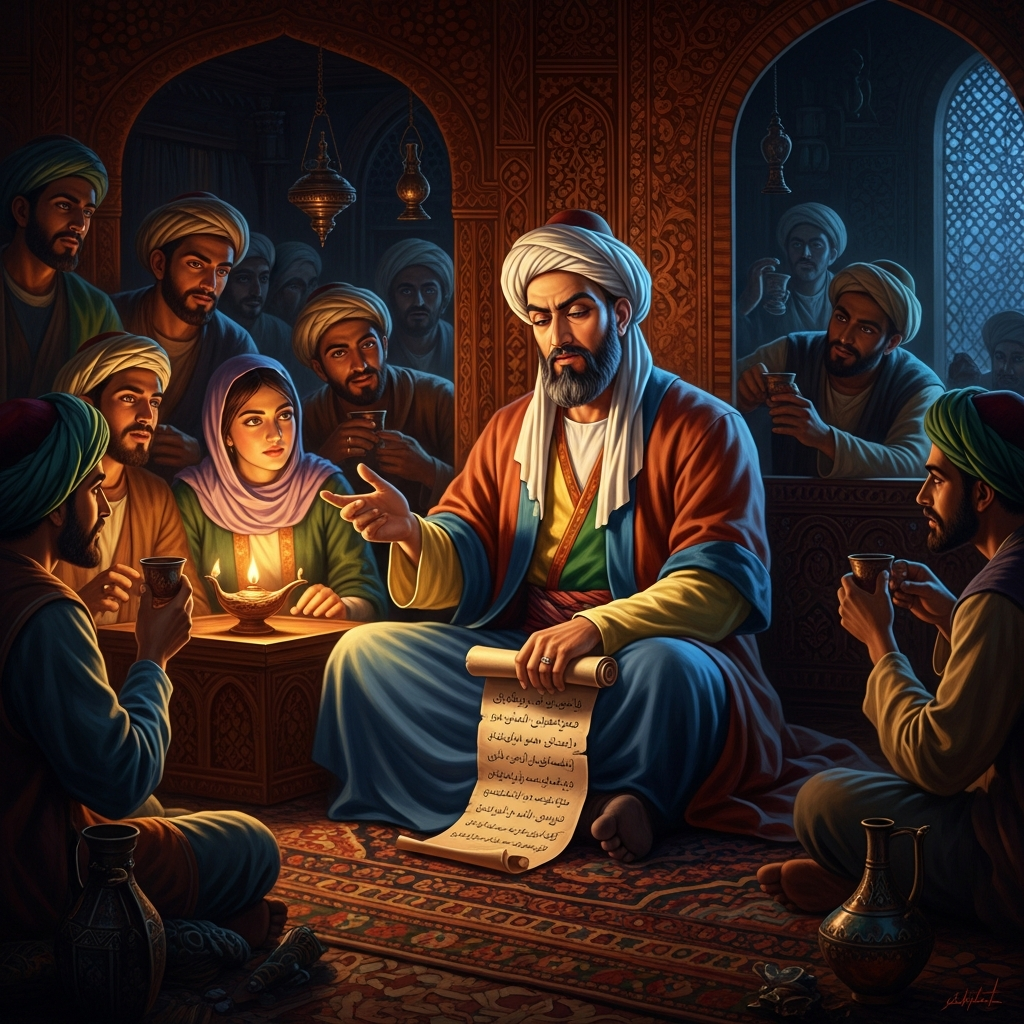
Hafiz and the Wine That Is Not Wine
c. 1315-1390 CE — the Muzaffarid period in Fars · Shiraz, capital of Fars Province, southwestern Iran — city of rose gardens, cypresses, and the tomb in Musalla
Contents
In the rose gardens and taverns of fourteenth-century Shiraz, a court poet writes five hundred ghazals in which every cup of wine is also the cup of God, every beloved is also the divine, and every reader for seven centuries afterward will open the book at random to ask their fate.
- When
- c. 1315-1390 CE — the Muzaffarid period in Fars
- Where
- Shiraz, capital of Fars Province, southwestern Iran — city of rose gardens, cypresses, and the tomb in Musalla
He is in the tavern again.
Or he is not. That is the point.
The candle on the low table burns down, and the cupbearer — who is fourteen years old, who is sixty, who is a woman, who is a boy, who is the angel that bends over the bed of the dying — pours something into the cup. The poet leans forward. He says he is drunk. He says the wine is forbidden. He says he loves it more than the prayer mat. He says the muhtasib — the religious police, the morality patrol of fourteenth-century Shiraz — should come arrest him now and put an end to it.
He has been saying this for fifty years.
Nobody has arrested him.
His name is Shams al-Din Muhammad. The city calls him Hafiz — the one who has memorized — because by the time he was a teenager he had memorized the entire Qur’an, all one hundred fourteen suras, every vowel, every elongation, every pause. The honorific is a credential. It is also, the way he uses it, a joke. The man who has memorized the Book most strenuously is also the man who writes that he would trade the prayer hall for the wine shop. The man who knows every verse on the punishment of drunkards is the man who writes that the cupbearer’s glance has converted him.
He lives through three dynasties. He outlasts the Injuids, the Muzaffarids, and the first wave of Timur’s invasions. He sees four sultans rise and fall in his own city. One of them — Shah Shuja, the Muzaffarid ruler who reads Arabic philosophy and writes his own poetry — is alternately his patron and his enemy. Hafiz writes ghazals praising him. Hafiz writes ghazals mocking him. The Shah, who can quote every line, exiles the poet to Yazd for two years and then begs him to come back.
The poet comes back. He always comes back to Shiraz. He has been to Yazd and hated it. He has been invited to the courts of Bengal and Baghdad and refused. He writes that he cannot leave the cypress trees of Musalla and the water of the Ruknabad stream. He writes that he is the nightingale of the rose gardens, and the nightingale does not migrate.
He claims he writes about wine.
He also claims, in the same poem, that he writes about God.
The line between the two — the place where the metaphor pivots — is the entire architecture of the ghazal. He inherits a tradition. The Sufis before him had used the language of the tavern for two centuries. Khamr — wine — was already the standard image for the divine intoxication that Bayazid Bistami spoke of, that Hallaj died for, that Rumi turned into a roaring river of verse. The cupbearer — the saqi — was already the figure of the spiritual master who pours into the seeker’s cup what the seeker cannot pour for himself. The tavern was already the Sufi lodge, the khanqah, the place where the dervishes drank what the orthodox could not see.
Hafiz takes this convention and pushes it into a place no one else has taken it.
He refuses to resolve the ambiguity.
This is the discipline. A lesser poet would write a ghazal about wine and footnote it: of course I mean the divine wine. A pious poet would write a ghazal about God and decorate it with images of cups and cupbearers as ornaments. Hafiz does neither. He writes a ghazal in which he is in a real tavern, drinking real wine, sleeping with a real beloved whose hair smells of musk, and also in the divine presence, drinking the divine wine, in union with the Beloved whose hair is the dark hair of the universe, and the reader is never permitted to choose. To choose is to misread. To insist on the literal is to be a fundamentalist. To insist on the allegorical is to be a hypocrite. The poem holds both, and the reader’s mind, holding both, is doing the spiritual work.
This is what the Persian tradition will call rindi — the way of the rind, the dissolute holy man, the drunkard who is closer to God than the jurist, the lover who has burned his prayer rug because he no longer needs it. Hafiz is the great theoretician of rindi. He says, again and again, that the man in the wine shop has more chance of seeing God than the man on the minbar. He says the muhtasib who beats the drunkards is more sinful than the drunkards. He says hypocrisy — riya — is the only unforgivable sin, and the religious establishment is full of it.
The religious establishment, hearing this, considers having him killed.
It does not kill him. He is too popular. The bazaar already memorizes his ghazals. The Sufi lodges already chant them. The court already pays him. To kill Hafiz would be to kill the city’s voice.
Of the five hundred ghazals, the one everyone knows is the one that begins:
Agar an Tork-e Shirazi be dast arad del-e ma ra — If that Turk of Shiraz would only take my heart in her hand, I would give Samarkand and Bukhara for the mole on her cheek.
The lines have been quoted at the courts of Delhi and the salons of Weimar. Tamerlane, when he conquered Shiraz in 1387, summoned Hafiz to his tent and demanded an explanation: I have shed blood from Anatolia to India to make Samarkand and Bukhara great. You would give them away for a mole? The poet, seventy-some years old, allegedly bowed and said: Sire, it is by such extravagance that I have come to such poverty. Tamerlane laughed. He spared the city. The story may be a fable. The fable’s circulation is the truth: the Persians need to believe that one of their poets, with one quip, turned aside the wrath of the world’s deadliest conqueror.
Shakh-e Nabat — Branch of Sugarcane — is the name the tradition gives the beloved of his youth. Some scholars say she existed: a girl in the rose gardens of Pir-e Sabz whom he loved and could not marry. Others say the name is itself a metaphor, the sweetness of the divine that the poem cannot reach for without first reaching for a body. Hafiz never decides. He writes about her as if she were real. He writes about her as if she were the universe.
This is the wine that is not wine.
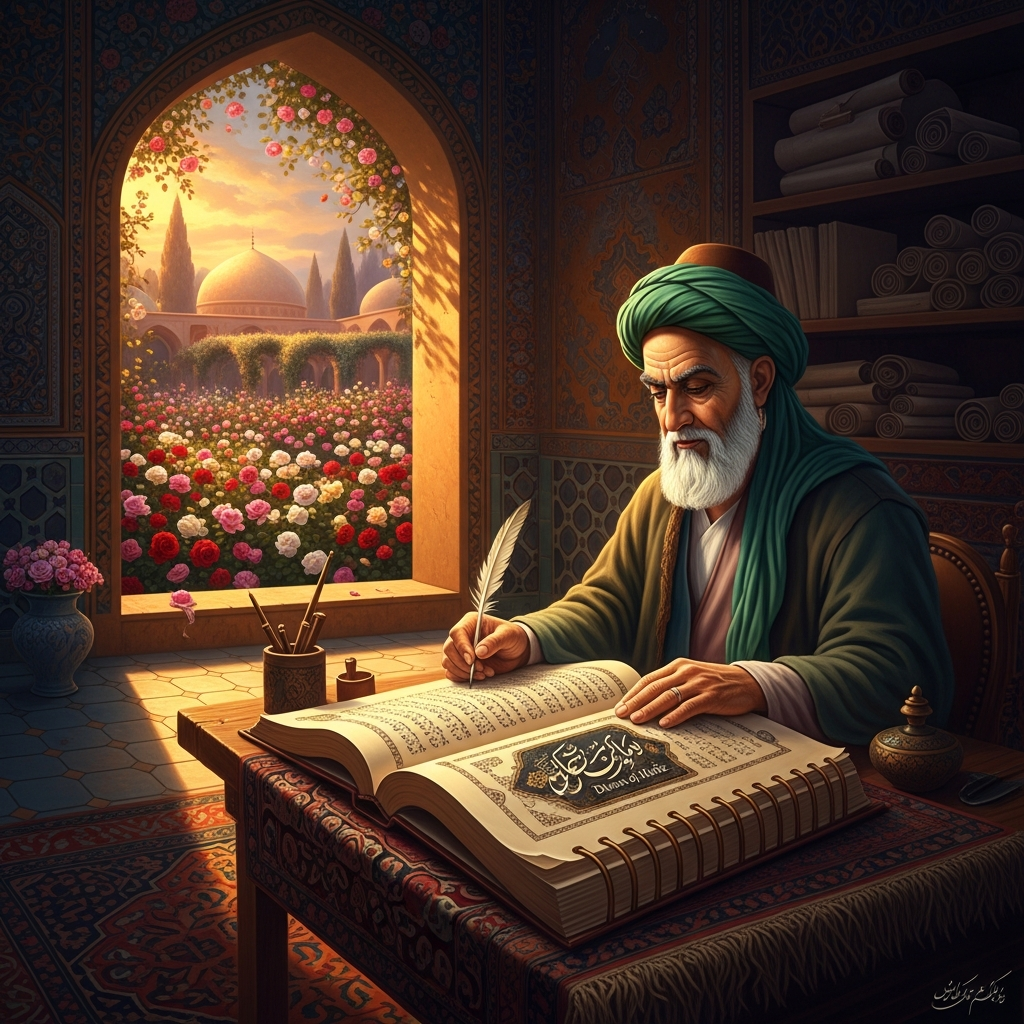
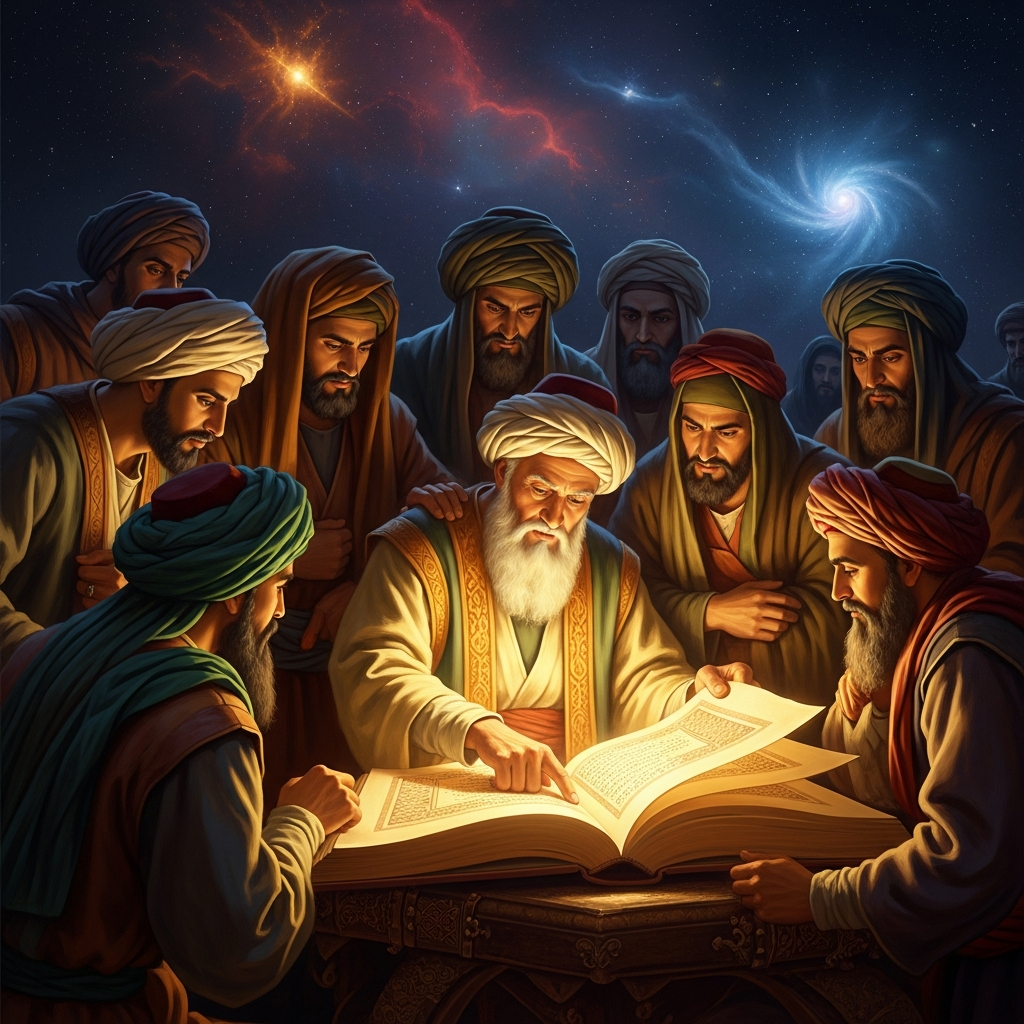
He dies around 1390. The exact date is contested. He is buried in the rose garden in Musalla, on the north side of Shiraz, beside the Ruknabad stream he had refused to leave. The clergy refuse him a proper Muslim burial — he was, after all, the man who had spent fifty years celebrating wine and ridiculing the pious. The mourners, the story goes, open the Divan at random to ask the poet himself what to do. The page falls open at a couplet:
Step boldly to the bier of Hafiz — For though he was drowned in sin, he is going to paradise.
The clergy concede. He is buried where he wanted to be.
The tomb becomes a shrine almost immediately. By the sixteenth century the Safavids have built a marble pavilion over it. By the twentieth, the Pahlavi state has rebuilt it in white stone with a copper dome shaped like a dervish’s hat. Iranians come every day. They come on the New Year, Nowruz, by the thousand. They come at the night of Yalda, the winter solstice, with the family and the pomegranate and the watermelon, and they come carrying the Divan.
They open it at random.
This is fal-e Hafiz — the augury of Hafiz. The reader holds a question in mind: Should I marry him? Should I leave the country? Will my mother recover? They open the book without looking. The page that falls open is the answer. The convention is older than Hafiz — the Persians did it with the Qur’an, the Romans with the Aeneid, the early Christians with the Psalms — but Hafiz’s Divan has come to displace the others in the Persian world because his ambiguity is hospitable to every question. There is always a couplet that could be read as an answer. The reader’s intuition closes the gap.
In Weimar, two centuries later, a sixty-five-year-old Goethe is sent a translation of the Divan by an Austrian Orientalist. He sits up in his study reading it. He writes, in his diary, that he has discovered a brother across the centuries. He puts everything else aside and writes the West-östlicher Divan — Western and Eastern Divan — twelve books of poems in dialogue with Hafiz. He writes that without Hafiz he could not have continued.
In Concord, Massachusetts, Emerson translates Hafiz from German into English and reads him aloud at the Saturday Club. He writes: Hafiz fears nothing. He sees, and dares, and tells, what other poets only dream.
In Shiraz, every night, the tomb is open until late. A young woman in a headscarf stands beside an old man with a cane. They take turns opening the book. They read the lines aloud. The old man, who has lost his wife three months ago, hears the cupbearer’s voice in the courtyard. The young woman, who is going to leave for Tehran tomorrow, hears the rose garden refuse to be left.
The wine that is not wine is poured again.
She drinks.
Scenes
Hafiz recites in the tavern of Shiraz, where wine is the metaphor for divine intoxication and the cupbearer is the face of God
Generating art… The completed Divan — five hundred ghazals that every Persian household will memorize for seven centuries
 Generating art…
 Pilgrims open the Divan at random at Hafiz's tomb in Shiraz, using it as an oracle — as he intended
 Generating art…
 Echoes Across Traditions
Entities
- Hafiz (Shams al-Din Muhammad Hafiz-i Shirazi)
- Shah Shuja
- Shakh-e Nabat
- Goethe
- the dervishes of the Shiraz khanqah
Sources
- Hafiz, *Divan*, trans. Dick Davis, *Faces of Love: Hafez and the Poets of Shiraz* (Penguin, 2012)
- Hafiz, *The Green Sea of Heaven*, trans. Elizabeth T. Gray (White Cloud, 1995)
- Peter Avery (trans.), *The Collected Lyrics of Hafiz of Shiraz* (Archetype, 2007)
- Annemarie Schimmel, *Mystical Dimensions of Islam* (UNC Press, 1975)
- Reza Aslan, *No god but God* (Random House, 2005), chapter on Sufism