Shango: Thunder in Exile
~14th century CE (historicized) · Oyo Kingdom, Yorubaland · Old Oyo — the ancient capital of the Oyo Empire, present-day Oyo State, Nigeria
Contents
The third Alafin of Oyo experiments with lightning — and burns his own palace. Consumed by grief, he walks into the forest. His disciples find the tree bare.
- When
- ~14th century CE (historicized) · Oyo Kingdom, Yorubaland
- Where
- Old Oyo — the ancient capital of the Oyo Empire, present-day Oyo State, Nigeria
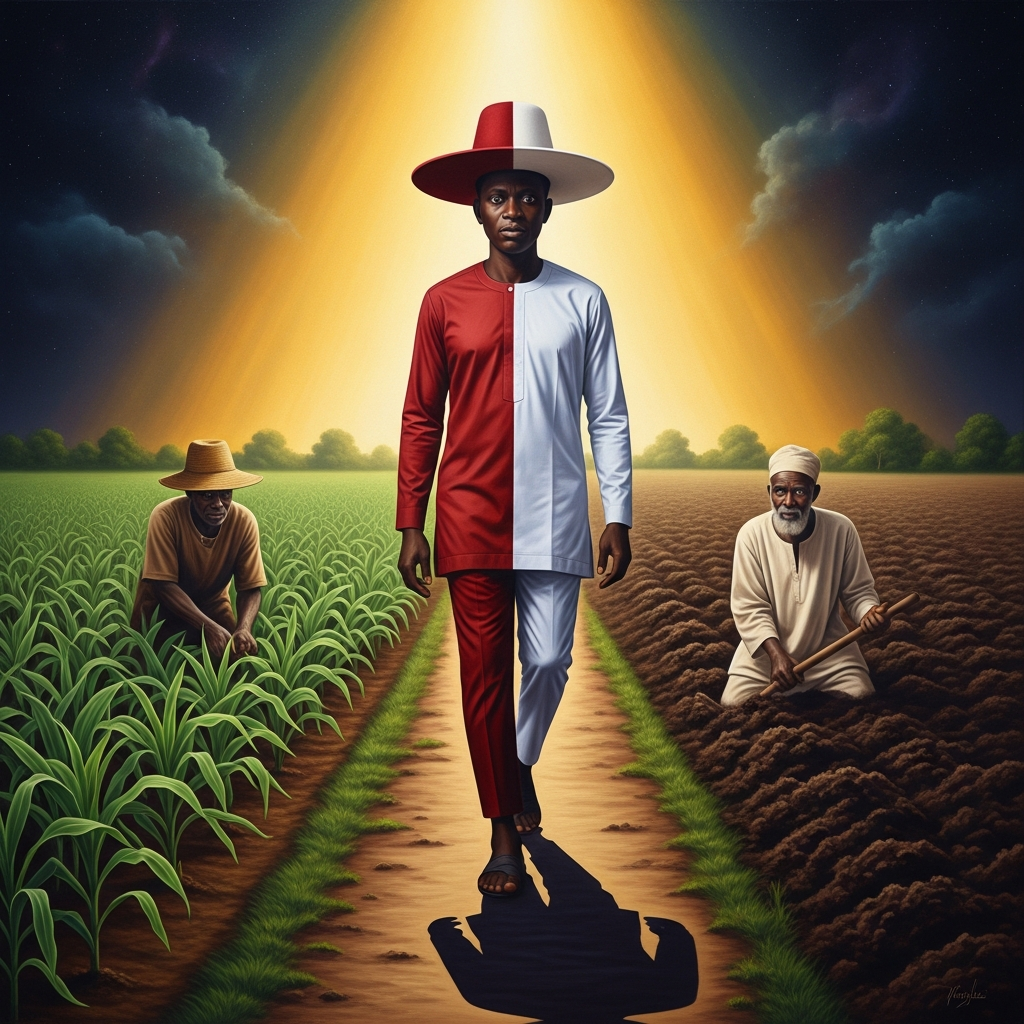
Shango is the Alafin of Oyo — the third, counting from Oranmiyan, the founder’s son — and he is already a god even before he becomes one.
He is tall, wide in the shoulder, red-eyed in the particular way that means either wine or fury and with Shango it is usually both. He does not argue; he commands and thunders. His wives — Oya, the one who owns storms and rivers and the marketplace; Obà, the faithful and quiet; Oshun, who owns sweetwater and gold — orbit him with the wariness of women who know an atmospheric condition. He rules well enough, in the way that rulers rule when they are powerful enough that the people around them manage their worst impulses before those impulses can cause open catastrophe. But Shango is always reaching for more power. He is the kind of man who does not understand that some doors are locked from the inside for a reason.
He finds the incantation.
He finds it the way dangerous knowledge is always found — in a locked room in someone else’s library, or in this telling, in the mouth of a medicine man who should have known better than to teach it to a king. It is an incantation for calling lightning. Not for protection against it, not for predicting it — for calling it, directing it, making the sky’s most concentrated violence arrive exactly where you point. Shango learns it carefully. He practices the words in private. He is too experienced to make the mistake of arrogance; he makes the more subtle mistake of expertise, which is the belief that because you understand a thing you can therefore control it.
He recites the incantation in the courtyard of the palace, pointing at the sky.
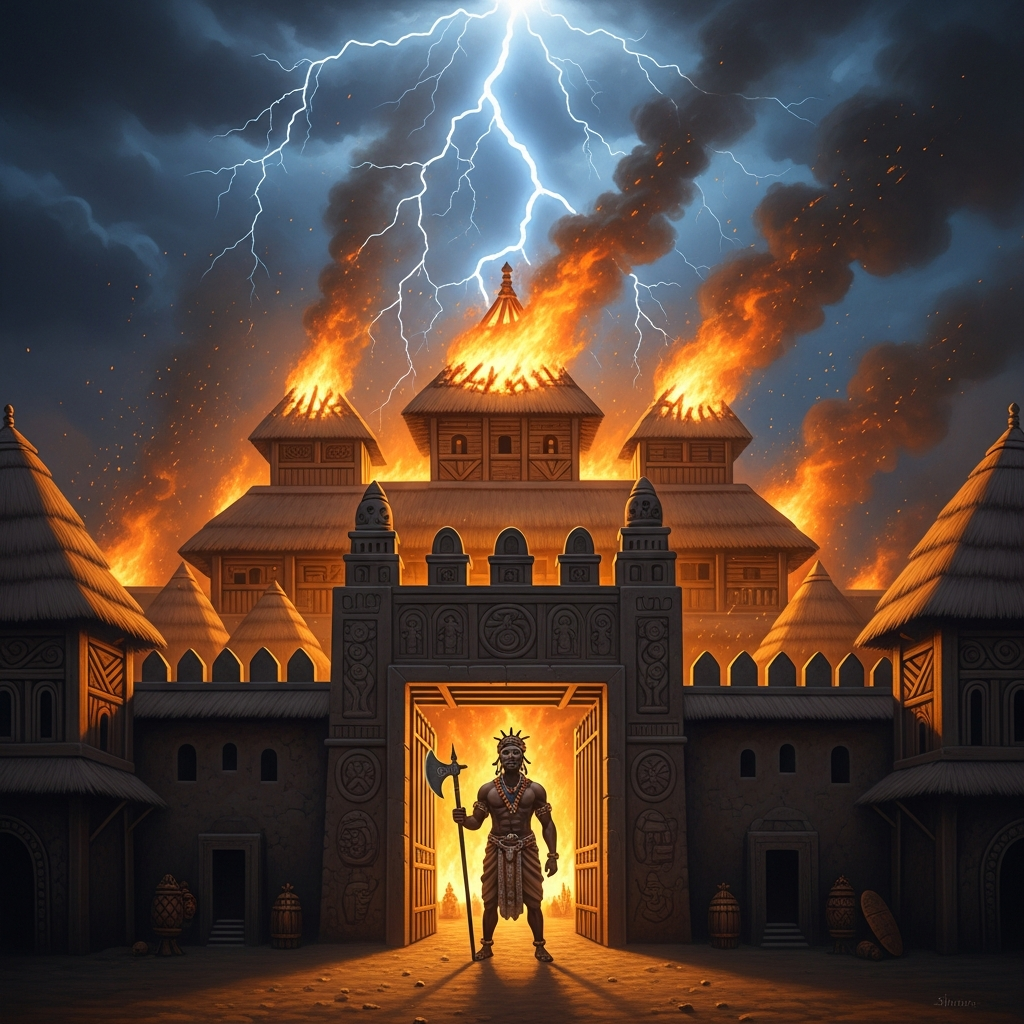
The lightning comes at the palace.
Not at a target, not at an enemy, not outward into the harmless sky beyond the walls — at the palace itself, the nested compound of thatch and carved wood and silk curtains and storage rooms and wives’ quarters and children’s rooms. The fire takes the central court first. It takes the thatch roof in three places simultaneously and then everything begins to burn, and what does not burn falls, and what falls traps people underneath it. His wives. His children. Not all of them — some run — but enough. The night fills with the smell of burning thatch and burning cloth and burning things that should not burn, and Shango stands in the main gate and watches what his words have made. He does not run. He does not call for water. He stands and watches until there is nothing left to watch.
He does not speak afterward.
He does not speak for three days, sitting in the ruins of the court. His chiefs come to him. His griots come. Oya comes and stands at the edge of what was the gate and watches him from across the ash. He does not move. On the fourth day he stands. He puts on no royal clothing. He takes nothing with him. He walks through the gate and north into the bush and into the forest at the edge of the savanna, where the trees are old enough that their upper branches touch without touching. His disciples follow at a distance — close enough to see him, far enough to give him space to be whatever he is becoming.
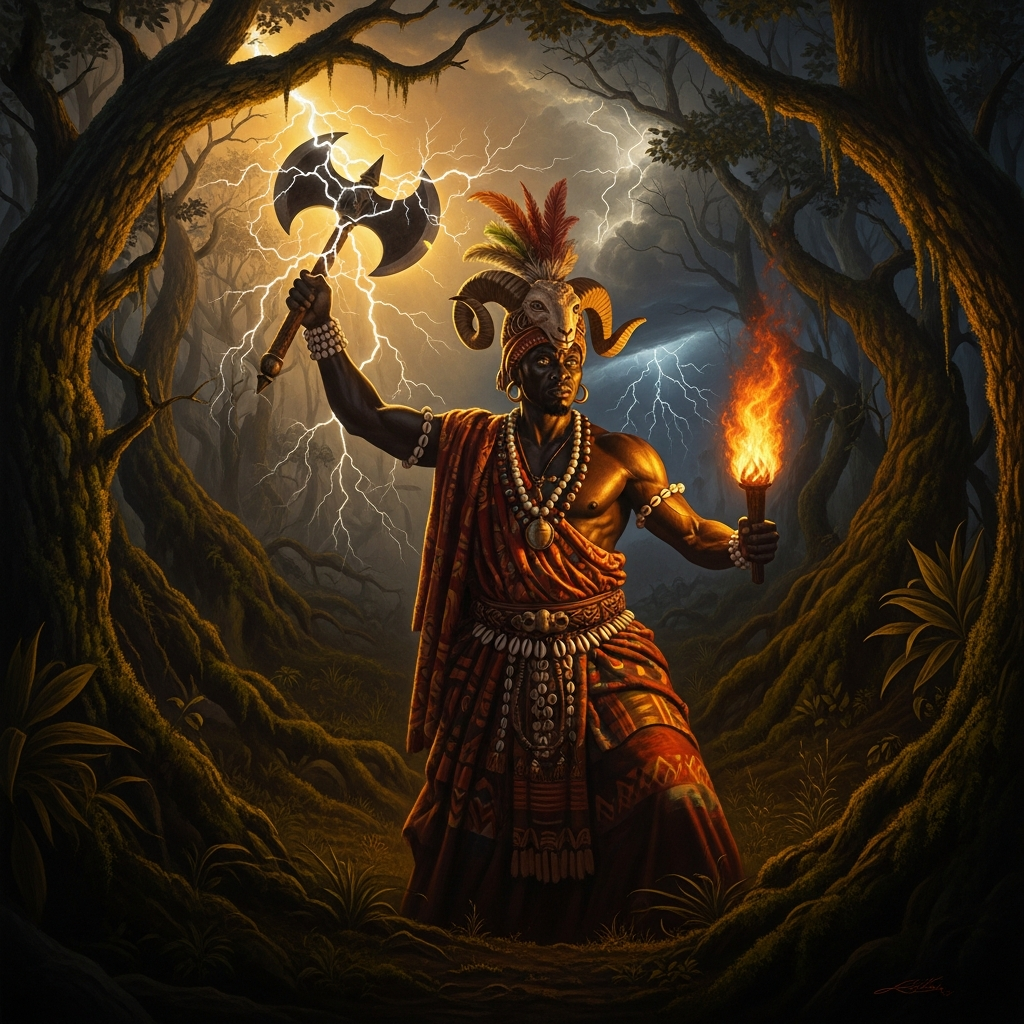
He walks until the forest is dense enough that the sky becomes a rumor above the canopy. He finds the ayan tree, the hardwood, the one that grows where lightning has struck before. He stops.
His disciples stop.
They hear no sound.
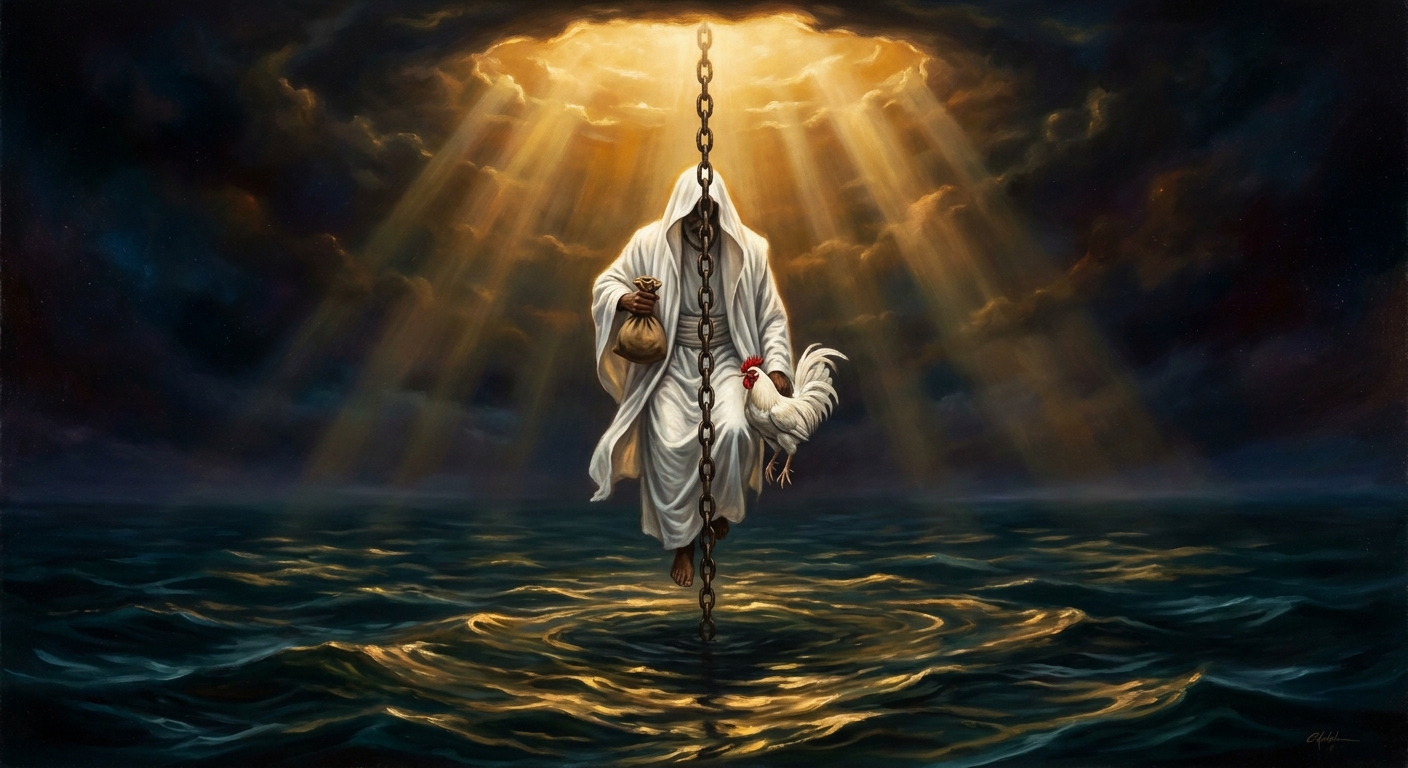
They wait. When enough time has passed that silence itself becomes information, they walk forward through the undergrowth to the ayan tree. The rope hangs from its lowest branch, swinging in no wind. The ground beneath it is bare. He is not there. The rope is still knotted — the knot is undone from within, from below, the way a man undoes a noose after he has ceased to need it because he has somewhere else to be.
His disciples look up.
Above the canopy, through the gap the old tree makes in the forest roof, the sky is clear and lit with what is not quite lightning — not the fast slash of a single strike but the diffuse, constant, inner luminosity of a sky that has recently been reorganized. They stand under the ayan tree for a long time. Then one of them speaks the first praise-name, and the thunder answers — not immediately, but inevitably, the way a king answers a proper address: in his own time, on his own terms, with all the authority of someone who no longer has anything to prove.
He is Jakuta now — the stone-thrower.
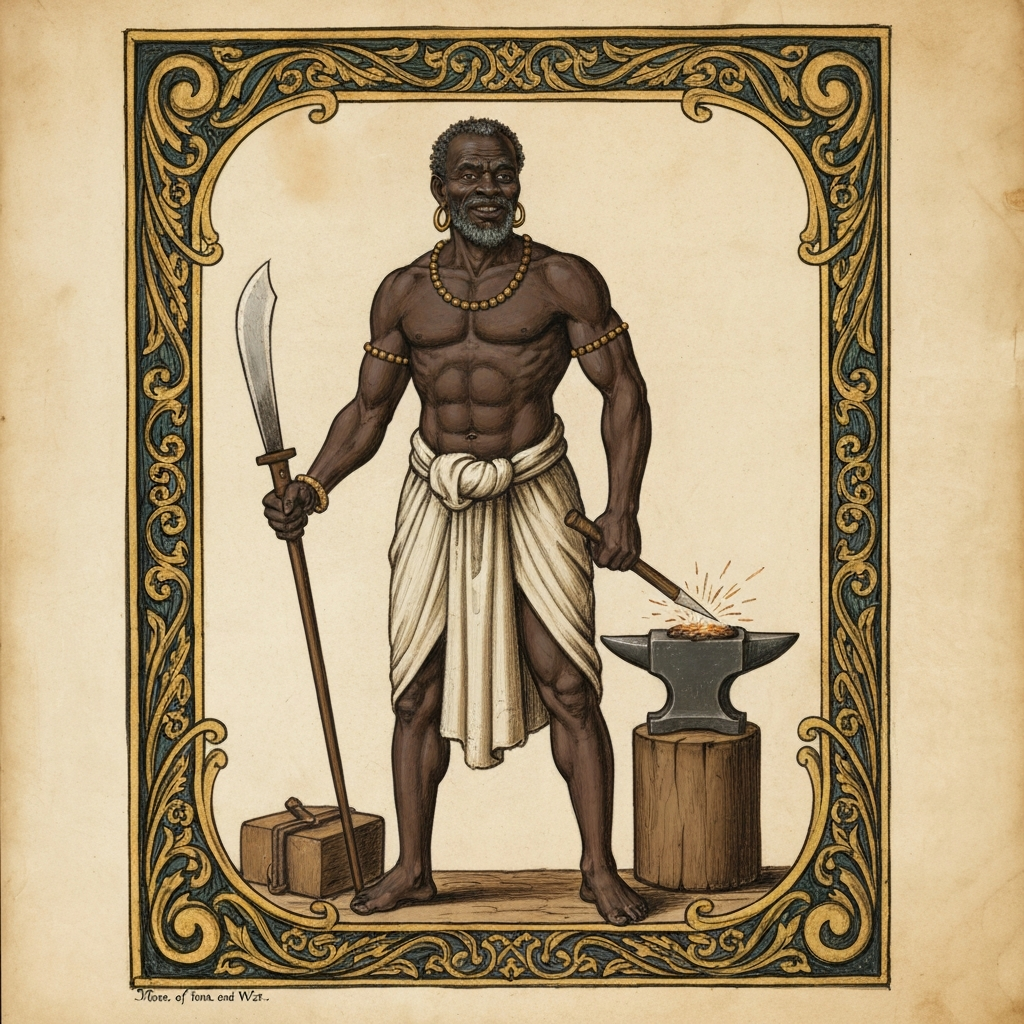
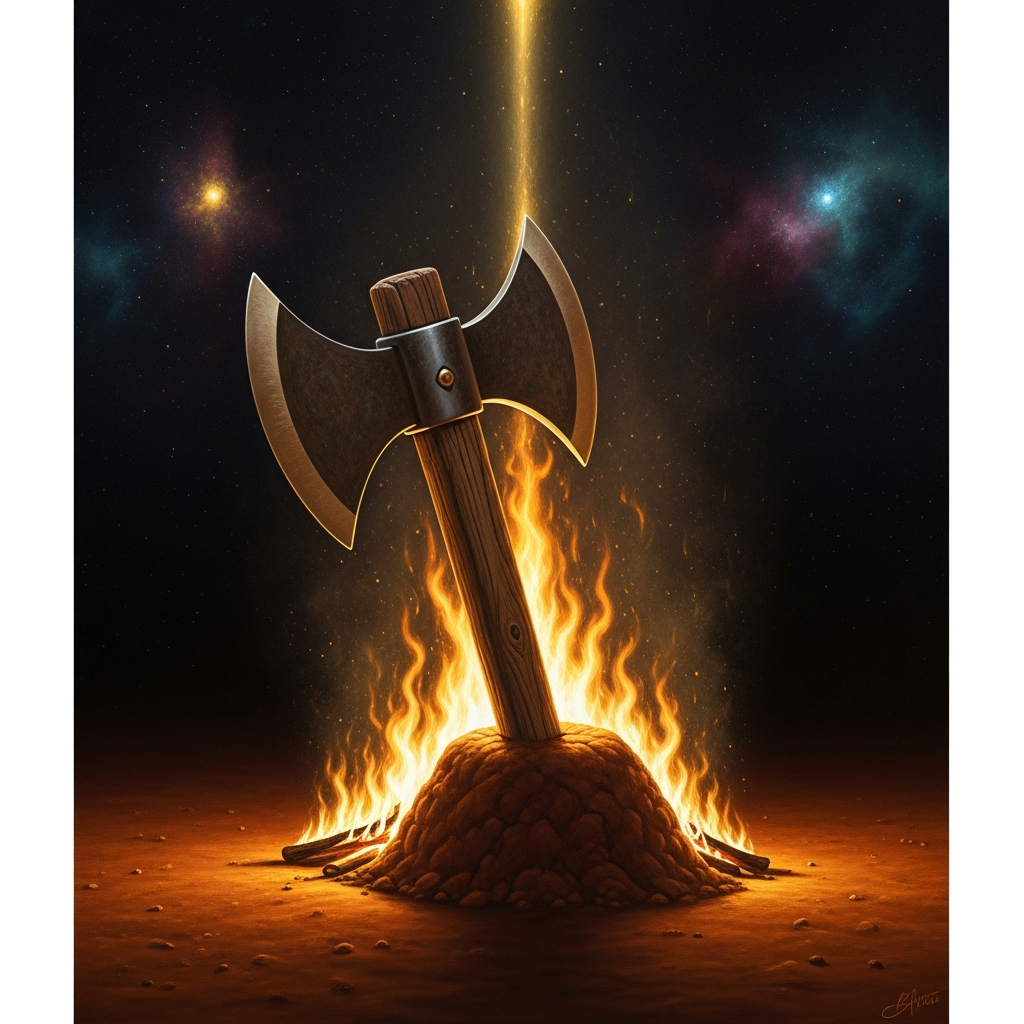
He is Oba Koso — the king did not hang. Every Shango shrine in Yorubaland holds the oshe Shango, the double-bladed axe, because two blades can strike in two directions and Shango’s power moves both ways: downward to earth in fire and destruction, upward from earth in the smoke of sacrifice and the prayers of kings. He is the patron of Oyo. He is the patron of every mortal who has ever had too much power and too little wisdom and destroyed something he loved with the same instrument he used to protect it. He is the patron of the honest catastrophe: the fire you set yourself, the ruin you name truthfully, the grief that does not permit you to lie about what caused it.
He is in every storm.
He is especially in the first thunder — the boom that arrives after the flash, after the damage, after the choice has already been made. The thunder is what follows when the lightning has already fallen and there is nothing left to do but announce it.
The king who cannot forgive himself does not die — he becomes the thing he most feared to be, and in that becoming discovers that the fear was the last obstacle between him and his actual nature.
Scenes
The palace burns
Generating art… Deep in the forest, Shango's rope hangs from the ayan tree
 Generating art…
 The first Shango shrine at Oyo: a double-bladed axe driven into sacred clay, the oshe, set before fire
 Generating art…
 Echoes Across Traditions
Entities


Sources
- Samuel Johnson, *The History of the Yorubas* (1921)
- Wande Abimbola, *Ifá: An Exposition of Ifá Literary Corpus* (1976)
- Judith Gleason, *Oya: In Praise of an African Goddess* (1987)
- Rowland Abiodun, *Yoruba Art and Language* (2014)