Combat Profile
Golden Honeyed Blessing
Oshun bestows prosperity and magnetic charm upon allies, drawing fortune and submission from all who encounter her influence.
River's Diplomat
Oshun's presence soothes conflict and binds hearts in harmony, making enemies hesitant to strike and allies devoted to her cause.
Vanity and heartbreak. Oshun's beauty and desire for love can lead to suffering. She has been betrayed by lovers. Her generosity can be exploited. But underestimate her at your peril -- beneath the beauty is iron will
“Oshun is the force of harmony. Without her, the world does not work.” — Ifa proverb
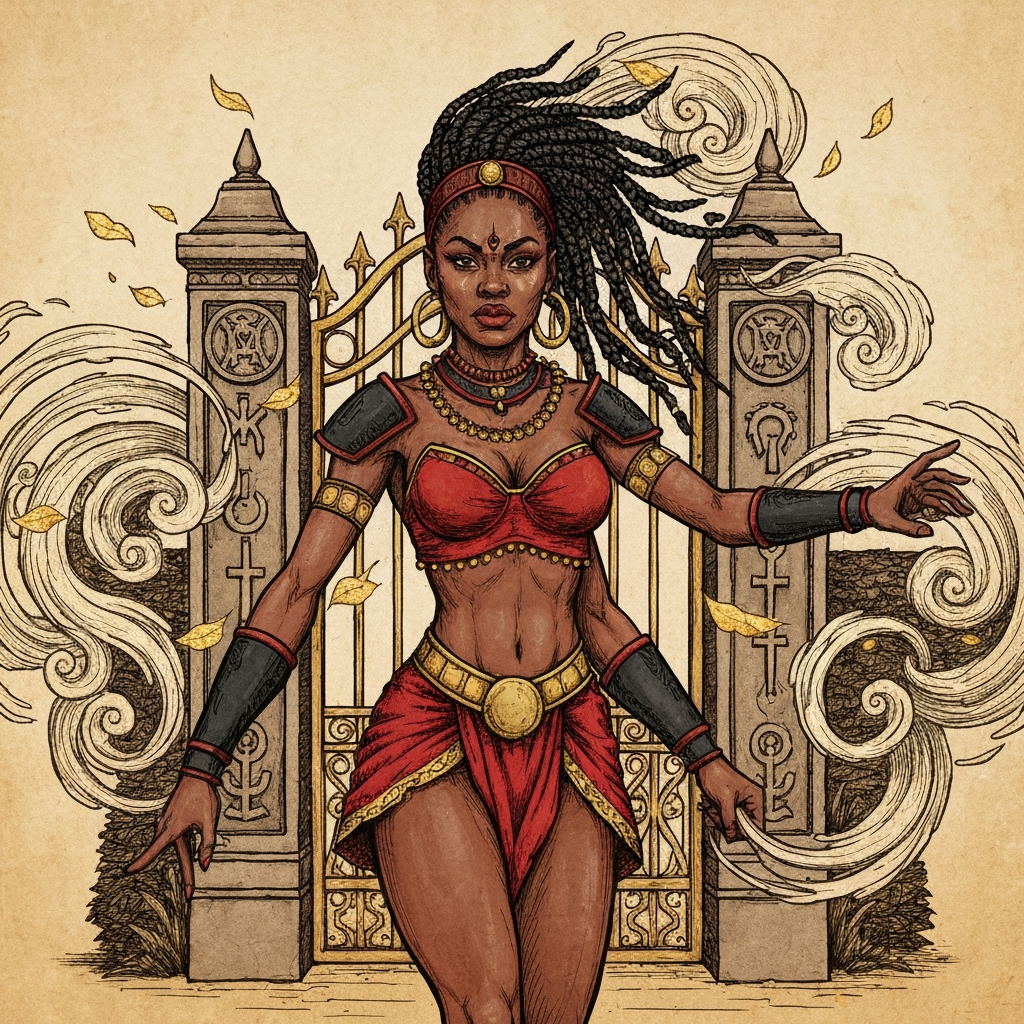
Lore: Oshun (Ochun in Cuba, Oxum in Brazil) is the Orisha of rivers — sweet water as opposed to Yemoja’s salt water — and of love, beauty, fertility, wealth, and above all, diplomacy. She is often presented as the most beautiful of the Orishas, associated with honey, gold, mirrors, fans, and the color yellow/amber. But to see only her beauty is to miss her power entirely. Oshun’s central myth is one of the most important feminist theological narratives in any world religion: when the male Orishas tried to organize creation without consulting Oshun (the only female Orisha sent on the original mission in some versions of the story), everything failed. The world dried up. Nothing grew. Nothing lived. Creation itself required the feminine principle — not as decoration but as essential force. Only when the male Orishas recognized their error and gave Oshun her proper place did the world become habitable. This is not a secondary myth — it is the foundational explanation of why the feminine is cosmically necessary.
Parallel: Oshun parallels Aphrodite/Venus (love, beauty, the power of desire) but also Lakshmi (wealth, fortune, the prosperity that comes from harmony) and — most surprisingly — Esther. The biblical Esther used her beauty, intelligence, and diplomatic skill to save her entire people from genocide (Esther 4-7). Oshun uses beauty, intelligence, and diplomacy to save all of creation. Both demonstrate that feminine power exercised through grace and strategy is not weakness but the highest form of strength. In Cuba, Oshun was syncretized with Our Lady of Charity (La Caridad del Cobre), Cuba’s patron saint — an identification so deep that the two are functionally inseparable in Cuban popular religion.
1 min read
Neglect. Oshun can be hurt by being ignored or taken for granted. But this is also a trigger: when Oshun withdraws her sweetness, the world dries up. In the key myth, when the male Orishas excluded her from their council, ALL their plans failed until they begged her to return
Odu Ifa; Joseph Murphy, *Santeria: African Spirits in America* (1988); Diedre Badejo, *Oshun Seegesi: The Elegant Deity of Wealth, Power, and Femininity* (1996)