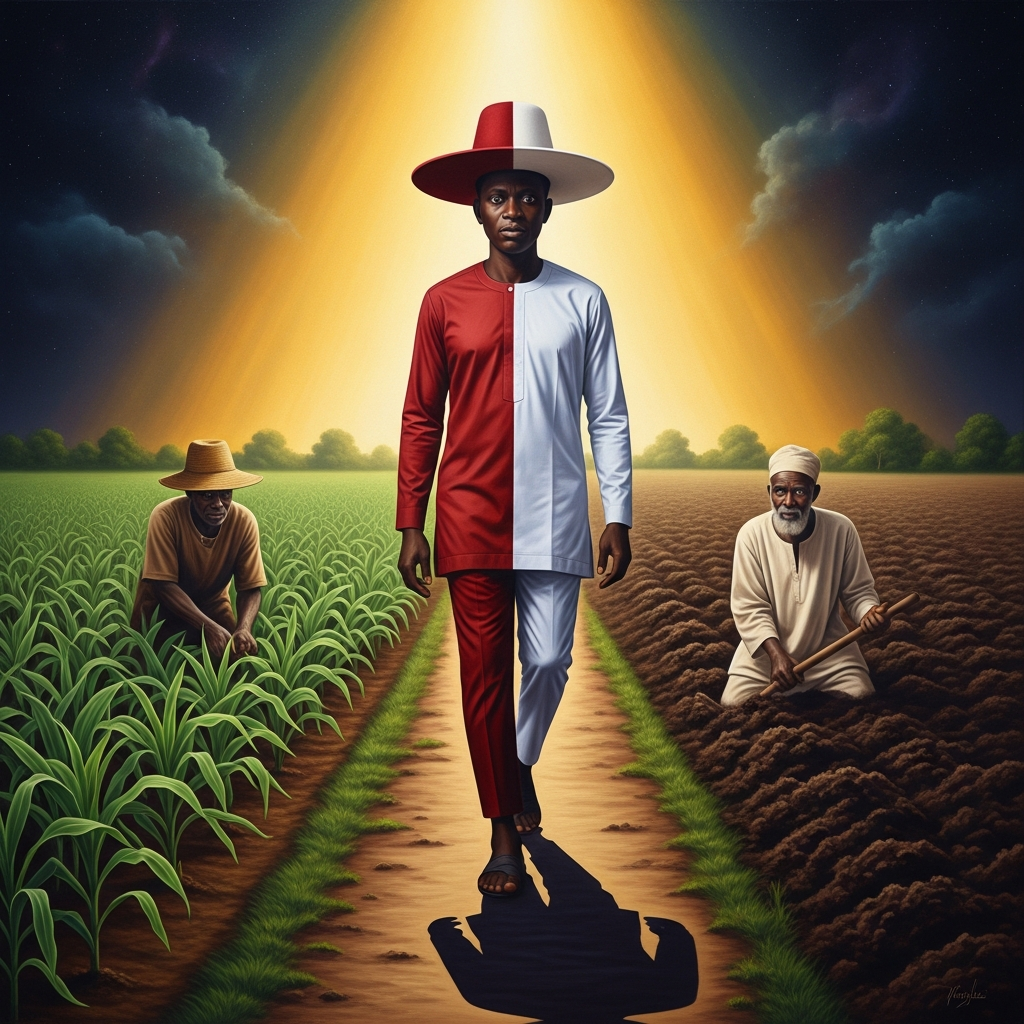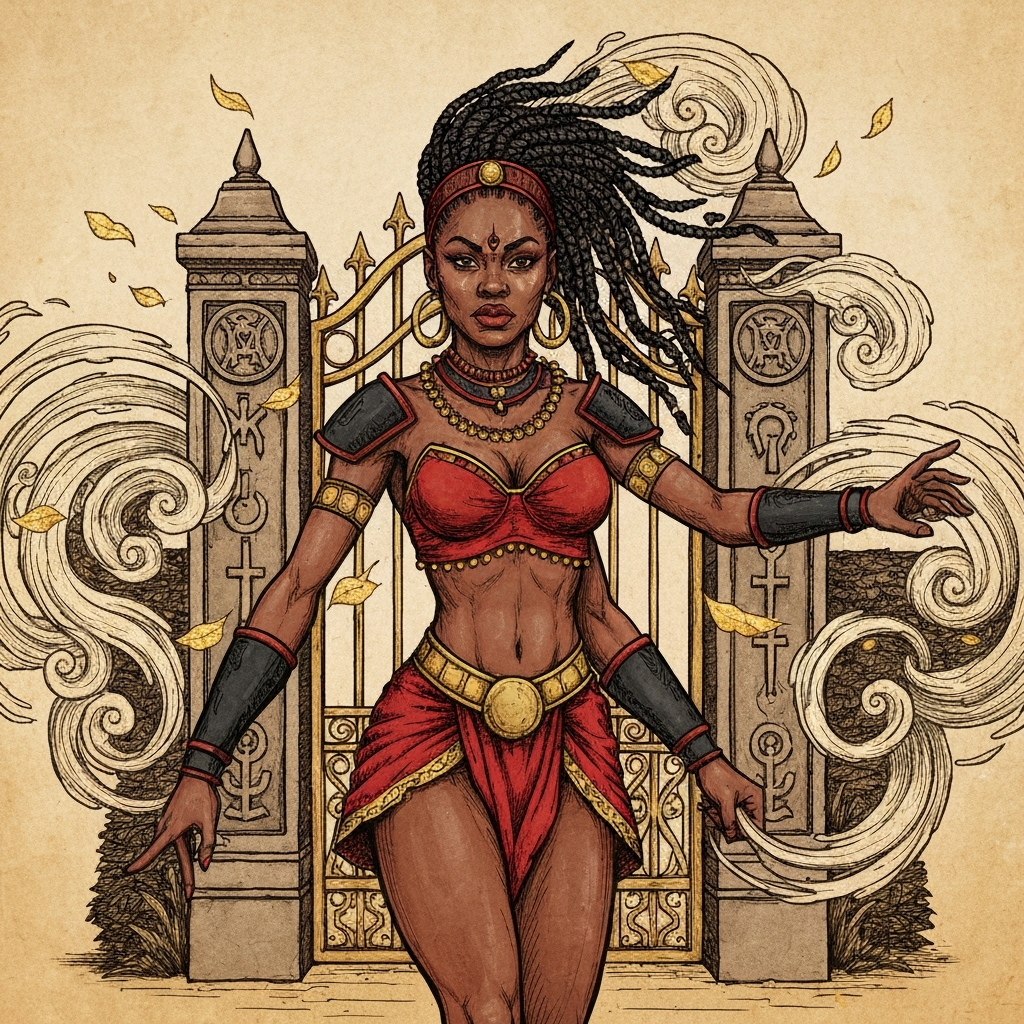
Shango Does Not Hang
~14th century CE (historicized) and mythic time — Oyo Kingdom, Yorubaland · Old Oyo, the ancient capital of the Oyo Empire, present-day Oyo State, Nigeria
Contents
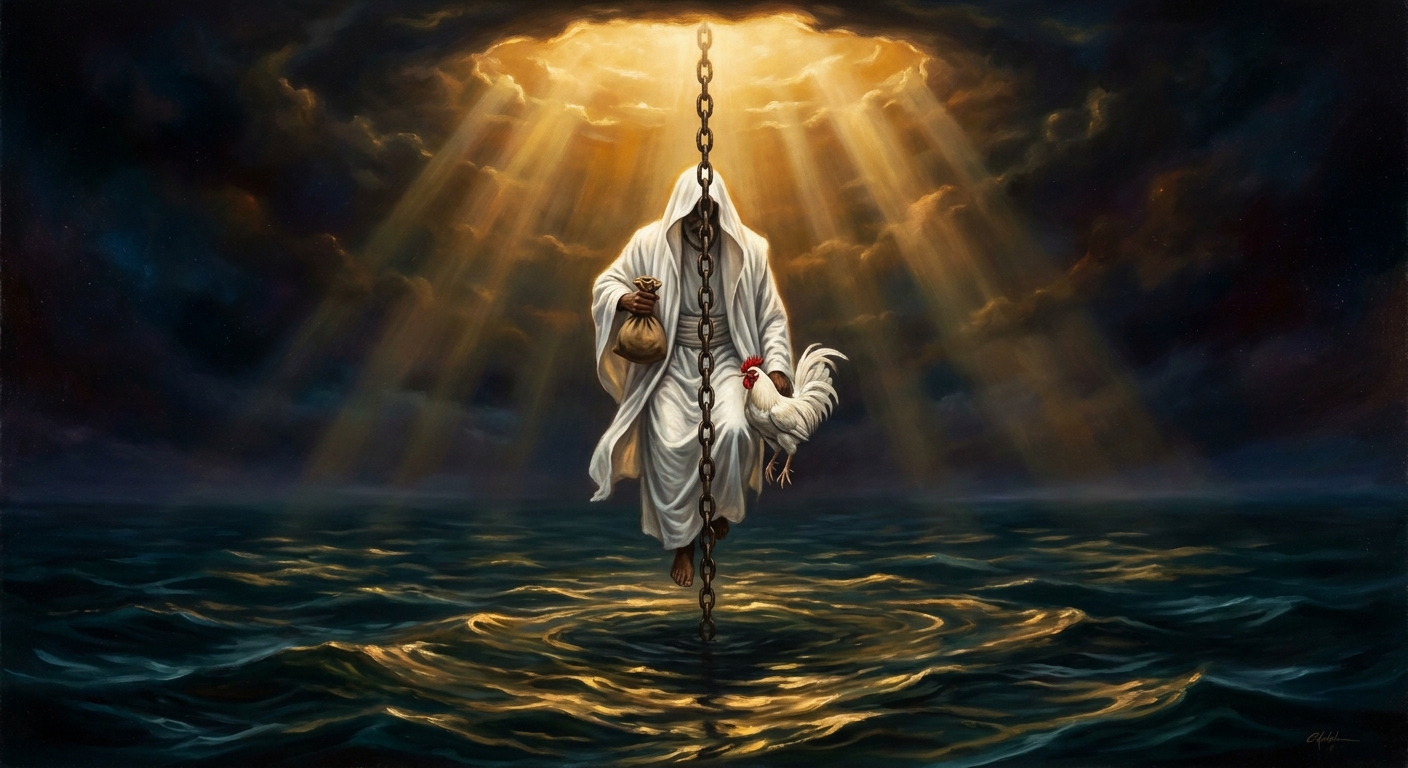
Shango, the fourth Alafin of Oyo, is abandoned by his generals and walks into exile. He hangs himself from an ayan tree in the forest. His disciples find the rope empty and the ground bare. He has not died — he has ascended. The thunder is him walking.
- When
- ~14th century CE (historicized) and mythic time — Oyo Kingdom, Yorubaland
- Where
- Old Oyo, the ancient capital of the Oyo Empire, present-day Oyo State, Nigeria
Shango is the fourth Alafin of Oyo — the ruler of the city, the holder of the ade crown, the one whose word is the law of the kingdom. He is already divine before he becomes divine. The Yoruba understand this distinction. There are men who carry more ase — more sacred force, more concentrated power — than ordinary life can hold without transforming. Shango is one of these men. He is large in every dimension: in his body, in his appetites, in his rages, in his capacity for loyalty and for cruelty. His three wives — Oya who owns the storms and the marketplace, Oba who is faithful and tends the household, Oshun who owns sweetwater and gold — move through his palace with the calibrated care of people who understand they are living inside an atmospheric condition.
He rules. He rules powerfully and imperfectly, in the way that power rules when the man holding it has not yet learned the difference between his will and what is good. He taxes the trade routes. He raises armies. He promotes the generals who win and demotes the ones who lose, and then, because he is Shango, he promotes some of the ones he demoted back again when he needs them.
He has enemies. Timi of Ede is the general he sent south to deal with a rebellion, thinking the distance would remove a threat from the capital. Gbonka is the general he sent afterward, when Timi refused to come back. What follows between these two generals — the battle, the outcome, the return to Oyo of the winner carrying the head of the loser — is a problem Shango created by his own political maneuvering, and the problem is that Gbonka, who has now defeated Shango’s most powerful general, has come home and Shango cannot absorb this.
The Alafin demands that Gbonka fight again. He finds or invents a pretext. Gbonka refuses. Gbonka’s refusal is a political act, the way all general’s refusals are political acts when the king has made an obviously bad decision. The court watches. The court, which has been watching Shango make bad decisions for years, watches this one more carefully than usual.
The generals do not follow.
Shango leaves Oyo.
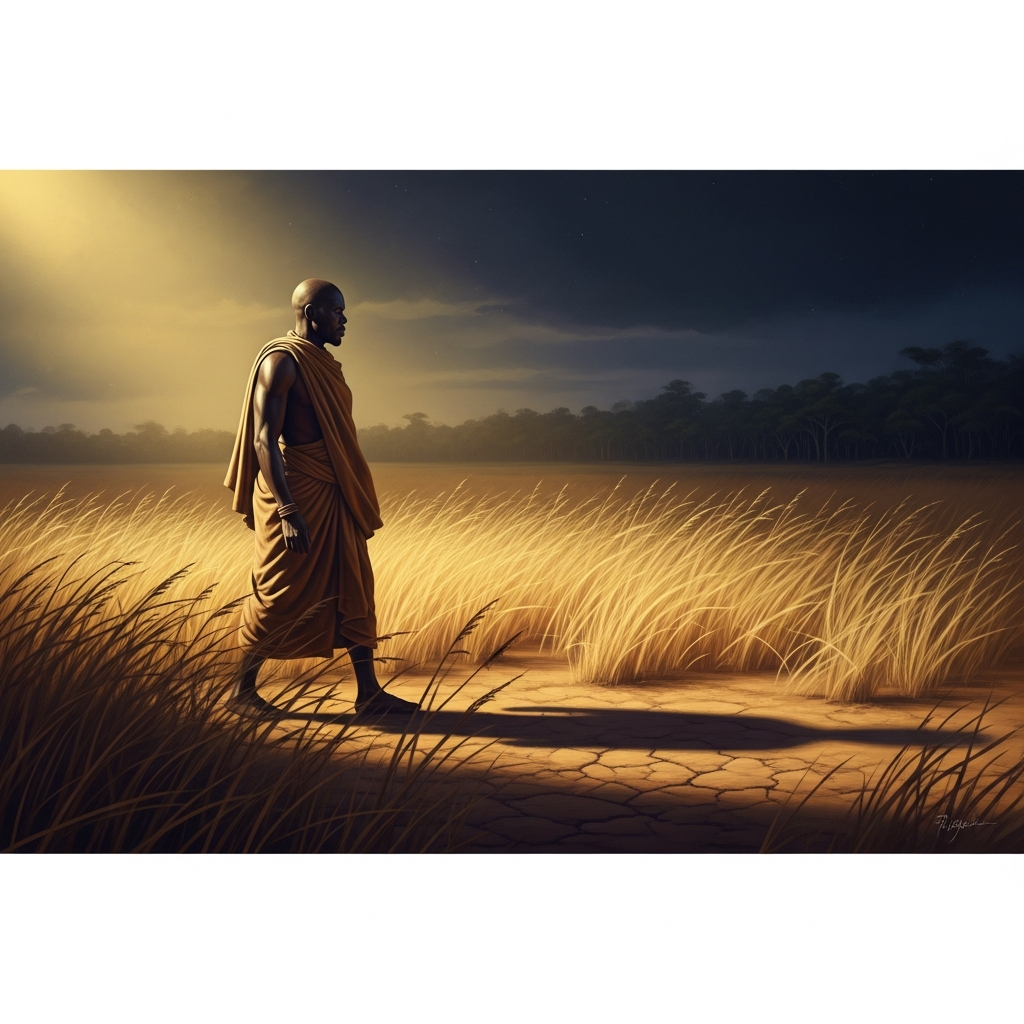
He does not flee in the night. He does not leave in secret. He walks out of the capital in the dry season — the harmattan is blowing, carrying dust from the Sahara south across the savanna, and the air has that dry, close quality that makes distant things look clear and near things look faded — and he walks north through the tall grass toward the forest at the edge of the settled land.
He is alone.
His wives are not with him. Oya follows after, but not beside — she is behind him at the distance that grief requires, the distance that says I am here without saying I am holding you up. He does not stop for her. He does not acknowledge her. He walks with the particular speed of a man who has somewhere to go even though he doesn’t know where that is, the walking of someone who has stopped waiting for the world to make sense and has started moving before he can think about it.
He walks for three days through the forest.
He eats nothing. He drinks from streams. At night he sleeps on the ground in the way of soldiers who no longer care about comfort, which is not sleep so much as a period of horizontal darkness. In the morning he stands and walks again.
On the third day he finds the ayan tree.
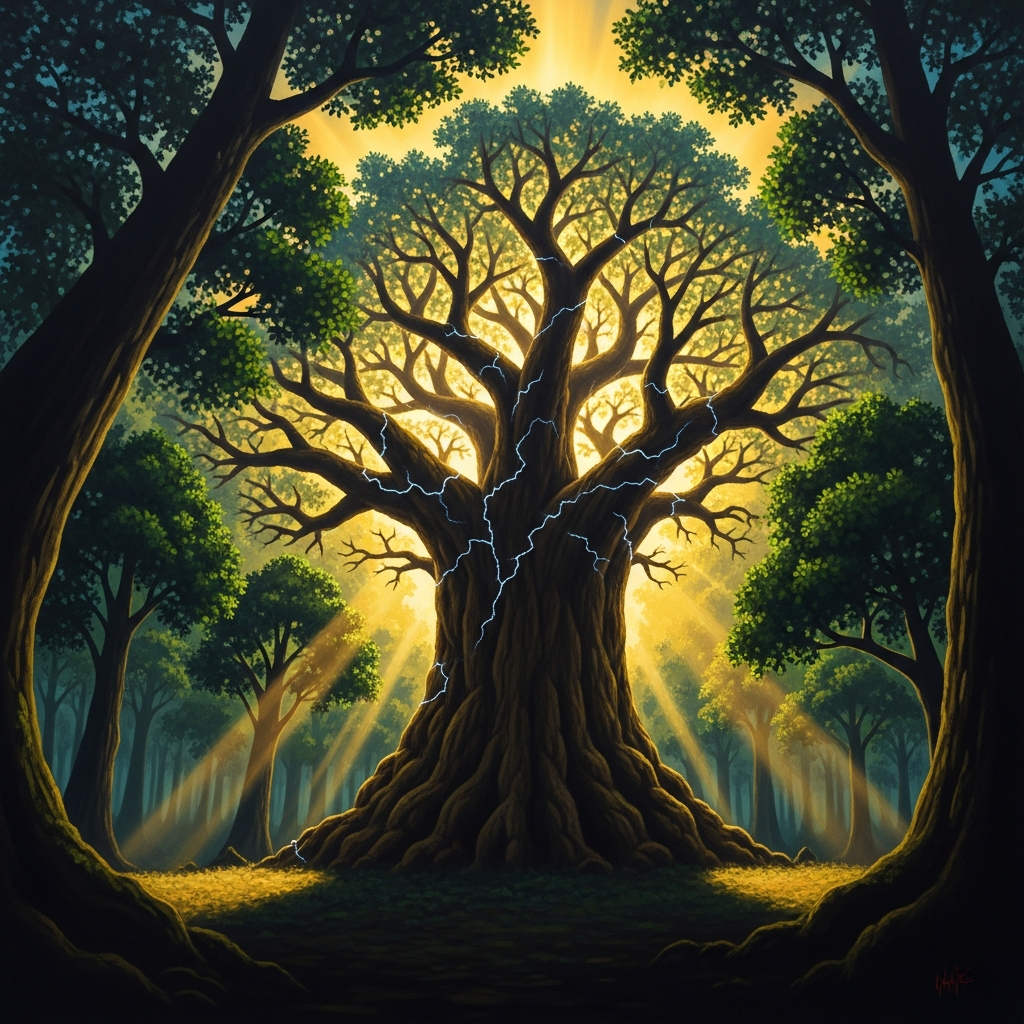
The ayan tree is a hardwood — Distemonanthus benthamianus, if the botanists need to be satisfied — that grows in the dense forest of Yorubaland, old and tall and specifically beloved of lightning, because it grows where lightning has struck before and it grows there straight and reaches high. Shango does not choose the ayan tree because he knows this. He chooses it because it is there and because it is old and because it is the kind of tree that a person goes to when they are done.
He has a rope.
His disciples are behind him. They have been following at the distance that love and terror together require — close enough to see him but not close enough to change what is happening. They have watched him walk north for three days and they know where this leads. They walk faster now through the undergrowth toward the ayan tree.
They arrive beneath the tree.
The rope hangs from the lowest branch. It swings in no wind. Below it, the ground is bare — no body, no blood, no sign of anyone who was recently standing here. The knot in the rope has been undone from inside, from below, in the way that a man unties himself when he has somewhere else to be and no longer needs the rope.
The disciples look up.
Through the gap the ayan tree makes in the forest canopy, the sky is clear. It is not the ordinary clear of a harmattan sky — dry and white-bright and clean. It is the clear of something that has recently been reorganized. The light in it is different. It is distributed more widely than light usually distributes. It is as if the sky now contains, in its substance, something additional that was not there before.
One of the disciples says: Oba koso. The king did not hang.
The thunder comes that night.
It comes from the north, from the direction Shango walked. The sound arrives before the storm — not the sharp crack of near lightning but the low, structural rumble that means the storm is still far away and moving and enormous. It is the sound of someone walking who has very large footsteps and does not need to be quiet.
The lightning that precedes the next day’s storm strikes three of the compounds of the generals who did not follow.
The lightning that comes the week after that strikes the home of Gbonka.
The Yoruba observe this. They observe it carefully. They draw the obvious conclusion: the king did not hang. The king ascended. The king is now the sky-king, the orisha of thunder, and he is expressing his opinions about the betrayal through the most direct medium available to him, which is voltage.
From that day, everything struck by lightning is sacred.
No one throws away anything that lightning has touched. Shango’s priests — the Mogba, the Oni-Shango — go immediately to every place where lightning has struck and collect what the strike has left: the fused earth, the split wood, the stones that fell from the sky in the thunder’s wake. These objects are edun ara, thunderstones, the physical evidence of the orisha’s attention. They are kept in shrines. They are washed in palm oil and prayer. To throw one away is to refuse the attention of a god who is paying attention specifically to you.
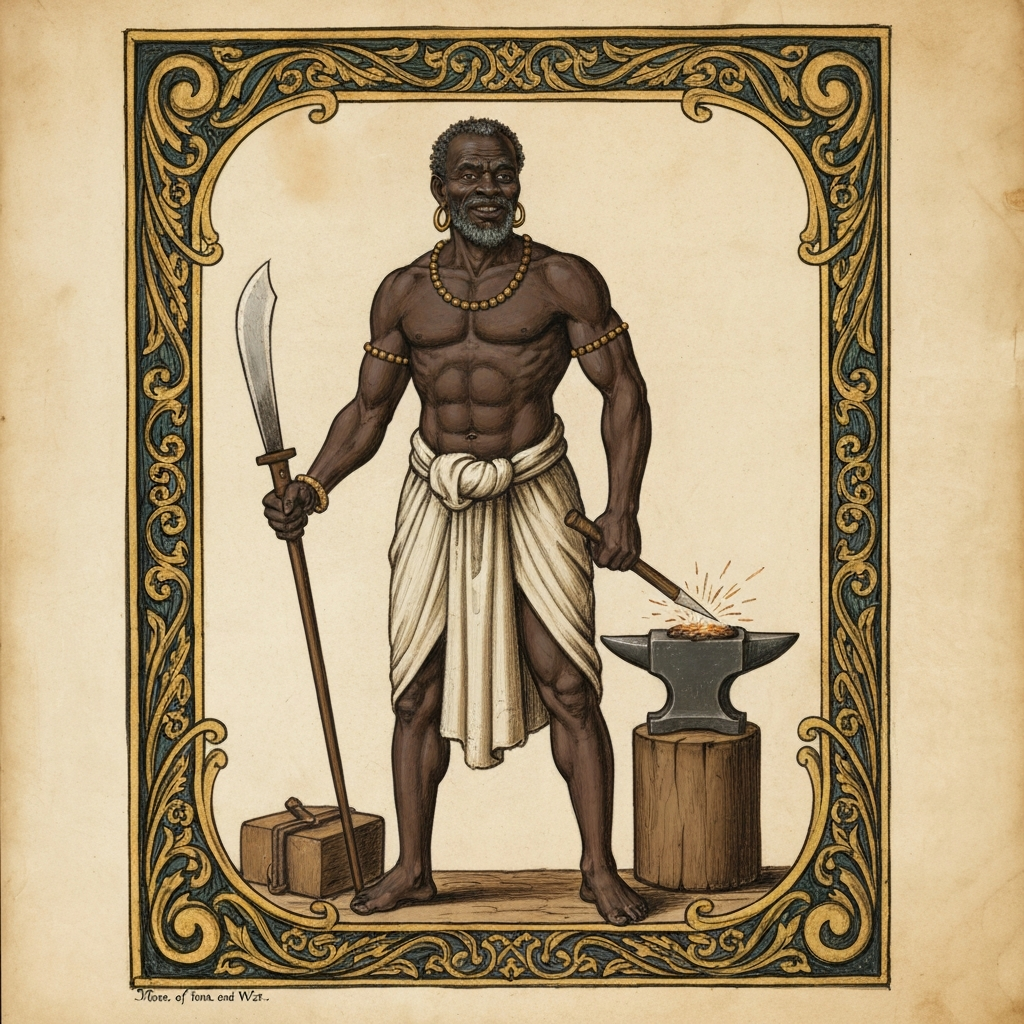
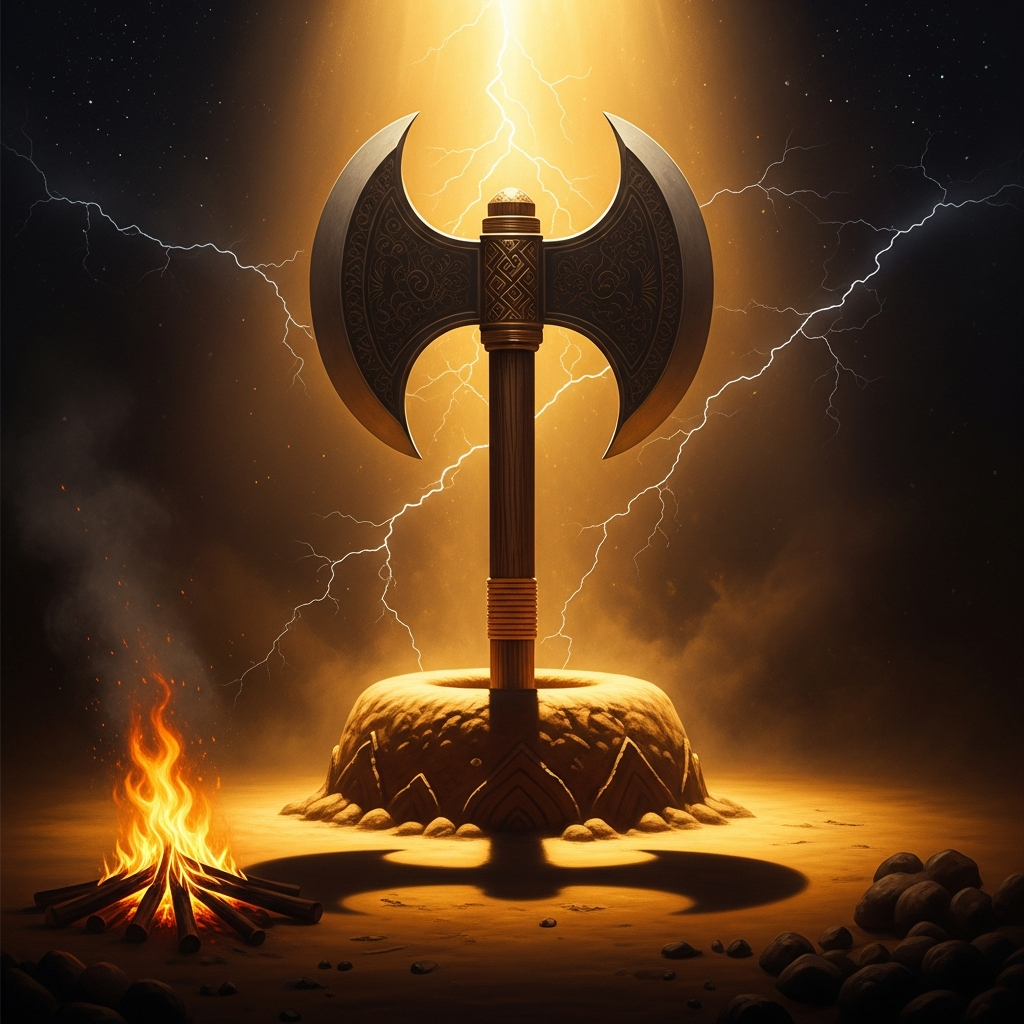
Shango’s shrine holds the oshe — the double-bladed axe.
Two blades, facing opposite directions, because Shango’s power moves in two directions simultaneously: downward to earth in fire and destruction, upward from earth in the smoke of sacrifice and the prayers of everyone who has ever held power and lost it and asked a divine power to acknowledge the cost. The double axe is also the balance between the two faces of authority: what it does and what it costs. Every king in the Yoruba world understands this balance. Every Alafin of Oyo after Shango has been reminded of it.
He is Jakuta — the stone-thrower, the one who hurls the meteorite.
He is Oba Koso — the king who did not hang.
He is the patron of kings because he was one, because he was a bad one in specific ways, and because being transformed by catastrophic failure is something the gods are uniquely positioned to understand. The generals who refused him sent him into the forest. The forest sent him up. He is in every storm now, specific and personal — the thunder is not an abstraction, not a meteorological event with Shango as its symbolic correlate. The thunder is Shango walking. The specific direction of it tells you something if you know how to listen.
In Oyo-Ile today, on the feast day of Shango, the dundun talking drums carry his praise-names across the city. The drummers speak his epithets in the drum language, in Yoruba, and the drums say: Shango, owner of lightning, the mighty one whose anger burns. They say: Oba koso. The king did not hang. This is not only a claim about what happened in the forest that day. It is a claim about the nature of sovereignty — that real authority cannot be destroyed by those who refuse to follow it, that it only transforms, that the man who walks into exile carrying nothing becomes the god who walks in storms carrying everything.
Oya follows him.
She was behind him on the road north. She stayed behind him. She is the orisha of storms as well, the wind that precedes the lightning, the one who owns the marketplace and the cemetery and the space between life and death where the biggest changes happen. She knows what is in that space. She was already there, in the forest, watching him walk toward the ayan tree, and when he went up she did not weep because she knew what the ascension was going to cost.
The thunder comes. The rain follows. The harmattan dust clears from the air and the sky is clean for a day.
Somewhere in the north, the king who did not hang is walking.
Every Yoruba child learns this: do not speak ill of the thunder. Do not point at lightning. Do not throw away what the storm has touched. These are not superstitions — they are recognitions. The sky is populated. The storms are conducted. The man who was abandoned by his generals became the force that no one can abandon, because you cannot abandon weather, you can only survive it or fail to.
Scenes
Shango walks north from Oyo in the dry season, alone, no regalia, no retinue — the king who was abandoned by his generals moving through the harmattan grass toward the forest where the ayan trees grow
 Generating art…
 The ayan tree in the dense forest, Shango's rope hanging empty from the lowest branch, swinging in no wind
 Generating art…
 The double-bladed axe of Shango — the oshe — driven into sacred clay at the first shrine at Oyo, before fire, the thunder answering each time a praise-name is spoken
 Generating art…
 Echoes Across Traditions
Entities
- Shango
- Oya
- Timi of Ede
- Gbonka
- Oyo

Sources
- Samuel Johnson, *The History of the Yorubas* (CMS Bookshops, 1921)
- Wande Abimbola, *Ifa: An Exposition of Ifa Literary Corpus* (Oxford University Press, 1976)
- Judith Gleason, *Oya: In Praise of an African Goddess* (HarperCollins, 1987)
- Rowland Abiodun, *Yoruba Art and Language: Seeking the African in African Art* (Cambridge University Press, 2014)
- Pierre Verger, *Orixas: Deuses Iorubas na Africa e no Novo Mundo* (Corrupio, 1981)