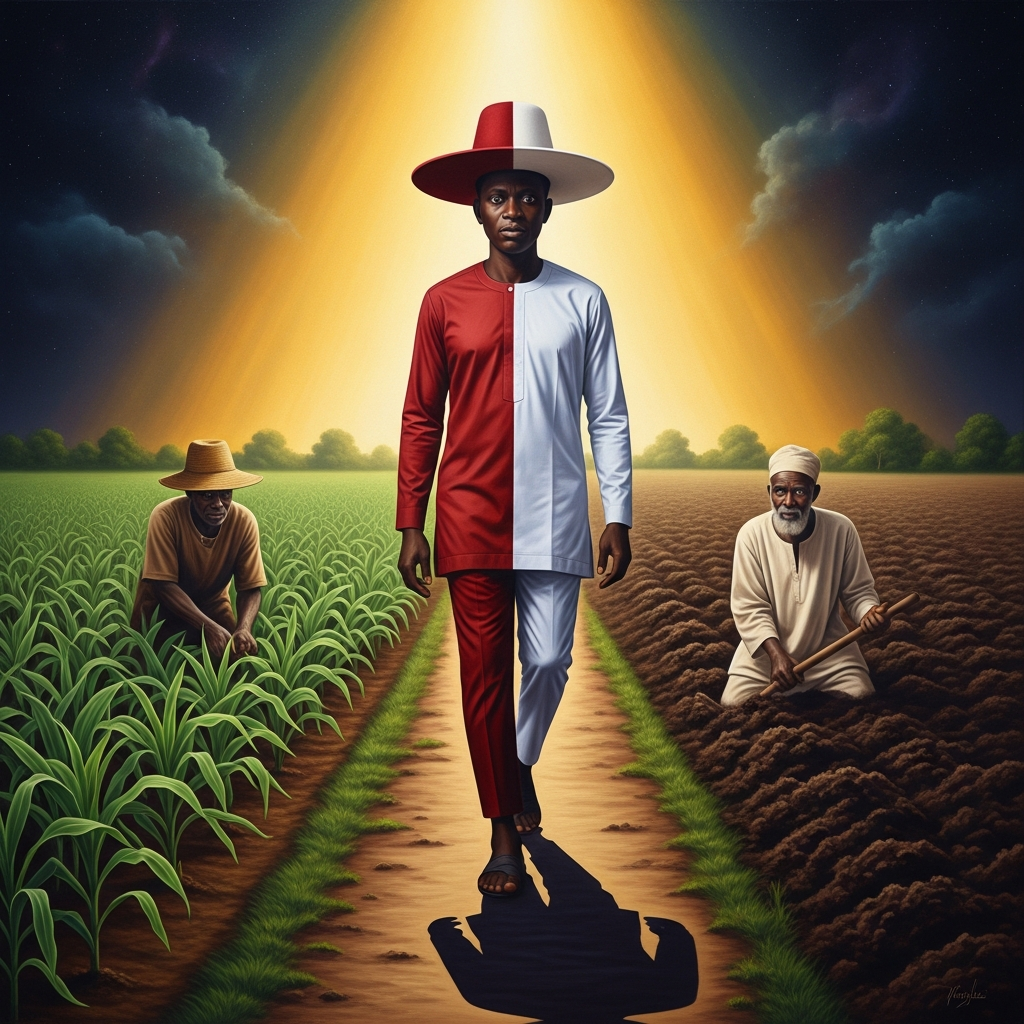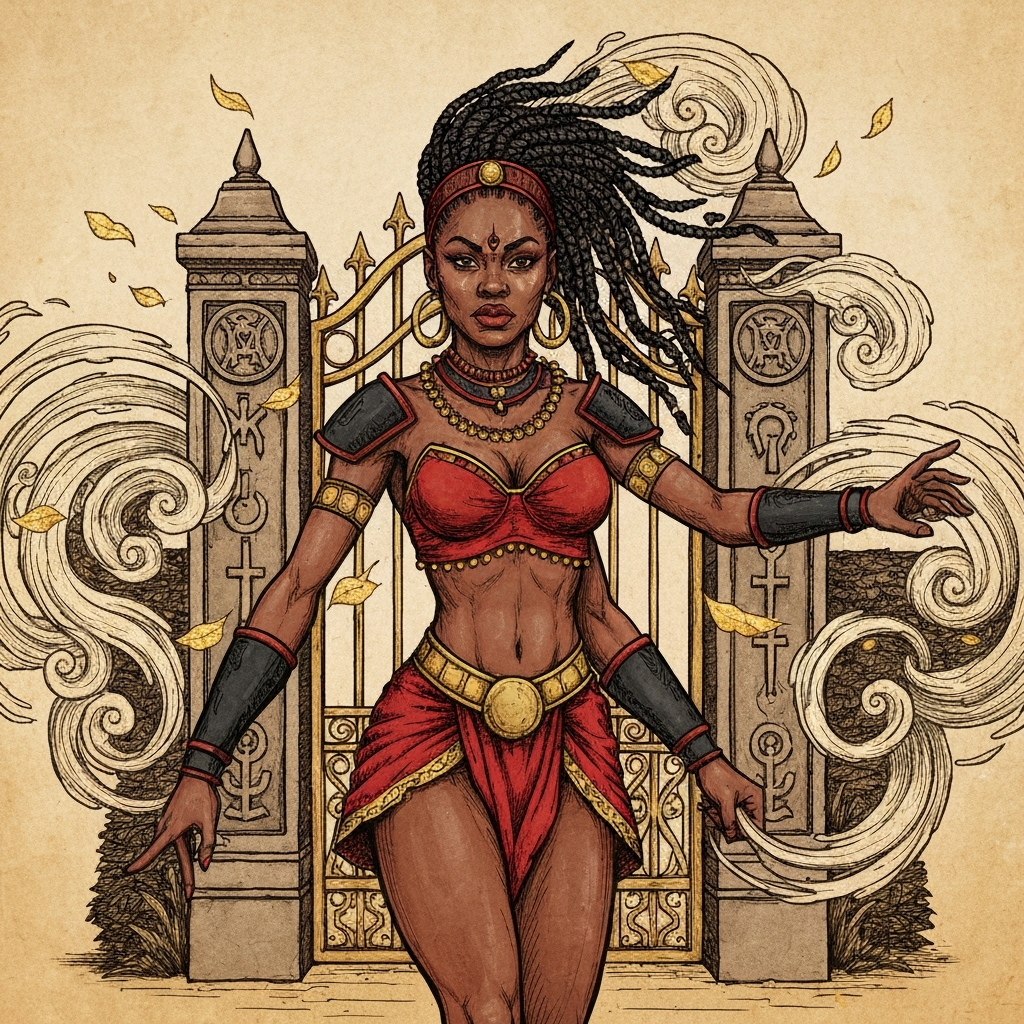
Oya Storms Over Niger
~14th century CE · the fall of old Oyo · Old Oyo — the palace, the forest, the boundary no one crosses twice
Contents
When Shango walks into the forest after his fall from the throne of Oyo, Oya follows him. What she finds at the ayan tree, and the choice she makes there, is why she now rules the boundary between the living and the dead.
- When
- ~14th century CE · the fall of old Oyo
- Where
- Old Oyo — the palace, the forest, the boundary no one crosses twice
Everyone knows where Shango goes.
He goes north, into the bush, beyond the last compound of Old Oyo, into the forest that begins where the savanna thins and the trees grow old and dense enough to hold private conversations in their canopy. He goes because the palace is ash. He goes because the thunder he called came down on his own people. He goes because a man who has done what he has done cannot remain in the place where he did it and maintain any relationship with himself that is worth maintaining. His chiefs see him go. His griots see him go. His wives see him go.
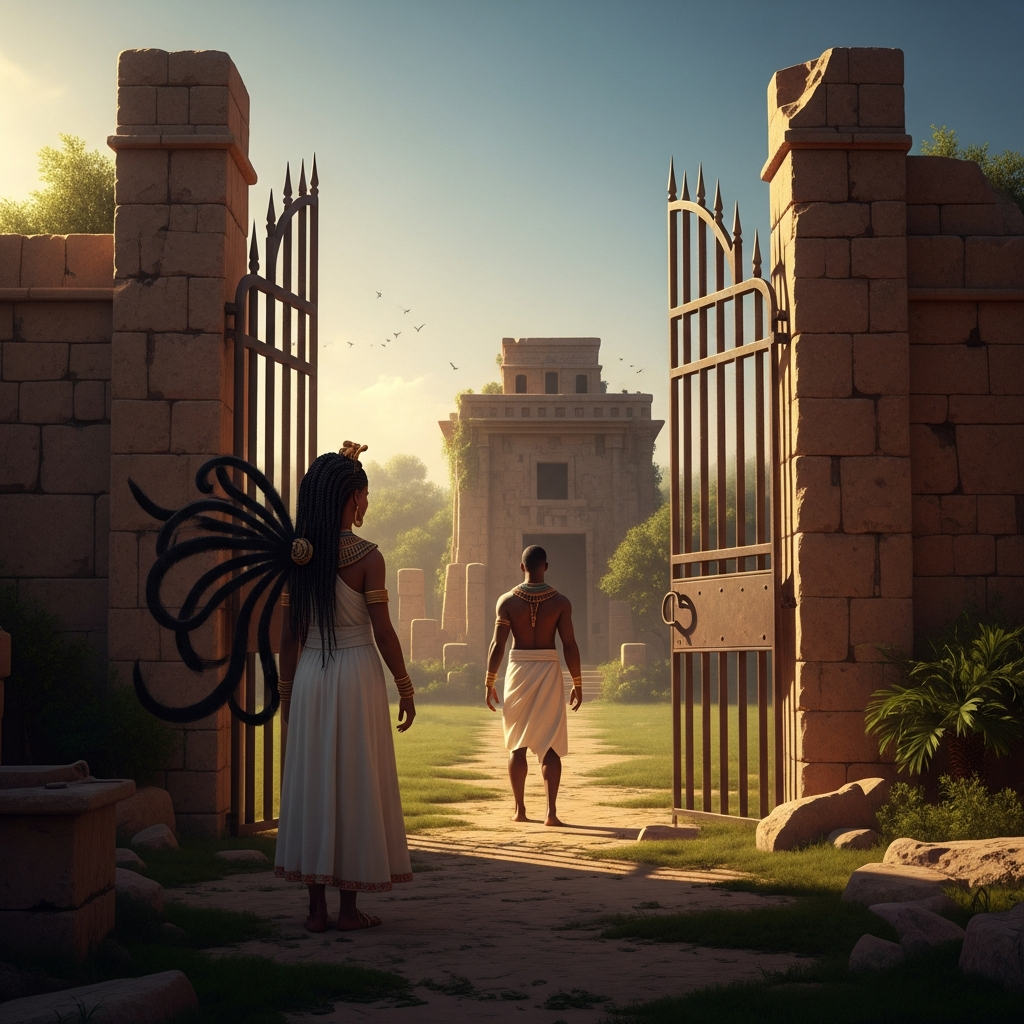
Oya watches him go from the gate of what used to be the main courtyard.
She does not call after him. She has never been a woman who calls after people. She has been, for the length of their marriage, the storm that flanks the larger storm, moving in the same direction but not identical to it, capable of her own intensities, never requiring Shango’s thunder to justify her wind. She watches him walk north until he is past the last houses and into the bush, and then she is still for a long moment, her nine-tailed flywhisk hanging quiet from her hand, the purple and wine-red of her cloth unmoved by any natural wind.
Then she follows.
She does not follow him at his pace.
She follows at her own pace, which is the pace of someone who knows where the other person is going and has no need to arrive simultaneously. Oya knows forests. She knows the language of trees that have witnessed violent things — they hold the information in their bark, in the angle of a branch that grew around some old damage, in the way the roots grip the earth more tightly in certain places. She reads the forest as she walks through it, and the forest tells her things about Shango’s passage: the broken stem, the displaced stone, the place where a man moving quickly and without care disturbed the pattern of leaves on the ground.
She carries her flywhisk. Nine tails — because nine is the number of her deep nature, nine is the Rivers of Niger, nine is the months of carrying, nine is the boundary count. The flywhisk makes no sound. She is moving through the forest in the hour between late afternoon and the dying of the light, when colors intensify and shadows acquire intention and the forest becomes the kind of place it actually is underneath its daytime comportment.
She smells the ayan tree before she sees it. The hardwood has a scent that is almost iron, almost mineral, the smell of a tree that has been struck by lightning before and carries the memory of it in its resin.
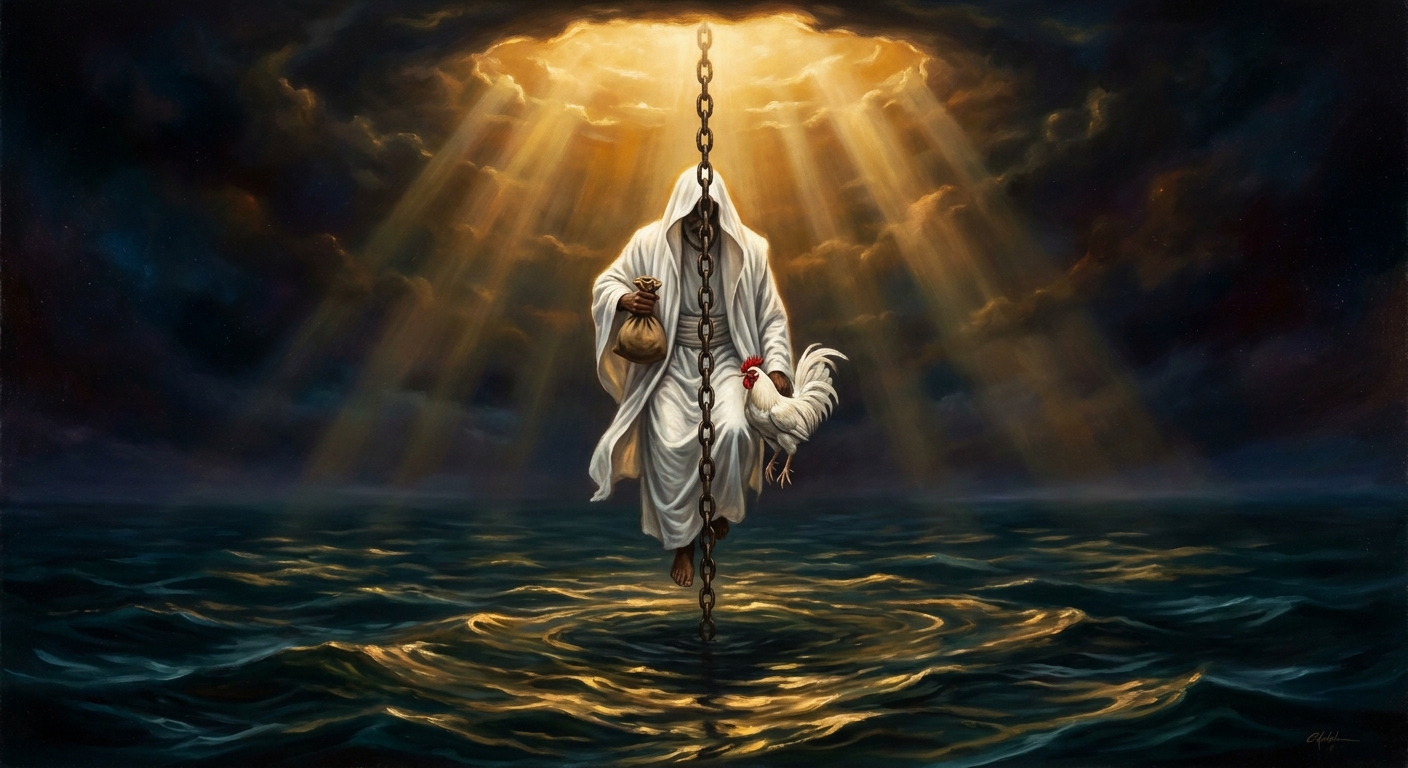
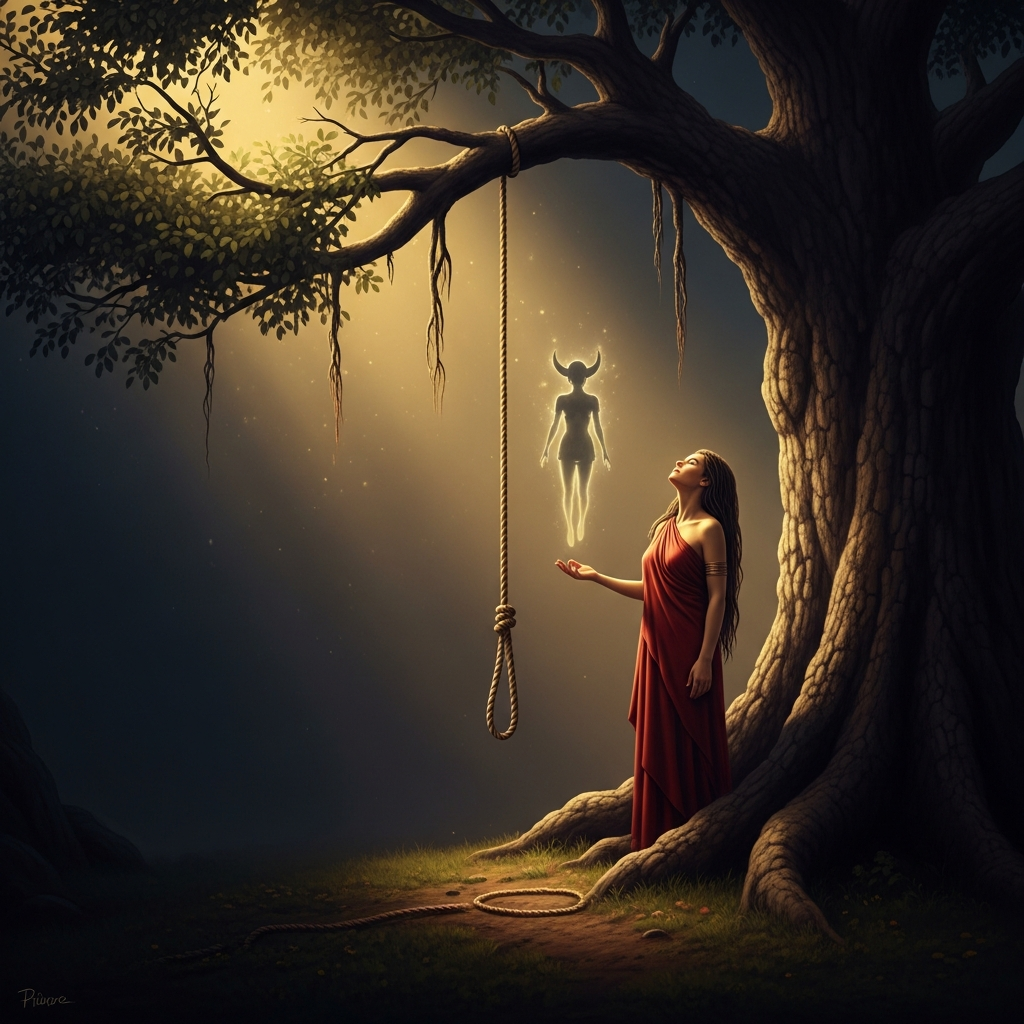
The rope hangs from the lowest branch.
It is still swinging. Very slightly, in no wind, which means he has just gone, which means the space between his being here and her arriving here is the width of a few minutes, which is not nothing. She walks to the base of the tree and stands under the rope and looks up at the knot. The knot is intact, which means whatever happened here was not violence in the conventional sense. The knot hangs from the branch the way a shed skin hangs from a stone — as the empty form of something that had occupied it.
She reaches up and touches the rope.
The rope is still warm. She does not know what this means in any theology she has been given, because this is the moment before anyone has had to develop a theology for it. She only knows what she feels: the warmth of a life that has just moved on, the particular heat of a transition that is still radiating from the materials it passed through. She wraps her hand around the rope and holds it and feels the warmth leaving, and she lets it leave without trying to call it back.
Oya does not call things back. This is the most important fact about her.
She stays at the tree long enough to understand what has happened.
Not to grieve — or not only to grieve, because grief and understanding are not opposites and she is capable of both simultaneously, which is one of her gifts and one of her costs. She understands that Shango has not died, which is different from understanding where he has gone. She understands that the rope is a door that opened in one direction. She understands that she is standing at a threshold, that the ayan tree is growing in the exact soil of the boundary between the living and the dead, and that she has arrived here under her own power and of her own will — not as a dead thing, not as a divine emissary with official business, but as a woman following a man she loves to the place where love runs out of jurisdiction.
She looks at the threshold.
She does not cross it. This is the part that will be misunderstood for centuries: the stories will say she followed him all the way, that her love was the kind that goes anywhere. But the truth is more precise. She stands at the boundary and looks across it and understands, for the first time and in a way that will not leave her, what the boundary is, what it costs to cross it, what remains on the other side and what cannot follow. She understands the dead not because she dies but because she stands here, at the rope’s edge, until the boundary becomes familiar.
Until she belongs to it.
When she turns back toward the living world, she is different.
Not changed in any way that would be visible to someone who did not know her before — the wine-red cloth, the flywhisk, the direct and slightly dangerous quality of her attention are all as they were. But she is now the Orisha of the boundary in a way that is not appointment but consequence. She has walked to the edge of the dead. She has stood where the rope ended. She has felt the warmth leaving. This is not a qualification that can be bestowed; it is a qualification that can only be acquired by going, which is why she, among all the Orishas, is the one who can.
She walks back through the forest. The wind picks up around her as she walks — not from behind her, not from ahead, but from everywhere, the way winds move when they are not blowing from any particular direction but rising from the forest floor, which is the wind’s way of saying that the boundary is permeable, that the dead are not elsewhere but here, circulating through the same forest in a frequency the living usually cannot perceive.
She walks back into Old Oyo.
She goes to the marketplace, because the marketplace is where what the dead made continues to circulate — the cloth woven by dead weavers, the iron shaped by dead smiths, the recipes carried in the hands of daughters whose mothers are gone. She goes to the cemetery, where the boundary is thinnest. She goes to both, because both are hers, because she is the only one who has stood where she has stood and can therefore speak to both.
Her whirlwind comes without warning now.
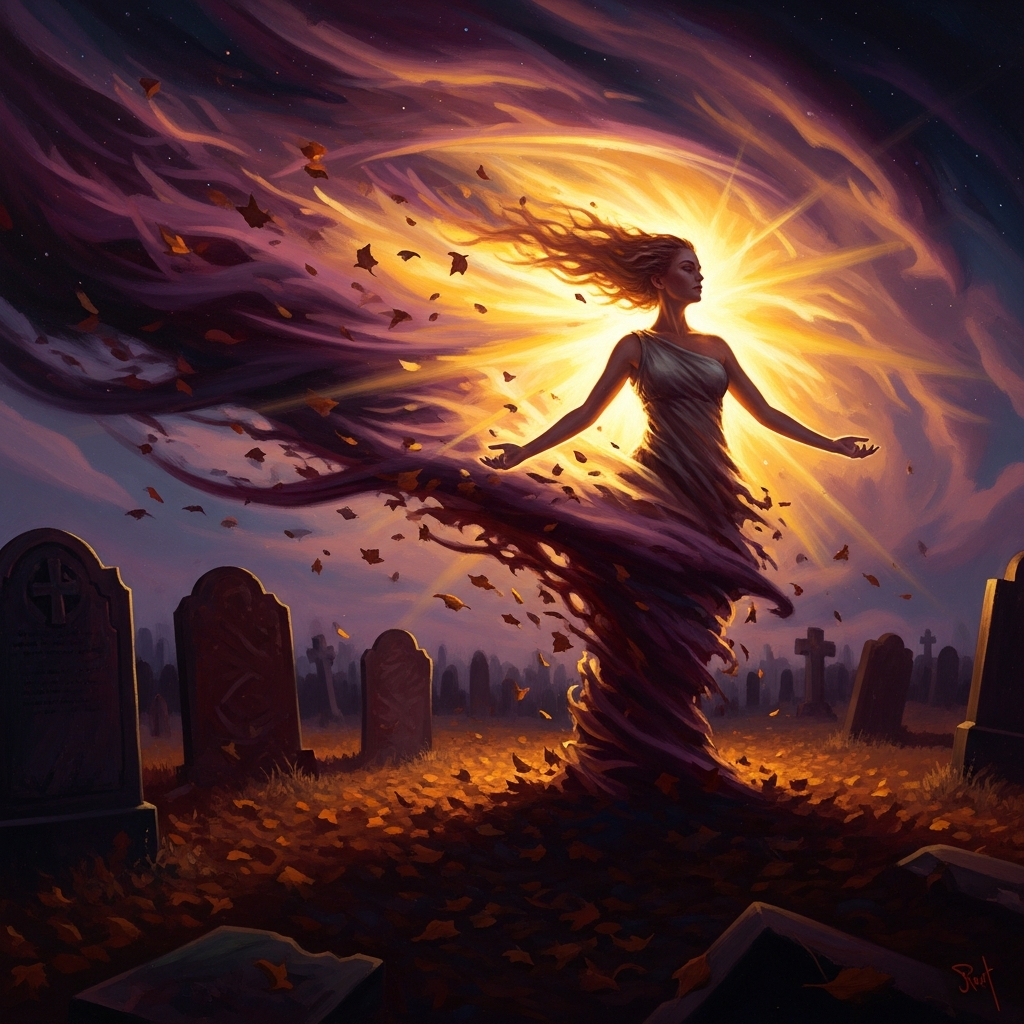
It comes the way it always came — the purple sky, the smell of iron and rain, the leaves stripping from the trees in a spiral — but it means something different now. She is not just the storm before the storm. She is the stripping that prepares. She comes before death to clear the air, to make the boundary visible, to remind the living that the world has two faces and that both faces are looking back at you at all times. The leaves she strips from the trees are not casualties; they are the dead being released from the form they had, freed into the cycle that will make them soil, then root, then new wood, then leaves again.
She is the force that makes this possible. She is what happens between the last breath and the first decomposition. She is the wind between.
The rope still hangs from the ayan tree. No one takes it down. They build a shrine around it, and the shrine becomes the first Shango temple, and Oya stands at its edge in every telling of what happened in the forest — not as the mourner, not as the widow, but as the witness who stayed long enough at the boundary to learn what the boundary is made of.
She follows him all the way to the edge of where love has power and no further, because she knows that what lies beyond the edge is not her domain by right — it is her domain by knowledge, earned by the willingness to walk to the rope, hold it, feel the warmth drain from it, and turn back. The dead she serves are served by that return. She cannot speak for them if she has not stood where they went. She cannot guide the living if she has not seen what they are moving toward. Her storms prepare the world. Her wind is already there when the rest of you arrive.
Scenes
Oya stands at the gate of the ruined palace, nine-tailed flywhisk at her side, watching Shango walk north into the bush
 Generating art…
 At the ayan tree, the rope hangs empty from the lowest branch
 Generating art…
 She becomes the whirlwind
 Generating art…
 Echoes Across Traditions
Entities


Sources
- Judith Gleason, *Oya: In Praise of an African Goddess* (1987)
- Samuel Johnson, *The History of the Yorubas* (1921)
- Robert Farris Thompson, *Flash of the Spirit* (1983)
- Wande Abimbola, *Ifá: An Exposition of Ifá Literary Corpus* (1976)